Kitchen & Dining · Gadgets
Best Kitchen Utility Knife
Compare seven utility knives by blade length, steel, handle grip and care, and see which kind of cook each one suits best.
Affiliate disclosure: As an Amazon Associate I earn from qualifying purchases.
At a glance
1
Best OverallMercer Culinary
4
Best for ProduceMercer Culinary
5
Compact Carry PickKeemake
7
Chef's-Knife Style PickVictorinox
Detailed reviews
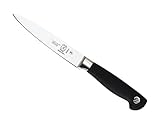
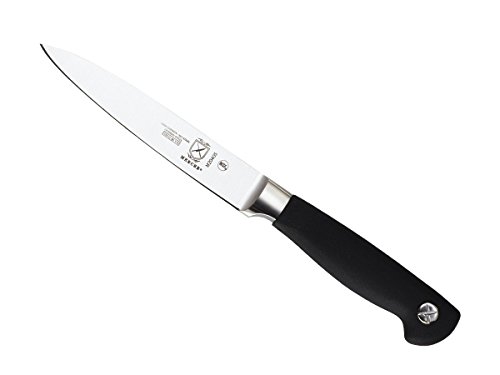
We'd point most buyers here first. The blade is forged from high-carbon German steel with a taper-ground edge, and the maker positions it for slicing pickles, fruit, cheese and sandwiches and for peeling apples. The handle is built to stay non-slip even with wet hands, and the knife sits at a size that does what a paring blade cannot without the bulk of a chef's knife.
Owners report a keen edge that holds up well, a light and balanced feel, and a textured grip that stays secure. Cooks describe reaching for it ahead of their other knives for small trimming and chopping jobs. A common note is that it benefits from sharpening before first use and regular touch-ups after that. It is hand wash only, so it is a poor fit for a dishwasher household.
Pros
- Forged high-carbon German steel blade
- Non-slip handle, even when wet
- Balanced, light feel owners like
Cons
- Hand wash only
- Needs sharpening before first use
Key features (4)
- Forged one-piece blade with taper-ground edge
- Non-slip ergonomic handle for wet-hand control
- Five-inch length for in-between slicing and peeling
- Lifetime limited manufacturer's warranty
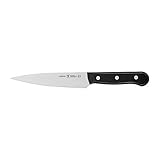
Weight is the draw here. At 0.19 pounds it is lighter in the hand than the Mercer Culinary Genesis 5 Inch Utility Knife at 0.22 pounds, and the single-piece stamped blade is built for effortless, low-pressure cutting. The maker lists it for mid-sized fruit and vegetables, meats and cheese, and says it can go in the dishwasher or be washed by hand, with a stain and rust-free blade.
Owners report that it arrives razor sharp and keeps its edge for a long time, and it earns go-to status for everyday tasks. The size and handle divide opinion: owners with larger hands report that it feels small and less comfortable to hold. A common complaint is that the blade feels flimsy, which is worth weighing if you like a stiffer knife for firmer produce.
Pros
- Lightweight, easy to guide
- Dishwasher or hand-wash cleanup
- Sharp straight out of the package
Cons
- Blade can feel flimsy
- Small and less comfortable for larger hands
Key features (4)
- Single-piece precision-stamped stainless blade
- Six-inch length for mid-sized produce and meats
- Stain and rust-free blade finish
- Lifetime warranty against manufacturer's defects
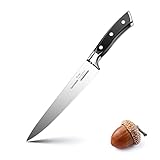
Triple-riveted pakkawood and a full tang put it in the same build class as the OAKSWARE 5.5 Inch Kitchen Utility Knife, but it is the heavier of the two at 0.33 pounds against 0.29 pounds. The high-carbon German steel is listed at 56+ Rockwell hardness, with a hand-sharpened edge at 14 to 16 degrees per side, and the maker covers it with a lifetime warranty against material or workmanship defects. It is pitched for slicing vegetables, fruit, sandwiches and cheese, and also for filleting fish and portioning meat.
Owners describe the quality as premium, the edge as long-lasting, and the cutting as clean enough to pass through a ripe tomato without bruising the skin. The well-weighted handle feels sturdy yet comfortable, and the size suits smaller hands too. Satisfied buyers say they would buy it again.
Pros
- Full-tang triple-riveted handle
- Edge stays sharp a long time
- Well-weighted, comfortable in smaller hands
Key features (4)
- High-carbon German steel at 56+ Rockwell hardness
- Hand-sharpened edge at 14 to 16 degrees
- Triple-riveted full-tang pakkawood handle
- Lifetime warranty against material and workmanship defects
Anyone weighing this against the Mercer Culinary Genesis 5 Inch Utility Knife should note the extra inch of blade and the thinner profile. The one-piece high-carbon Japanese steel is described as easy to maintain, and the handle carries textured finger points for a non-slip hold. The maker pitches it for pickles, fruit, cheese, apples and sandwiches, and owners lean on it for salads and vegetables, where a thin blade slices cleanly.
Owners report a sharp, balanced knife that is light enough to avoid fatigue, with a grip that suits large hands well. A common complaint is that the handle runs a bit big and bulky for smaller hands. Another is that the edge arrives sharp but needs a few passes on a sharpener to stay that way, and the blade is reported to flex, so we would keep it for slicing rather than heavy chopping. Like the other Mercer, it should be hand washed and dried.
Pros
- Thin blade for vegetables and salads
- Light, balanced, low fatigue
- Textured, non-slip handle
Cons
- Handle can feel bulky
- Hand wash only
- Edge needs regular touch-ups
Key features (4)
- One-piece high-carbon Japanese steel blade
- Textured finger points for a non-slip grip
- Six-inch length for produce and sandwich work
- Thin blade profile that slices cleanly
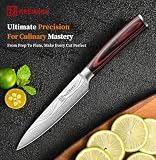
At the same 0.22 pounds as the Mercer Culinary Genesis 5 Inch Utility Knife, this one adds a fitted sheath and a pakkawood handle, and the listing quotes 3.52 oz and a 9.37-inch overall length. That makes it easy to fit on a compact board, in an apartment kitchen, or in an RV or picnic kit. The forged high-carbon stainless blade has a plain edge and is sized for tomatoes, citrus, apples, cheese, sandwiches and mushroom trimming.
It offers more reach than a paring blade without the room a chef's knife takes up. For very fine garnish work the toothpick knife is a different tool, but this blade handles peeling, coring and trimming before moving on to slicing. Care is simple but not optional: it is not dishwasher safe, so hand wash it with mild soap and dry it promptly, especially after cutting acidic foods like lemons or limes.
Pros
- Fitted sheath for storage and transport
- Lightweight and easy to maneuver
- Contoured pakkawood handle
Key features (4)
- Forged high-carbon stainless steel plain edge
- Contoured pakkawood handle for repetitive prep
- Fitted protective sheath included
- 9.37-inch overall length that fits compact cutting boards
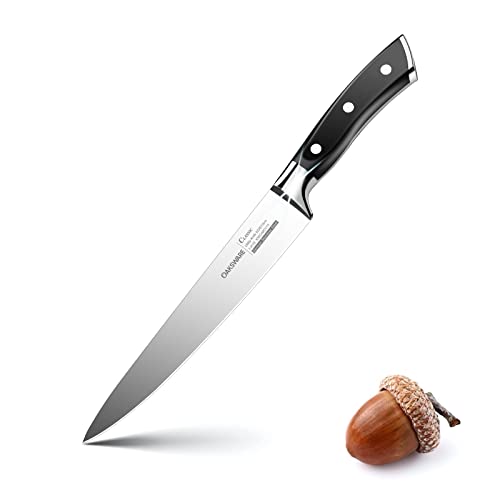
Slotting in at 5.5 inches, it lands between the Keemake 5" Utility Knife and the six-inch knives. The blade is German 1.4116 X50CrMoV15 stainless steel at 57+ Rockwell, with a 14 to 16 degree hand-polished edge. The full-tang handle is triple riveted and has a bolster between blade and handle to balance the cut.
Owners report that it arrives sharp, holds its edge well and feels good in the hand, with a weight and size that work for chopping, carving and general prep. It is described as a go-to knife that fits neatly between a paring knife and a big chef's knife. The main complaint is that the handle runs short for large hands. The maker's care note is to rinse it lightly after use and dry it promptly with a soft cloth.
Pros
- Full-tang triple-riveted handle
- Sharp out of the box
- Good weight and comfortable in hand
Cons
- Handle short for larger hands
Key features (4)
- German 1.4116 stainless steel at 57+ Rockwell hardness
- Hand-polished edge at 14 to 16 degrees
- Full-tang handle with balance-protection bolster
- Slim blade for fruit, vegetables, bread and meat
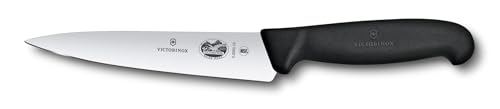
Strictly speaking this is a small chef's knife, so it behaves differently from the dedicated utility patterns here. At 0.17 pounds it is the lightest knife on the page, ahead of the Henckels Solution 6-inch Utility Knife at 0.19 pounds. The tapered stainless blade is described as razor sharp, and the thermoplastic elastomer handle is made to stay non-slip even when wet. Victorinox gives it a lifetime guarantee against defects.
Owners report that it arrives sharp, keeps its edge well and handles meats, vegetables and fruit, even tougher cuts like a rack of ribs. The grip stays secure when wet, and the comfortable handle shape has been called suitable for hands with arthritis. We like it for cooks who want the control of a chef's knife in a smaller, lighter package.
Pros
- Lightest knife on the page
- Handle stays grippy when wet
- Handles meats, vegetables and fruit
Key features (4)
- Tapered stainless steel six-inch blade
- Thermoplastic elastomer non-slip handle
- Balanced, lightweight chef's knife profile
- Lifetime guarantee against defects
Side by side
| Pick | Size | Item weight | Warranty |
|---|
#1 Best Overall
Mercer Culinary | 5" | 0.22 pounds | Lifetime limited manufacturer's warranty |
#2 Easiest Cleanup
Henckels | 6" | 0.19 pounds | Lifetime Warranty Against Manufacturer'S Defects |
#3 Premium Build
Cutluxe | 5.5 Inches | 0.33 pounds | lifetime warranty against material or workmanship defects |
#4 Best for Produce
Mercer Culinary | 6" | 0.31 Pounds | — |
#5 Compact Carry Pick
Keemake | 5" | 0.22 pounds | — |
#6 Full-Tang Pick
Oaksware | 5.5" | 0.29 pounds | — |
#7 Chef's-Knife Style Pick
Victorinox | 6" | 0.17 pounds | Lifetime warranty |
How to Choose a Kitchen Utility Knife
How long should the blade be?
A utility knife is the smaller sibling of the chef's knife and generally runs from about four to seven inches. A shorter blade gives you control for peeling and trimming, while a longer one reaches across a sandwich or a big tomato. Here the range is 5 to 6 inches, and the Keemake 5" Utility Knife is the one to choose when board space is tight, while the Victorinox Fibrox Chef's Knife 6 Inch gives you the most reach with the least weight.
Cheese is a fair use for any of them when you are trimming or portioning for a sandwich, but if a serving board is the real goal, the best cheese knife is a specialist tool built for that job.
What makes a handle comfortable and safe?
A good handle is an extension of the tang, shaped to fit the palm, and it should stay non-slip when wet. Hand size matters as much as the material. Owners with large hands report that the Mercer Culinary Millennia 6 Inch Utility Knife fits well, though the same handle can feel bulky to smaller hands, while the Victorinox Fibrox Chef's Knife 6 Inch keeps a secure grip even when wet.
Which blade steel is worth paying attention to?
Steel decides how well the edge holds and how much care the knife wants. Read the spec for the steel type and the Rockwell figure where one is listed; the Cutluxe Kitchen Utility Knife 5.5" lists 56+ and the OAKSWARE 5.5 Inch Kitchen Utility Knife lists 57+, both with a 14 to 16 degree edge. These are the categories to know:
- High-carbon steel: holds a keen edge and resharpens easily, but needs drying
- Stainless steel: resists rust and stains with less upkeep
- High-carbon stainless: a blend aimed at edge keeping plus corrosion resistance
- Forged blades: a sturdier feel, often with a bolster for balance
- Stamped blades: thinner and lighter in the hand
How much care will it need?
Plan for hand washing with mild soap and a prompt dry, because most of these knives ask for it and a damp blade is the quickest way to dull an edge or stain it. The Henckels Solution 6-inch Utility Knife is the one the maker lists as dishwasher friendly, while the Mercer Culinary Genesis 5 Inch Utility Knife and the Mercer Culinary Millennia 6 Inch Utility Knife both call for hand washing. Sharpening is part of care too, and a short session on a sharpener is a habit worth building from the start.
Our picks at a glance
1
Best OverallMercer Culinary
4
Best for ProduceMercer Culinary
5
Compact Carry PickKeemake
7
Chef's-Knife Style PickVictorinox
Frequently asked
How is a utility knife different from a paring knife?
A paring knife is short and made for peeling and detail work, while a utility knife is longer and covers slicing jobs that are too big for a paring blade but too small for a chef's knife. Owners of the OAKSWARE 5.5 Inch Kitchen Utility Knife describe it as sitting right between those two sizes, which is the clearest picture of the category.
Do I still need one if I own a chef's knife?
A chef's knife can cover most tasks, but a lighter, shorter blade is easier for sandwiches, fruit and quick trims, and you avoid dirtying the big knife for small jobs. If you want a chef's knife profile in a smaller size, the Victorinox Fibrox Chef's Knife 6 Inch is the pick that fits that idea best.
How often should a utility knife be sharpened?
There is no fixed schedule, since it depends on the steel and how much you use the knife. Owners of the Mercer Culinary Millennia 6 Inch Utility Knife report needing a few passes on a sharpener regularly, while owners of the Cutluxe Kitchen Utility Knife 5.5" describe the edge lasting a long time, so the second is the one to choose if you want to sharpen less often.