Kitchen & Dining · Gadgets
Best Cheese Knife
Seven perforated, serrated and hard-cheese slicers compared on steel, handle build and how well each handles soft or firm blocks.
Affiliate disclosure: As an Amazon Associate I earn from qualifying purchases.
At a glance
1
Forged German Steel PickHammer Stahl
3
Best for Everyday SlicingZyliss
4
Best for Portioned CutsSyokami
6
Hard Cheese SpecialistWüsthof
Detailed reviews
We'd point this knife at cooks who want one forged blade that works on a cheese board and on sandwich tomatoes. It is made from German X50CrMoV15 high-carbon stainless steel with a Rockwell hardness of 55 to 57, pairs a perforated, serrated blade with a forked tip, and sits on a quad tang pakkawood handle. At 0.55 pounds it is the heaviest of the picks that list a weight, and it carries a lifetime warranty.
Owners praise its looks and overall quality and call it handy for cheese boards, hors d'oeuvres and tomatoes. Sharpness is where the reports diverge: buyers describe it gliding through block cheese, while a common complaint is dull serrations and a butter-knife feel. Durability and comfort split the same way, with reports of a sturdy build sitting beside complaints of the blade snapping and of the metal and wood handle being uncomfortable to hold.
Pros
- Forged German high-carbon steel blade
- Quad tang pakkawood handle
- Lifetime warranty
- Handles cheese, tomatoes and fruit
Cons
- Serrations reported dull in complaints
- Blade snapping reported in durability complaints
- Handle comfort draws complaints
Key features (4)
- Perforated serrated blade with fork tip
- German X50CrMoV15 steel at Rockwell 55 to 57
- Quad tang pakkawood handle for balance
- Weight of 0.55 pounds
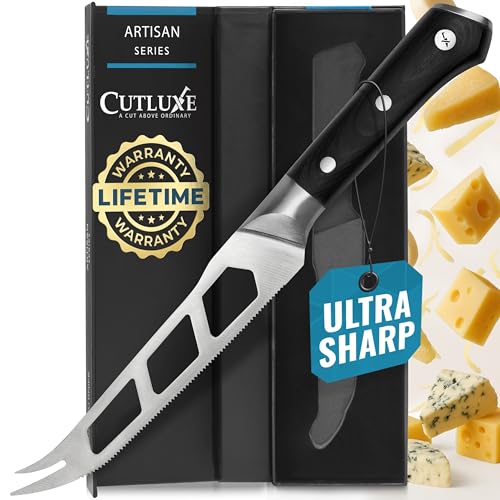
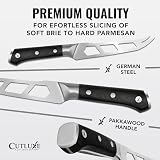
This is the knife we'd hand to most home cooks who want a single cheese knife for everything from mozzarella to cheddar. The blade is hollowed to limit contact, serrated for control and finished with a pronged tip for lifting slices, all forged from high-carbon German steel rated at 56+ Rockwell. The pakkawood handle is triple-riveted, and a lifetime warranty covers defects.
Owner feedback is strongly positive on sharpness, heft and balance, and it describes cheese releasing cleanly from the blade rather than sticking. Buyers also like the sleek look and the protective box it arrives in. The caveat is blade stiffness: owners who cut dense parmesan report the thin blade bending, and another notes a slight give that makes very thin slices of hard cheese tricky. Against the Hammer Stahl 5 Inch Cheese and Tomato Knife, which shares the pakkawood handle and German steel, this one draws far steadier praise for how it cuts.
Pros
- Cheese releases cleanly from hollow blade
- Heavy, balanced feel with secure grip
- Triple-riveted pakkawood handle
- Lifetime warranty against defects
Cons
- Thin blade can bend on parmesan
- Slight flex hampers thin slices of hard cheese
Key features (4)
- Hollow serrated blade with pronged tip
- High-carbon German steel at 56+ Rockwell
- Triple-riveted laminated pakkawood handle
- Lifetime warranty against material or workmanship defects
We think this is the knife for people who cut cheese most days and do not want to baby the tool. The stainless blade has wavy serration and blade holes to stop sticking, a forked tip lifts slices onto the board, and the handle is made from wheat straw. The listing describes it as dishwasher safe, and a 5-year guarantee backs it. At 0.13 pounds it weighs a fraction of the Hammer Stahl 5 Inch Cheese and Tomato Knife, which suits a hand that likes a light tool.
Owners report that cheese slides off the blade without catching in the holes, that the edge is sharp, and that it gives clean slices from block cheese, including very thin ones. Opinions differ on build: owners report a sturdy blade, while a common complaint is that it feels thin and flimsy. Cleaning around the holes also gets mixed remarks, and the handle is plastic-feeling in some accounts, so this is a practical working knife rather than a showpiece.
Pros
- Cheese slides off perforated blade
- Lightweight at 0.13 pounds
- Dishwasher safe with wheat straw handle
- Forked tip lifts and serves slices
Cons
- Blade can feel thin and flimsy
- Cleaning around the holes draws complaints
Key features (4)
- Stainless blade with gentle serration and perforations
- Built-in forked tip for serving
- Wheat straw handle reducing plastic use
- 5-year guarantee
If you cut cheese into measured slices, cubes or sandwich layers, this is the pick we'd choose over the Cutluxe Cheese Knife. Its blade carries marks at 0.2 and 0.4 inches, the hollow serrated blade is forged from German steel at HRC56+, and a fork-shaped tip pierces hard cheeses such as parmesan to steady the cut. The blade is designed to sit off the counter, and the full tang wenge wood handle is triple-riveted and made from FSC-certified wood. It also arrives in a gift box.
Owners describe it as very sharp, good looking and equally at home on tomatoes, bread and cured sausage. Owners report cheddar falling cleanly away from the holes, but also that the thin blade struggled with the waxy rind of a hard parmesan and that very soft Brie still clung to it. Treat it as a semi-soft and semi-hard specialist rather than a one-knife answer for every block.
Pros
- Blade marks for measured portions
- Fork tip anchors cuts in hard cheese
- Triple-riveted wenge wood full tang handle
- Sharp German steel at HRC56+
Cons
- Thin blade struggles with waxy rinds
- Very soft Brie still clings
Key features (4)
- Printed 0.2 and 0.4 inch cutting marks on the blade
- Hollow serrated German steel blade
- Fork-shaped tip for piercing and serving
- FSC-certified wenge wood handle in a gift box
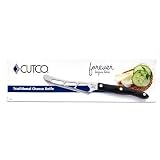
We'd recommend this one to cooks who want a single serrated slicer for the whole kitchen, not only the cheese board. The 5.5 inch Micro-D serrated edge is perforated to keep dense foods from sticking, and the listing positions it for hard to soft cheeses as well as potatoes and tomatoes. It weighs 0.1 pounds and runs about 10.55 inches overall.
Owner feedback centers on sharpness and thin slicing: buyers say it cuts cheese like butter, slices tomatoes, onions and apples paper thin, handles summer sausage, and stays sharp through daily use. Owners describe it as a favorite among the maker's knives, and they mention the maker's sharpening service as part of the appeal. Both this knife and the Syokami Cheese Cutter Knife measure 5.5 inches, though the Syokami adds ruler marks and a wood handle, while this one is built around the thinnest possible slice.
Pros
- Cuts thin, clean slices of soft produce
- Perforations stop dense foods sticking
- Sharp edge that stays sharp with daily use
- Works well beyond cheese
Key features (4)
- 5.5 inch Micro-D serrated edge
- Perforated blade for dense or sticky foods
- Lightweight 0.1 pound build
- Suited to cheese, vegetables and fruit
This is the knife in the lineup designed around firm cheese, and we'd pick it for people whose boards lean on Emmental, Gruyère, Gouda or similar. The stable, etched blade of high-carbon stainless steel is made in Germany, meant to stop cheese sticking, and covered by a limited lifetime warranty. It weighs 0.2 pounds. The listing is explicit that it is hand wash only.
Owners praise the build, weight and finish, with owners calling it a standout cheese knife and describing it cutting right through a big piece of gouda. The sticking point is the elevated, offset handle: a common complaint is that the hand sits above the edge, which makes straight cuts hard to control, and the blade is described as thin and better suited to fresh cheeses because the raised handle makes pressing hard awkward. Unlike the perforated Cutluxe Cheese Knife, it has no pronged tip for serving, so we see it as a cutting tool first.
Pros
- Etched flat blade made for firm cheeses
- Made in Germany from high-carbon steel
- Limited lifetime warranty
- Elevated handle keeps knuckles clear
Cons
- Hand wash only
- Offset handle can hinder straight cuts
Key features (4)
- Etched blade of high-carbon stainless steel
- Offset handle raising the hand above the edge
- Designed for hard and semi-hard cheeses
- Weight of 0.2 pounds
This is the pick for small boards and small hands. At 3.8 inches it is shorter than the Zyliss Cheese Knife's 5 inch blade, and it is American made. It also carries perforations, which, per the maker's own wording, keep dense foods from sticking, and is positioned for slicing cheese, fruit and vegetables alike.
Owners describe it as the best cheese knife they have used and praise the sharpness across a range of foods, including cheese, melons and vegetables, and even chocolate Easter eggs that it cuts without breaking. Few other details are available on build or handle comfort, so we'd treat it as a sharp, compact all-rounder rather than a heavy-duty cutter. Anyone slicing large blocks will want more blade length.
Pros
- Sharp across cheese, melon and vegetables
- American made
- Perforations keep dense foods from sticking
Cons
- Shortest blade of the lineup
Key features (4)
- 3.8 inch perforated blade
- Brown handle on a compact build
- Designed for hard to soft cheeses
- Also suited to fruit and vegetables
Side by side
| Pick | Size | Item weight |
|---|
#1 Forged German Steel Pick
Hammer Stahl | 5 inches | 0.55 pounds |
#2 Best Overall
Cutluxe | 5" | — |
#3 Best for Everyday Slicing
Zyliss | 5" | 0.13 pounds |
#4 Best for Portioned Cuts
Syokami | 5.5" | — |
#5 Most Versatile
Cutco | 5.5" | 0.1 pounds |
#6 Hard Cheese Specialist
Wüsthof | 10" | 0.2 pounds |
#7 Compact Pick
Cutco | 3.8" | — |
How to Choose a Cheese Knife
Which blade suits the cheese you serve?
Texture decides the blade. These knives are one kind of tool to cut cheese, and the right one depends on whether your board leans soft, semi-hard or firm. A knife that glides through young cheddar can stall on a hard, rinded wedge, and the reverse is just as true.
For aged blocks that need splitting rather than slicing, the hard cheese knife with a wedge-shaped blade is the specialist; the perforated slicers here handle many firm cheeses but are not made to pry apart dense wheels. Pick the blade to the cheese you cut most.
- Soft and sticky cheeses: perforations or hollow cutouts reduce contact so slices release
- Semi-hard cheeses: serrations grip without crushing, and a forked tip lifts slices
- Firm and aged cheeses: a stiff, flat blade resists flexing under pressure
- Mixed boards: a perforated slicer covers the widest range of textures
What should the blade and handle be made of?
High-carbon steel holds an edge longer than basic stainless, and German steel is rated by Rockwell hardness. The Cutluxe Cheese Knife pairs 56+ Rockwell German steel with a triple-riveted pakkawood handle, which is the combination we'd look for in a durable all-purpose pick.
Handle material matters for grip and care. Wood handles feel solid and look good but can need gentler washing, wheat straw keeps weight down, and a raised or offset handle changes how you press into a block. Two knives with the same blade length can feel entirely different in the hand, so read the weight and handle shape alongside the steel.
Do forked tips, scale marks and dishwasher safety earn their place?
A forked tip lets you spear a slice and move it straight to the board, which is handy for serving but optional if you plate by hand. Measuring marks help only if you cut to size; the Syokami Cheese Cutter Knife is the pick that has them. Care is the other practical split: hand-drying and hand-washing protect most stainless blades, but the Zyliss Cheese Knife is the one described as dishwasher safe, which makes it the easiest to live with. Check the care note before you buy.
Our picks at a glance
1
Forged German Steel PickHammer Stahl
3
Best for Everyday SlicingZyliss
4
Best for Portioned CutsSyokami
6
Hard Cheese SpecialistWüsthof
Frequently asked
Which of these is best for hard cheese like parmesan or aged gouda?
The Wüsthof Gourmet Hard Cheese Knife is the one designed for hard and semi-hard cheeses, with a flat, stable blade, though its offset handle takes some getting used to. Thin perforated blades can flex against dense or rinded blocks, so the Cutluxe Cheese Knife and Syokami Cheese Cutter Knife are better kept for semi-hard and softer cheeses.
Why do cheese knives have holes in the blade?
The holes cut down the surface area that touches the cheese, which reduces friction and stops soft or sticky slices from clinging. The Zyliss Cheese Knife is a good example, with owners reporting that slices slide off without catching in the holes.
Can I put a cheese knife in the dishwasher?
It depends on the model. The Zyliss Cheese Knife is described as dishwasher safe, while the Wüsthof Gourmet Hard Cheese Knife is hand wash only. For the others, hand washing and drying right away is the safer habit.
Can a cheese knife also slice tomatoes?
Yes, serrated, perforated cheese knives double on soft produce. The Hammer Stahl 5 Inch Cheese and Tomato Knife is sold with that dual use in mind, and owners of the Cutco Model 1764 CUTCO Traditional Cheese Knives report slicing tomatoes and onions very thin.