Kitchen & Dining · Gadgets
Best Knife for Vegetables
Flat nakiri, weighty santoku or curved chef's knife: how blade shape, steel and weight change daily vegetable prep, and which one suits your hands.
Affiliate disclosure: As an Amazon Associate I earn from qualifying purchases.
At a glance
2
Best All-RounderVictorinox
3
Most Versatile SantokuCutluxe
4
Heavy-Duty NakiriMercer Culinary
5
Best Starter SetAstercook
Detailed reviews
The PAUDIN 7" Nakiri Knife is the clearest answer to what a vegetable knife should be: a tall, flat blade that push-cuts straight down, so slices separate instead of staying joined at the bottom. The 5Cr15Mov stainless blade is listed at 56+ hardness, and the wave pattern along the side is described as cutting down on food friction.
Owners report that it arrives very sharp and copes with dense produce such as butternut squash and sweet potato, with tomatoes slicing cleanly too. The handle and balance draw steady praise, and the 0.5 pound weight keeps it nimble for long prep sessions. Owners also say it manages soft meat and fish, though a common caution is to keep it away from bones and hard-frozen food, and to hand wash and dry it right away.
The flat edge means no rocking, which suits cooks who chop in straight strokes. One owner questioned the steel and found the knife more attractive than durable, so regular honing is sensible.
Pros
- Flat blade avoids the accordion effect
- Sharp enough for squash and tomatoes
- Light and comfortable in hand
Cons
- Hand wash and dry recommended
- Not meant for bones or frozen food
Key features (4)
- 7 inch nakiri blade in 5Cr15Mov stainless steel
- Hardness listed at 56+
- Pakkawood handle joined to the blade
- Wave pattern to reduce food friction
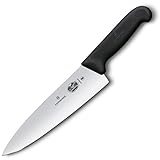
Next to the PAUDIN 7" Nakiri Knife, the Victorinox Fibrox Pro 8 Inch Chef's Knife trades the nakiri's flat push-cut for a curved belly that rocks through herbs and breaks down larger vegetables. That makes it the sensible pick when vegetables are only part of what you cook.
The tapered stainless blade comes with a non-slip handle made of thermoplastic elastomer, and the knife is listed as dishwasher safe and backed by a lifetime warranty against defects. Owners describe the grip as comfortable even when pressure is needed, with one noting less hand strain when working through tough squash, and the weighting and balance get consistent praise.
Owners also point out that the blade is thin, which makes it easy to sharpen but means the edge does not last as long under heavy use, so expect to touch it up regularly. Owners also mention cosmetic scuffing on the blade from sharpening.
Pros
- Non-slip handle stays secure when wet
- Lifetime warranty against defects
- Dishwasher safe materials
- Curved blade suits rock chopping
Cons
- Thin edge needs regular sharpening
- Sharpening can scuff the blade
Key features (4)
- 8 inch stainless chef's knife with tapered edge
- Thermoplastic elastomer non-slip handle
- Dishwasher safe construction
- Lifetime warranty against material and workmanship defects
If you want a middle path between a nakiri and a chef's knife, the Cutluxe Santoku Knife 7" is where we'd look. The santoku shape keeps a mostly flat edge for push-cutting but adds enough profile to chop meat, and the hand-sharpened edge is listed at 14 to 16 degrees per side on a 56+ Rockwell blade of German steel.
Owners praise the sharp edge, the solid feel and the balance, and owners remark that the weight helps with hard produce such as squash and corn husks. The triple-riveted pakkawood handle gets credit for comfort, including from cooks with sore hands or weak wrists, and the included sheath makes storage safer.
The flip side of that heft is that it is a heavier knife than the PAUDIN 7" Nakiri Knife, and owners say so. A common complaint is that vegetable slices cling to the blade somewhat, though the dimples on the side reduce it.
Pros
- Balanced weight helps with hard produce
- Triple-riveted handle feels secure
- Sheath included for storage
- Lifetime warranty on materials and workmanship
Cons
- Heavier feel may tire some hands
- Vegetable slices can stick to blade
Key features (4)
- 7 inch santoku forged from high-carbon German steel
- Hand-sharpened edge at 14 to 16 degrees
- Triple-riveted pakkawood handle
- Protective sheath included
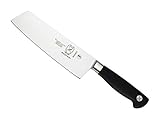
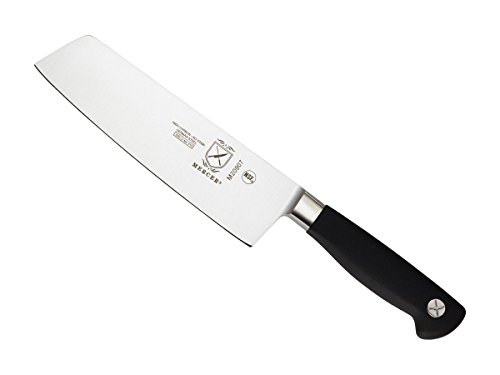
The Mercer Culinary Genesis 7-Inch Nakiri Vegetable Knife is the nakiri for people who like a knife that does some of the work itself. It is forged from high-carbon German steel with a taper-ground edge, and the non-slip handle is made to stay secure even with wet hands.
Owners report that the pleasing heft helps it through sweet potatoes and winter squash, that tomatoes slice very thin, and that the wide rectangular blade slides along the knuckles and scoops chopped pieces from board to pan. Sharpness out of the box and good edge retention come up repeatedly, and the balance gets steady praise.
There are two things to plan for. The care instructions call for hand washing only, with no dishwasher and no long soaks. And an owner who cut a finger twice in a day put it down to the weight and unfamiliarity, so cooks used to light knives should go slowly at first. Compared with the Hoshanho Nakiri Knife 7 Inch, this one leans on forged weight rather than a very hard steel.
Pros
- Forged German steel with taper-ground edge
- Heft helps with dense vegetables
- Wide blade scoops chopped food
- Holds its edge well
Cons
- Hand wash only
- Weight takes getting used to
Key features (4)
- Precision-forged high-carbon German steel blade
- Taper-ground edge for efficient cutting
- Non-slip handle that grips when wet
- Hand wash care instructions
The Astercook Knife Set 13 Pieces is a different kind of purchase from the single blades above, and the right one if your drawer is empty. It bundles an 8 inch chef knife, an 8 inch slicing knife, a 7 inch santoku, an 8 inch serrated bread knife, a 5 inch utility knife, a 3.5 inch paring knife and kitchen shears, with a blade guard for each knife.
For vegetables, the chef knife and santoku do the bulk chopping, the utility and paring knives handle small jobs such as trimming and peeling. Owners say the knives cut smoothly through raw vegetables and meat and perform like a more expensive collection for everyday cooking, and they like the colour-coded handles and the guards that protect each edge. Reports of the coating holding up, with no chipping or peeling after several weeks, are encouraging. The listing describes an anti-rust coating and dishwasher-safe construction.
A single specialist such as the Victorinox Fibrox Pro 8 Inch Chef's Knife puts everything into one blade, while this set spreads the work across several.
Pros
- Covers chef, santoku, utility and paring jobs
- Blade guard for each knife
- Colour-coded handles identify each knife
- Dishwasher safe with anti-rust coating
Key features (4)
- 13 pieces including shears and six blade guards
- Anti-rust coating on stainless steel blades
- Colour-coded handles by function
- Dishwasher safe construction
Among the nakiri here, the Hoshanho Nakiri Knife 7 Inch carries the most demanding spec: 10Cr15CoMoV high-carbon stainless steel at 60HRC after vacuum heat treatment, with a 15 degree edge and scallop-shaped hollows on the side to ease release. The pakkawood handle is shaped to reduce fatigue.
Owners report that it arrives very sharp, slices carrots and ripe tomatoes thinly and cleanly, and feels balanced with a satisfying heft. The wide blade is praised for producing even slices, and owners describe it as handy for general tasks beyond vegetables.
Durability feedback goes both ways. Owners report the blade keeping its edge for a long time, but a common complaint is chipping within the first month and a handle that cracked. One review also notes the wooden handle sitting slightly out of line with the metal, leaving a sharp exposed edge to be careful around. Given the chipping reports, keep it to vegetables and boneless food. In weight it sits above the PAUDIN 7" Nakiri Knife.
Pros
- Hard 60HRC steel takes a fine edge
- Wide blade gives even slices
- Hollows on blade help food release
Cons
- Blade chipping within weeks reported
- Handle joint may leave sharp metal exposed
- Handle cracking reported
Key features (4)
- 10Cr15CoMoV high-carbon stainless steel at 60HRC
- 15 degree hand-polished edge
- Scallop hollows on the blade side
- Pakkawood handle shaped to reduce fatigue
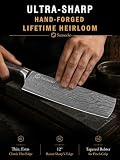
The Sunnecko Nakiri Knife 7" borrows much of the PAUDIN 7" Nakiri Knife's formula, with a wavy pattern to reduce friction and a pakkawood handle, and adds a sheath plus a 12 degree double-bevel edge that works for left- and right-handed cooks. The listing describes Japanese high-carbon stainless steel that resists rust.
Owners report it is very sharp from the start and keeps its edge through tomatoes and peppers, which dull blades quickly. It is also reported to cut watermelon and meat, and the comfortable grip and balance come up often. Owners like how good it looks.
One owner points out that the pattern on the blade is laser-etched, not true Damascus. The listing never claims otherwise, but if you value a pattern that goes right through the steel, know that this one is surface decoration and may fade over time. Compared with the Mercer Culinary Genesis 7-Inch Nakiri Vegetable Knife, it is a better fit for cooks who prefer a visually striking blade with a cover for drawer storage.
Pros
- 12 degree edge for smooth gliding
- Blade cover included
- Holds sharpness through tomatoes and peppers
- Comfortable, well-balanced pakkawood handle
Cons
- Blade pattern is etched, not true Damascus
Key features (4)
- 7 inch nakiri in Japanese high-carbon stainless steel
- 12 degree double-bevel edge
- Wavy pattern to reduce food friction
- Protective sheath included
Side by side
| Pick | Item weight | Size |
|---|
#1 Best Overall
Paudin | 0.5 pounds | 7" |
#3 Most Versatile Santoku
Cutluxe | 0.57 pounds | 7" |
#4 Heavy-Duty Nakiri
Mercer Culinary | 0.25 pounds | 7" |
#6 Hardest Steel
Hoshanho | 0.77 pounds | 7" |
#7 Sheathed Nakiri
Sunnecko | — | 7" |
How to Choose a Knife for Vegetables
Which blade shape fits the way you cut?
Shape decides how a knife behaves on a cutting board before steel or handle ever matters. Three styles cover almost every vegetable task, and each suits a different cooking habit.
If vegetables dominate your prep, a nakiri such as the PAUDIN 7" Nakiri Knife gives you a flat edge that meets the board along its whole length. For a single knife that also carves chicken and slices steak, the Victorinox Fibrox Pro 8 Inch Chef's Knife has the curved belly to do it. The Cutluxe Santoku Knife 7" sits in between. If your kitchen has nothing yet, the Astercook Knife Set 13 Pieces supplies all three jobs at once.
- Nakiri: tall, flat and squared off, built for straight push-cuts and scooping food off the board
- Santoku: shorter, with a mostly flat edge and a gentle curve at the tip, good for chopping meat and vegetables
- Chef's knife: curved belly for rocking, longer blade for larger squash and general kitchen work
What do steel and edge angle change in practice?
Steel hardness and edge angle set how fine the cut feels and how long it lasts. The PAUDIN and the Cutluxe both list a hardness of 56+, the Hoshanho Nakiri Knife 7 Inch goes to 60HRC with a 15 degree edge, and the Sunnecko Nakiri Knife 7" is polished to 12 degrees. A harder steel takes a finer edge but tends to chip if it meets bone or a frozen block, and owners of the Hoshanho have reported exactly that, so a gentler steel can be the more forgiving choice for heavy daily use.
Thin blades such as the Victorinox sharpen easily but need touching up more often. Whichever you pick, a honing steel and hand washing do more for edge life than the spec sheet. Cooks building a broader lineup can also look at the best knife for cutting veggies on this site.
How heavy and how well balanced should it be?
Weight is personal. A heavier knife such as the Mercer Culinary Genesis 7-Inch Nakiri Vegetable Knife drops through sweet potatoes and winter squash with little force, while a lighter blade is easier to control over long sessions. Handle material matters too: pakkawood, Santoprene and elastomer all grip well when wet.
If you cannot hold the knife first, look for a handle that lets your knuckles clear the board and a blade that does not feel front-heavy. And if you are comparing more options, the best knives for cutting vegetables are worth a look alongside these.
Our picks at a glance
2
Best All-RounderVictorinox
3
Most Versatile SantokuCutluxe
4
Heavy-Duty NakiriMercer Culinary
5
Best Starter SetAstercook
Frequently asked
Is a nakiri better than a chef's knife for vegetables?
For pure vegetable work a nakiri is easier to control, because the flat edge makes full contact with the board and the tall blade protects your knuckles. A chef's knife is the better single knife when you also cut meat or mince herbs; the Victorinox Fibrox Pro 8 Inch Chef's Knife is our pick for that role, and the PAUDIN 7" Nakiri Knife for vegetables alone.
Can I put these knives in the dishwasher?
Only some. The Victorinox Fibrox Pro 8 Inch Chef's Knife and the Astercook Knife Set 13 Pieces are listed as dishwasher safe, while the Mercer Culinary Genesis 7-Inch Nakiri Vegetable Knife specifically calls for hand washing, and owners of the PAUDIN 7" Nakiri Knife recommend washing and drying it by hand right away.
Can a vegetable knife cut meat?
A nakiri can slice soft, boneless meat, but bones and hard-frozen food risk chipping the thin blade. If you want one knife to move between produce and meat, the Cutluxe Santoku Knife 7" is the more comfortable choice.