Kitchen & Dining · Gadgets
Best Hard Cheese Knife
Compare blade shape, stiffness, grip and cleaning across seven cheese tools, from Parmesan splitters to perforated slicers and a plane.
Affiliate disclosure: As an Amazon Associate I earn from qualifying purchases.
At a glance
1
Best for Everyday SlicingZyliss
2
Best for Breaking ParmesanSwissmar
3
Traditional Forged PickMercer Culinary
4
Compact Parmesan SpecialistBoska
6
Best Plane-Style SlicerBoska
7
Multipurpose PickHoshanho
Detailed reviews
We think the Zyliss Cheese Knife is the easiest recommendation for a household that cuts a bit of everything. The wavy stainless steel blade is perforated so slices release instead of clinging, and the forked tip lets you lift a slice straight onto a board or plate. The handle is made with wheat straw material, which keeps the knife light, and the maker backs it with a 5-year guarantee.
Owners report that it cuts cleanly, that slices fall away from the perforations, and that it manages very thin slices of block cheese. It also goes in the dishwasher, which matters for a tool you reach for daily. On the other side, a common complaint is that the blade can feel thin and a little flimsy, and cleaning around the holes takes some effort. For dense aged wedges we'd lean toward a stiffer, shorter blade, but for slicing and serving this is the all-rounder of the group.
Pros
- Perforated blade releases slices cleanly
- Forked tip lifts and serves
- Dishwasher safe, light wheat straw handle
- Backed by a 5-year guarantee
Cons
- Blade can feel thin and flimsy
- Blade holes take effort to clean
Key features (4)
- Wavy stainless steel blade with perforations
- Built-in forked tip for serving slices
- Lightweight wheat straw handle
- Five-inch overall blade size, dishwasher safe
The Swissmar Barcelona Parmesan Cheese Knife is the opposite of the Zyliss Cheese Knife in spirit: instead of a long blade that glides, it offers a short, stiff one meant for slicing into and breaking apart firm aged cheeses like Parmesan and Cheshire. The stainless steel blade joins a sand-blasted handle that gives a steady, modern look and a comfortable grip.
Owners report that it feels solid, holds an edge well and shrugs off pressure, and that medium and firm cheeses part easily under it. Reviews also note it does not cut soft cheese well, so it belongs in a hard-cheese role, not on a mixed board. Reviews raise two cosmetic points: the join between blade and handle is visible, and the finish picks up wear marks quickly. Neither affects the cutting, but they are worth knowing if appearance matters to you.
Pros
- Stiff blade resists bending under pressure
- Holds an edge well
- Short blade gives good control
- Suits firm aged cheeses
Cons
- Finish shows wear marks early
- Visible seam between blade and handle
- Does not cut soft cheese well
Key features (4)
- Short stainless steel blade for crumbling dense cheese
- Sand-blasted handle with comfortable grip
- Designed for Parmesan and Cheshire
- Spade-shaped blade for breaking medium to hard cheese
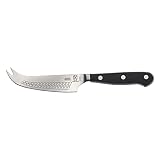
The Mercer Culinary Renaissance Hard Cheese Knife 4.75 Inch is the traditional kitchen-cutlery option. The blade is precision forged from high-carbon German steel with a taper-ground edge and full tang, and the triple-riveted handle has a rounded spine for a comfortable hold. A forked tip helps you move slices once they are cut, which the Swissmar Barcelona Parmesan Cheese Knife does not offer.
It is aimed at cheddar, asiago and provolone, so think of it as a slicer for firm everyday cheese more than a wedge splitter. The care instructions are strict: wash it by hand, dry it fully and keep it out of the dishwasher. If you already look after your chef's knives that way, this fits in naturally.
Pros
- Forged high-carbon German steel blade
- Full tang gives good balance
- Triple-riveted ergonomic handle
- Forked tip helps serve slices
Cons
- Hand wash only, no dishwasher
Key features (4)
- One-piece forged blade with taper-ground edge
- High-carbon German steel construction
- Triple-riveted handle with rounded spine
- Forked tip for lifting sliced cheese
The BOSKA Parmesan Knife 110mm is a specialist tool with one purpose: splitting tough, aged cheese. The pointed stainless steel blade is designed to open up Parmesan wheels, and the ergonomic handle is built for the downward pressure that job needs. It carries a design award and a 10-year warranty, and it is the heaviest knife on our list at 0.52 pounds.
Compared with the Cutluxe Cheese Knife, which slices and serves, this one is for breaking and chipping, so the two do different work at the board. It is also the smallest of the picks, so it will not replace a slicer for everyday sandwich cheese. The maker advises washing by hand, even though it is dishwasher safe, to keep the edge sharp.
Pros
- Pointed blade built for splitting wheels
- Sturdy handle for firm pressure
- Backed by a 10-year warranty
- Recognized design award
Cons
- Smallest size of these picks
- Hand washing recommended
Key features (4)
- Sharp pointed stainless steel blade for Parmesan
- Robust ergonomic handle for controlled splitting
- Ergonomic handle for controlled downward pressure
- Weighs 0.52 pounds
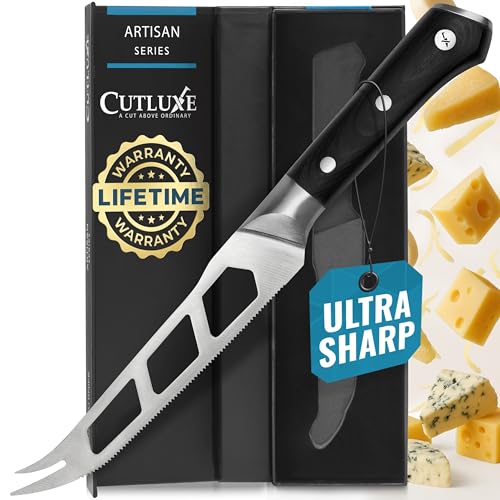
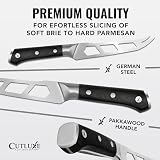
The Cutluxe Cheese Knife is the heftier, more handsome alternative to the Zyliss Cheese Knife for people who like a knife with presence. Its high-carbon German steel blade is serrated and hollowed to limit contact with the cheese, the pronged tip picks up slices, and the pakkawood handle is triple riveted. A lifetime warranty against material or workmanship defects sits behind it.
Buyers praise how easily it cuts block cheese, that slices release from the blade, and that the weight and balance feel reassuring. Owners also report it handles tomatoes and bread, which makes it handy beyond the cheese board. Where it falls short is dense Parmesan: a common complaint is that the blade is slim enough to flex when cutting very hard cheese, and wafer-thin hard-cheese slices take practice. We'd reach for it with cheddar, gouda and serving duty, and keep a stiffer blade around for Parmesan.
Pros
- Serrated hollow blade limits sticking
- Pronged tip lifts slices
- Weighty, balanced pakkawood handle
- Lifetime warranty on defects
Cons
- Slim blade flexes on dense Parmesan
Key features (4)
- High-carbon German steel serrated blade
- Hollow blade design with pronged tip
- Triple-riveted pakkawood handle
- Five-inch blade, lifetime warranty
The Boska Stainless Steel Cheese Slicer is the odd one out here: it is a plane, not a knife, and it shaves uniform slices off a block rather than cutting wedges. Where the BOSKA Parmesan Knife 110mm breaks cheese apart, this one thins it out, and the hollow one-piece handle keeps it very light. It is fully dishwasher safe, and the maker offers a lifetime warranty.
What comes up in reviews is even, thin slices on semi-hard and hard cheese, easy handling compared with a knife, and trouble-free cleaning. They also mention it works on vegetables like cucumber and carrot. The weak spot is the very hardest cheese, where slices can crumble or break. If even planks are the goal, our best cheese slicer for hard cheese page compares more plane-style tools before you commit to a blade.
Pros
- Even, thin, adjustable slices
- One-piece stainless steel, dishwasher safe
- Light hollow handle
- Lifetime warranty
Cons
- Hardest cheeses can crumble or break
Key features (4)
- One-piece stainless steel plane construction
- Hollow handle keeps it exceptionally light
- Cuts semi-hard and hard cheese into slices
- Also slices cucumber and carrots
The Hoshanho Cheese Knife 5 In sits closer to a utility knife than a dedicated cheese tool, and it is listed in the tomato knife category. The serrated, hollow blade is forged from high-carbon stainless steel from Japan, honed on both sides, with a fork-shaped tip and a handle shaped to fit the hand. It arrives in a gift box.
Feedback centres on it staying sharp, handles cheese such as Gouda, cheddar and camembert, and slices tomatoes without crushing them. By comparison with the Mercer Culinary Renaissance Hard Cheese Knife 4.75 Inch, it is the one to choose if one knife has to cover produce too. A common complaint is that the serrated edge is hard to resharpen at home and that it can feel less sharp than expected out of the box, including on tomatoes. For dedicated hard-cheese work, a stiffer blade is the better fit.
Pros
- Sharpness holds up over long use
- Fork-shaped tip lifts slices
- Slices tomatoes without crushing
- Arrives in a gift box
Cons
- Serrated edge is hard to resharpen
Key features (4)
- Serrated hollow blade with fork-shaped tip
- High-carbon stainless steel from Japan
- Ergonomic non-slip handle contour
- Weighs 0.4 pounds; five-inch serrated blade
Side by side
| Pick | Item weight | Item dimensions |
|---|
#1 Best for Everyday Slicing
Zyliss | 0.13 pounds | 0.47 × 1.54 × 10.12 inches |
#2 Best for Breaking Parmesan
Swissmar | 0.33 pounds | 7.24 × 1.38 × 0.31 inches |
#4 Compact Parmesan Specialist
Boska | 0.52 pounds | — |
#6 Best Plane-Style Slicer
Boska | 0.13 pounds | 11.42 × 3.15 × 0.79 inches |
#7 Multipurpose Pick
Hoshanho | 0.4 pounds | 5 × 2 × 2 inches |
How to Choose a Hard Cheese Knife
Which blade shape suits the cheese you cut?
Blade shape decides whether a knife slices, splits or serves, so match it to the job before comparing anything else.
For breaking aged wedges, a short rigid blade gives the leverage; the Swissmar Barcelona Parmesan Cheese Knife and the BOSKA Parmesan Knife 110mm are the two that fit that role. For slicing blocks and serving the slices, a longer serrated or perforated blade is gentler on the cheese.
- Short, pointed or spade blade: splits wheels and wedges
- Serrated blade: grips the surface and slices cleanly
- Perforated blade: reduces drag on dense, oily cheese
- Forked tip: lifts slices without touching them
- Plane blade: shaves even sheets off a block
Does stiffness really matter on dense cheese?
Yes, because a blade that flexes tends to crack hard cheese instead of cutting it. Thin, long blades are comfortable for slicing cheddar but can bend when pushed into very dense Parmesan, as owners of the Cutluxe Cheese Knife point out. If aged wedges are your main cheese, choose a short, thick blade; if you mostly slice, a slimmer one such as the Zyliss Cheese Knife is fine.
Weight helps too, since a heavier knife lets you lean into the cut with less effort.
How much do handle and cleaning matter?
A grip you can push down on is worth more than a decorative one, especially when your hands are damp. Look at the care instructions as well: the Zyliss Cheese Knife and the Boska Stainless Steel Cheese Slicer go in the dishwasher, while forged high-carbon blades like the Mercer Culinary Renaissance Hard Cheese Knife 4.75 Inch need hand washing and drying.
Daily sandwich slicing is where the handheld cheese slicer earns its place, since it shaves uniform sheets with no knife technique at all.
Our picks at a glance
1
Best for Everyday SlicingZyliss
2
Best for Breaking ParmesanSwissmar
3
Traditional Forged PickMercer Culinary
4
Compact Parmesan SpecialistBoska
6
Best Plane-Style SlicerBoska
7
Multipurpose PickHoshanho