Kitchen & Dining · Cookware
Best Serbian Chef Knife
Weigh blade steel, edge angle, handle design and rust care across seven forged, sheathed cleaver-style knives before you pick one.
Affiliate disclosure: As an Amazon Associate I earn from qualifying purchases.
At a glance
5
Best for Secure GripHuusk
6
Best for Bone ChoppingHoshanho
Detailed reviews
We'd steer most first-time Serbian knife buyers here. Blade and tang are forged in a single piece, so there is no seam at the handle to loosen, and a black oxide coat is there to hold off rust. Pakkawood scales pinned with brass rivets shrug off heat and moisture, and the weight is listed at 1 pound, which sits in the middle of this lineup.
Owners report an edge that arrives very sharp and stays that way, a hefty feel that does much of the chopping, and enough balance to take on frozen ingredients and bones. The leather sheath is described as well made. The handle runs large, so people with petite hands may find it a lot to hold. Care is simple but not optional: the maker asks for hand washing and thorough drying after each use.
Pros
- Black oxide coating against rust
- One-piece full-tang forged build
- Owners praise sharpness and balance
- Leather sheath included
Cons
- Hand wash and dry only
- Handle may overwhelm petite hands
Key features (4)
- High-carbon steel blade with black oxide finish
- Hand-forged full tang running through pakkawood handle
- Brass rivets and moisture-resistant handle scales
- Leather sheath with belt-ready design for storage and carrying
Rust protection is the clearest difference from the Müellerhome Ancient Forged Serbian Meat Cleaver Knife, whose blade carries a black oxide coat; here the maker states plainly that proper care is needed to prevent corrosion. In return you get a hammered blade texture meant to keep food from sticking, a full-tang ergonomic handle with reinforced rivets, and a hand-sharpened edge.
Owners report a razor-sharp edge out of the box, a weight that suits chopping, and a hand-made look. Owners who prep big batches of meals report slicing through meat and vegetables with little effort, and treat rust as a matter of drying the knife properly. The caution is durability: owners report both long, trouble-free service and, in other cases, blade cracking, chipping or bending, so we'd treat it as a knife for careful, regular use rather than prying or hard impacts.
Pros
- Hammered texture helps food release
- Razor-sharp edge out of the box
- Weight suits heavy chopping
- Full-tang, reinforced-rivet handle
Cons
- Reports of cracking, chipping or bending
- Needs regular care against corrosion
Key features (4)
- Hand-sharpened, hammered-finish forged blade
- Full-tang ergonomic handle with reinforced rivets
- Leather sheath and gift box in the set
- Overall length of 11.42 inches
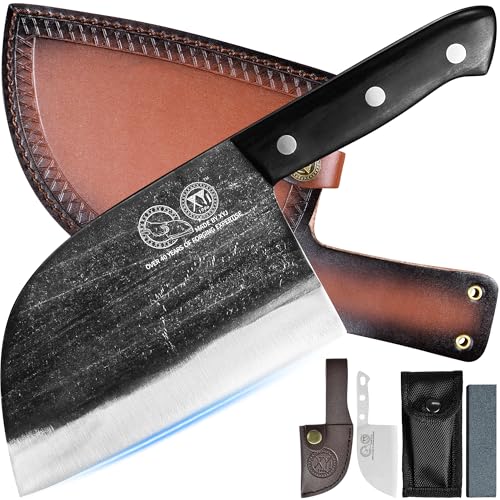
This is the pick for readers who like to read the steel spec before buying. The steel is ATS-34 high-carbon, forged to 59–61 HRC and honed to a 13–15° bevel, a hardness range a notch above the 58-60 HRC given for the Hoshanho 6.5" Serbian Chef Knife. The oak handle is full tang with three rivets, and a finger hole gives your index finger an anchor for both fine slicing and forceful chopping.
Owners report an edge that needs no sharpening on arrival and works through poultry and beef bones; the balance, ergonomics and construction all draw praise. As with any high-carbon blade, the leather sheath is for storage and does not replace drying the steel after washing.
Pros
- 59–61 HRC ATS-34 high-carbon steel
- 13–15° bevel for fine slicing
- Finger hole adds grip control
- Oak full-tang handle, three rivets
Key features (4)
- Hammered-surface blade in ATS-34 high-carbon steel
- Oak full-tang handle with three solid rivets
- Built-in finger hole at the handle
- Leather sheath and gift box included
Heft separates it from the rest: at 1.8 pounds it outweighs every other pick whose weight is stated, including the XYJ Serbian Chef Knife 6.7 Inch at 1.34 pounds. The 6.7-inch blade is high-carbon stainless steel, with a full-tang wooden handle and three rivets, and a fitted leather sheath comes in a gift box.
Owners report a sharp edge from the start, a weight that makes meat and bones easy work, and a hand-forged look with a good finish. Frozen meat with small bones is mentioned as manageable. The one clear complaint is rust: owners describe stains showing up on the blade, so plan to dry it right after washing and not leave it wet in the sheath or on a rack.
Pros
- Heaviest weight among stated picks
- Sharp edge ready to use
- Cuts meat and small bones easily
- Fitted leather sheath and gift box
Cons
- Owners report rust stains on blade
Key features (4)
- High-carbon stainless steel 6.7-inch wide blade
- Full-tang wooden handle reinforced with three rivets
- Fitted leather sheath for storage and travel
- Premium gift box packaging
Anyone weighing it against the Huusk Serbian Chef Knife should know they share a maker, an oak handle, a finger hole, the ATS-34 steel and a 59-61 Rockwell hardness range; the difference in feedback is rust, which comes up here. The blade has a hammered finish to help food release and a lanyard hole at the base of the handle, and the maker tells buyers to wash by hand.
Owners report a razor-sharp edge, a heavy but well-balanced feel, and easy cutting through chicken bones and frozen fish. The finger hole stands out for people who want extra security in the hand, and the blade is described as surprisingly precise for its bulk. On the other side, owners report both lasting durability and rust appearing overnight, and edge retention is described as uneven, with the wide blade awkward to sharpen. Carbon steel asks for more care than stainless, and this one is no exception.
Pros
- Finger hole improves grip security
- Handles bones and frozen fish
- Hammered blade helps food release
- Lanyard hole for hanging storage
Cons
- Rust experiences are mixed
- Edge retention can be uneven
- Hand wash only
Key features (4)
- Hand-forged steel rated 59-61 Rockwell hardness
- Oak full-tang handle with three rivets
- Hammered blade surface with thick back
- Leather sheath with lanyard hole at handle base
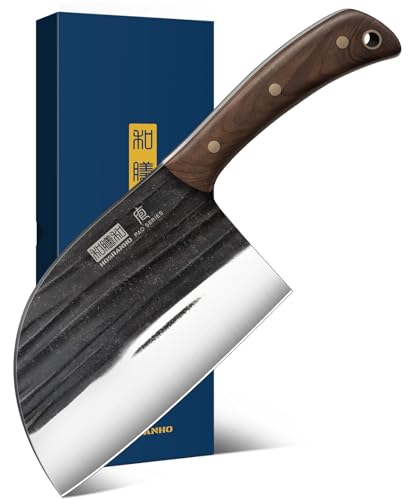
Spine thickness is the point of difference here: the Huusk Meat Cleaver Knife describes a thick back without giving a number, while this one states 4mm, which supports the heavy chopping its features emphasize. The blade is high-carbon steel at 58-60HRC with a 15-20 degree cutting angle, and the walnut full-tang handle has three rivets.
Owners report a very sharp edge that holds up, a weight with good balance, and clean cuts through meat and even a whole watermelon. The feel is described as solid and well made. A note of caution in the feedback is a wish for sturdier blade and handle construction. The product details do not mention a sheath, so factor in storage if you need one.
Pros
- 4mm thickened spine for chopping
- Sharp edge that holds well
- Good balance for its weight
- Walnut full-tang handle
Cons
- Feedback wishes for sturdier build
Key features (4)
- 4mm thickened blade back for bone and frozen food
- High-carbon steel rated 58-60HRC
- Walnut full-tang handle with three steel rivets
- 15-20 degree cutting angle for slicing and dicing
Almost everything but the sheath and the unit count matches the Hoshanho 6.5" Serbian Chef Knife: the same 4mm thickened spine, the same 58-60HRC high-carbon steel, a 15-20 degree cutting angle and a walnut full-tang handle with three rivets. This version adds a durable leather sheath for carrying, which suits outdoor cooking and barbecue use.
Owners report a sharp edge that keeps its bite, weight with good balance, and cuts that glide through meat. It is configured as a two-unit purchase, and its stated size and weight differ from the single knife, so check exactly what arrives before ordering and what you want to do with the second blade.
Pros
- Thick 4mm spine for chopping
- Leather sheath for carrying
- Sharp edge with good balance
- Walnut full-tang handle
Key features (4)
- 4mm thickened blade back for heavy chopping
- High-carbon steel rated 58-60HRC with hammered forging
- Walnut full-tang handle with three steel rivets
- Durable leather sheath for outdoor cooking and camping
Side by side
| Pick | Size | Item weight |
|---|
#1 Best Overall
Müellerhome | 7 inch | 1 pounds |
#2 Best for Meal Prep
XYJ | 6.7" | 1.34 pounds |
#3 Best Steel Specs
Huusk | 6.3" | — |
#4 Heaviest Pick
Enoking | 6.7" | 1.8 pounds |
#5 Best for Secure Grip
Huusk | 6.5" | 1.03 pounds |
#6 Best for Bone Chopping
Hoshanho | 6.5" | 1 pounds |
#7 Two-Unit Option
Hoshanho | 7.3" | 1.45 pounds |
How to Choose a Serbian Chef Knife
How much blade care are you willing to do?
Most knives in this style use high-carbon steel, which takes a keen edge but will rust if left damp. That makes care the first decision, more than looks. The Müellerhome Ancient Forged Serbian Meat Cleaver Knife is the one that states a black oxide coat for protection, while owner feedback on the Enoking 6.7 Inch Serbian Chef Knife and the Huusk Meat Cleaver Knife brings up rust, so buyers who want low upkeep should lean toward the coated blade.
Whichever you choose, a short routine keeps the steel healthy.
- Wash the blade by hand soon after cutting.
- Dry the blade and handle completely with a towel.
- Wipe a thin film of food-safe oil on the steel before long storage.
- Keep the knife in a drawer, its sheath or on a wall hook, away from damp.
- Check the edge now and then for rust spots or chips.
What hardness and edge angle suit your cutting?
Hardness is measured in HRC, and a higher figure usually means longer edge life but less forgiveness against chips. The Huusk Serbian Chef Knife gives the clearest numbers, 59–61 HRC and a 13–15° bevel, which points to finer slicing alongside bone work. For raw chopping power, the Hoshanho 6.5" Serbian Chef Knife adds a 4mm thickened spine, and its blade runs a slightly softer 58-60HRC, which trades some edge life for toughness.
Buyers curious about knives with a longer lineage than the Serbian style can explore vintage kitchen knife brands as a separate shopping path.
Which handle and weight will feel right in your hand?
Nearly every pick has a full-tang wooden handle held by rivets, so the real differences are weight, size and grip aids. The Huusk Meat Cleaver Knife adds a finger hole for security, while the Enoking 6.7 Inch Serbian Chef Knife is the heaviest at 1.8 pounds, which lets weight do the chopping but tires smaller hands sooner. A heavy blade is also clumsier for light jobs like trimming a shallot, so if your cooking is mostly delicate, a lighter blade or a standard chef's knife serves better.
If the cleaver side of the style is what draws you, the serbian cleaver picks cover that angle directly.
Is a sheath part of the deal?
A leather sheath protects both the edge and your fingers in a drawer, and doubles as a carry case for camping or barbecue. The Müellerhome Ancient Forged Serbian Meat Cleaver Knife, the XYJ Serbian Chef Knife 6.7 Inch, the Huusk Serbian Chef Knife, the Enoking 6.7 Inch Serbian Chef Knife, the Huusk Meat Cleaver Knife and the Hoshanho 6.5 Inch Serbian Chef Knife are all described with one, while the Hoshanho 6.5" Serbian Chef Knife does not state it, so plan storage separately if you choose that knife.
Our picks at a glance
5
Best for Secure GripHuusk
6
Best for Bone ChoppingHoshanho
Frequently asked
Can a Serbian chef knife replace a regular chef's knife?
It can handle meat, bones and bulky vegetables well, but its width and weight make fine work like thin slicing or mincing a small shallot clumsy. If you want one blade that stays precise despite its bulk, the Huusk Meat Cleaver Knife draws owner comments about surprisingly accurate cuts, though a lighter standard chef's knife is still the easier tool for delicate prep.
Can these knives cut through bones?
They are built to, within reason. Feedback on the Huusk Serbian Chef Knife mentions chicken, turkey and beef bones, and the thick 4mm spine on the Hoshanho 6.5" Serbian Chef Knife is aimed at ribs and frozen food. Keep to ordinary kitchen bones, use a cutting board rather than a hard surface, and avoid twisting or prying, since a thin or hard edge can chip.
Why is it called a Serbian knife?
The name points to a style popularised by one brand rather than a long-standing regional design, and it has since spread to many makers who copy the wide, hooked cleaver shape. Most describe their blades as hand-forged high-carbon steel, so treat the term as a shape and construction label more than proof of origin.