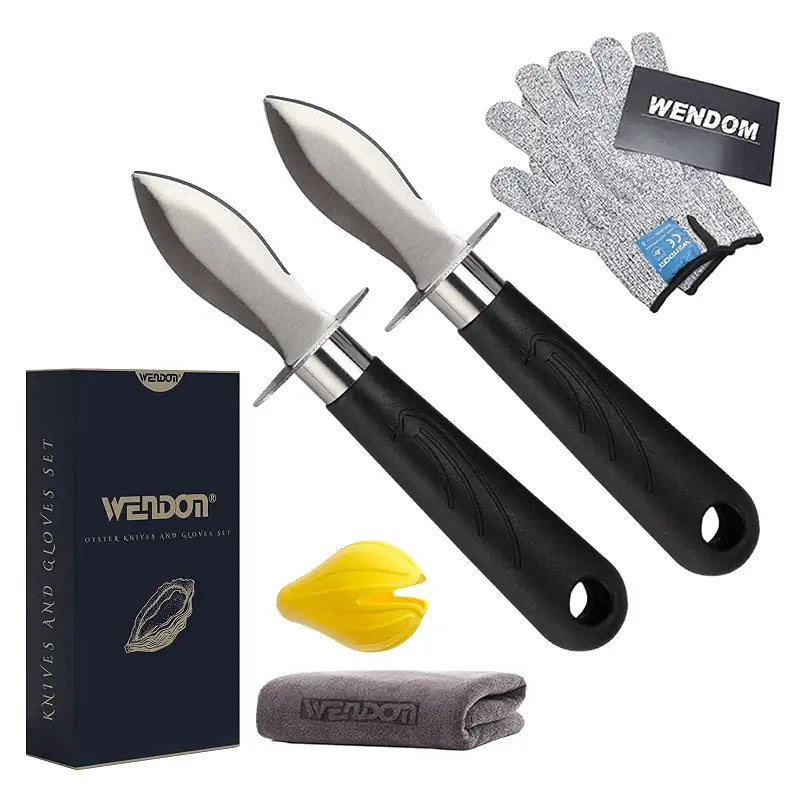
Ideal for: Beginners and casual entertainers shucking oysters a few times a year.
The Wendom set appeals to first-time buyers who want to try oyster shucking without investing heavily upfront. You get two spaced-shaped blades, a pair of cut-resistant gloves, a non-slip cloth, and a lemon squeezer, which means everything lands in one box for a straightforward price point. The concavo-convex handle grip is thoughtful and does help when hands are wet or salty.
Where this set shows its limits is under real stress. Owners report that the blades can bend or flex if you hit a particularly stubborn oyster, which defeats the purpose of a rigid tool built for leverage. The handle is also on the smaller side, making it harder to generate torque when you need to twist into a tight hinge. If you're shucking more than a few dozen oysters in a sitting, hand fatigue becomes noticeable.
I'd recommend this if you're hosting a casual dinner and want a no-regrets entry point, or if you enjoy oysters just often enough to justify a modest toolkit. Skip it if you plan to shuck regularly or work through bulk orders: you'll find the blade flex frustrating and end up replacing it anyway.
Pros
Includes protective gloves and cloth for safe handling
Two knives let you share the work at the table
Affordable starter price for the complete package
Cons
Blade can bend under pressure on tough oysters
Small handle limits torque and causes hand fatigue
Key features
Space-shaped blade design with guard near the heel
Ideal for: High-volume home entertainers and casual oyster bars that shuck 50+ oysters per session.
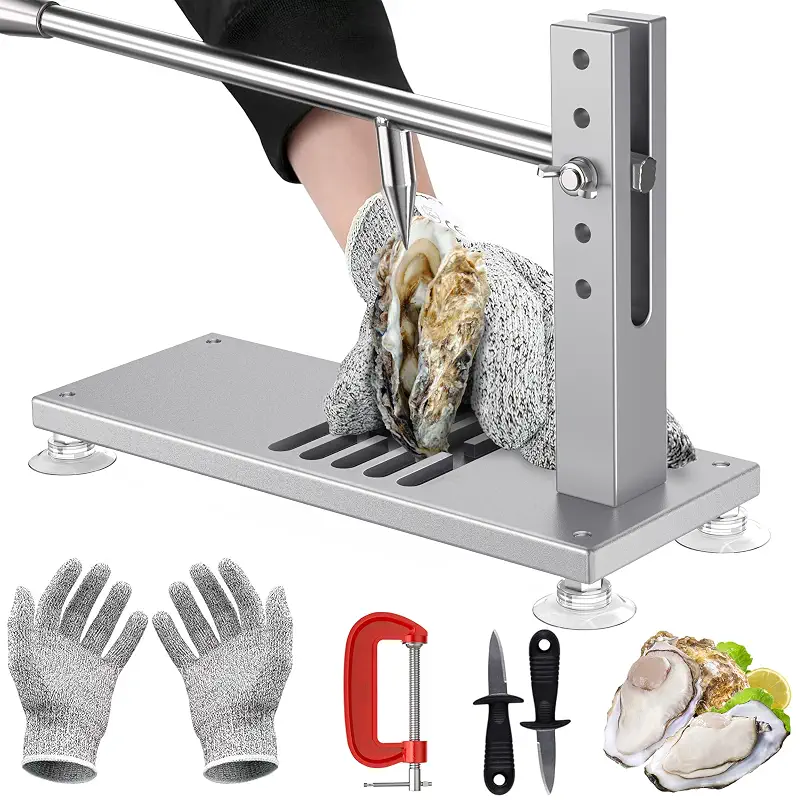
The ZeroPone machine is a game-changer if you're opening dozens of oysters at once. Instead of wrestling each shell with a blade, you place the oyster in a grooved base, press down a hinged lever, and the knife does the splitting work. Five adjustable positions let you dial in the height for jumbo or petite oysters without constant fiddling. Suction cups and a G-clip lock it to your counter, so the tool stays put while you work one-handed.
Owners who shuck large batches report opening 75-120 oysters with minimal blade work and zero hand punctures. The aluminum-alloy base is durable and dishwasher-safe, and the stainless steel cutter head resists corrosion. The trade-off: if you get an occasional stubborn oyster, you'll still need a hand knife to finish the job, so you can't abandon blade skills entirely. Some users also noted quality inconsistencies on the finish when unpacking, though the core tool works reliably.
Compared to hand knives like the R Murphy, this machine removes the skill requirement and the fatigue, but it takes up counter space and works best when oyster sizes are similar. I'd choose this for entertaining a crowd or running a casual oyster bar at home; hand shuckers suit smaller, more intimate meals where space is tight.
Pros
Opens 75+ oysters with minimal hand fatigue or injury
Adjustable for small and jumbo oyster sizes
Suction cups and G-clip keep tool stable on counter
Cons
Requires counter space and cannot be easily stored
Occasional stubborn oysters still need hand knife finishing
Key features
Five adjustable handle positions for varied oyster sizes
Aluminum-alloy base with non-slip grooves to stabilize shells
Stainless steel cutter head, corrosion and deformation resistant
Includes suction cups, G-clip, two hand knives, and gloves
#3 Pick
Best Premium Hand Knife
UJ Ramelson Co
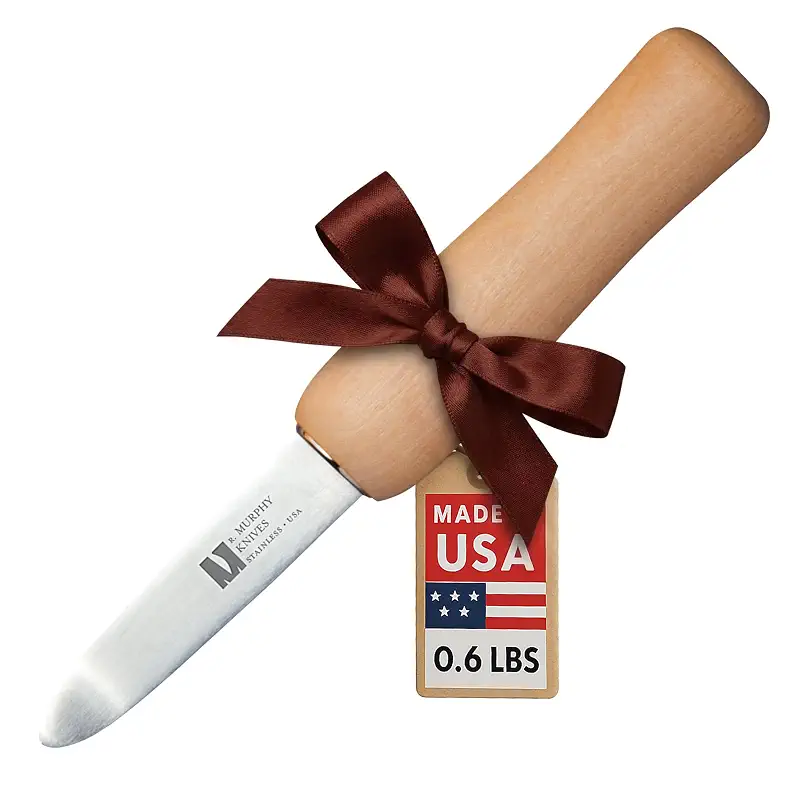
R Murphy Ramelson New Haven Oyster Shucking Knife, Regular, Wood Handle | Shucker Tool Opener, Curved Bent Tip, Stainless Steel Blade, Made in USA
4.6(217)
Professional-grade curved-blade shucker made in the USA, favored by seafood pros for precision and durability.
Ideal for: Experienced shuckers and seafood professionals who appreciate precision and hand control.
The R Murphy New Haven knife is the standard-bearer for hand shuckers. The curved tip and bent blade design glide into the oyster hinge with less slippage than a straight blade, and the 2.6-inch stainless steel blade stays rigid under pressure. The lightweight wood handle is balanced for all-day shucking, and the taper-ground edges hold their sharpness through hundreds of oysters. It's made in the USA with cutlery-grade steel, which shows in the craftsmanship.
The catch: at this price tier, you're buying a single knife, not a bundle. Some owners have reported chipped blades after moderate use, suggesting the steel, while sharp, can be brittle if you apply sideways force. The blade is also thinner than some competitors, which some find helps with insertion but others perceive as fragile. The wood handle needs hand-washing and occasional oiling to stay in shape: it's not a grab-and-rinse tool.
I'd reach for this if you shuck oysters regularly and want a tool that feels like a real kitchen knife rather than a gadget. It pairs well with an oyster machine for high-volume work, or stands alone for a dozen oysters at dinner. Where the ZeroPone machine removes the skill, this knife rewards technique and feel.
Pros
Curved New Haven tip designed for smooth hinge insertion
Blade stays sharp longer with taper-ground edges
Made in USA with cutlery-grade steel and professional reputation
Cons
Blade can chip if subjected to sideways force or impact
Wood handle requires hand-washing and occasional maintenance
Key features
Curved bent-blade design minimizes slippage and improves safety
Rigid 2.6-inch stainless steel blade resistant to bending
Balanced lightweight wood handle reduces hand fatigue over time
Made in the USA and trusted by seafood festival professionals
Ideal for: Safety-conscious home entertainers and groups learning to shuck together.
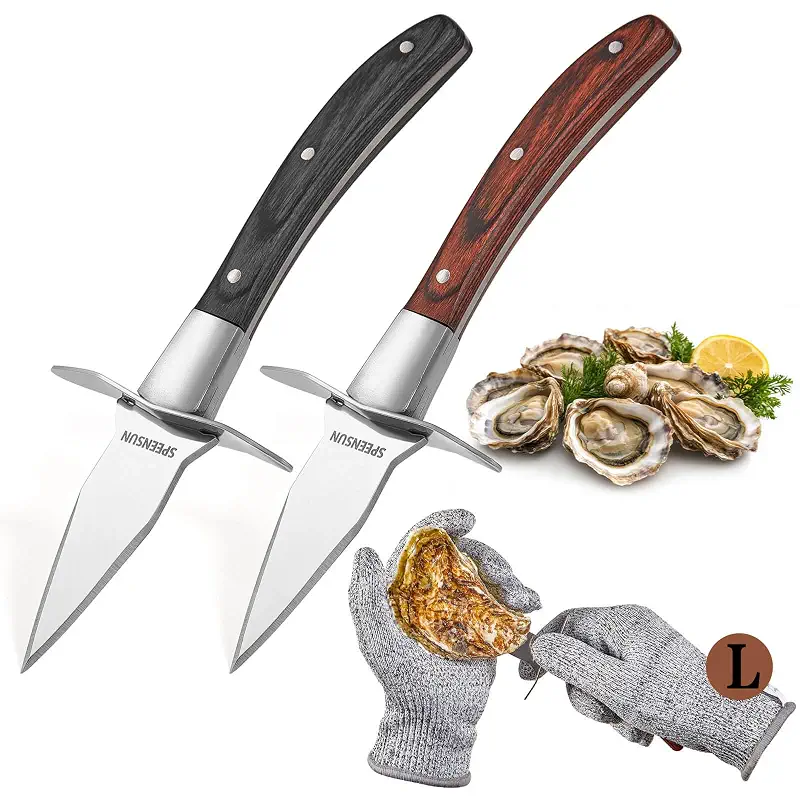
The Speensun set goes all-in on safety features. Each knife has a full-tang design anchored with three strong rivets, a thick 3CR14 stainless steel blade that resists bending, and a hand-guard shield near the heel to catch a slipping blade before it finds skin. The Pakkawood handle has an ergonomic curve, and the included Level 5 cut-resistant gloves are food-grade and machine-washable. You get two knives, so pairs can work in tandem or you keep a backup.
Owners appreciate the sturdy build and the confidence the hand guard instills, especially for novices worried about their fingers. The thick blade does excellent work on tough shells and clams, and the knife cleans up easily. However, one reviewer's blade tip broke after a year of occasional use, suggesting that while the blade resists bending, it's not immune to impact damage if the tool is dropped or levered too aggressively. The handle may feel small for large hands, and the wood requires hand-washing, not the dishwasher.
Compared to the R Murphy's precision and heritage, this is a more modern, safety-focused design. I'd pick Speensun if you're shucking with family or hosting crowded parties where you want every layer of protection, or if you're newer to the technique and value the hand guard confidence.
Pros
Hand guard shield prevents blade slip from reaching skin
Two knives in one set for shared shucking or backup
Level 5 gloves included, machine-washable and durable
Cons
Blade tip can break if subjected to hard impact or drop
Hand guard and thick blade design may feel bulky to some users
Key features
Full-tang design with three rivets anchoring thick 3CR14 blade
Hand guard shield near heel prevents slip-and-stab injuries
Pakkawood handle with ergonomic curve and non-slip texture
Two knives and Level 5 cut-resistant gloves in one set
#5 Pick
Best Compact Mechanical Opener
Zoameacy
Stainless Steel Oyster Shucker Tool,Portable Oyster Shucking Knife,Easy to Use Oyster Knife,Oyster Opener Machine for Home Use,Including Two Oyster Shucking Knife,a pair of Glove and one G-Clamp.
4.4(134)
Lightweight lever-based machine with adjustable height, ideal for smaller kitchens and modest-volume entertaining.
Ideal for: Moderate-volume entertainers with limited counter space who want machine assistance.
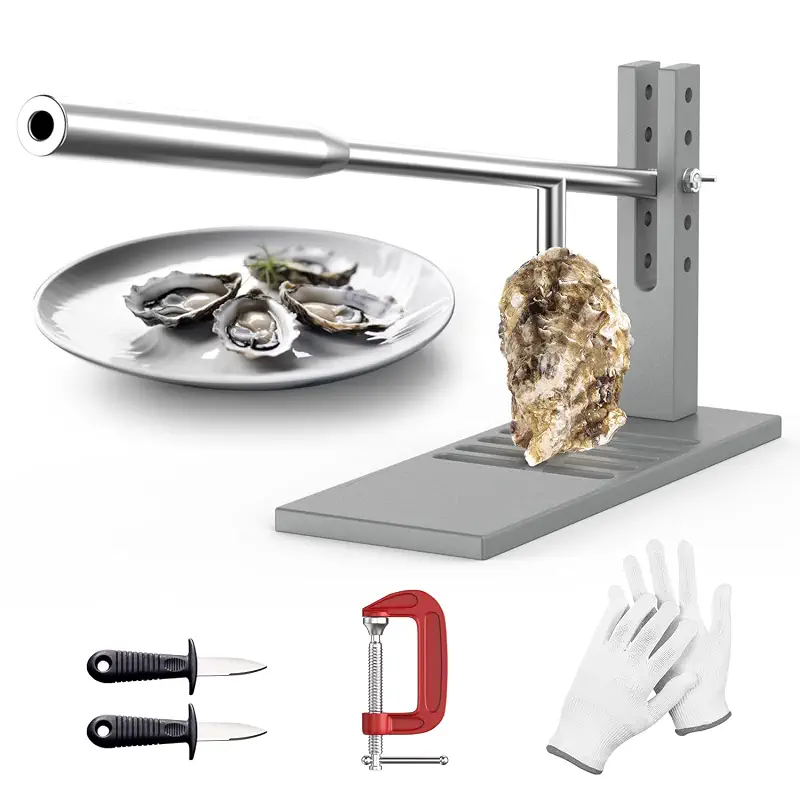
The Zoameacy machine is a lighter-duty cousin to the ZeroPone: it uses the same lever principle with suction-cup stability and adjustable height positions, but its footprint and pressure feel more modest. The aluminum-alloy base has five grooves to cradle oysters, and the stainless steel cutter and handle are straightforward and easy to rinse. You get two hand knives and gloves included, which extends your options if the machine alone doesn't finish every oyster.
Owners who shuck 30-50 oysters report good success and much less hand strain than knife-only work. The adjustability for oyster size is appreciated, and the G-clamp add-on gives you another anchor option if suction cups don't grip your counter. The drawbacks: some users reported chipping or burrs on the aluminum base that scratched countertops, and plating that peeled off the cutter point early on. These aren't deal-breakers but suggest the manufacturing tolerances are looser than the pricier ZeroPone.
I'd choose this over the ZeroPone if you shuck less frequently or have limited counter space, but you're willing to accept less precision in exchange for a smaller package. If you're already considering an oyster knife versus machine opener, this sits in the middle: it reduces physical demand more than a hand knife but stores smaller and costs less than a full-size machine.
Pros
Adjustable handle with four height positions for varied oyster sizes
Five grooves on base stabilize oysters and prevent slipping
Lightweight aluminum construction occupies less counter space
Cons
Base finish and plating can show quality inconsistencies
Aluminum edges may have burrs that scratch countertops
Key features
Four adjustable handle positions to fit small and jumbo oysters
Stabilizing grooves at base reduce slipping and hand risk
Premium aluminum-alloy and stainless steel, corrosion-resistant
Includes two oyster knives, gloves, and G-clamp for added security
How to Choose an Oyster Shucker
Four trade-offs that actually matter when matching a oyster shucker to your kitchen.
Hand Knife vs. Machine Opener
The oyster knife versus machine opener choice shapes everything else. Hand knives demand technique and build skill over time, but they occupy minimal space, cost less, and give you complete control over blade placement. Machine openers remove the technique requirement, protect your hands, and let you process dozens of oysters with less fatigue, but they need counter space and work best on consistently sized shells. For a special dinner with a few dozen oysters, a hand knife is nimble. For a larger gathering or regular entertaining, a machine handles volume better and safer.
Blade Material and Build Quality
Stainless steel blades are standard, but thickness and alloy matter. A thick, rigid blade resists bending under pressure: critical when you're twisting into a tough hinge. Look for full-tang designs where the blade runs through the handle and is secured with multiple rivets; this construction lasts through hundreds of uses. 3CR13 and 3CR14 alloys are common in consumer shuckers. Premium hand knives use cutlery-grade steel and taper-ground edges that hold sharpness longer. Budget sets prioritize affordability, which sometimes means blades flex or dull faster.
Handle Ergonomics and Safety Features
A comfortable handle reduces fatigue during sustained shucking and improves control. Look for a non-slip surface, especially if your hands will be wet or salty. Protective gloves are valuable, especially Level 5 cut-resistant pairs that shield against blade contact. Hand guards near the blade heel catch a slipping tool before it reaches skin. Wood handles like Pakkawood feel premium but require hand-washing; stainless steel handles are low-maintenance. If you're shucking with family or novices, safety features pay dividends in confidence and injury prevention.
Set Contents vs. Single Tool
Bundle sets often include two knives, protective gloves, and extras like cloths or clamps. This is great if you're entertaining and want to share the work, or if you want a backup when one blade needs cleaning. Single-knife purchases let you invest in a higher-grade tool upfront. Gloves are almost always worth having; they improve grip and protect hands from both cuts and shell pinches. Clamps and G-clips for machine openers are nice for securing the base but not essential if your countertop has good suction-cup grip.
Volume and Frequency of Use
Casual home cooks opening oysters a few times a year can start with an affordable all-in-one set and upgrade if they find themselves reaching for it often. Regular entertainers or seafood enthusiasts benefit from investing in a premium hand knife or a mechanical machine that reduces physical strain. Professional shuckers and high-volume hosts should prioritize durability and materials that withstand intensive use without fatigue. Think about your typical shucking session: if it's 20-30 oysters, a hand knife is enough. If it's 75+, a machine becomes a game-changer.
Frequently asked
Quick answers to the questions readers ask most.
Do I need gloves when shucking oysters?
Gloves are highly recommended, especially if you're new to shucking. They protect against cuts from shell edges and blade slips, and they improve grip when hands are wet or salty. Most quality shucker sets include cut-resistant gloves rated Level 4 or 5. They won't prevent puncture wounds from a direct stab, so technique and focus still matter, but they're a smart safety layer.
Can I put oyster knives in the dishwasher?
Most stainless steel blades are dishwasher-safe, but hand-washing is gentler and extends sharpness. Wood handles should always be hand-washed to prevent warping or finish damage. Mechanical machines with aluminum bases and stainless steel parts are typically dishwasher-safe, though the manufacturer's instructions should be your guide. When in doubt, rinse and dry by hand.
What's the difference between a curved-tip and straight-blade oyster knife?
Curved-tip designs, like the New Haven style, are shaped to glide smoothly into the oyster's hinge with minimal force. Straight blades require more direct leverage and can slip more easily. Curved tips are generally preferred by experienced shuckers because they reduce hand fatigue and offer better control. Straight blades are simpler and may feel more intuitive to beginners, but curved tips become the go-to once you develop the technique.
How many oysters can I open with a hand knife before my hands get tired?
This depends on your grip strength, technique, and the knife's balance. Most casual shuckers can handle 20-40 oysters comfortably. Heavy entertaining sessions of 75+ oysters become tiring with a hand knife, which is where a mechanical machine shines. Lightweight, balanced knives and proper ergonomic handles help reduce fatigue, especially if you're shucking regularly.
What should I do if my oyster knife blade bends or breaks?
A bent blade usually indicates the knife is too thin or the alloy is insufficiently rigid for the force you're applying. A thick, high-carbon stainless blade should resist bending. If a blade breaks or chips, contact the manufacturer for a replacement if under warranty. For future purchases, prioritize full-tang construction and thick, rigid blades rated for heavy use. A broken blade is a sign to upgrade to a more durable shucker rather than replace with the same model.