Kitchen & Dining · Gadgets
Best Bunka Knife
How blade length, steel type and care habits set seven Japanese-style kitchen knives apart, and which kind of cook suits each one.
Affiliate disclosure: As an Amazon Associate I earn from qualifying purchases.
At a glance
2
Best Carbon SteelGrumpy Dad CO
4
Premium Damascus PickMiyabi
6
Best Bunka Santoku HybridKotai
Detailed reviews
We see the Misen 6-Inch Bunka Knife as the low-fuss choice here. Its steel is presented by the maker as highly rust resistant, and the triangular tip suits mincing and trimming while the rounded spine and bolster are shaped for a pinch grip. That combination fits cooks with a pinch grip or smaller hands who want compact, versatile prep from one short knife.
Owners report an edge that arrives very sharp, a light and balanced feel, and a pinch grip that stays comfortable. Amazon's summary of its reviews points the same way, praising overall quality and sharpness. At 6 inches it has the shortest blade of these seven picks, so cooks who want more reach for large produce may prefer the Sanmeiho 9 Inch Kiritsuke Chef Knife.
Pros
- Rust-resistant stainless steel
- Rounded spine suits pinch grip
- Light, balanced feel in hand
Cons
- Shortest blade of these picks
Key features (4)
- Japanese high-carbon stainless steel blade
- Triangular tip for mincing and trimming
- Rounded spine and bolster for pinch grip
- Straight-belly 6 inch blade
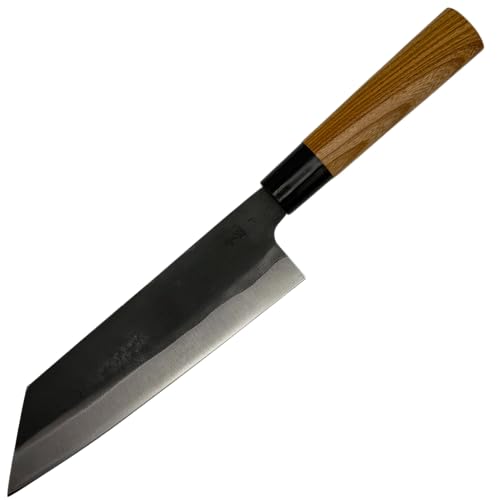
The Grumpy Dad CO Yoshidahamono Bunka Knife 190mm is the traditionalist's pick: Aogami #2 carbon steel (HRC 62-64), an edge ground to 15 degrees per side, and a full-tang Zelkova wood handle. At 162 g it is light for a 190 mm blade, and the maker pitches it as doing a santoku's work with a proper tip added for fine scored cuts.
Carbon steel asks for habits. The maker advises hand washing, drying, occasional oiling and whetstone-only sharpening, since a ceramic honing rod can chip an edge this hard. Owners report that rust and discoloration are the risk if it is left damp or unoiled, while they praise the sharpness, the balance, the light feel and the craftsmanship of the handle. Cooks who want less upkeep will find the Misen 6-Inch Bunka Knife easier to live with.
Pros
- Aogami #2 carbon steel edge
- Light for its 190 mm length
- Full-tang Zelkova wood handle
Cons
- Needs drying and oiling against rust
- Hand wash and whetstone only
Key features (4)
- Aogami #2 carbon steel, HRC 62-64
- Reverse tanto tip for fine scored cuts
- Double-edged grind for right and left hands
- Full-tang Zelkova handle in an oval shape
The Enso HD 7" Bunka Knife is the one we would start most cooks on. Its blade is 37 layers of stainless with a hammered finish, hand-ground to about 12 degrees, and the double-bevel edge works for left- and right-handed users. A black canvas micarta handle with three rivets and a lifetime warranty round out the package.
Moving up from the Misen 6-Inch Bunka Knife, you gain a bit more blade, and owners say the nearly flat edge keeps the whole length usable on the board, tip included, with no wrist lift. Amazon's summary of its reviews praises sharpness and edge holding, comfort, light weight and the Damascus-style look, and owners say it responds well to a stone. The one caution from owners is to keep it away from bones, joints and smashing garlic; it is a precision slicer, not a cleaver.
Pros
- steel holds a keen edge
- Double bevel suits left-handers
- Light and comfortable in the hand
- Takes well to stone sharpening
Key features (4)
- 37-layer stainless steel with hammered finish
- Blade hand-ground to roughly 12 degrees, double bevel
- Black canvas micarta handle with three rivets
- Handcrafted in Seki City with lifetime warranty
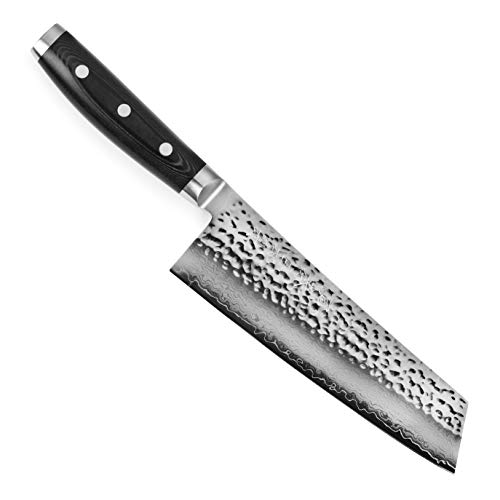
The Miyabi Kaizen II 6.5-inch Bunka Knife puts an FC61 steel core at 61 Rockwell inside 48 layers of Damascus, then ice-hardens it and hones the edge by hand to between 9.5 and 12 degrees. The black pakkawood handle is D-shaped, with a thicker rounded bolster meant to add comfort and balance. The listing describes the bunka shape as a lighter, thinner and shorter alternative to a Western chef's knife.
Its closest relative on this page, the Miyabi Mizu 6.5" Bunka Knife, shares the 6.5 inch size but swaps the layered core for powder steel and a hammered finish. It lists 0.5 pounds, the highest weight of any pick that states one, and measures 12.25 × 1 × 2 inches. Amazon has no owner reviews for it to draw on, so our read rests on the specs and features.
Pros
- Hard 61 Rockwell FC61 steel core
- Thin Japanese blade profile
- Comfortable D-shaped pakkawood handle
Key features (4)
- FC61 steel core in 48 Damascus layers
- Double ice-hardened FRIODUR blade
- Honbazuke edge hand-honed to 9.5 to 12 degrees
- D-shaped pakkawood handle with mosaic pin
The Miyabi Mizu 6.5" Bunka Knife is built around SG2 micro-carbide powder stainless steel with a hammered tsuchime finish, intended to help food release from the blade. Ice-hardening brings it to 63 Rockwell, and a three-step Honbazuke process leaves a 12 degree double-bevel edge. The micarta D-shaped handle has a bolster, a mosaic pin and a metal end cap for balance.
Hardness is where it edges past the Miyabi Kaizen II 6.5-inch Bunka Knife, at 63 against 61 Rockwell, while the weight of 0.46 pounds sits close to the Enso HD 7" Bunka Knife despite the shorter blade. It is made in Seki, Japan. Its flat edge and angled tip are pitched at precise slicing and detailed vegetable or protein prep.
Pros
- Very hard 63 Rockwell SG2 steel
- Hammered finish helps food release
- Made in Seki, Japan
Key features (4)
- SG2 powder stainless steel with tsuchime finish
- Honbazuke-sharpened 12 degree double bevel edge
- D-shaped micarta handle with metal end cap
- Made in Seki, Japan
The Kotai Bunka Santoku Knife 6.7-inch blends a santoku's versatility with the pointed K-tip of a bunka, in stainless steel at HRC 60. It has a hand-hammered finish to reduce sticking, a full hidden tang, and an octagonal ebony handle that suits left- and right-handed users. A bamboo saya and gift box come with it, which makes it easy to present as a gift.
Hand washing is the shared habit with the Grumpy Dad CO Yoshidahamono Bunka Knife 190mm, though the Kotai's steel is billed as corrosion resistant, so it should ask for less care than carbon steel. Dry it promptly after use; the included saya gives the HRC 60 edge protection in storage.
Pros
- Corrosion-resistant stainless steel
- Includes bamboo saya and gift box
- Ebony handle suits both hands
Cons
- Hand wash and dry promptly
Key features (4)
- Japanese stainless steel at HRC 60
- Hand-hammered tsuchime anti-stick finish
- Full hidden tang through an ebony handle
- Reverse tanto-inspired K-tip for detailed cuts
The Sanmeiho 9 Inch Kiritsuke Chef Knife is not a true bunka but a kiritsuke, a related long Japanese shape the maker sells as a chef-and-slicer hybrid. It is a 9-layer blade at 62 HRC, sharpened to 12 degrees, with a textured hand-forged finish and an octagonal G10 and rosewood handle.
At 9 inches it out-reaches even the Kotai Bunka Santoku Knife 6.7-inch, yet its listed weight of 0.25 pounds is the lowest of any pick that gives one. Owners report that it is sharp, well balanced and nicely weighted, with praise for how cleanly it slices fish and tomatoes and for the handle detailing. Handle comfort is the one reported caveat: a complaint on record is that the octagonal handle was uncomfortable to use.
Pros
- Nine inch blade slices cleanly
- Sharp, balanced and nicely weighted
- Light for its length
Cons
- Handle comfort reported as a caveat
Key features (4)
- Nine-layer steel at 62 HRC
- Hand-forged textured finish that reduces sticking
- Octagonal G10 and rosewood handle
- Gift box presentation
Side by side
| Pick | Size | Item weight |
|---|
#1 Best Easy-Care Pick
Misen | 6" | — |
#2 Best Carbon Steel
Grumpy Dad CO | 7.5" | 0.36 pounds |
#3 Best Overall
Enso | 7" | 0.44 Pounds |
#4 Premium Damascus Pick
Miyabi | 6.5" | 0.5 pounds |
#5 Powder Steel Pick
Miyabi | 6.5" | 0.46 pounds |
#6 Best Bunka Santoku Hybrid
Kotai | 6.7" | 0.37 pounds |
#7 Longest Blade
Sanmeiho | 9" | 0.25 Pounds |
How to Choose a Bunka Knife
What does the bunka shape actually give you?
The defining trait is the reverse tanto tip: a pointed, angled end above a mostly flat edge. The flat edge makes push cuts and slices efficient, while the tip handles detail such as mincing, trimming and scoring. Most bunka are double-bevel, so left- and right-handed cooks can use them equally.
If you like a santoku but want a sharper point, the Kotai Bunka Santoku Knife 6.7-inch is the clearest hybrid on this page. If your cooking is mostly vegetables, the nakiri knife is the squared-off alternative, though it gives up the tip a bunka keeps for detailed work.
Stainless or carbon steel: how much care will you give it?
Steel choice sets your maintenance routine more than any other factor. Stainless alloys resist rust, so they suit busy kitchens, while carbon steel can take a keener edge but needs attention. For low upkeep we would point to the Misen 6-Inch Bunka Knife, whose maker cites rust resistance through repeated dishwasher cycles. For carbon steel with oiling and whetstone-only sharpening, the Grumpy Dad CO Yoshidahamono Bunka Knife 190mm is the example here. If you need something for rougher outdoor handling instead, our camp kitchen knife picks cover that ground.
- Stainless: resists rust and needs little more than prompt drying
- Carbon steel: sharpens easily but needs drying, oiling and a whetstone
- Powder or layered stainless: harder edges, usually with Damascus or hammered finishes
How hard should the steel be?
Rockwell hardness hints at edge retention, though harder steel also asks for gentler use. The Miyabi Mizu 6.5" Bunka Knife sits at 63 Rockwell, the top figure among the stainless picks, while the Enso HD 7" Bunka Knife is a touch softer at 61 and is the one owners report takes well to a stone. Edge angles differ too: the Miyabi Kaizen II 6.5-inch Bunka Knife is honed between 9.5 and 12 degrees, against 15 degrees per side on the Grumpy Dad CO knife.
| Pick | Steel | Rockwell |
|---|
| Miyabi Mizu | SG2 powder stainless | 63 |
| Grumpy Dad CO | Aogami #2 carbon | 62-64 |
| Sanmeiho | , 9 layers | 62 |
| Enso HD | , 37 layers | 61 |
| Miyabi Kaizen II | FC61 core, 48 layers | 61 |
| Kotai | stainless | 60 |
Which blade length fits your board and hand?
Length decides how much work you can do in one stroke and how nimble the knife feels. For small hands or compact boards, the 6 inch Misen 6-Inch Bunka Knife is the easiest to control. For a balance between reach and agility, the Enso HD 7" Bunka Knife covers most chef's knife jobs, and the Grumpy Dad CO Yoshidahamono Bunka Knife 190mm is longer still. Cooks wanting slicing reach beyond that can consider the Sanmeiho 9 Inch Kiritsuke Chef Knife.
Our picks at a glance
2
Best Carbon SteelGrumpy Dad CO
4
Premium Damascus PickMiyabi
6
Best Bunka Santoku HybridKotai