Kitchen & Dining · Gadgets
Best Tomato Slicer: Top Picks for Clean, Even Slices
Find the best tomato slicer for your kitchen. Compare manual knives, commercial cutters, and handheld tools to get perfectly even slices every time.
Affiliate disclosure: As an Amazon Associate I earn from qualifying purchases.
At a glance
1
Best for Small and Medium TomatoesQujifetu
2
Best Commercial-Grade CutterHappybuy
3
Best Overall Tomato KnifeRADA
4
Best Budget Commercial SlicerNew Star Foodservice
5
Best Budget-Friendly Serrated KnifeOmesata
Detailed reviews
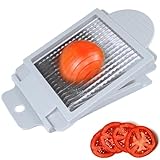
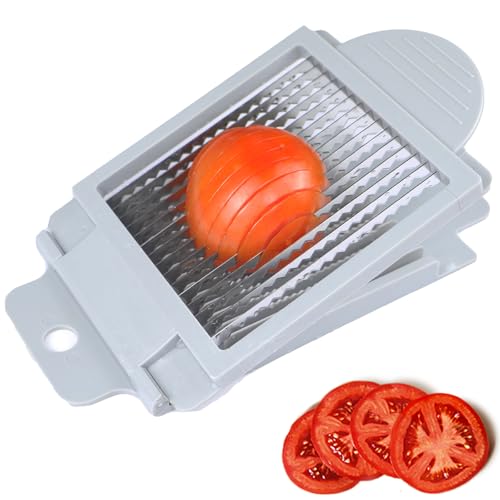
The Qujifetu Tomato Slicer Tool offers a low-cost entry point into dedicated slicing gear. Its 15 ultra-sharp blades promise uniform 0.28-inch slices, and the compact footprint makes it easy to tuck away between uses. The dishwasher-safe design and included cleaning brush appeal to cooks who value easy maintenance. However, owners consistently report that firm tomatoes require a delicate touch; the cradle-and-press mechanism tends to compress softer fruit or those with thin skin rather than slice cleanly through them. Results improve noticeably with smaller or firmer specimens, and it does excel with denser vegetables like zucchini and cucumber, making it a reasonably versatile tool for mixed prep work.
Where the RADA Cutlery Tomato Slicer Knife excels at any tomato size without crushing, this handheld cutter shines only when tomato firmness cooperates. If your go-to tomatoes are medium-sized and picked just before peak ripeness, this tool delivers quick, even results. But ripe, delicate varieties demand more finesse than the design accommodates.
The locking mechanism and hand-finished construction suggest durability, though real-world longevity depends on how gently you operate it. It's best viewed as a specialty tool for batch slicing salad tomatoes, not as an everyday kitchen knife replacement.
Pros
- Ultra-sharp 15-blade system produces consistent thickness
- Compact and dishwasher-safe for easy cleaning
- Versatile with other vegetables like zucchini and cucumber
Cons
- Crushes softer or ripe tomatoes instead of slicing cleanly
- Limited capacity requires cutting larger tomatoes in half
Key features (4)
- Fifteen stainless steel blades deliver uniform 0.28-inch slices
- Vertical push design with stable horizontal base for controlled cuts
- Compact 6.88 x 4.13 inch footprint fits tight kitchen storage
- Food-grade stainless steel and dishwasher-safe construction
The Happybuy VEVOR Commercial Tomato Slicer is purpose-built for kitchens that process tomatoes in bulk. Its cast aluminum frame, removable food-grade stainless steel blades, and dual handle system (vertical and horizontal) are engineered for restaurants and catering operations. Owners praise the razor-sharp cuts and speed: one buyer reports coring and slicing three tomatoes in 15 seconds. The 1/4-inch precision thickness suits sandwich and burger assembly lines where uniformity matters.
The critical caveat: this tool requires firm tomatoes. Ripe, soft specimens will squish under pressure, and you'll need a collection bowl nearby because the tomato launch is vigorous. The sliding mechanism takes real force to initiate, which is why the dual handles exist. Some owners report that the rubber feet slip during extended use, and early models had issues with fasteners loosening, though recent builds appear more robust. Compared to the New Star Foodservice Tomato Slicer, the Happybuy is heavier and sturdier, but both demand the same respect for tomato ripeness and effort on the handle.
For home cooks with modest needs, this is overkill. For small restaurants, delis, or anyone slicing 10+ tomatoes daily, the speed and consistency justify the counter space and the learning curve.
Pros
- Cuts 24 tomatoes per minute with razor-sharp uniform 1/4-inch slices
- Heavy-duty cast aluminum frame resists wobbling during high-volume use
- Removable stainless steel blades simplify cleaning and replacement
Cons
- Requires firm tomatoes; soft or ripe fruit will crush and smush
- Forceful handle operation and significant launch distance can be unwieldy
Key features (4)
- Cuts uniform 1/4-inch thick slices at commercial production pace
- Heavy-duty cast aluminum alloy with reinforced frame for stability
- Dual vertical and horizontal handles distribute cutting force effectively
- Removable blade set and built-in cutting board for workspace efficiency
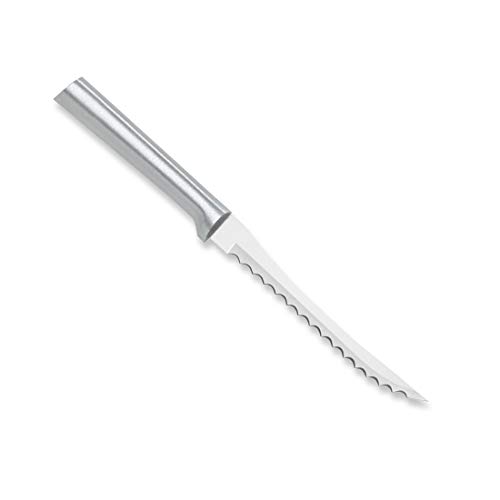
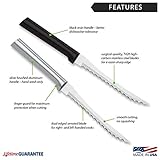
The RADA Cutlery Tomato Slicer Knife earns its stellar reputation through engineering that prioritizes sharpness and thin blade geometry. The T420 high-carbon stainless steel dual-serrated edge combined with a hollow-ground design means the knife cuts through both the tough skin and soft flesh without compressing fruit. Owners (many with 10+ years of use) consistently report that this knife outperforms standard chef's knives and specialty blades costing three times as much. The 5-inch blade is thin enough to make paper-thin slices yet sturdy enough to handle tomato after tomato without dulling. The permanently cast brushed aluminum handle provides satisfying weight and balance.
The practical trade-off is that the aluminum handle requires handwashing only; dishwasher use causes tarnishing and darkening over time. Some newer versions offer resin handles that resist discoloration, which addresses that concern. Unlike handheld cutters or commercial guillotines, this knife works equally well on any tomato ripeness: ripe, soft fruit poses no problem whatsoever. It also handles bread, vegetables, and soft fruits with the same grace. If you're exploring serrated-blade options, the best tomato slicing knife combines that edge geometry with longevity and versatility that few competitors match.
If you want a single tomato tool that doubles as a versatile kitchen knife and will still be sharp decades from now, this is the safest choice.
Pros
- Dual-serrated blade slices ripe tomatoes cleanly without crushing or smashing
- T420 high-carbon stainless steel holds its edge for years with minimal maintenance
- American-made quality with decades-long user loyalty and proven durability
Cons
- Aluminum handle requires handwashing only; dishwasher use causes tarnishing
- Higher initial cost than basic kitchen knives or handheld cutters
Key features (4)
- Dual-serrated blade made from T420 high-carbon stainless steel for lasting sharpness
- 5-inch thin blade geometry slices ripe tomatoes without crushing or juice loss
- Cast brushed aluminum handle with satin finish and satisfying weight balance
- Made in the USA and backed by user testimonials spanning two decades
The New Star Foodservice Tomato Slicer delivers commercial-grade cutting speed and precision at a more accessible price than heavier competitors. The 1/4-inch (or 3/16-inch option) stainless steel blades produce uniform, clean slices, and it comes with an extra blade plus a replaceable blade option: a genuine advantage when high-volume work dulls the factory edge. The vertical and horizontal handle layout provides good leverage, and the rubber feet help prevent drift during rapid slicing. Owners in restaurant and catering settings praise the time savings and consistent output.
The durability trade-off is significant: multiple owners report that the fastening screws loosen within weeks of heavy use, wearing away the aluminum mounting points and eventually rendering the handle unusable. Applying Loctite to screws before first use appears to mitigate this problem, but it's an annoying extra step. One buyer also noted that replacement blades for certain widths (3/16-inch, for instance) can become hard to source, which limits long-term serviceability. Compared to the Happybuy VEVOR model, this slicer is lighter and cheaper but less robust and more prone to fastener wear. For occasional or seasonal use in a small restaurant, the lower cost and compact footprint are appealing; for daily high-volume work, the Happybuy's heavier frame may prove worth the premium.
If you commit to basic maintenance (Loctite on screws, tight storage) and stick with readily available blade widths, you'll get reliable slicing at a bargain.
Pros
- Compact aluminum frame takes up less counter and storage space than heavier models
- Includes extra blade and replaceable blade option for extended use
- Produces uniform, razor-sharp slices at commercial pace
Cons
- Fastening screws loosen quickly with heavy use, wearing aluminum mounting points
- Replacement blades for some widths can be difficult to source long-term
Key features (4)
- Razor-sharp stainless steel blades deliver uniform 1/4-inch slices
- Lightweight aluminum construction with rubber feet for slip resistance
- Includes extra blade and replaceable blade option for maintenance
- Vertical and horizontal handles provide proper cutting leverage and control
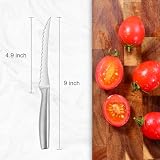
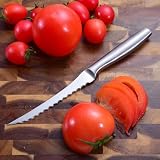
The Omesata Tomato Knife brings serrated-blade slicing to a price point far below the RADA, making it an attractive choice for cooks who want the benefit of a dedicated tomato knife without premium investment. Owners rave about the sharpness: the blade slices through ripe peaches, kiwis, and tomatoes with minimal pressure, and the pointed tip is handy for seed removal. The high-carbon stainless steel holds its edge reasonably well, and the textured, non-slip handle feels balanced and comfortable. Several buyers have purchased multiples as gifts or backups, suggesting genuine satisfaction with the value.
The caveat is that the blade is extremely sharp and thin, which demands respectful handling. Multiple owners warn that you can easily slice your fingertips if you're not careful with grip and cutting technique. Compared to the RADA Cutlery knife, this Omesata is slimmer, lighter, and feels slightly less substantial, though it performs the core task of slicing soft fruit without crushing just as effectively. It also runs significantly cheaper, making it accessible for cooks testing whether a dedicated tomato knife fits their routine. Just as a best potato chip slicer relies on consistent blade sharpness for clean cuts through delicate product, this knife's edge-retention matters for repeated use on tender fruits.
The dishwasher-safe construction and resistance to rust (unlike some aluminum-handled competitors) add practical appeal. If you practice good knife habits and appreciate a razor-sharp, budget-conscious option, this knife delivers genuine value and handles ripe tomatoes, delicate fruits, and tender vegetables beautifully.
Pros
- Ultra-sharp high-carbon stainless steel blade slices ripe fruit without crushing
- Lightweight, balanced design with non-slip textured handle for comfortable control
- Dishwasher-safe and rust-resistant stainless construction for easy maintenance
Cons
- Extremely sharp blade requires careful hand placement to avoid finger cuts
- Slimmer, lighter construction feels less substantial than heavier kitchen knives
Key features (4)
- High-carbon stainless steel serrated blade stays razor-sharp through repeated use
- Lightweight and balanced design for precise, effortless slicing of soft fruits
- Dishwasher-safe stainless steel throughout; resists rust and discoloration
- Textured handle with non-slip grip and contemporary design aesthetic
How to Choose a Tomato Slicer
Knife Versus Manual Cutter: Which Type Suits Your Kitchen
Serrated knives like the RADA and Omesata excel at everyday slicing of ripe tomatoes without crushing. They work on any tomato ripeness and double as general kitchen tools. Manual cutters and commercial guillotines (Qujifetu, Happybuy, New Star) are faster for batch work but demand firm fruit and dedicated counter space. If you slice tomatoes occasionally as part of meal prep, a knife is more practical. If you're running a restaurant or catering business prepping dozens daily, a commercial slicer saves significant time. The knife versus manual cutter comparison shows that serrated blades suit varied home cooking better than fixed-blade systems, which excel only when tomato conditions are ideal.
Tomato Ripeness and Firmness Matter
This is the single biggest factor owners overlook. Handheld cutters and commercial guillotines require firm tomatoes; soft or ripe fruit will compress and smush rather than slice cleanly. If your tomatoes are vine-ripened and delicate, a serrated knife is mandatory. If you source firm, early-picked tomatoes or work with greenhouse varieties, manual cutters become viable. Owners of the Happybuy and New Star repeatedly emphasize: use firm tomatoes or accept mush. The RADA and Omesata knives handle any ripeness, which is why they appeal to home cooks who can't control tomato texture.
Volume and Counter Space
Commercial slicers process 20-24 tomatoes per minute but occupy significant footprint and require dedicated storage. Handheld cutters like the Qujifetu are compact and portable: a genuine advantage in small kitchens. Serrated knives occupy a single drawer slot. If you're prepping fewer than five tomatoes per session, a knife or handheld cutter suffices. If you're a restaurant or high-volume catering operation, the commercial guillotine's speed justifies the space. For most home cooks, a good serrated tomato knife balances performance, storage, and versatility.
Maintenance and Longevity Expectations
Serrated knives like RADA and Omesata require only handwashing and occasional honing; they're built to last decades. Commercial slicers demand regular blade cleaning and monitoring of fasteners: the New Star model's screws are notorious for loosening, so Loctite is essential preventive care. Handheld cutters with multiple blades (Qujifetu) need careful cleaning around the blade assembly to prevent food residue. Budget time for tomato slicer blade maintenance guide before purchasing any dedicated cutter. Replacement parts availability varies; commercial options may become hard to service if the manufacturer discontinues your specific blade width.
Budget and Long-Term Value
Serrated knives range from budget-friendly (Omesata) to premium (RADA), but both hold value and utility for years. Handheld cutters are low initial cost but may disappoint if tomato texture doesn't cooperate. Commercial slicers are moderate to high initial investment but amortize quickly in restaurant settings. If you're a casual home cook testing the waters, start with the Omesata knife. If you're serious and patient with maintenance, the RADA is a once-in-a-lifetime purchase. For business use, the Happybuy or New Star deliver reliability that pays for itself within weeks of high-volume slicing.
Our picks at a glance
1
Best for Small and Medium TomatoesQujifetu
2
Best Commercial-Grade CutterHappybuy
3
Best Overall Tomato KnifeRADA
4
Best Budget Commercial SlicerNew Star Foodservice
5
Best Budget-Friendly Serrated KnifeOmesata
Frequently asked
Will a tomato slicer work on soft, ripe tomatoes?
It depends on the tool. Serrated knives (RADA, Omesata) slice ripe tomatoes cleanly without crushing. Handheld cutters and commercial guillotines (Qujifetu, Happybuy, New Star) work best on firm tomatoes; soft fruit will compress rather than slice. If your tomatoes are fragile and ripe, choose a serrated knife. Commercial slicers are designed for batch processing of firmer, consistent produce.
How thin can these slicers cut?
Serrated knives can produce paper-thin slices because the blade is narrow and sharp; thickness depends on your hand pressure and technique. Commercial guillotines are fixed at 1/4-inch (or 3/16-inch on some models), offering consistency but less flexibility. Handheld cutters like the Qujifetu deliver fixed 0.28-inch (0.7 cm) thickness. Choose commercial slicers for standardized thickness in high-volume work; choose knives if you want slicing flexibility.
Are commercial tomato slicers worth it for home use?
Only if you slice 10+ tomatoes regularly. The speed is genuine (24 tomatoes per minute versus 2-3 minutes with a knife) but they occupy counter or storage space, require maintenance, and demand firm produce. For occasional home cooks, a serrated knife is faster to grab, easier to clean, and works on any tomato. Commercial slicers are built for restaurants and catering.
Can you hand-wash all of these, or are some dishwasher-safe?
Serrated knives like RADA require handwashing only; aluminum handles tarnish in the dishwasher (newer resin-handle versions resist this). The Omesata knife is stainless throughout and dishwasher-safe. Commercial slicers and handheld cutters are generally dishwasher-safe, though you should hand-clean around blades to prevent food buildup. Always check the manual for your specific model.
Which tool is safest for beginners?
Serrated knives require learning proper hand position and grip, but they're intuitive once you've sliced a few tomatoes. Commercial slicers demand forceful operation and careful blade handling. Handheld cutters eliminate blade contact but can crush fruit if pressed too hard. Beginners typically find serrated knives most forgiving and versatile; the Omesata is a budget entry point, while the RADA's premium build and edge-holding inspire confidence.