Compare top oyster shucker knives for shucking ease and durability. Find the best knife for your skill level, from professional-grade to beginner-friendly options.
Verdict, analysis, and key features for each pick.
#1 Pick
Best Overall
Dexter Outdoors
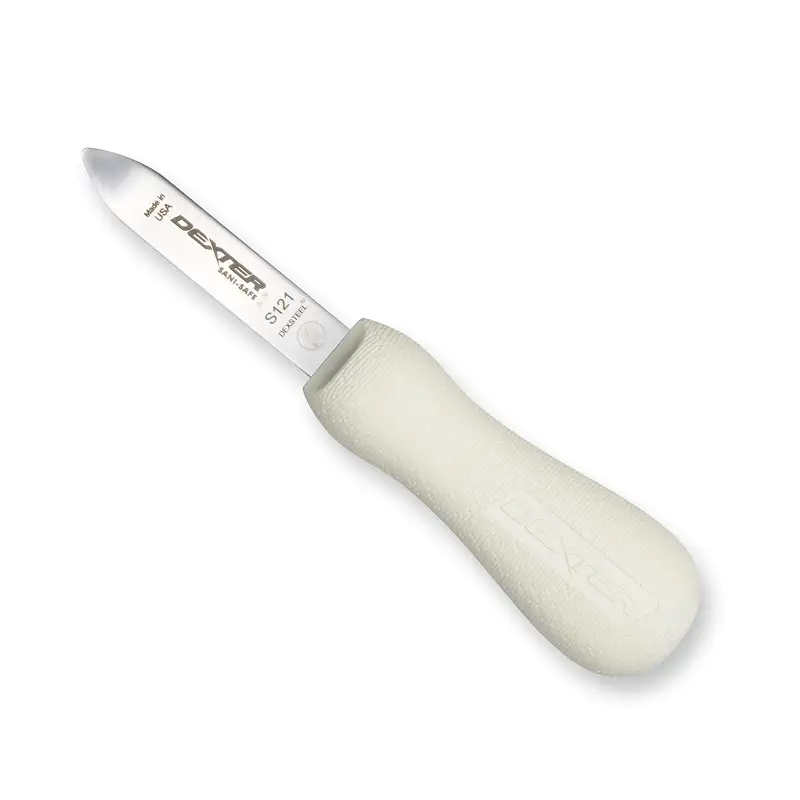
Dexter-Russell Sani-Safe 2.75" New Haven Oyster Knife, Carbon Steel | Classic New Haven pattern blade with bent tip that pops oysters open easily. Slip-resistant grip for raw bar and home use.
4.8(2,155)
The gold standard: carbon steel bent tip, non-slip grip, and proven durability through thousands of oysters.
Ideal for: Daily home cooks and seafood professionals seeking reliability and precision.
The Dexter-Russell New Haven is the workhorse that professionals and serious home cooks trust. Its 2.75-inch carbon steel blade with a bent tip is sized for serious leverage without being unwieldy, and the compact length makes it easier to control than longer alternatives. The non-slip Sani-Safe handle stays secure even when hands are slick and shucking rhythm is fast. What strikes me most from owner feedback is the consistency: people who shuck daily report it performs the same way on the hundredth oyster as the first, which speaks to build quality that justifies its reputation.
The blade geometry is particularly clever. The bent tip slides into the hinge with less force than straight-blade designs, reducing the chance you'll slip and cut your hand or fracture the shell. Owners report opening medium to large oysters with reliable ease, and the carbon steel takes an edge that holds through extended use. The handle ergonomics matter too: after opening dozens of oysters, your palm and fingers don't ache the way they do with cheaper tools.
One caveat: carbon steel requires light maintenance to prevent rust in a damp kitchen, unlike stainless alternatives. If you're the type to rinse and store immediately, no problem. If you're the type to leave tools in a sink overnight, the Duxbury or OXO stainless models might suit you better. But for sheer performance and longevity, the Dexter-Russell is the knife that earns its place in a serious cook's drawer.
Pros
Bent carbon steel tip slides in with minimal force
Non-slip handle stays secure when wet
Compact blade offers maximum leverage and control
Cons
Carbon steel requires routine care to prevent light rust
Not ideal for very large oysters with thick hinges
Key features
2.75-inch carbon steel blade with signature bent tip design
Textured Sani-Safe handle provides grip in wet, fast-paced environments
Compact profile maximizes torque for shell entry and hinge separation
Built for commercial seafood stations and home kitchen use
#2 Pick
Best for Precision Shucking
UJ Ramelson Co
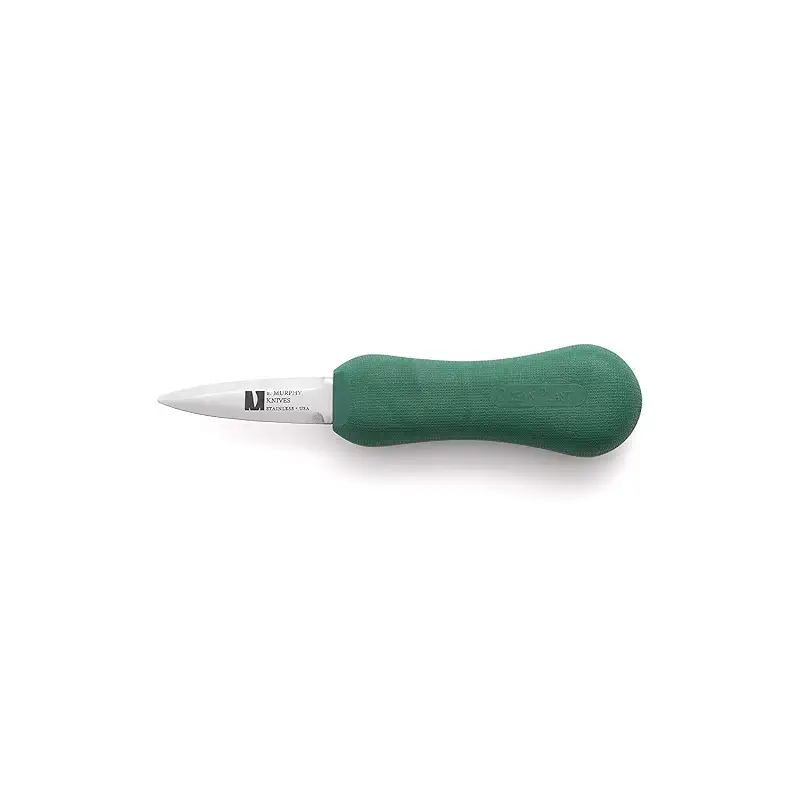
UJ Ramelson Co R. Murphy Duxbury Oyster Knife - As Seen in Bon Appetit Magazine - Shellfish Seafood Clam Shucker Tool - Made in USA
4.7(380)
Designed with oystermen; a tighter blade angle and pointy tip excel at small-to-medium oysters with surgical accuracy.
Ideal for: Experienced shuckers working primarily with small-to-medium oysters.
The R. Murphy Duxbury was co-designed with oystermen at Island Creek Oysters in Massachusetts, and you feel that specialization in every detail. The stainless steel blade tapers to a tighter, more acute point than most competitors, which lets you find and exploit the tiniest opening in the oyster hinge. Owners who work with smaller East Coast oysters consistently praise how little force is required to seat the blade: important when you're shucking dozens in a shift and want to preserve hand strength.
The trade-off is real, though: that tighter angle makes the blade more vulnerable to breakage under extreme torque, and it struggles with the huge, thick-shelled oysters you might find on the Gulf Coast. The Murphy Green polypropylene handle is ergonomic and non-slip, but lighter cooks might find it a bit thin compared to the beefier grips on the Dexter-Russell or OXO models. One professional shucker I read about replaces this knife every month or two from heavy use, while another prefers it for its precision and accepts the breakage as a cost of accuracy. Where the OXO Good Grips emphasizes comfort and beginners, the Duxbury prioritizes finesse and speed: if you know what you're doing.
This is the knife for someone who's serious about East Coast oysters and willing to accept a more brittle tool in exchange for surgical shucking technique.
Pros
Tight blade angle penetrates small hinge openings easily
Made in USA with commercial-grade stainless steel
Pointy tip allows precise adductor muscle cuts
Cons
Blade susceptible to breakage with large or thick-shelled oysters
Thinner handle offers less torque leverage than alternatives
Key features
Stainless steel blade with acute point for precise hinge entry
Ergonomic Murphy Green polypropylene handle, non-slip design
Co-designed with Island Creek Oysters oystermen in Massachusetts
Made in USA; ideal for small-to-medium East Coast oyster varieties
#3 Pick
Best for Beginners
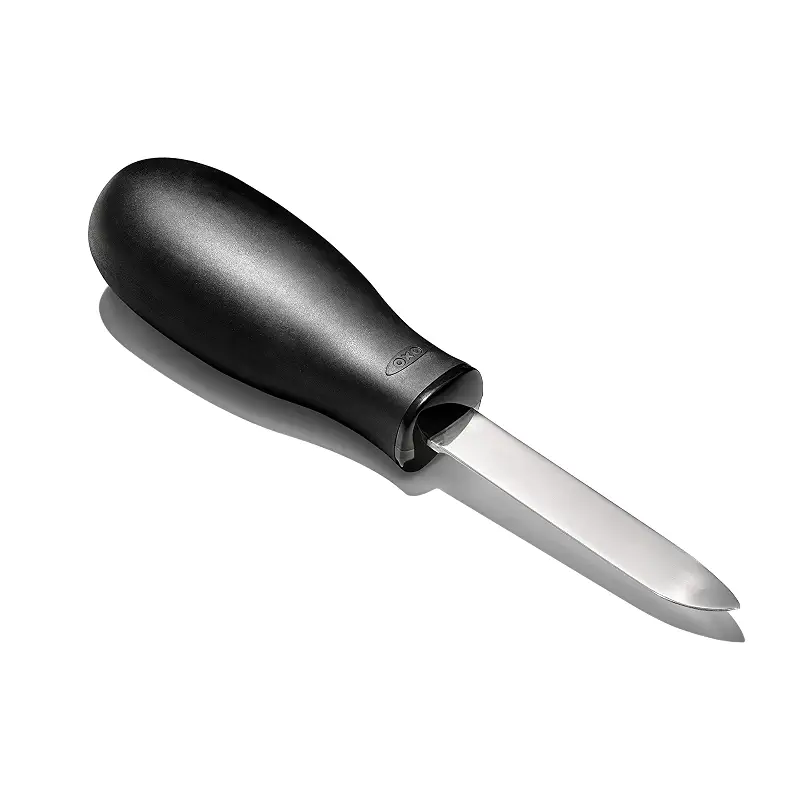
OXO Good Grips Stainless Steel Non-Slip Oyster Knife
4.7(2,764)
OXO's signature ergonomics and forgiving design make this the safest entry point for learning to shuck.
Ideal for: Home cooks new to shucking or opening oysters occasionally.
The OXO Good Grips is the knife I'd recommend if you're shucking oysters for the first time or teaching someone else how to do it. The handle is notably thicker and more cushioned than competitors, with a soft rubber grip that fills your palm and reduces hand fatigue during those early awkward attempts when your technique is still developing. The blade is thicker and less tapered than the Duxbury (more uniform steel from base to tip) which means it's more forgiving if your angle is slightly off and harder to snap under beginner pressure.
Owners report success learning the shucking motion with this knife, and the slightly upward bent tip does help guide the blade into the hinge. The stainless steel construction means you can rinse and forget without worrying about rust, a real advantage over carbon steel for casual cooks. The dishwasher-safe rating is a bonus that appeals to anyone who isn't fussing about knife maintenance. One limitation: the uniformity of the blade that makes it beginner-friendly also makes it slightly harder to find that sweet spot in very tight hinges. Experienced shuckers may feel like they've outgrown this knife faster than they would a tighter-tipped alternative.
Compared to the Dexter-Russell, the OXO trades some precision for comfort and approachability. If you're buying your first oyster knife and you're not sure you'll shuck regularly, this is the safer choice. If you know you'll be opening dozens at a time, the Dexter-Russell's leverage advantage becomes worth the steeper learning curve.
Pros
Thick, cushioned handle reduces hand strain for learners
Uniform stainless blade is forgiving and hard to break
Ideal for: Aesthetically-minded home cooks who appreciate traditional wood handles and lower shucking volumes.
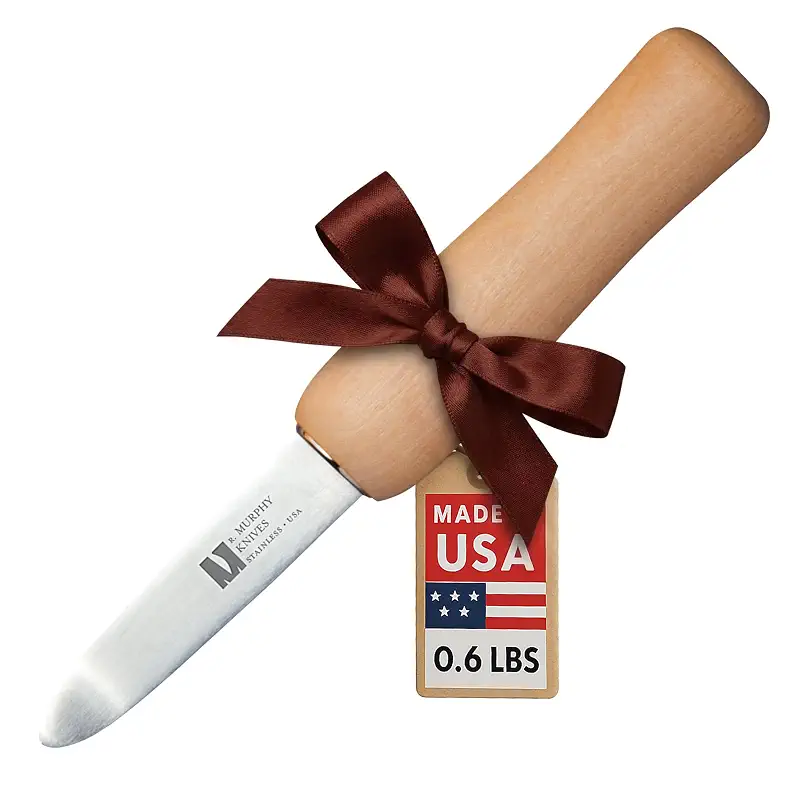
The R. Murphy Ramelson New Haven in wood is the knife that looks right next to oysters on a raw bar. The handle is crafted from wood rather than polypropylene or rubber, giving it a tactile quality that appeals to cooks who care about the feel of their tools. The curved New Haven-style tip is similar in principle to the Dexter-Russell, designed to slide into the hinge with a smooth glide rather than aggressive prying. The blade is slightly thinner than the Dexter, which some owners prefer because it feels less muscular and more refined.
Here's where I'd caution: several owners report the wood handle can feel a touch dry out of the box, and the blade arrived with some machining marks that didn't inspire confidence in durability. One buyer experienced a chip within twenty oysters, which is concerning for a premium-positioned knife. The blade alloy feels stiffer (more brittle) than competitors, which may be the trade-off for thinness. If you receive a flawless example and maintain it well, it's a handsome, functional tool. If quality control is inconsistent, you might end up disappointed. The wood handle also requires more care than sealed polypropylene or rubber: it's beautiful but less practical for professional or high-volume use.
Where the R. Murphy Ramelson stands out is aesthetic and heritage. If you value a knife that looks and feels like a traditional craftsperson's tool, and you're willing to accept slightly higher risk of finish issues, this is the one. For pure reliability and durability compared to the OXO or Dexter-Russell, though, I'd lean toward those.
Pros
Beautiful lightweight wood handle with genuine tactile appeal
Curved New Haven tip designed for smooth hinge entry
USA-made with cutlery-grade steel construction
Cons
Blade reports occasional chipping; quality control can be inconsistent
Wood handle requires more maintenance than sealed alternatives
Key features
2.6-inch stainless steel blade with New Haven curved tip
Lightweight wood handle balanced for reduced hand fatigue
Taper-ground edges stay sharper longer through extended use
Made in USA; pairs heritage craftsmanship with functional design
#5 Pick
Best Value Bundle
Wendom
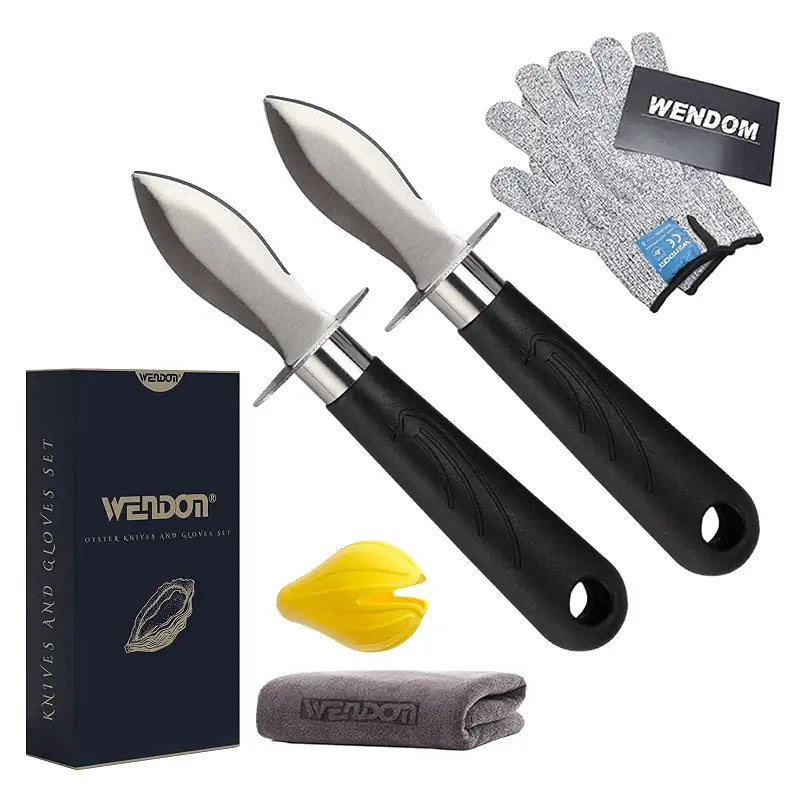
Oyster Knife Shucker Set Oyster Shucking Knife and Gloves Cut Resistant Level 5 Protection Seafood Opener Kit Tools Gift(2knifes+2Glove+1Cloth)
4.5(4,745)
Two knives, protective gloves, and cloth in one kit; a practical option for couples or those just starting out.
Ideal for: Couples, beginners, or home entertainers who want two knives and protective gloves.
The Wendom set makes sense if you're buying for two people or want backup knives without paying for them twice. The bundle includes a pair of cut-resistant gloves that genuinely help, especially for someone nervous about slipping during their first shucks. The two knives are forged from 3CR13 stainless steel, which is respectable mid-range material, not the carbon steel of the Dexter or the premium stainless of specialists, but solid enough for casual use. The concavo-convex handle pattern does provide a textured grip that resists slipping when wet.
The catch is that owners report the blades can bend under pressure if the oyster is particularly stubborn. This isn't a catastrophic flaw, but it suggests the steel lacks the rigidity of higher-end options and that the knife is designed more for consistent, steady shucking rather than aggressive prying on monster oysters. The lemon squeezer and cloth bundled in the set feel like filler: useful the first time, then forgotten. The real value is in the gloves and the two-knife convenience. If you're a couple who want to shuck together without buying separate knives, or a household that wants a spare, the bundle math works out favorably compared to buying quality knives individually.
Compared to the Dexter-Russell or Duxbury, this set prioritizes affordability and convenience over blade precision or durability. It's an honest entry-level option that works fine for home entertaining, but professional shuckers or anyone opening oysters daily would outgrow it quickly.
Pros
Two knives plus cut-resistant gloves included at competitive price
3CR13 stainless steel resists rust and is easy to clean
Textured handle grip remains secure when wet
Cons
Blade can bend under pressure with tough oysters
Bundle includes unnecessary lemon squeezer and cloth
Key features
Set of two 3CR13 stainless steel oyster knives with bent tips
Pair of Level 5 cut-resistant gloves for safe shell handling
Concavo-convex textured handle pattern for non-slip grip
Includes cloth and lemon squeezer; packaged as complete gift set
How to Choose the Right Oyster Shucker Knife
Four trade-offs that actually matter when matching a oyster shucker knife to your kitchen.
Understanding Oyster Knife Blade Styles
Oyster knife blade styles fall into two main categories. The New Haven bent-tip design curves upward slightly and is engineered to glide into the hinge with minimal force, making it the choice for most home cooks and professionals who want reliability and efficiency. The straighter, pointier Duxbury-style blade tapers to an acute angle and excels at finding tight hinges, but requires more skill to master and can be brittle under heavy pressure. The difference matters: a New Haven blade suits someone opening a dozen oysters on a Saturday; a Duxbury suits someone shucking professionally or specializing in smaller oyster varieties. Blade thickness also varies: thicker blades (like OXO) are forgiving for beginners, while thinner blades (like the Murphy Duxbury) offer precision once you know your technique.
Handle Material and Grip in Wet Conditions
Your handle is where comfort and safety intersect. Rubber and polypropylene (OXO, Dexter, Wendom) stay non-slip even when soaking wet and require minimal maintenance. Wood handles (R. Murphy Ramelson) look beautiful and feel traditional but need periodic care and can absorb water over time. If you're shucking fast or in a damp environment, sealed or soft synthetic handles outperform wood. The grip thickness matters too: thicker handles (OXO) reduce hand fatigue during learning; thinner handles (Murphy Duxbury) allow more torque leverage for experienced shuckers. Try to imagine holding the knife for 20 oysters in a row. Does the handle fill your palm comfortably, or would you want more or less material?
Material: Stainless vs. Carbon Steel
Carbon steel (Dexter-Russell) holds a sharper edge longer and feels more responsive to sharpening, but it rusts if left wet or in humid conditions. Stainless steel (OXO, Murphy Duxbury, Wendom) is maintenance-free and dishwasher-safe, but duller slightly faster and feels less responsive to touch. For a home cook who rinses and stores immediately, carbon steel's edge retention is worth the minor upkeep. For someone who leaves tools in a sink or forgets about maintenance, stainless is the practical choice. Neither is inherently superior; it's a trade-off between sharpness and convenience.
Oyster Size and Shucking Volume
Size and volume matter. A compact, rigid blade (Dexter-Russell at 2.75 inches) suits high-volume shucking and medium-to-large oysters; it gives you leverage without requiring you to maneuver a longer tool in tight quarters. A taper-pointed blade (Murphy Duxbury) excels at smaller oysters and tight hinges but struggles with thick shells. A thicker, uniform blade (OXO) is beginner-friendly but slower to find the sweet spot in finicky oysters. If you're opening 50 oysters at a party, you want speed and reliability; the Dexter wins. If you're opening a half-dozen premium small oysters and want to showcase precision shucking, the Duxbury shines. Honest question: how many oysters do you actually shuck in a year? Your answer should guide your choice.
Frequently asked
Quick answers to the questions readers ask most.
Can I use an oyster knife if I've never shucked before?
Yes, absolutely. The OXO Good Grips is specifically designed with beginners in mind: the thick handle, uniform blade, and forgiving design make the learning curve gentler. Watch a video on proper technique (insert at the hinge, wiggle gently, don't force), wear a glove on your holding hand, and start with a few oysters to build muscle memory. The knife isn't the only skill; understanding how to find the hinge and when to apply pressure matters. Once you're confident, you can graduate to a more specialized blade if you want.
Why do oyster knife blades bend or break?
Bending and breakage happen when the blade material isn't rigid enough, or when you're applying force perpendicular to the blade's design. Thinner, pointier blades (like the Duxbury) are more prone to breakage because they're engineered for precision in tight spaces, not raw leverage. Thicker blades (Dexter, OXO) resist bending because the steel is heavier and the geometry distributes pressure differently. Using a blade to pry sideways instead of straight up, or forcing it into a shell that's too thick, speeds up failure. Buy a knife matched to the oysters you actually eat, and use technique rather than brute force.
Is stainless steel or carbon steel better for an oyster knife?
Stainless is better if you dislike maintenance and want dishwasher-safe convenience. Carbon steel is better if you shuck frequently and want an edge that holds longer. Neither is a flaw. Stainless oyster knives (OXO, Duxbury, Wendom) work great for home cooks who rinse immediately and store dry. Carbon steel (Dexter-Russell) appeals to professionals and serious amateurs who maintain their tools deliberately. If you're in doubt, go stainless: one less thing to worry about.
What's the difference between a New Haven and Duxbury oyster knife?
New Haven and Duxbury are regional blade styles. New Haven (Dexter-Russell, R. Murphy Ramelson) features a curved, slightly blunt tip that glides into the hinge and works across all oyster sizes. Duxbury (Murphy Duxbury) has a tighter, more acute point that excels at finding small hinges and is prized by pros working with East Coast oysters, but can bend or break on very large shells. New Haven is the all-purpose choice. Duxbury is the specialist's blade. Learning oyster knife blade styles helps you understand the choice between versatility and precision.
How do I care for and sharpen an oyster knife?
Rinse immediately after use and dry with a cloth: don't leave it soaking. Carbon steel benefits from a light wipe with food-grade mineral oil to prevent rust. Stainless doesn't need oil but will dull faster. Sharpen with a whetstone or honing steel every few months if you shuck frequently; most home cooks don't sharpen often enough to worry about it. If the blade ever chips or bends, most manufacturers offer replacements. Proper storage (knife block or magnetic strip, not loose in a drawer) keeps the edge safe and your hands safer.