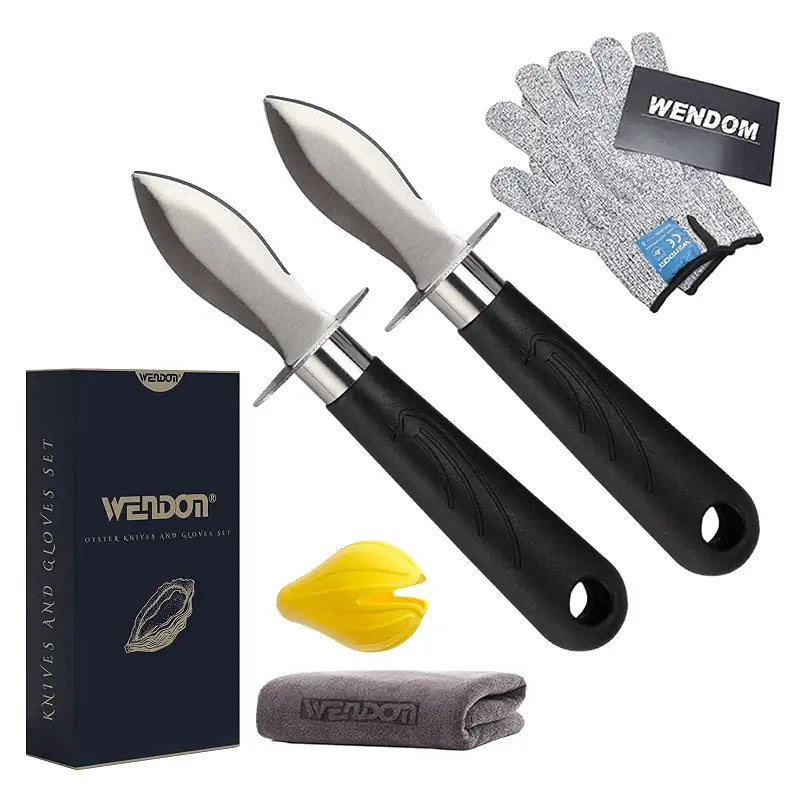
Ideal for: Beginner shuckers, casual oyster nights, gift-givers on a budget
The Wendom set appeals to cooks trying oyster shucking for the first time or handling occasional meals without dropping serious cash. The bundle logic is sound: two knives, a pair of cut-resistant gloves, a grip cloth, and a lemon squeezer all arrive together: which removes the friction of shopping for accessories separately. The silicone grip pattern on the handle does prevent slipping when hands get wet, and the 3CR13 stainless steel blade holds a decent edge for routine work.
Where this set falters is blade rigidity. Owners who work with tougher oyster shells report the knife begins to flex or bend under sustained pressure, which undercuts confidence and slows the job. The handle also runs narrow, limiting leverage when you need to apply rotational force to break the hinge. For occasional entertaining or first dates, the set delivers; for anyone processing larger quantities or expecting restaurant-grade durability, expect frustration.
Compared to the mechanical shucker designs in this lineup, the Wendom demands more wrist work and technique. If you're a beginner, watching a video first is essential, shucking isn't intuitive with a knife alone, and poor form compounds the blade-weakness issue. The lemon squeezer gets tossed by most owners; that accessory slot could have gone to a useful coconut opener or a better honing steel instead.
Pros
Complete kit includes gloves and grip cloth
Affordable entry into oyster shucking
Non-slip handle pattern aids wet-hand control
Two knives provide backup if one needs sharpening
Cons
Blade flexes under pressure on tough shells
Narrow handle limits torque and rotational power
Key features
Forged 3CR13 stainless-steel blade with concave-convex grip
Two full-size oyster knives per set for backup
Cut-resistant gloves rated Level 5 protection
Includes anti-slip cloth and lemon squeezer
Best for hand-shucking method with guided technique
#2 Pick
Best Mechanical Shucker
Zoameacy
Stainless Steel Oyster Shucker Tool,Portable Oyster Shucking Knife,Easy to Use Oyster Knife,Oyster Opener Machine for Home Use,Including Two Oyster Shucking Knife,a pair of Glove and one G-Clamp.
4.4(134)
Lever-action machine with adjustable height; requires finishing work and benefits from a quality knife upgrade.
Ideal for: High-volume entertainers, cooks with hand fatigue or arthritis, anyone serious about speed
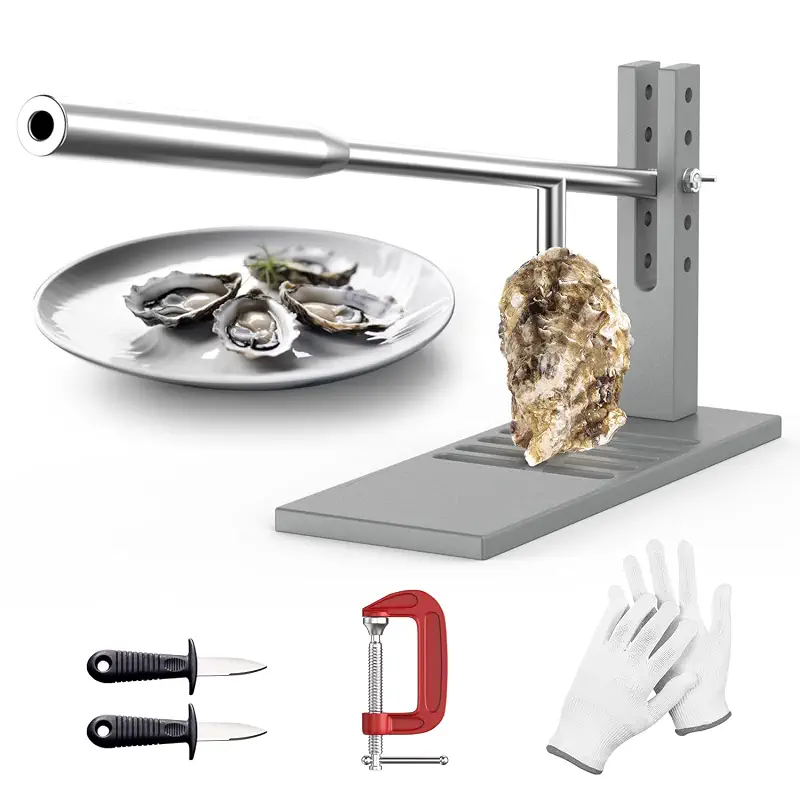
The Zoameacy takes the knife work out of the first critical move, puncturing the shell at the hinge. The five grooves in the aluminum base cradle the oyster securely, and the adjustable handle positions (four slots) let you dial in the right height for jumbo or small shells. Once you press the lever down, the pointed blade pops the hinge with force you'd struggle to generate by hand alone, especially if you have arthritis or weak grip strength. The stainless-steel components resist rust, and cleanup is straightforward.
The catch is that this machine opens the shell but doesn't remove the meat. You'll still need a proper oyster knife to sever the adductor muscle after the hinge gives. Most owners appreciate this trade-off because the hardest, most dangerous part of shucking (the blind force required to crack the shell) is handled by the tool. Owners processing 75 to 120 oysters in a session report dramatically faster work and less hand fatigue than knife-only methods.
Finish quality has minor issues. Some units arrive with chipped nickel plating on the point, and the aluminum base can have burrs that scratch counters if not filed smooth. The included knives are serviceable but not premium; many owners recommend investing in a separate, higher-quality oyster knife to pair with this machine. Against the Freudeere and ZeroPone models, the Zoameacy feels slightly less refined in assembly, though the core mechanism works reliably.
Pros
Lever action removes most dangerous opening step
Adjustable handle fits small and oversized oysters
Five grooves stabilize shells and prevent slipping
Aluminum and stainless construction resists corrosion
Cons
Requires finish work: may have burrs or chipped plating
Included knives are basic; upgrade recommended
Key features
Adjustable handle with four position slots for variable oyster sizes
Aluminum-alloy base with five stabilizing grooves
Pointed stainless-steel blade punctures hinge with mechanical force
Includes two oyster knives, cut-resistant gloves, and G-clamp
Designed for hinge-pop opening, leaving adductor muscle work to manual knife
#3 Pick
Premium Mechanical Classic
King Kooker
King Kooker 5500 Stainless Steel Oyster Opener, with Oyster Knife
4.4(681)
American-made, lever-style opener with robust wooden base; simple, proven design for high-volume shucking.
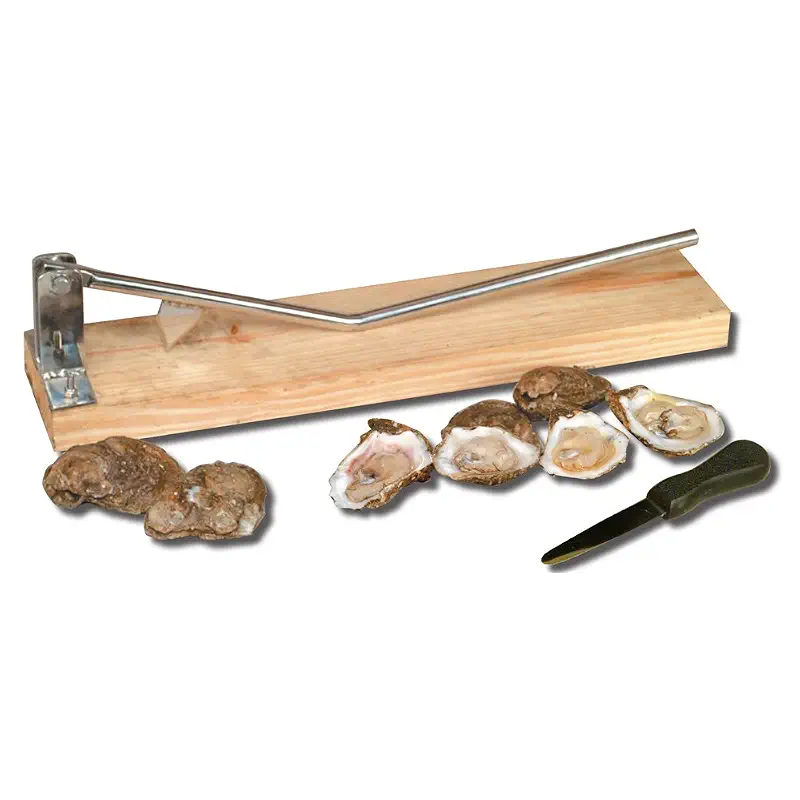
King Kooker's design is elegantly simple: a pointed blade mounted on a lever arm above a wooden board, with a straightforward 1/4-inch stainless bolt as the pivot. The oyster stands upright on the board with its hinge tip directly under the point; you pull the handle down, and the hinge pops. The included oyster knife is quality stainless steel, suitable for finishing work without needing an upgrade. Owners who process multiple bushels (we're talking 120+ oysters) consistently report this tool cut their shucking time in half compared to knife-only methods and, crucially, preserved most of the oyster liquor: the brine that makes eating them worth the effort.
The wooden base will eventually dent and wear as shells press into it; that's expected and the board is replaceable. The simple construction means almost zero maintenance: no springs, no suction cups, no grooves to jam with shell fragments. It's the kind of tool that works the same way for decades. Compared to adjustable-handle machines like the Freudeere, this one requires you to position the oyster correctly rather than adjusting the tool to fit different sizes. That's a trade-off: more technique-dependent, but fewer moving parts to fail.
The aesthetic also matters here: if you're setting up a proper oyster station at a catered event, this tool's established heritage and solid construction project competence and care in a way plastic-based or highly engineered options don't.
Pros
American-made with durable stainless-steel and wooden construction
Included oyster knife is high quality, no upgrade needed
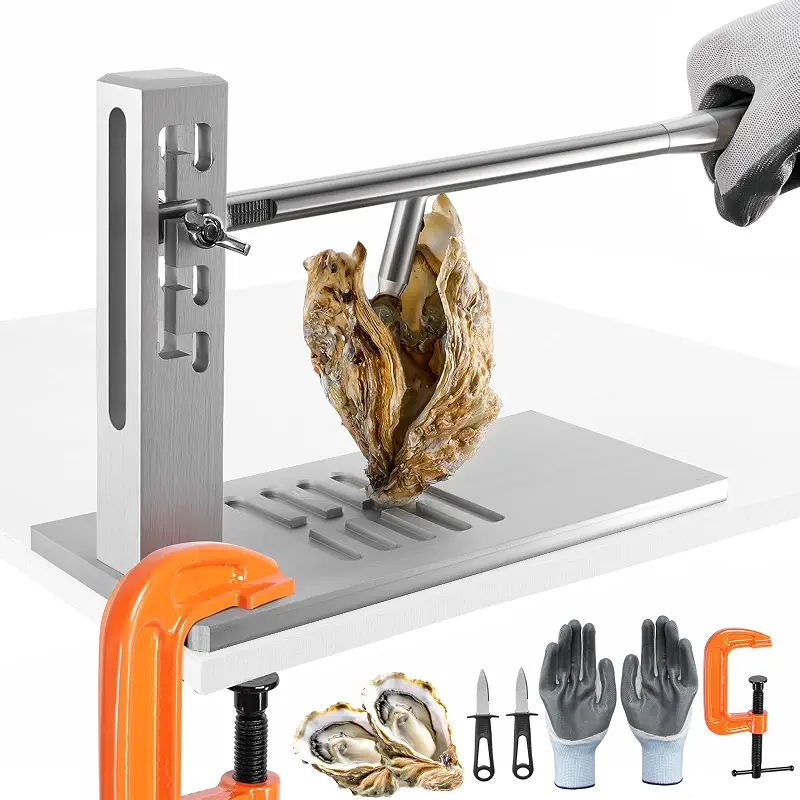
The Freudeere refines the mechanical shucker concept with careful attention to stability and ergonomics. Four adjustable height holes let you fine-tune for different oyster sizes without fumbling, the aluminum base sits solid and won't tip, and the suction cups clamp firmly to any table surface. The five grooves on the base cradle the shell securely, and the stainless-steel handle and blade are reinforced for repeated impacts. Most critically, owners report losing minimal liquor: if you ease the handle down rather than hammer it, the oyster opens gently and retains its brine.
Setup requires assembly but nothing complicated; instructions are visual and parts fit snugly. The G-clip adds a secondary locking point if your table surface doesn't grip the suction cups perfectly. What elevates this above the Zoameacy is execution: the finish quality is cleaner, and owners receive fewer reports of chipped plating or burrs. The trade-off is that this tool, like all lever machines, requires you to finish the opening with a knife; the included knives are serviceable but not premium, so upgrading to a proper oyster knife is still recommended for the final step.
Compared to the King Kooker's wooden simplicity, this machine trades some aesthetic charm for modern convenience and height adjustment: valuable if you're shucking mixed-size oyster batches and don't want to reposition constantly. For folks who like engineering that works invisibly, this ranks highest.
Pros
Four adjustable height positions fit small and oversized oysters
Suction cups and G-clip secure tool firmly to any table
Aluminum-alloy base is durable and won't dent like wood
Refined finish quality with minimal defects reported
Cons
Included knives are basic; a quality oyster knife improves results
More moving parts mean more potential assembly points
Key features
Four adjustable handle positions for variable oyster sizing
Aluminum-alloy base with five non-slip grooves
Suction cups and G-clip for secure table mounting
Stainless-steel handle and blade, reinforced for repeated use
Complete kit includes two oyster knives, cut-resistant gloves, G-clip
#5 Pick
Best Multi-Function Shucker
ZeroPone
ZeroPone Oyster Clam Opener Machine Adjustable Oyster Shucker Tool Set | Includes Knives, Glove and G-Clip, Seafood Tools for Hotel Family Buffet
4.2(376)
Five-position adjustable lever with four suction cups; versatile for both oysters and clams.
Ideal for: Bulk entertainers, seafood buffets, anyone processing both oysters and clams
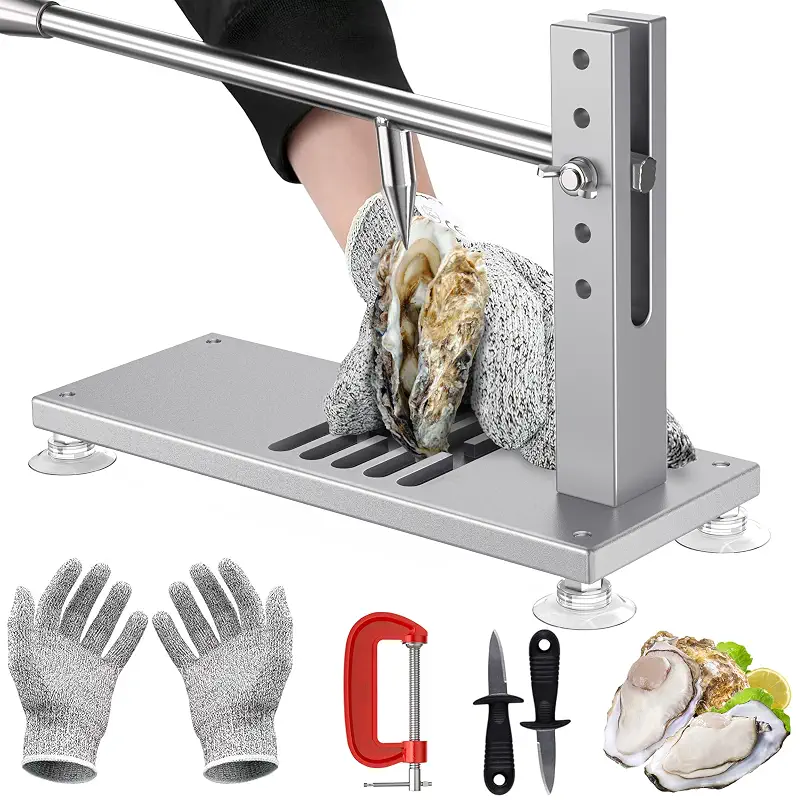
ZeroPone positions this tool as dual-purpose, designed for oysters and clams alike. The five adjustable positions (compared to four on the Freudeere) offer slightly finer granularity for size increments, and the four suction cups provide more contact points for securing to the table than some competitors. The aluminum base resists corrosion and won't warp, and the extended handle increases leverage, which owners appreciate when working through large batches. The anti-slip groove design on the base prevents shells from shifting mid-puncture, a critical safety feature that reduces hand-injury risk.
Owners report mixed assembly quality: one reviewer received a unit with silver paint peeling off the drive point, suggesting a coating issue rather than true stainless steel. That's a finish defect but not a functional failure; the blade still works, though it raises questions about long-term durability. Performance-wise, owners who process 75+ shells in one session consistently praise the tool for speed and safety; the included knives are basic, so a separate quality oyster knife upgrades the finished product significantly. Some find the adjustment requirement tedious if oysters vary widely in size, though once dialed in for a batch, work moves fast.
Against the Freudeere's four positions, the extra adjustment slot is marginal; the real differentiation is brand support and cosmetic finish. ZeroPone's clam-friendly marketing may appeal if you do dual-species seafood prep, but for oysters alone, the Freudeere and King Kooker deliver similar or better value.
Pros
Five adjustable positions provide fine-tuned height control
Four suction cups distribute pressure for maximum table stability
Aluminum construction resists corrosion and warping
Extended handle increases leverage and reduces hand fatigue
Cons
Finish quality inconsistent; some units arrive with paint peeling
Included knives are basic; professional knife upgrade recommended
Key features
Five adjustable handle positions for precise oyster and clam sizing
Four suction cups and G-clip for reinforced table mounting
Aluminum-alloy base with five non-slip grooves
Extended stainless-steel handle for improved leverage
Dual-purpose design works for oysters, clams, and other bivalves
How to Choose an Oyster Opener
Four trade-offs that actually matter when matching a oyster opener to your kitchen.
Hand Tool vs. Mechanical Shucker
The oyster knife versus machine comparison shapes nearly every decision here. Hand-shucked oysters require technique, wrist strength, and confidence with a sharp blade: steep learning curves for beginners. Mechanical shuckers (lever machines with suction-cup bases) handle the hardest, most dangerous part: cracking the shell. You still finish with a knife, but the heavy work is done. For occasional meals, a quality knife set works; for entertaining crowds or regular high-volume batches, a mechanical shucker saves hands and time. Beginners almost always regret starting with a knife-only approach.
Size Adjustment and Oyster Variety
Oysters range from tiny cocktail-size (sometimes called petites) to massive jumbo shells. Hand knives adapt easily: just different wrist angles. Mechanical shuckers need height adjustment. If you buy from a single supplier or stick to consistent sizes, a fixed design (like the King Kooker) works fine. If oysters vary widely in a single batch (common at farmers markets or when shucking multiple suppliers) adjustable machines with four or five position slots minimize repositioning. The extra adjustment points matter less if all your oysters are similar size but become invaluable for mixed batches.
Speed and Volume Considerations
Hand shucking one or two dozen oysters takes patience but is manageable; processing 75+ in an afternoon demands a mechanical advantage. Owners consistently report mechanical shuckers cut opening time in half. If you're hosting an oyster roast, catering a rehearsal dinner, or running a restaurant prep kitchen, a lever machine paired with a quality finishing knife is non-negotiable. For intimate dinners or occasional entertaining, the hand-knife sets save counter space and work adequately with practice.
Material Quality and Durability
Stainless steel blades resist rust and hold an edge longer than cheaper alternatives. Aluminum-alloy bases on mechanical shuckers are lighter and corrosion-resistant but will show dents from shell impacts over time (expected wear, not failure). Wooden bases on traditional designs develop character and are easily replaced. Pay attention to finish quality: some units arrive with chipped plating or burrs that require light filing. For long-term use, simpler designs with fewer moving parts (like the King Kooker) tend to outlast complex adjustable machines with springs or multiple components.
Hand Safety and Protection Gear
Oyster shucking is inherently sharp and can cause nasty cuts. Level 5 cut-resistant gloves come in most kits: they work, but fit varies and many cooks find thinner, higher-quality gloves more comfortable for dexterous work. Mechanical shuckers reduce hand risk by removing the blind-force step; your hands stay further from the blade. With hand knives, technique and steady grip matter more. The grooved or sloped surfaces on mechanical-shucker bases prevent shells from rotating unexpectedly, a critical safety feature that hand tools can't provide.
Frequently asked
Quick answers to the questions readers ask most.
Do I lose oyster liquor when using a mechanical shucker?
Minimal loss if you control the downward motion. Owners report that easing the handle down rather than hammering it preserves most of the brine: sometimes less than hand-shucking methods. The oyster opens when the hinge breaks, not from violent impact. Use a shallow bowl or sheet pan under the tool to catch any drips and contain shell fragments.
What's the difference between a pointed and straight-blade oyster knife?
Pointed blades wedge into the hinge area and work well for mechanical shuckers' finishing step. Straight blades are better for hand-shucking because they slide along the shell interior to sever the adductor muscle cleanly. Most sets include pointed designs; if you do manual shucking, a separate straight-blade knife from a quality cutlery brand serves you better than bundled knives.
Can a mechanical shucker handle all oyster sizes?
Adjustable machines with four or five position slots accommodate small to jumbo oysters. Fixed-height designs (like the King Kooker) work best when oysters are consistent size; you reposition the oyster on the board rather than adjust the tool. If you buy from mixed sources or prefer variety, an adjustable model saves frustration.
How often do oyster knife blades need sharpening?
Quality stainless-steel blades hold an edge for dozens of shucking sessions. After 50+ oysters, you may notice the blade working harder. A ceramic rod or honing steel maintains sharpness between uses. Budget oyster knives from starter kits dull faster and may not sharpen effectively, which is why many owners upgrade to a professional-grade knife even if the bundled set works initially.
Are suction cups and G-clamps necessary on a mechanical shucker?
Suction cups anchor the tool to the table so your hands stay free for positioning oysters and using the finishing knife. Without them, the shucker can shift or tip during use, creating safety risks. G-clamps add backup locking, valuable if your table surface doesn't grip suction cups well (glass, marble, or heavily waxed wood). Both are practical safety features rather than luxuries.