Kitchen & Dining · Cookware
Best Miyabi Chef Knife: Top 8-Inch Models for Home Cooks
Find the best Miyabi chef knife for your kitchen. Compare Kaizen II, Koh, Birchwood, and Artisan models handcrafted in Seki, Japan with hand-honed blades.
Affiliate disclosure: As an Amazon Associate I earn from qualifying purchases.
At a glance
2
Best for Hybrid StyleMiyabi
3
Best Damascus PatternMiyabi
4
Premium Investment PickMiyabi
5
Best for Precision WorkMiyabi
Detailed reviews
The Kaizen II represents Miyabi's refinement of their core formula. The FC61 steel core delivers the 61 Rockwell hardness that underpins edge retention without becoming so hard that the blade turns brittle. Buyers consistently praise the out-of-box sharpness and the way the knife handles both rocking cuts and precise slicing, which suggests the hand-honed 9.5- to 12-degree edge genuinely works across cutting styles. The black pakkawood handle feels warm to the touch and offers real grip texture, a detail that matters during longer prep sessions.
What makes this knife land at the top is the return on investment. Owners report that the Kaizen II feels closer to knives at much higher prices, and a five-year owner noted it has become the go-to blade in their kitchen. The 48-layer Damascus cladding isn't just visual; it locks in corrosion resistance, so the knife can handle acidic foods (like tomatoes or citrus) without the fussiness demanded by carbon-steel purists. The FRIODUR ice-hardening process translates into edge retention that outlasts many mid-range competitors.
The only substantive caveat is that one buyer reported the knife wasn't sharp out of the box. Top gyuto performance, as best gyuto guides confirm, depends on a pinch grip and gentle rocking motion rather than aggressive downward chopping, and the Kaizen II is no exception. This isn't a flaw, but it does require knowing how to use the knife properly.
Pros
- Razor-sharp edge that glides through delicate and tough cuts
- Exceptional edge retention over months of regular use
- Balanced weight feels natural in hand, reduces fatigue
Cons
- Requires hand-washing and careful drying to prevent spotting
- Not designed for chopping through bone or frozen items
Key features (5)
- FC61 super steel core with 48-layer Damascus cladding for durability
- Hand-honed to 9.5–12 degrees using the Honbazuke method
- Double FRIODUR ice-hardened blade for corrosion resistance
- Ergonomic D-shaped black pakkawood handle with mosaic pin
- Handcrafted in Seki, Japan
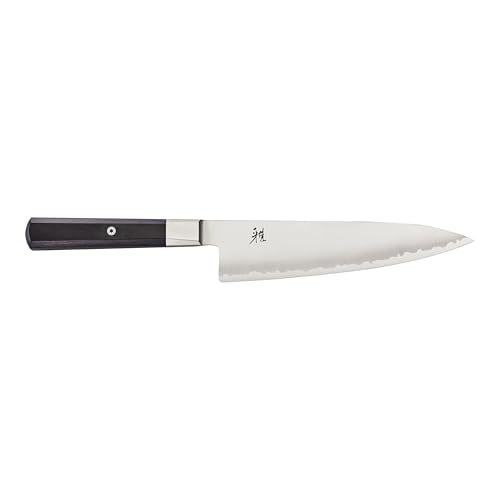
The Koh strips away the decorative Damascus pattern and lands on understated elegance. Its octagon-shaped pakkawood handle and mirror-polished blade with sandblasted katana edge feel purposeful rather than ornamental. What sets it apart is the geometry: the rounded spine and heel are finished to perfection, making it comfortable for Western-style chopping motions while the thin blade profile still delivers the slicing capability of a Japanese knife.
Owners describe this as the entry point for people accustomed to German or French knives who want to experience Japanese sharpness without abandoning the ergonomics they know. One chef with a decade of experience and a collection of premium blades called it "exceptional" and noted the blade was perfectly straight with confident geometry. Another experienced reviewer appreciated that it performs well across rocker chopping, mincing, and dicing without demanding a specific grip technique. The FC61 steel (61 Rockwell) and FRIODURx2 ice-hardening offer the same durability as the Kaizen II.
The trade-off is that quality control has been inconsistent. A few buyers received blades with asymmetric bolster transitions or slight warping, which was frustrating at this price tier. The sandblasted finish, while elegant, can show scratches more visibly than polished or damascene blades. If symmetry and perfect straightness matter to you, this is worth considering; if you're less sensitive to cosmetic variation, the Koh's value proposition is genuinely strong.
Pros
- Symmetrical octagon handle works ambidextrous for either hand
- Rounded spine and heel comfortable for extended cutting sessions
- Lightweight design reduces hand and wrist fatigue
Cons
- Quality control sometimes inconsistent with blade centering and straightness
- Sandblasted finish shows scratches more visibly than other Miyabi models
Key features (5)
- FC61 fine carbide stainless steel at 61 Rockwell hardness
- FRIODURx2 ice-hardened for exceptional durability and edge retention
- Mirror-polished blade with sandblasted katana edge detail
- Octagon-shaped pakkawood handle, ambidextrous design
- Hand-honed using the Honbazuke method to 9.5–12 degrees
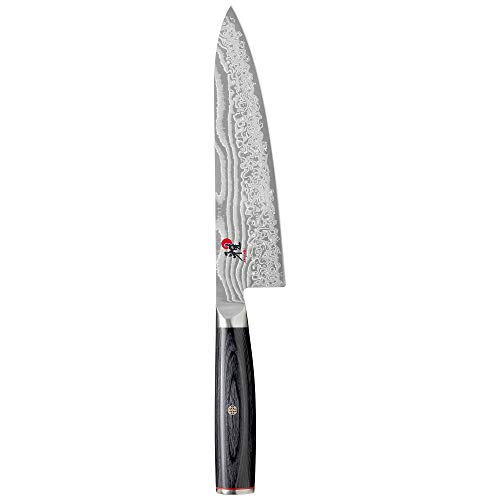
The original Kaizen is where Miyabi's reputation was forged. The 64-layer flower Damascus pattern isn't decoration; it's functional cladding that adds durability and elegance in equal measure. The VG10 super steel core, ice-hardened to Rockwell 60, strikes a different balance than the FC61 found in newer models. VG10 is slightly more forgiving on hardness (60 vs 61), which can translate to easier maintenance for home cooks who sharpen their own blades.
Owners consistently highlight three things: the blade arrives razor-sharp, it stays that way through extensive use, and the hand feel is almost meditative. A professional chef mentioned that after a decade in kitchens, this knife "fits great in my hand" and performs flawlessly across all standard cuts. The black Micarta handle (linen pattern with red spacers) resists moisture better than wood, which matters if you're less religious about drying immediately after washing. The perfectly balanced D-shape rests comfortably even during longer prep work.
The visual appeal is real, but it comes with one practical consideration: the blade's aesthetic thinness and the relatively steep 9.5- to 12-degree edge mean this knife does best with controlled, precise technique rather than aggressive pushing. Buyers are told not to use it for bone work or frozen items. If you understand that constraint and want a knife that feels like a hybrid of art and tool, the original Kaizen delivers. Compared to the Kaizen II, this one trades the newer FC61 steel for VG10 and Micarta for pakkawood; for many cooks, that's worth the trade.
Pros
- 64-layer Damascus cladding combines durability with striking aesthetics
- VG10 steel easier to sharpen than higher-hardness alloys for home maintenance
- Moisture-resistant Micarta handle won't swell or absorb stains
Cons
- Thin, hard blade requires careful technique to avoid edge chipping
- Best results with whetstones; steel honing rods can damage the edge
Key features (5)
- VG10 super steel core protected by 64-layer flower Damascus pattern
- CRYODUR ice-hardened blade at Rockwell 60 for sharpness and durability
- Hand-honed using three-step Honbazuke process to 9.5–12 degrees
- Black Micarta D-shaped handle with red spacer accents and steel end cap
- Handcrafted in Seki, Japan
The Birchwood represents Miyabi's top tier. SG2 micro-carbide powder steel is fundamentally different from stainless or semi-stainless alloys; it's harder, finer-grained, and holds an edge that feels almost impossibly thin. Buyers describe cutting wet cloth with zero pressure, slicing through meat and vegetables with no resistance, and feeling the blade bite into everything from delicate herbs to tougher roots. The cladding isn't just cosmetic excess; it's a practical strategy to protect a harder core from chipping while maintaining edge geometry.
The Karelian birch handle is where this knife becomes a luxury object. This wood was prized enough to appear in Faberge eggs; it's light, gorgeously grained, and feels warm in hand. The finish is polished to a silky texture that balances grip security with tactile beauty. Owners report that the knife feels perfectly balanced at the bolster and is genuinely a pleasure to use, even after extended prep work.
The catch is that SG2 powder steel demands respect. It's more brittle than stainless at the same edge angle, so it will not tolerate heavy downward chopping, bone cutting, or aggressive twisting. One buyer mentioned that forcing the blade can cause it to snap. This is not a weakness of the Birchwood; it's the price of that extraordinary sharpness. If your cutting technique is solid and you understand that you're buying a knife for vegetables, fruits, fish, and tender proteins, this is transformational. For cooks who also work with specialized blades like the best yanagiba knives for sashimi prep, the Birchwood complements that toolkit beautifully as the all-purpose slicer.
Pros
- SG2 micro-carbide powder steel holds scalpel-like edge for extended periods
- Karelian birch handle is both functional and a true luxury material
- Perfect balance at bolster reduces fatigue during meticulous work
Cons
- SG2 steel more brittle than stainless; requires careful technique and no chopping bone
- Light-colored birch handle can stain from acidic foods or raw meat residue
Key features (5)
- SG2 micro-carbide powder steel core with flower Damascus cladding
- CRYODUR ice-hardened for exceptional sharpness and cutting precision
- Karelian (Masur) birch handle, a prized material known for beauty and durability
- Hand-honed to 9.5–12 degrees using three-step Honbazuke process
- Handcrafted in Seki, Japan; arrives in premium gift box
The Artisan combines SG2 powder steel with a completely different aesthetic direction. The Tsuchime (hand-hammered) finish is both functional and beautiful: the subtle texture reduces food sticking during fine slicing, while visually it reads as understated craftsmanship rather than flashy damascene patterns. The Cocobolo rosewood pakkawood handle is richer in color than the pale birch of the Birchwood, with brass and red spacers that add visual interest without overdoing it.
Owners praise the edge retention relentlessly. One buyer noted that after 6 days of heavy use (3-5 hours daily), the Artisan showed no sign of dulling, while a similarly priced German steel knife required resharpening after the same period. Another chef described the 70/30 edge geometry (favoring one side slightly) as ideal for precision work and noted that dense produce like squash requires finesse rather than force, which actually keeps the blade safer. The D-shaped handle nestles comfortably in hand for long sessions.
The caveat is that this knife, like the Birchwood, demands respect for its hardness. Dense, thick vegetables or any chopping against the blade's orientation will cause the edge to veer sideways and create friction that can stress the steel. This isn't poor design; it's the nature of SG2 at this edge angle. Compared to the miyabi steel composition guide, the Artisan's 9- to 12-degree edge and SG2 core position it as a precision instrument rather than a workhorse. If you do fine vegetable prep and understand the technique, the edge retention and cutting experience are extraordinary.
Pros
- Exceptional edge retention; cuts as cleanly on day six as day one
- Tsuchime hand-hammered finish reduces food sticking during fine slicing
- 70/30 edge profile optimized for precision cuts rather than aggressive chopping
Cons
- SG2 steel brittle when forced; requires proper technique and never bone or dense vegetable chopping
- Hand-hammered finish can collect debris in texture if not cleaned carefully
Key features (5)
- SG2 micro-carbide powder steel core with Tsuchime (hand-hammered) finish
- Layered steel cladding for durability without sacrificing edge sharpness
- Cocobolo rosewood pakkawood handle with brass and red spacer details
- Hand-honed to 9.5–12 degrees using three-step Honbazuke process
- Handcrafted in Seki, Japan; includes mosaic pin and steel end cap
How to Choose Your Miyabi Chef Knife
Understand Your Steel: Stainless, Semi-Stainless, and Powder Steel
Miyabi's lineup spans three steel philosophies. The FC61 alloy in the Kaizen II and Koh is stainless and forgiving, holding an excellent edge while tolerating minor lapses in technique. VG10 in the original Kaizen sits in the middle, offering good edge retention and slightly easier home sharpening. SG2 powder steel in the Birchwood and Artisan achieves extraordinary sharpness but demands more careful use and sharper technique. The miyabi steel composition guide walks through these differences and when each makes sense. For most home cooks starting their first premium knife, FC61 is the sweet spot.
Edge Angle and Cutting Technique Matter
All Miyabi chef knives feature a 9.5- to 12-degree edge angle, which is much sharper than Western chef knives but also more delicate. This edge geometry excels at slicing and precision work with a pinch grip and gentle rocking motion. It does not tolerate heavy downward chopping or aggressive twisting. If your knife skills are still developing or you're accustomed to forcing a blade through dense vegetables, the learning curve exists. Conversely, if you already use Japanese knives or have trained in proper technique, you'll immediately appreciate the cutting experience.
Aesthetics, Handle Material, and Maintenance
Miyabi offers striking visual options: damascene patterns (Kaizen, Birchwood), hand-hammered finishes (Artisan), or clean, modern designs (Koh). Beyond looks, handle material affects daily care. Pakkawood is moisture-resistant and low-maintenance. Micarta (original Kaizen) is similarly durable. Karelian birch (Birchwood) is gorgeous but can stain from acidic foods and requires mineral oil conditioning. All Miyabi knives are hand-wash only; dishwashers will damage the blade and handle. This is non-negotiable for knives at this caliber.
Fit Your Budget and Cutting Ambitions
The miyabi model comparison helps you decide between models at different price points. Entry-level seekers should start with the Kaizen II or Koh; both deliver professional-grade sharpness without the brittleness or high maintenance of powder-steel alloys. Mid-tier buyers who sharpen at home often gravitate toward the original Kaizen for its VG10 steel and visual appeal. Premium buyers and experienced cooks who prioritize edge sharpness and can commit to careful technique find the Birchwood or Artisan transformational. There is no wrong choice, only the one that matches your skills, kitchen habits, and values.
Our picks at a glance
2
Best for Hybrid StyleMiyabi
3
Best Damascus PatternMiyabi
4
Premium Investment PickMiyabi
5
Best for Precision WorkMiyabi
Frequently asked
Do Miyabi knives require whetstone sharpening, or can I use a steel honing rod?
Miyabi knives can be maintained with a ceramic honing rod between sharpenings, but the hardness of FC61, VG10, and especially SG2 steel means a traditional steel rod may damage the edge over time. A whetstone is the proper tool for actual sharpening. Most owners send their knives to professional sharpeners annually or learn to use a 1000- to 4000-grit whetstone. The payoff is that these blades hold their edge far longer than typical kitchen knives, so sharpening is infrequent.
Is the Damascus or hand-hammered pattern purely decorative, or does it serve a function?
The layered cladding is both functional and beautiful. It adds durability by surrounding the hard core steel with slightly more forgiving material, reducing the risk of chipping. The hand-hammered Tsuchime finish on the Artisan actually reduces food sticking during slicing, improving cutting performance. So while the aesthetics matter, the patterns exist for real reasons.
Can I use a Miyabi knife to chop through bone or frozen vegetables?
No. The thin edge angle and hard steel (especially SG2) are optimized for slicing soft to moderately dense items like vegetables, fruits, fish, and tender proteins. Chopping against the blade's spine or forcing it through bone or frozen foods will either chip the edge or, in extreme cases with SG2, crack the blade. Use a dedicated butcher's knife for bone work.
How do I care for the handle if it's wood or Micarta?
Hand-wash with mild detergent and dry immediately. For Karelian birch handles, occasional conditioning with food-grade mineral oil keeps the wood nourished and restores color. Avoid prolonged soaking and never expose wood handles to a dishwasher. Pakkawood and Micarta are more resistant to moisture but still require the same hand-wash approach for longevity.
What's the difference between the Kaizen II and the original Kaizen?
The Kaizen II uses the newer FC61 steel and pakkawood handle, making it more forgiving and lower-maintenance. The original Kaizen uses VG10 steel (slightly easier to sharpen at home) and Micarta (more moisture-resistant than pakkawood). Both are excellent; the Kaizen II is the safer choice for first-time buyers, while the original appeals to cooks who sharpen regularly and want a handle that won't require ongoing conditioning.