Best Knives for Cutting Brisket: Expert Picks for Clean Slices
Find the best brisket slicing knives for clean, professional cuts. Compare top-rated carving knives, sets, and specialty meat cutters for BBQ and holiday cooking.
Verdict, analysis, and key features for each pick.
#1 Pick
Best Overall
Cutluxe
Cutluxe Brisket Knife, 12" Carving & Slicing Knife for Meat & BBQ | Razor Sharp German Steel, Full Tang Ergonomic Handle, Sheath Included – Grilling Gift for Men
4.8(7,433)
A razor-sharp German steel workhorse that delivers restaurant-quality slices at a fair price, backed by lifetime warranty.
Ideal for: Home cooks, BBQ enthusiasts, and holiday carvers seeking one versatile 12-inch slicing blade.
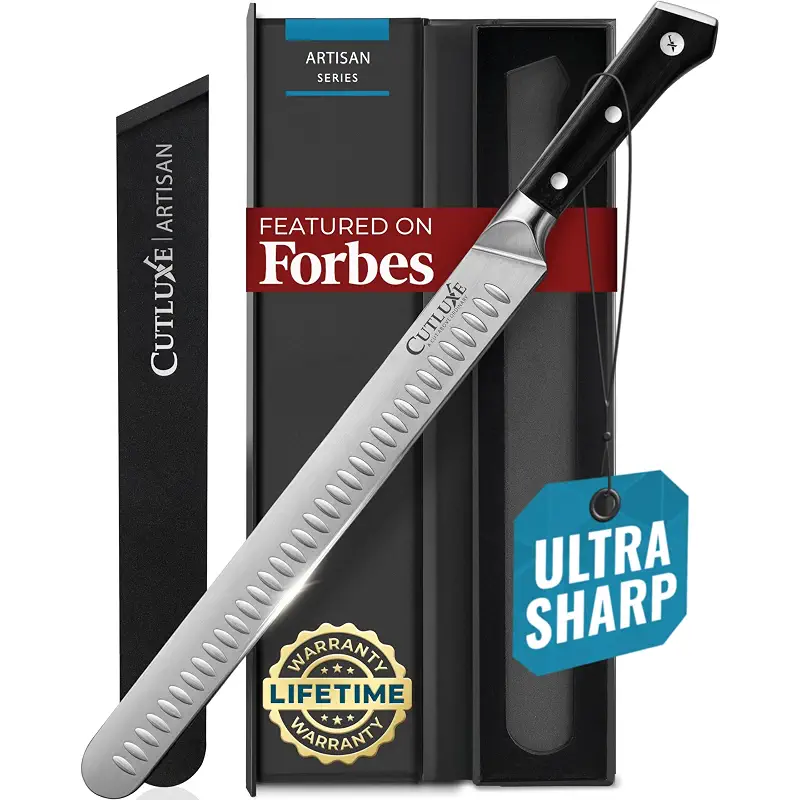
The Cutluxe Brisket Knife sets the standard for single-knife versatility. At 12 inches with a 56+ Rockwell hardness rating, the blade glides through brisket, turkey, roasts, and ribs with almost no resistance, and owners consistently praise the clean cuts and lack of tearing. The full-tang construction and triple-riveted pakkawood handle provide the stability needed for long carving sessions, while the Granton edge (those shallow dimples along the blade) reduces friction and prevents meat from sticking to the side. Hand sharpening at 14-16 degrees per side is aggressive enough to bite through fat and sinew on the first stroke.
The ergonomic handle design distributes pressure evenly across your palm and fingers, a detail that becomes critical when you're slicing through a 15-pound brisket. Most owners report the knife maintains its edge through multiple uses before needing maintenance, and the high-carbon German steel responds well to honing on a whetstone. One lingering note from reviewers: the included sheath has occasional quality issues (inner material detaching), though the knife itself carries full lifetime protection.
If you're buying a single carving knife and want professional performance without breaking the bank, this is the right call. It's long enough to make single-pass cuts through large meats, balanced enough to control precisely, and sharp enough to justify the investment. Hand-wash only to preserve the edge.
Pros
Razor-sharp Granton blade glides through meat with minimal resistance
Full-tang construction with ergonomic handle for extended comfort and control
56+ Rockwell hardness maintains edge retention through repeated use
Lifetime warranty covers material and workmanship defects
Cons
Included sheath has reported durability issues with inner material detachment
12-inch length requires storage space and learning curve for new users
Key features
12-inch German steel blade hand-sharpened to 14–16 degrees per side
Full-tang construction with triple-riveted pakkawood handle for stability
Granton edge reduces friction and prevents meat sticking during slicing
56+ Rockwell hardness resists dullness; responds well to honing on whetstone
Includes protective sheath; lifetime warranty against defects
#2 Pick
Best Versatile Set
Cutluxe
Cutluxe Carving Knife Set, Brisket Slicing & Boning Knife for Meat & BBQ | Razor Sharp German Steel, Full Tang Ergonomic Handle – Grilling Gift for Men, Artisan Series
4.8(1,524)
Two-knife set combining a 12-inch slicer and 6-inch boning knife, offering complete coverage from breakdown to carving.
Ideal for: Cooks who need both a slicer and boning knife for comprehensive meat prep and don't want to buy them separately.
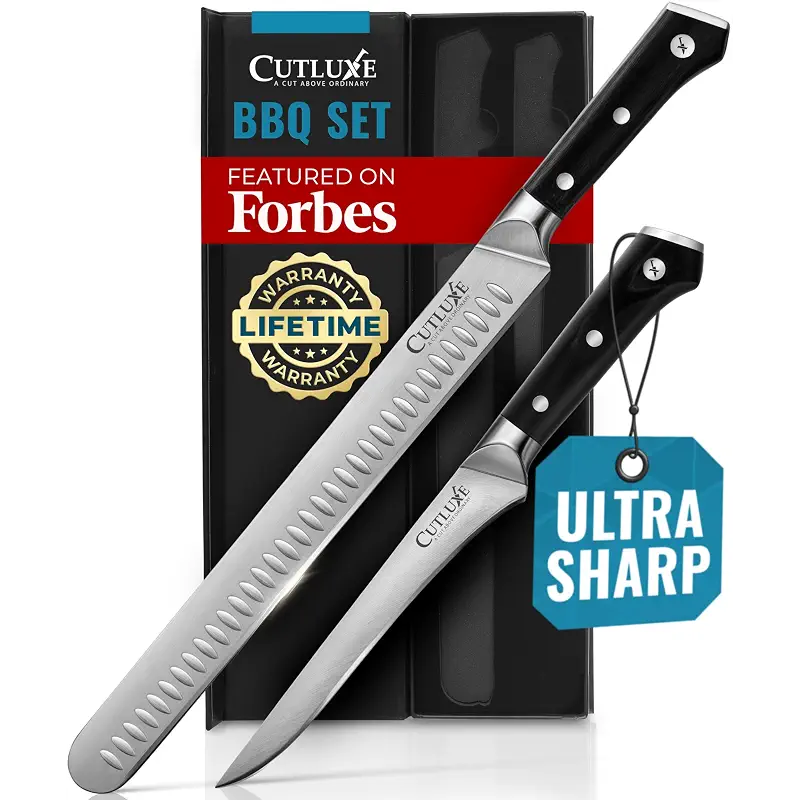
This Cutluxe set gives you both a carving specialist and a trimming tool in one purchase. The 12-inch slicing knife matches the single-knife option in sharpness and blade geometry, but here you also get a 6-inch boning knife with the same Granton edge and German steel construction. That second knife is the key difference: it lets you debone a chicken thigh, trim fat from a brisket before cooking, or separate meat from bone on ribs without dulling your slicing blade on bone edges. Owners who've bought multiple Cutluxe sets note consistent quality across the line and say the boning knife earns its place in regular rotation.
The set arrives in a velvet-lined box, which looks elegant for gift-giving but also serves as safe storage if you don't have dedicated knife block space. Both handles are ergonomic and full-tang, so the smaller knife still feels substantial and controlled, even in smaller hands. Compared to the Syokami set below, this option leans more toward straightforward German steel reliability and less toward decorative handle aesthetics; the trade-off is that you get proven edge retention and a simpler maintenance story.
Buyers consistently mention the value relative to comparable sets at specialty retailers. If you already own a chef's knife and want to add the two tools that matter most for meat work, this set is the smarter buy than a three-piece alternative that includes a utility knife you might not use.
Pros
Both knives feature Granton edge and 56+ Rockwell German steel for consistency
6-inch boning knife handles trimming and deboning without dulling slicer
Premium velvet-lined gift box and storage; lifetime warranty on both blades
Owners report high quality across repeat Cutluxe purchases
Cons
12-inch length requires cleared counter space during carving
Set price higher than single knife, though value is solid per blade
Key features
12-inch carving knife and 6-inch boning knife in matched set
Granton edge on both blades reduces drag and prevents sticking
Full-tang ergonomic handles on both knives for control and comfort
High-carbon German steel; 56+ Rockwell hardness for edge retention
Velvet-lined presentation box; lifetime warranty on both blades
#3 Pick
Best for Aesthetics and Japanese Steel
Syokami
SYOKAMI Brisket Slicing Knife Set, Carving & Boning Knife for Meat & Turkey | Japanese Style High Carbon Steel Kitchen Knives Set for Home & BBQ, Wenge Wood Ergonomic Full Tang Handle, Ideal for Gift
4.7(700)
High-carbon Japanese steel set with striking wenge wood handles and excellent balance, ideal for cooks who value beauty alongside performance.
Ideal for: Cooks who value hand-tool craftsmanship, prefer Japanese steel geometry, and want knives that double as kitchen display pieces.
The Syokami set stands out visually and delivers solid cutting performance, though with a different steel philosophy than the German options above. The high-carbon steel (56+ Rockwell) is engineered at 13–15 degrees per side, a slightly steeper angle than the Cutluxe knives, which means a hair more durability if you're rough on edges but potentially a touch less aggressive bite on the first stroke. The 12-inch slicing knife includes hollow dimples for drag reduction, and the 6.7-inch boning knife is genuinely flexible, bending slightly to follow bone contours without snapping.
What sets this apart is the wenge wood handle. African wenge is dense, naturally absorbs hand moisture to maintain grip, and develops a richer patina over time if oiled periodically. The gear-tooth texture molded into the handle provides non-slip security even when wet, and the weight distribution between blade and handle leans toward a more forward-balanced profile preferred by some butchers and chefs. If you display your knives on a magnetic rack or prefer a statement piece in the kitchen, the Damascus-patterned steel (reviewers note it's decorative rather than functional layering) appeals differently than brushed German stainless.
One buyer caveat worth noting: the 12-inch blade has a slight curvature along its length, which makes it function partially like a Chinese cleaver and works beautifully for a rocking mincing motion, but if you prefer a flat slicer that sits flush against the cutting board, the Cutluxe above handles that style more intuitively. The Japanese steel also sharpens faster on a whetstone than German equivalents, which is a plus if you actively hone rather than defer to a professional. Where the Cutluxe set focuses on straightforward reliability, this one rewards cooks who engage with their tools.
Pros
Dense wenge wood handle maintains grip when wet; develops character over time
Japanese high-carbon steel sharpens quickly on whetstones for active maintenance
Hollow dimples on slicer and flexible boning knife for different cutting tasks
Full-tang construction with gear-tooth texture for secure non-slip grip
Cons
Slight curvature on slicer blade requires adjustment if you prefer flat contact with board
Damascus-patterned appearance is decorative; some prefer simpler aesthetics
Key features
12-inch slicing knife and 6.7-inch flexible boning knife with hollow dimples
Japanese high-carbon steel forged to 13–15 degrees for sharp edge retention
Full-tang construction with FSC-certified wenge wood handles and gear-grip texture
Forward-balanced profile favors rocking motion for mincing and detailed prep
High-quality gift box packaging; ideal for kitchen display and daily use
#4 Pick
Best Three-Piece Set
Hoshanho
HOSHANHO Carving Knife Set 3PCS, Japanese Brisket Slicing Knife Sets | Ultra Sharp Japanese High Carbon Steel Butcher Knife Breaking Knife Boning Knife for Meat Cutting, Ergonomic Handle, Gifts
4.6(225)
Comprehensive three-knife set with Japanese high-carbon steel, offering 12-inch, 10-inch, and 7-inch blades for every meat-cutting scenario.
Ideal for: Cooks seeking a complete set covering carving, breakdown, and detail work, with experience managing multiple knives.
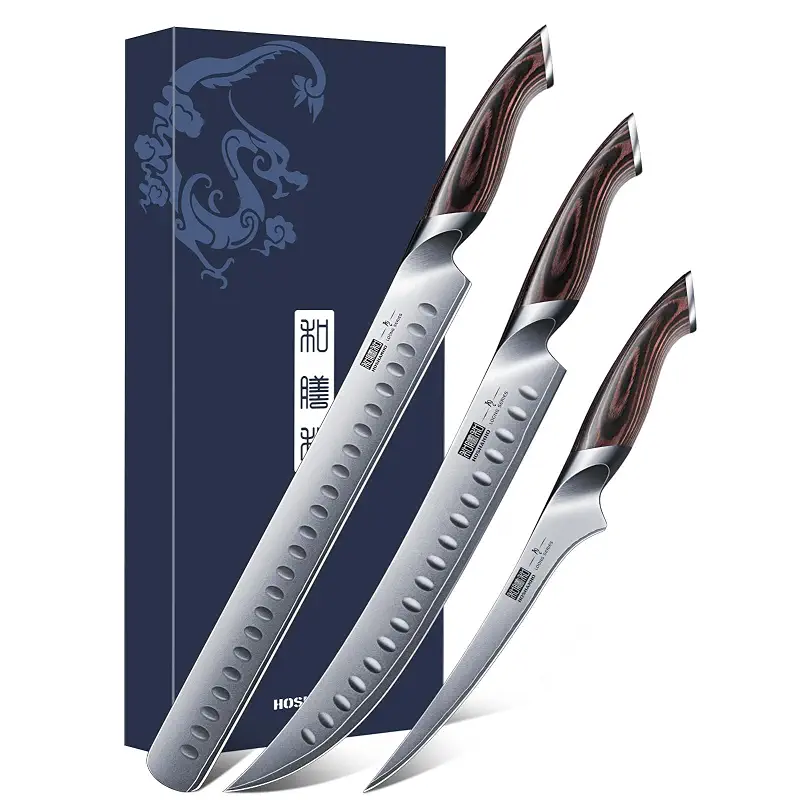
The Hoshanho set is the most complete option if you want all the tools in one purchase and don't mind managing three blades instead of two. The 12-inch carving knife handles the primary slicing job, but the 10-inch brisket knife fills an interesting middle ground: shorter than the main slicer yet longer than a boning knife, useful if you're trimming a brisket before cooking or breaking down a shoulder roast into more manageable chunks. The 7-inch fillet knife rounds out the trio for smaller, more detailed work on ribs or poultry.
All three blades are forged from 10Cr15CoMoV Japanese high-carbon steel with a 15-degree factory bevel, and owners report they arrive scary-sharp and maintain that edge through regular use. The pakkawood handles are curved to fit finger joints, reducing hand fatigue during long prep sessions, and the set comes in an elegant gift box. Compared to the Cutluxe set, you're adding a third blade, but that comes with a slight trade-off: fewer owners have reported on edge retention over months of use, so the long-term durability story is less proven than the German Cutluxe line.
One practical note: reviewers with smaller or petite hands found the knives heavier than expected, which affects control during extended cutting. If you have large hands, the curved handle and weight distribution feel balanced and natural. The Japanese steel sharpens readily on a whetstone (easier than German stainless), but you'll need edge guards or a knife roll for safe storage since the set doesn't include a block or sheath for all three.
Pros
Three blades (12-inch, 10-inch, 7-inch) cover carving, trimming, and detail work
Japanese high-carbon steel hand-ground to 15 degrees per side, arrives razor-sharp
Curved pakkawood handles fit finger joints; reduced fatigue during extended use
Well-balanced feel; holds edge through regular use
Cons
Heavier overall weight may fatigue users with smaller hands during long sessions
No included storage; requires separate edge guards or knife roll for safety
10Cr15CoMoV Japanese high-carbon steel; hand-ground to 15-degree ultra-fine edge
Curved pakkawood handles reduce fatigue; all three knives full-tang construction
Elegant gift box included. Japanese steel readily responds to honing
Ideal for BBQ, camping, grilling, and everyday kitchen meat work
#5 Pick
Best Single Investment
Cutluxe
Cutluxe Brisket Knife, 12" Carving & Slicing Knife for Meat & BBQ | Razor Sharp German Steel, Full Tang Ergonomic Handle, Sheath Included – Grilling Gift for Men
4.8(7,433)
The Cutluxe 12-inch remains the smartest one-knife choice for cooks who want professional results without owning a full set.
Ideal for: Budget-conscious buyers, apartment dwellers with minimal storage, and cooks who prefer one excellent tool to multiple mediocre ones.
If budget or counter space limits you to one blade, the Cutluxe single knife outperforms specialty alternatives that promise more for less. The 12-inch length strikes the right balance between leverage on large cuts and control on finishing slices. A shorter 10-inch blade forces you to make multiple passes through thick brisket, increasing the risk of uneven thickness; a longer 14-inch knife introduces unnecessary weight and clumsiness for everyday use. This 12-inch profile has become the industry standard for a reason.
The Granton edge, full-tang construction, and 56+ Rockwell hardness combine to create a tool that forgives occasional mistakes (hitting bone at an angle, cutting on plastic) better than high-end specialty knives while delivering sharper slices than budget alternatives. Owners who've compared this directly to boutique brands costing twice as much report the Cutluxe outperforms in side-by-side cutting tests. The lifetime warranty removes financial risk: if the blade chips or the handle fails, you're covered.
Where this differs from the three-piece set is simplicity: you won't have backup options if you're working on a project that calls for both carving and deboning. But for most home cooks who slice brisket twice a year and occasionally carve roasts, owning one excellent blade beats owning three mediocre ones. Pair it with how to sharpen and maintain your brisket slicing knife knowledge, and you'll keep this knife performing well for decades.
Pros
12-inch German steel blade ideal for brisket and large roast slicing
Full-tang ergonomic design balances control and comfort in hand
Lifetime warranty and affordable price relative to specialty carving knives
Cons
Single blade means no dedicated boning tool for trimming work
Length and weight require practice to master compared to shorter chef's knives
Key features
12-inch German stainless steel blade with Granton edge for reduced drag
Hand-sharpened to 14–16 degrees per side; 56+ Rockwell hardness
Full-tang construction with triple-riveted pakkawood handle for stability
Includes protective sheath for safe storage; lifetime warranty on defects
Designed specifically for carving brisket, turkey, roasts, and ribs
How to Choose a Brisket Slicing Knife
Four trade-offs that actually matter when matching a knives for cutting brisket to your kitchen.
Blade Length and Weight Matter More Than You Think
A 12-inch blade is the practical sweet spot for brisket work. It's long enough to make single-pass cuts through thick meat without multiple strokes (which cause uneven thickness and tearing), yet short enough to control without arm fatigue. The weight should feel present in your hand (enough to let gravity assist the cut) but not so heavy that you're fighting it downward. Most quality carving knives range from 8 to 14 ounces. If you have smaller hands, test how the handle feels before committing; a comfortable grip matters more than blade length alone.
Edge Geometry: The Degree Angle Determines Sharpness vs. Durability
Carving knives are typically sharpened between 13 and 16 degrees per side. A sharper angle (13–14 degrees) bites harder into meat on the first stroke but dulls faster and is more fragile. A gentler angle (15–16 degrees) holds its edge longer and forgives occasional contact with bone, though it requires slightly more pressure to start the cut. German steel typically uses the 14–16 degree range for durability. Japanese steel often uses 13–15 degrees for a more aggressive bite. Your maintenance schedule matters too: if you hone regularly, a sharper edge pays off; if you cut several times a year and store the knife, a slightly gentler angle is wiser.
Full-Tang Construction and Handle Material Affect Control and Longevity
Full-tang means the metal blade runs all the way through the handle, making the knife stronger and better-balanced. A bolstered or riveted connection at the blade-handle junction adds security and prevents wobbling. Handle material varies: pakkawood is dense, smooth, and dishwasher-safe (though hand-washing is still recommended); wenge wood is aesthetically striking and naturally absorbs moisture for grip, but requires periodic oiling. Ergonomic curves that fit your finger joints matter during long carving sessions: a poorly shaped handle turns a two-hour holiday dinner into an uncomfortable chore.
Steel Type: German vs. Japanese and What Maintenance Requires
German high-carbon stainless steel (typically 56+ Rockwell hardness) is rust-resistant, forgives rough handling, and holds an edge without constant honing. Japanese high-carbon steel (also 56+ Rockwell but different alloy composition) sharpens faster on a whetstone and requires active maintenance but responds beautifully to honing. If you own a whetstone and enjoy sharpening, Japanese steel rewards that engagement. If you prefer to hone occasionally and sharpen professionally once a year, German steel is lower-touch. Neither is objectively better; the choice depends on your maintenance philosophy and how actively you engage with your tools.
Single Blade vs. Set: Why One Excellent Knife Often Beats Three Mediocre Ones
A complete three-piece set (carving, boning, utility) sounds comprehensive, but most home cooks use a slicing knife for 90 percent of the work and a boning knife for 10 percent. If you already own a decent chef's knife for general prep, a high-quality 12-inch carver alone handles brisket, turkey, roasts, and most holiday carving. Sets are valuable if you work with meat professionally or entertain frequently. For occasional users, investing in one exceptional blade keeps counter space clear and ensures the tool you use most often is truly excellent.
Frequently asked
Quick answers to the questions readers ask most.
Should I hand-wash or can I put it in the dishwasher?
Hand-wash only. The dishwasher exposes the blade to extreme heat, detergent, and aggressive movement against other utensils, all of which accelerate dulling and can damage the handle. Rinse immediately after use under warm water, dry with a soft cloth, and store in a sheath or on a magnetic strip. This simple habit preserves the edge and handle finish for years.
How often do I need to sharpen a carving knife?
With regular use (weekly cuts), hone every 2–3 months on a whetstone or honing steel to realign the edge. True sharpening (removing metal to create a fresh edge) is needed once a year or every 18 months depending on how often you cut. A well-maintained carving knife can stay sharp for decades. High-carbon steel sharpens faster than stainless. German steel typically holds an edge longer between sharpenings.
What's the difference between a carving knife and a chef's knife?
Carving knives are thin, narrow, and 10–14 inches long, designed for slicing already-cooked meat cleanly. Chef's knives are wider, heavier, and typically 8 inches, built for chopping, mincing, and prep work on raw ingredients. The thin blade of a carver glides through meat with minimal resistance; the heft of a chef's knife crushes herbs and breaks down vegetables. They serve different jobs: one excellent carver won't replace a good chef's knife for general kitchen work.
Can I use a carving knife on frozen or partially frozen meat?
Not recommended. Frozen or very cold meat is dense and can chip or snap a carving blade, especially if the knife is thin or made from harder Japanese steel. Thaw your meat in the refrigerator before carving. If you must cut partially frozen meat, a heavier German steel knife with a gentle edge angle is more forgiving than a thin Japanese blade, but even then, let it warm to room temperature first for best results.
Why do some carving knives have dimples (Granton edge) and what do they do?
Granton dimples (small hollows) along the blade reduce surface area in contact with meat, creating tiny air pockets that prevent the meat from sticking to the side of the blade. This makes slicing faster, keeps meat slices intact, and reduces the need to wipe the blade between cuts. The dimples don't affect sharpness and are primarily a convenience feature. Some cooks prefer them for brisket work; others find a smooth blade equally functional.