Verdict, analysis, and key features for each pick.
#1 Pick
Best Overall Ceremonial Set
Eisinly
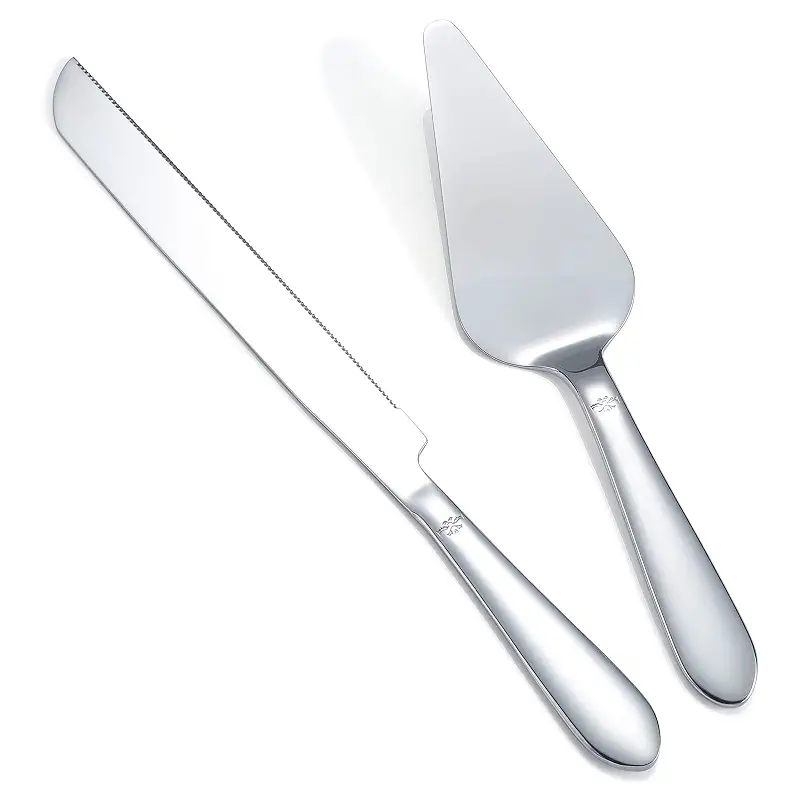
Eisinly Wedding Cake Cutting Set, Cake Knife and Server Set, 2Pcs Silver | Integral Stainless Steel Longer Cake Cutter and Wider Pie Spatula, Elegant, Ideal for Party Birthday Bridal Shower
4.8(5,773)
Elegant two-piece set with integral stainless steel construction, ideal for weddings and special events with a generous serving spatula.
The Eisinly set stands out because both pieces are cast as single-unit stainless steel rather than handles glued to blades. That's the structural choice that separates a keepsake from something that falls apart after a few uses. The knife measures 13 inches with serrated edges that handle larger cakes without tearing, and the spatula spans wide enough to support a decent slice without it sliding off mid-transfer. Most owners report the set feels substantial and looks polished without looking cheap, which matters when you're using it in front of guests.
The real trade-off is that this set prioritizes ceremony over everyday function. The blade is thinner than a professional bread knife, so it works best on soft cakes and lighter sponges rather than dense or crusty applications. If your main need is a tool that looks beautiful in photos and performs well at one or two formal occasions per year, this delivers. But if you're slicing bread or tackling harder pastries regularly, a dedicated kitchen knife will feel more authoritative.
Compared to the Sanexc set below, the Eisinly comes in classic silver and has slightly more weight in the handle, which some users prefer for stability. Both are gift-ready and dishwasher-safe, though hand washing preserves the finish longer.
Pros
Integral stainless-steel construction resists handle separation
Serrated blade cuts clean slices through larger cakes
Weighted handle provides stable control during cutting
Arrives in gift-quality packaging for immediate giving
Cons
Blade is thinner, better for soft cakes than bread or dense pastries
Classic design less versatile for daily kitchen use
Key features
13-inch integral stainless-steel knife with serrated edge
Matching 10.4-inch cake server with wide, flat surface
Elegant silver finish with ergonomic thickened handle
Dishwasher safe; hand washing recommended for longevity
Single-piece construction eliminates handle-separation risk
#2 Pick
Best for Professional Results
Kutler
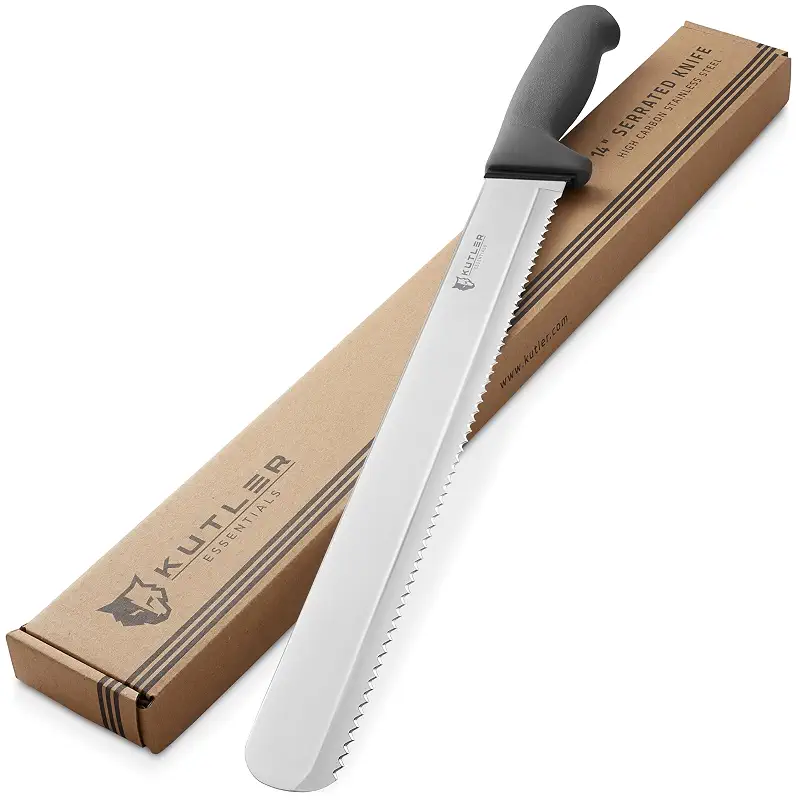
KUTLER Professional 14-Inch Bread Knife and Cake Slicer with Serrated Edge - Ultra-Sharp Stainless Steel Cutlery
4.8(2,549)
Extra-long 14-inch serrated blade with carbon stainless steel construction, purpose-built for clean cuts through bread and layered cakes.
Ideal for: Home bakers, serious bread makers, anyone layering or splitting cakes regularly.
The Kutler knife is a workhorse. At 20 inches overall with a 14-inch blade and 6-inch handle, it's long enough to cut across even large cakes or loaves in one fluid stroke without tilting or angling. The serrated edge is wavy rather than fine-toothed, which means it grips and cuts rather than tears: crucial when you're working with delicate crumb structure. Owners who do serious home baking or layer cakes frequently cite this as the best tool they own for the job, and volunteers in commercial kitchens report fighting over access to it.
The main consideration is that this is genuinely sharp and requires respect and careful handling. The blade is also heavier and less delicate than the Eisinly, so it's not going to feel ceremonial or gift-worthy in the same way. If your priority is function over aesthetics, and you're willing to hand-wash and store it carefully (many owners keep it in a sheath), this outperforms every other option here for actual slicing performance.
Where this differs from the meizhouer knife is reach and blade thickness: the Kutler's extra length and heft make it superior for layering and for bread work, while the meizhouer is thinner and more nimble for delicate cake-layer cuts.
Pros
Ultra-sharp wavy serrated edge cuts through bread and cake cleanly
14-inch blade length reaches across large cakes in single stroke
High carbon stainless steel resists corrosion and maintains sharpness
Heavy, well-balanced blade provides control and precision
Cons
Razor-sharp blade requires careful handling and respect
Not designed for formal presentation or gift-giving
Key features
14-inch serrated blade, 20 inches overall length with offset handle
High carbon stainless steel, wavy-edge serration for grip
Ergonomic textured non-slip grip for safe control
Versatile for bread, cakes, bagels, soft fruits, tomatoes
Professional-grade sharpness maintained without sharpening
Ideal for: Home bakers, cake layers, occasional bread slicers on a tight budget.
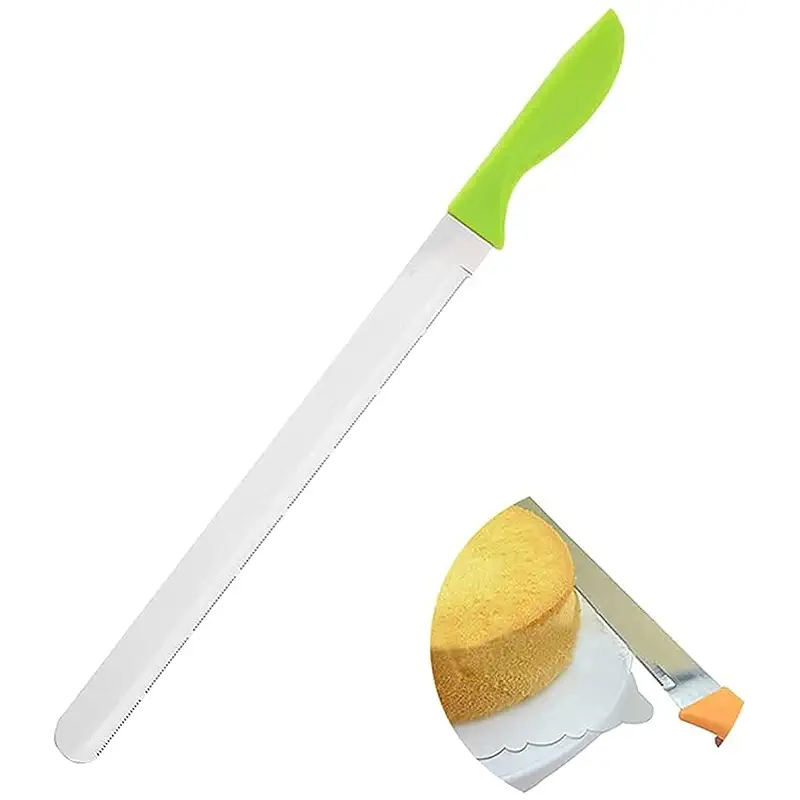
The meizhouer occupies a useful middle ground: it's longer than most ceremonial sets (12 inches), thinner than the Kutler, and costs significantly less than either. Home bakers who are just starting to layer cakes report this as a revelation: the blade is thin enough to cut horizontally through a cake without compressing the crumb, yet long enough to reach beyond the diameter so you're not wrestling with angle or leverage. One experienced baker bought this in 2021 and still uses it daily, noting the blade remains sharp years later.
The trade-off is that the plastic handle, while ergonomic, doesn't have the gravitas of stainless steel, and the blade is thinner than the Kutler, so it demands a steady hand and a clear cut. It won't feel as premium if you're serving guests, and the plastic handle may feel less durable over many years of heavy use. But for someone who makes a cake every month or two and wants a dedicated leveling knife without spending much, this delivers.
Compared to the nylon ChaLeeMoo knife below, the meizhouer is a traditional metal serrated blade suitable for any cake or bread; the ChaLeeMoo is nylon specifically for protecting nonstick pans, so they serve different needs.
Pros
12-inch blade long enough to level large cakes in one smooth cut
Thin serrated design cuts cleanly without compressing crumb
Plastic handle keeps price low while remaining ergonomic
Sharp edge remains effective over years of regular use
Cons
Plastic handle lacks the feel and longevity of stainless steel
Thinner blade requires steadier hand than heavier knives
Ergonomic plastic handle, available in 10-inch or 12-inch length
Thin blade ideal for horizontal layering cuts
Suitable for cakes, bread, soft fruits, pineapples, bagels
Affordable entry price for dedicated cake-knife investment
#4 Pick
Best for Nonstick Pans
ChaLeeMoo
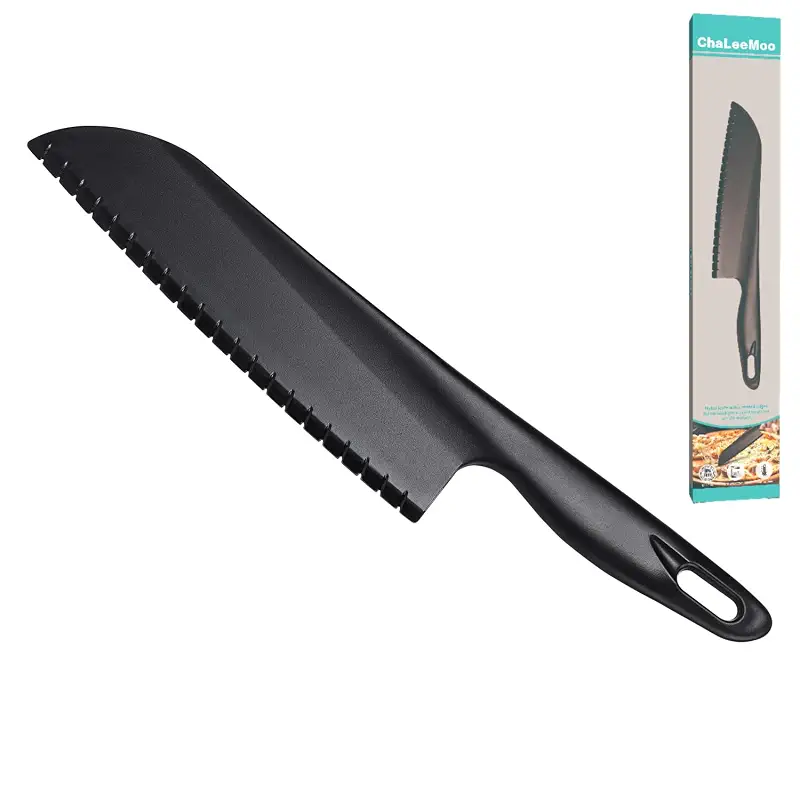
11" Nylon Knife for Nonstick Pans, Plastic Serrated Kitchen Cutter to Cut Cake Brownie Pie Lasagna or Various Veggies and Fruits, Non-Metal Salad or Lettuce Knife, Black
4.5(362)
Nylon serrated blade that protects ceramic and coated cookware while cutting brownies, cakes, and sticky desserts without scratching.
Ideal for: Bakers with ceramic or nonstick cookware, brownies and sheet cakes in coated pans.
If your baking pans are ceramic-coated or nonstick, you cannot use metal. The ChaLeeMoo nylon knife solves a real problem: it cuts through brownies, Rice Krispie treats, and sheet cakes cleanly without leaving scratches that collect rust or damage the pan's surface. One user who collects knives and bakes frequently mentioned this is her daily driver now, precisely because it lets her cut directly in the pan without worry. The 11-inch length gives decent reach, and the serrated nylon edge grips sticky, fragile desserts that a metal blade might drag through.
The limitation is that nylon isn't as hard as stainless steel, so it doesn't perform as well on tough crusts or bread with a chewy exterior. The manufacturer recommends avoiding unpeeled tomatoes or very crusty bread, which tells you where the boundaries are. If you're cutting soft cakes and brownies from nonstick pans, this is ideal; if you need one knife to do everything, a traditional metal blade suits you better.
This differs from the meizhouer and Kutler in material and use case: those are metal knives for general cake work, while the ChaLeeMoo is nylon specifically to protect your cookware surface.
Pros
Nylon material prevents scratches on coated and ceramic pans
Serrated edge cuts sticky brownies and treats cleanly
11-inch length suitable for standard sheet pans
Dishwasher safe and heat-resistant nylon construction
Cons
Nylon is softer than metal, not suitable for tough crusts or bread
Less durable long-term than stainless-steel alternatives
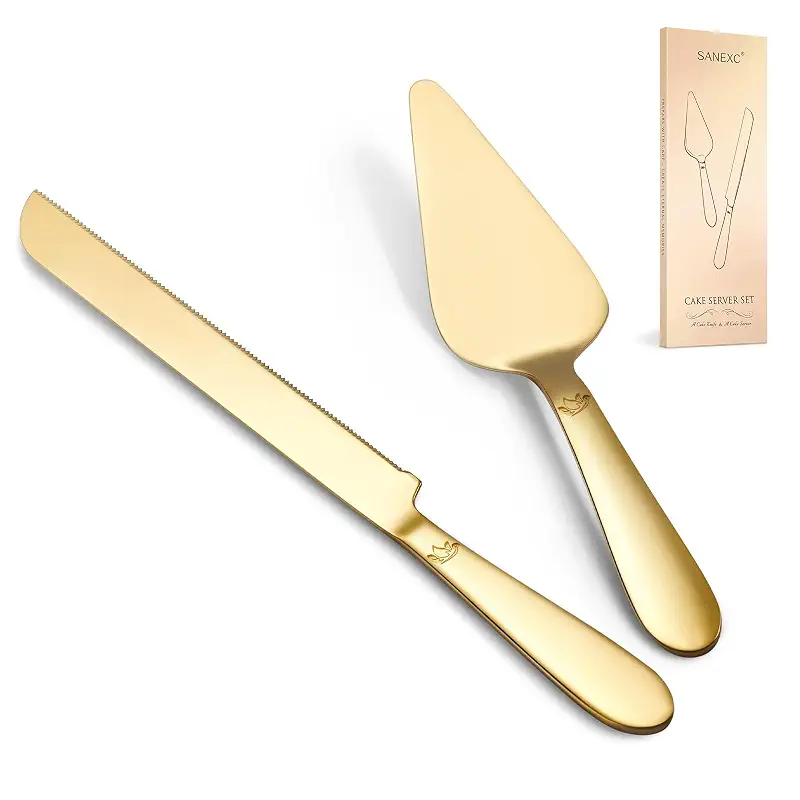
The Sanexc set mirrors the Eisinly in concept but distinguishes itself through mirror-gold finish and slightly heavier construction. If the Eisinly is understated elegance, this is formal glamour: owners report it photographs beautifully at weddings and anniversaries, and the weight in hand feels premium. The 13-inch knife handles large cakes, and the 10.4-inch server has enough width to carry a substantial slice without anxiety. Like the Eisinly, both pieces are integral stainless steel, so there's no handle-separation risk after repeated use.
The consideration is similar: this is a ceremonial tool, not a daily workhorse. The blade is serrated but moderate in its aggressiveness, so it excels on soft, moist cakes but may struggle with crusty bread or very firm pastries. The mirror-gold finish is attractive but requires prompt drying after washing to prevent water spots, which one anniversary user noted immediately. If you're using this for one or two formal events and then storing it, the finish will stay pristine; if you're using it weekly, you'll want to hand-wash and dry each time.
Compared to the Eisinly, the Sanexc offers the gold aesthetic if silver doesn't match your table setting, and users report similarly solid construction. Both are gift-ready; the choice between them comes down to color preference and decor.
Pros
Mirror-gold finish provides upscale aesthetic for formal events
Integral stainless-steel construction ensures durability
13-inch serrated blade cuts through larger tiered cakes
Arrives in gift box, ready for giving or keeping
Cons
Mirror-gold finish requires prompt drying to prevent water spots
Better for occasional formal use than regular kitchen work
Key features
13-inch integral stainless-steel knife with evenly serrated blade
Matching 10.4-inch cake server with wide flat surface
Mirror-gold finish with thickened, rounded-edge handle
Food-grade stainless steel, rust-proof and corrosion-resistant
Ideal for weddings, anniversaries, birthdays, deep-dish pizzas
How to Choose the Best Cake Knife
Four trade-offs that actually matter when matching a knife for cutting cake to your kitchen.
Blade Length and Thickness Matter
A cake knife needs to reach across the diameter of your cake without forcing you to tilt or angle the blade mid-cut. Most standard round cakes need a 12- to 14-inch blade. Thinner blades (like the meizhouer) excel at horizontal layering because they compress the crumb less, while thicker blades (like the Kutler) provide more structural support and feel more authoritative. For very large tiered cakes, you'll want 13 inches or more. Length also matters if you're splitting bread or cutting from a sheet pan: the extra reach prevents you from sawing back and forth.
Serration Style Affects Cutting Quality
Serrated edges come in two main flavors: fine teeth and wavy. Fine teeth work on softer cakes and are gentler overall; wavy serration (like the Kutler) grips tougher crusts and bread better because it uses sawing action more aggressively. For ceremonial sets like the Eisinly and Sanexc, the serration is moderate: good enough for soft cakes but not built for crusty bread. If you're splitting bread regularly, a wavy serration and heavier blade will perform noticeably better. Match the serration style to what you'll cut most often.
Material and Construction: Metal vs. Nylon
Stainless steel is standard for cake knives, but if your baking pans are ceramic or nonstick coated, you need nylon or silicone to avoid scratches. Traditional metal knives (Kutler, meizhouer, Eisinly, Sanexc) excel at general work; nylon (ChaLeeMoo) protects your cookware. One-piece integral construction, where the blade and handle are forged as a single unit, outlasts glued handles by years. Check the product description or photo to confirm whether the handle is bonded or integral: it's a major durability factor.
Ceremony vs. Everyday Function
Ceremonial sets (Eisinly, Sanexc) prioritize appearance and gift presentation; they're ideal for weddings or milestone anniversaries but may feel delicate for daily use. Professional-grade knives (Kutler) prioritize function but don't look elegant in photos. For a cutting cake cleanly guide, you'll want to consider the technique in addition to the tool: a sharp blade and steady hand make more difference than most bakers realize. If you're splitting and layering cakes regularly, invest in a dedicated kitchen knife; if you're cutting at one or two formal events yearly, a ceremonial set works perfectly.
Storage and Maintenance
All these knives are dishwasher-safe, but hand washing preserves sharpness and finish longer. Store metal blades with the edge protected: either in a sheath or lying flat in a drawer rather than upright in a block. Nylon doesn't require as much care. Mirror-finish gold (Sanexc) requires prompt drying after washing to prevent water spots. Regular stainless steel is more forgiving. If you're using the knife several times a week, hand washing and proper storage will keep it performing well for years.
Frequently asked
Quick answers to the questions readers ask most.
Can I use a regular chef's knife to cut cake?
A chef's knife is not ideal. It's usually 8 inches or shorter, so you'll struggle to reach across a large cake diameter. The blade is also straight-edged rather than serrated, so it will compress the crumb and drag rather than cut cleanly. A cake or bread knife with serration and length (12+ inches) works much better. If you don't own a dedicated cake knife, a long serrated bread knife is your next-best option.
What's the difference between a bread knife and a cake knife?
They're essentially the same tool: long serrated blades typically 12 to 14 inches. The naming depends on marketing and use case. Bread knives often have slightly heavier, wavier serration for crusty exteriors, while cake knives are sometimes thinner to avoid compressing soft crumb. For most home kitchens, one good serrated blade does both jobs well. The Kutler performs excellently at both; the meizhouer is slightly thinner and better for cakes specifically.
Are serrated blades really necessary, or can I use a straight edge?
For cake, a straight edge actually compresses the crumb more than serration does. The serrated teeth grip and cut rather than drag, which creates cleaner slices with less crushing. This is especially true for soft sponges or delicate layer cakes. A sharp serrated blade outperforms a dull straight knife every time. If you only own a straight-edge knife, make sure it's very sharp, and use a gentle sawing motion rather than pushing down.
Should I hand-wash or use the dishwasher?
All five knives are technically dishwasher-safe, but hand washing extends the life of the blade and finish significantly. The dishwasher's heat and tumbling can dull serration faster and cause staining on mirror-finish blades. If you use the knife frequently, hand wash it and dry it immediately to prevent water spots or rust. For occasional-use ceremonial sets, hand washing is especially important to preserve the polish and appearance.
Which knife is best if I only buy cake knives occasionally?
If you're a casual baker buying one cake knife, the meizhouer offers the best value: it's affordable, long enough for most cakes, and performs well over years. If you're buying for a wedding or formal event, the Eisinly or Sanexc set is more appropriate because it includes a matching server and comes gift-ready. If you bake frequently or want one tool that handles both bread and cake expertly, the Kutler is the professional choice.