Kitchen & Dining · Cookware
Best Japanese Vegetable Knife
Flat-edged nakiri blades compared on steel, length and handle feel, plus care habits and which shape suits each kind of vegetable prep.
Affiliate disclosure: As an Amazon Associate I earn from qualifying purchases.
At a glance
Detailed reviews
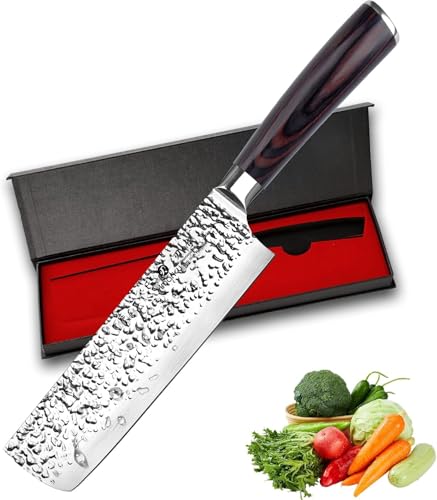
The Paudin Nakiri Knife 7" is where we'd point anyone buying a first flat-edged vegetable knife. Its 5Cr15Mov stainless blade is listed at 56+ hardness, a gentler figure than the hardest steels in this lineup, and the maker pitches that as a plus because the edge is simple to re-sharpen and keep clean. The frame is thin at 12.28 × 1.97 × 0.08 inches, and the wave pattern is cosmetic (the maker says plainly that it is not real Damascus) while also cutting down on food friction.
Owners report that it arrives very sharp, that it works through dense squash and sweet potato with little effort, and that the pakkawood handle feels comfortable and well balanced. Soft meat and fruit are fair game too, and the usual advice is to hand wash and dry it right away. A common complaint is that the thin blade feels too slight for watermelon rind and big squash, and its length is awkward when working fruit out of a rind. One negative report also doubts the steel's quality, so we'd treat it as a vegetable specialist rather than something to lean on hard.
Pros
- Sharp straight edge for push-cutting
- Thin, comfortable pakkawood handle
- Edge is simple to re-sharpen
- Wave pattern reduces food friction
Cons
- Thin blade struggles with watermelon rind
- Needs hand washing and drying
Key features (4)
- Flat nakiri profile suited to slicing, dicing and mincing vegetables
- 5Cr15Mov stainless steel blade listed at 56+ hardness
- Soft pakkawood handle joined to a thin blade
- Waved surface pattern that is cosmetic rather than true Damascus
The Imarku Nakiri Knife 7 Inch is the one we'd hand to a cook who wants a dependable everyday prep blade without much fuss. A 15° edge, a hammered finish with a hollow-edge design and a mirror-polished spine are all aimed at keeping food from clinging, and the full-tang pakkawood handle is meant to hold its balance through long chopping sessions. A protective sheath and gift box come with it, and at 12 × 2 × 0.09 inches it sits close to the Paudin Nakiri Knife 7" in footprint.
Owners report razor sharpness straight from the box, an edge that stays keen with light touch-ups on a steel, and a light, balanced feel that eases hand fatigue. Tomatoes slice paper thin, and firm vegetables and crusty bread are handled without trouble. The care sheet calls for hand washing only, owners advise sharpening only at the angle the instructions give, and a handle pin that works loose has turned up in a report, so it is worth checking the handle when it arrives.
Pros
- Light, balanced feel in hand
- Includes protective sheath and gift box
- Hammered finish reduces food sticking
- Sharp 15° edge
Cons
- Hand wash only care
- Handle pin can work loose
Key features (4)
- Japanese high-carbon stainless blade with hammered, hollow-edge anti-stick finish
- Full-tang construction with FSC-certified pakkawood handle
- Mirror-polished spine and 15° edge angle
- Protective sheath and gift box in the package
Hardness is the story with the Hoshanho 7 Inch Nakiri Knife. A 10Cr15CoMoV core inside nine composite layers, finished with cryogenic treatment, brings a listed Rockwell hardness of 62, and each side of the 2.5mm blade is ground to 12°. The squared-off straight edge is meant for firm down-chopping through sweet potato and carrot, and the hammered Tsuchime texture, stonewashed black oxide finish and octagonal rosewood handle round out the build.
At 0.53 pounds it weighs about the same as the Paudin Nakiri Knife 7" at 0.5 pounds, yet the steel sits in a different tier, which is the trade between a keen edge and a more careful routine. Owners describe it as extremely sharp, easy to keep that way and pleasantly weighted, and they like how it looks. Opinion divides on rust resistance: some find it holds up well, while others report rust, so we'd dry it right after each wash.
Pros
- Very hard layered steel core
- Sharp 12° double-bevel edge
- Hammered texture reduces food sticking
- Comfortable octagonal rosewood handle
Cons
- Rust resistance reports are divided
Key features (4)
- Nine-layer composite blade around a 10Cr15CoMoV core
- Rockwell hardness of 62 with cryogenic treatment
- 2.5mm blade ground to 12° on each side
- Stonewashed black oxide finish with hammered texture
The Shun Classic 6.5 Inch Nakiri Knife is the premium choice for cooks who want Japanese craftsmanship and plan to look after it. A VG-MAX core wrapped in 68 layers of Damascus cladding takes a 16-degree edge, and the D-shaped pakkawood handle is shaped to suit both left and right hands. It is made in Japan, carries a limited lifetime warranty, and the maker offers free sharpening and honing.
Both this and the Atumuryou Nakiri Knife 7'' wear layered cladding, but the Shun adds a lifetime warranty and free sharpening. Owners report one of the keenest factory edges they have come across, tomatoes and peppers parting with little pressure, and fruit that does not cling to the blade. They describe a reassuring heft and good balance, and they like it on a knife rack. A mild chemical smell from the handle can show up at first and fades after washing and airing out. The knife favors a slicing motion, and tap-chopping dulls it faster, so it rewards cooks who adapt their technique. Hand washing is recommended.
Pros
- Keen factory edge with VG-MAX core
- Free sharpening and honing support
- D-shaped handle suits both hands
- Limited lifetime warranty
Cons
- Handle smells at first, then fades
- Tap-chopping dulls the edge faster
- Hand washing is recommended
Key features (4)
- VG-MAX steel core clad in 68 layers of Damascus
- 16-degree edge angle on a 6.5-inch blade
- D-shaped pakkawood handle for left and right hands
- Handcrafted in Japan with free sharpening and honing
The Hoshanho 5.5 Inch Nakiri Knife is the compact option, and the shortest blade on this page. It uses Japanese 10Cr15CoMoV high-carbon stainless at 60HRC with a 15 degree edge and a pakkawood handle, and scallop-shaped hollows on the side help food release. We think it suits small boards, small hands and cooks who dice a few vegetables at a time rather than breaking down whole cabbages.
Sitting a notch under the Hoshanho 7 Inch Nakiri Knife at 62 Rockwell, it comes from the same brand with a slightly softer steel. Owners report razor sharpness out of the box that stays keen, easy handling that makes meal prep simpler, and a nicely heavy blade that cuts hard vegetables like carrots cleanly. Opinions on durability differ: some call it very durable, while others report chipping within the first month and a cracked handle, which makes careful use worth the effort.
Pros
- Compact blade suits small boards
- Sharp 15 degree edge
- Hollow pits help food release
- Comfortable pakkawood handle
Cons
- Some report chipping and a cracked handle
- Shortest blade on the page
Key features (4)
- Japanese 10Cr15CoMoV stainless steel at 60HRC
- 15 degree hand-polished edge on a 5.5-inch blade
- Scallop-shaped hollow pits on the blade side
- Pakkawood handle with a natural grain
The Atumuryou Nakiri Knife 7'' is the one we'd choose for a cook who wants a blade worth displaying on a magnetic strip that still does the work. A core at 62 HRC sits inside 67 layers of Damascus, hand-sharpened on Japanese whetstones at 12°, with a wood and blue resin handle. Its listed size is 7.1 inches, and the dimensions are 12.12 × 2.1 × 0.1 inches.
Anyone weighing the Shun Classic 6.5 Inch Nakiri Knife against a Damascus-clad rival should look here too, since this one is a touch longer and keeps the cutting surface straight and stable for vegetables. Owners report a blade that keeps its edge well, a spectacular layered pattern, easy balance and a handle that sits flush and feels solidly attached. It slices meat nicely too, and the handle is comfortable. Nothing in what we reviewed points to a weakness, which is why we're comfortable recommending it to anyone who values looks as well as performance.
Pros
- core with 62 HRC hardness
- Striking 67-layer Damascus pattern
- Solidly attached, flush handle
- Hand-sharpened 12° edge
Key features (4)
- Japanese steel core inside 67 layers of Damascus
- Hand-sharpened on whetstones to a 12° edge angle
- Natural wood and blue resin handle with unique grain
- Tall, straight blade for controlled vegetable cutting
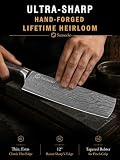
The Sunnecko Nakiri Knife 7" is the most versatile of the seven, built for vegetables, fruit and boneless meat in one cleaver-style blade. It has a hand-polished 12° double-bevel edge, Japanese high-carbon stainless steel, a pakkawood handle and a protective blade cover. The wavy pattern on the blade is meant to reduce food friction.
Because it ships with a sheath, like the Imarku Nakiri Knife 7 Inch, it is easy to store safely in a shared kitchen. Owners report it arrives very sharp, stays sharp even after tomatoes and peppers that dull blades quickly, and cuts watermelon, raw meat and sourdough with ease, with a comfortable, well-balanced handle. Its limitation shows on the blade: owners report the pattern is laser etched rather than true layered steel, so it may fade with wear. That is worth knowing, though the maker never promises Damascus and the cutting performance is what most buyers care about.
Pros
- Handles vegetables, fruit and boneless meat
- Sharp 12° double-bevel edge
- Includes protective blade cover
- Comfortable, balanced pakkawood handle
Cons
- Etched pattern, not true Damascus
Key features (4)
- Hand-polished 12° double-bevel edge on a 7-inch blade
- Japanese high-carbon stainless steel resistant to rust
- Non-slip pakkawood handle with ergonomic shape
- Protective sheath included for safe blade storage
Side by side
| Pick | Size | Item weight | Item dimensions |
|---|
#1 Best Overall
Paudin | 7" | 0.5 pounds | 12.28 × 1.97 × 0.08 inches |
#2 Best Everyday Prep
imarku | 7" | — | 12 × 2 × 0.09 inches |
#3 Hardest Steel
Hoshanho | 7" | 0.53 pounds | — |
#4 Premium Pick
Shun | 6.5" | 0.47 pounds | 13 × 2.38 × 0.9 inches |
#5 Compact Pick
Hoshanho | 5.5" | — | — |
#6 Showpiece Pick
Atumuryou | 7.1" | — | 12.12 × 2.1 × 0.1 inches |
#7 Most Versatile
Sunnecko | 7" | 0.95 pounds | — |
How to Choose a Japanese Vegetable Knife
Which blade shape suits vegetable prep?
A nakiri has a flat, squared-off edge, so the whole blade meets the board at once and slices separate cleanly instead of staying hinged together. That straight-down motion is why it handles cabbage, carrots and squash better than a rocking chef's knife, and the Paudin Nakiri Knife 7" is the simple, low-fuss way into the style.
A nakiri is a specialist, so a cook who wants one blade for everything can browse the best japanese knife under 100 for an all-rounder instead. The three shapes that come up for vegetables are:
- Nakiri: flat double-bevel edge for push-cutting vegetables
- Santoku: slight belly and pointed tip, so it also handles protein
- Usuba: single-bevel professional blade, handed and harder to learn
Does the steel or the pattern matter more?
The core steel does the cutting; the rippled pattern on a layered blade is cosmetic. Harder cores keep a fine edge longer but turn more brittle, so they reward careful handling and a whetstone rather than a honing steel. The Hoshanho 7 Inch Nakiri Knife lists a Rockwell hardness of 62 and the Atumuryou Nakiri Knife 7'' lists a core at 62 HRC, while the Paudin Nakiri Knife 7" is listed at 56+ with an edge that is simple to touch up.
Stainless cores are the easier first choice because a wipe and a dry is most of the upkeep. Carbon steel gets a fine edge but is better saved for a second knife.
What length and weight feel right?
Most nakiri run about 6 to 7 inches, and the length should suit your board: a shorter blade feels tighter on a small board, while a longer one sweeps through big cabbage or daikon. Weight changes the rhythm too, because the chopping motion lifts the blade on every stroke, so lighter models tire the arm less. The Shun Classic 6.5 Inch Nakiri Knife lists 0.47 pounds, the lightest weight stated here, and still earns praise for a reassuring heft.
Small hands or tight boards point to the Hoshanho 5.5 Inch Nakiri Knife, though for fine in-hand trimming the best japanese petty knife is the better tool.
How should you care for the blade?
A thin Japanese edge lasts longest with a short routine after every use. Models that include a sheath, such as the Imarku Nakiri Knife 7 Inch and the Sunnecko Nakiri Knife 7", make safe storage easier. A simple routine:
- Hand wash the blade soon after cutting, never in a dishwasher.
- Dry it completely, handle included, before putting it away.
- Store it on a magnetic strip or in a sheath, not loose in a drawer.
- Cut on wood or soft plastic boards, never glass, stone or ceramic.
- Keep it away from bones and frozen food.
- Touch up the edge at the angle the maker lists, using a whetstone for hard steel.
Frequently asked
Can a nakiri cut meat and fish?
Boneless, soft cuts are fine, but bones and frozen food risk chipping a fine edge. The Sunnecko Nakiri Knife 7" is the one here whose design is aimed at boneless meat as well as vegetables and fruit.
How often does a nakiri need sharpening?
There is no fixed schedule, because it depends on your board, your technique and what you cut. Sharpen when tomatoes start to crush instead of slicing or the blade needs extra pressure, and use a whetstone rather than a pull-through sharpener on hard steel. Buyers of the Shun Classic 6.5 Inch Nakiri Knife get free sharpening and honing from the maker, which takes some of the work out.
Do Japanese vegetable knives work for left-handed cooks?
Yes. A double-bevel nakiri is ground symmetrically, so it tracks straight in either hand, unlike the single-bevel usuba. The Hoshanho 7 Inch Nakiri Knife is ground to 12° on each side, so it suits left and right hands equally.
Can these knives go in the dishwasher?
Plan on washing them by hand and drying them straight away. The Imarku Nakiri Knife 7 Inch is listed as hand wash only, and the Shun Classic 6.5 Inch Nakiri Knife is recommended for hand washing too.