Kitchen & Dining · Cookware
Best Japanese Gyuto Chef Knives for Home & Professional Kitchens
Find the best Japanese gyuto chef knives. Compare sharp, durable blades for slicing, dicing, and prepping. Expert picks for every skill level and budget.
Affiliate disclosure: As an Amazon Associate I earn from qualifying purchases.
At a glance
1
Best Overall ValueMitsumoto Sakari
2
Premium Damascus BeautyYoshihiro
3
Best for Everyday UseYoshihiro
4
Premium Professional ChoiceMasamoto
5
Best Budget Damascuskanngou
Detailed reviews
The Mitsumoto Sakari brings authentic Japanese knife aesthetics and performance without premium pricing. The 3-layer San-Mai construction with a core strikes a practical balance between hardness and everyday usability. We value the hand-forged tsuchime texture here because it genuinely reduces food drag during slicing, not as a marketing detail but as a functional choice that seasoned cooks recognize.
What impresses us most is how consistent buyer feedback is across skill levels. Professional chefs and home cooks both report the same satisfaction: sharp out of the box, holds its edge well, and the octagonal rosewood handle guides grip without overthinking it. The deep-cryo treatment at HRC 60 keeps the blade forgiving enough that occasional sharpening (which we'd recommend with whetstones) stays straightforward.
The tradeoff worth noting is that this knife requires care. The hand-forged finish and core steel demand hand-washing and immediate drying, particularly after acidic ingredients. Owners who skip this step report surface staining. If you're organized about maintenance and drawn to the ritual of caring for a handmade tool, that's not a burden. If you prefer zero-fuss everyday knives, this leans toward the more demanding end of Japanese steel, where gyuto knives picks typically prioritize edge retention and hand comfort over low maintenance.
Pros
- Hand-forged finish and tsuchime texture reduce food adhesion
- HRC 60 hardness balances sharpness with sharpening ease
- Octagonal rosewood handle provides natural grip guidance
Cons
- Requires immediate hand-washing and drying after each use
- Not suitable for bones, frozen foods, or aggressive cutting boards
Key features (5)
- 3-layer San-Mai construction with high-carbon core
- Hand-forged tsuchime texture and kurouchi black finish
- Deep-cryo treated blade, HRC 60±2 hardness
- Octagonal rosewood handle with sandalwood storage box
- 8-inch blade length ideal for daily vegetable and protein prep
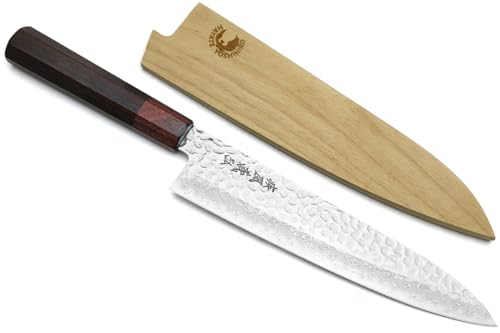
The Yoshihiro 46-layer Damascus with Shitan rosewood is the knife that makes you want to cook more, not just because it performs but because it's beautiful to hold and look at. The layered steel isn't decorative theater: buyers consistently report that the hammered finish genuinely helps food release during slicing, and the core delivers edge retention that justifies the investment.
We think the real appeal here is balance. This knife sits lighter in hand than Western equivalents, yet the forward blade weight gives gravity's help during repetitive chopping. The 47mm blade height provides knuckle clearance without excessive belly drag. Owners note the edge stays sharp through intensive prep; one reviewer used it almost daily for months and reported minimal dulling. The included magnolia-wood saya is functional, not fussy.
The catch is brittleness at the tip. A few owners report bent or broken tips after contact with very hard ingredients or the cutting board edge. This isn't a design flaw per se (it's the nature of thin, sharp blades) but it's a real consideration if your prep style involves pressure on thick foods like butternut squash or frozen items. The gyuto is the versatile all-purpose blade; if you want something equally beautiful but specialized for raw fish, the best kiritsuke knife offers a different profile and point geometry suited to slicing tasks where a longer, flatter edge helps.
Pros
- 46-layer Damascus pattern with striking visual appeal
- stainless steel resists staining and rusting well
- Light weight and excellent balance reduce hand fatigue
Cons
- Thin blade tip can bend or chip with excessive pressure on hard foods
- Hammered finish may trap food slightly; requires careful technique
Key features (5)
- 46-layer Damascus steel forged around core
- Octagonal Shitan rosewood handle, lightweight and ergonomic
- HRC 60 hardness, double-edged, 8.25-inch blade
- Natural magnolia-wood saya sheath included
- Best edge retention when maintained with whetstones
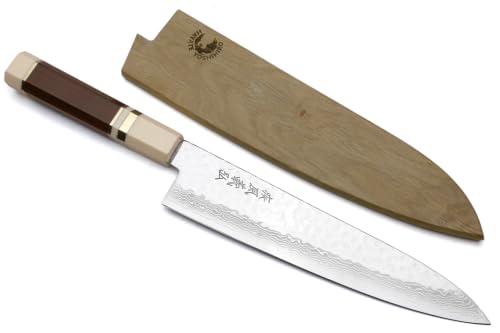
This Yoshihiro variant trades the Shitan rosewood for ambrosia wood, and that single change speaks to the maker's attention to material sourcing. Ambrosia is denser, more stable, and finishes with a richer visual depth. The specs remain identical (46 layers, core, HRC 60, magnolia saya) but buyers consistently report this handle version feels more refined over extended use.
What sets this apart in the Yoshihiro lineup is durability feedback. Owners report using it in professional fine-dining settings, handling 150+ covers per shift with edge maintenance between services, and the blade simply keeps up. One professional reviewer explicitly noted it handles every cut without compromise. For a home cook, that means you're buying into a blade that can grow with your skills without becoming a liability.
Compared to the Mitsumoto Sakari, this knife demands more attention to sharpening technique (the 80/20 grind requires whetstone skill) but rewards that effort with longer edge retention between sessions. If you're willing to invest in a whetstone and learn to maintain a thin blade, the Yoshihiro ranks among best gyuto choices where precision and longevity justify the step up. The ambrosia handle also handles being finished and personalized without risk, which several owners appreciated.
Pros
- Ambrosia wood handle is dense, stable, and visually refined
- Professional-tested edge retention through intensive daily use
- Excellent balance between blade tip control and rocking motion
Cons
- 80/20 bevel grind requires whetstone skill to maintain properly
- Spine thickness can wedge vegetables slightly; technique matters
Key features (5)
- 46-layer Damascus steel with core, HRC 60
- Octagonal ambrosia wood handle, professionally finished
- 8.25-inch blade with 47mm height for knuckle clearance
- Double-beveled 80/20 edge angle for precision work
- Magnolia-wood saya and presentation box included
Masamoto has made knives since 1866, and that heritage shows not in nostalgia but in uncompromising blade geometry. The VG series (this model uses Hyper Molybdenum Vanadium stainless steel at HRC 58–59) prioritizes the actual cutting profile over decoration. There's no Damascus pattern or hand-forged texture here: just excellent engineering. The blade is thinner than the Yoshihiros, with a flatter belly that favors push-cuts and slice work over rocking.
We notice that buyers with serious knife skills gravitate toward this knife. One owner explicitly compared it favorably to other Japanese gyutos and highlighted the 70/30 grind as easier to maintain than alternatives. Another professional praised the heel height (tall enough that knuckles clear the board) and the belly curve (not so deep it creates drag). These are subtle distinctions, but they compound into less fatigue over hours of prep.
The tradeoff is real: Masamoto assumes you'll sharpen every 2 weeks or so with a stone. This isn't neglect; it's the price of the thin, precise geometry. Compared to the Yoshihiro ambrosia (which edges out longer between sharpenings), the Masamoto demands more active maintenance. But if sharpening is part of your cooking ritual rather than a chore, this knife rewards you with an edge that bites differently: more finesse, less brute force.
Pros
- Thin blade geometry and flat belly ideal for clean push-cuts
- 70/30 grind is less demanding to maintain than 80/20 alternatives
- Exceptional balance and heel height reduce hand fatigue
Cons
- Requires sharpening every 2–3 weeks with whetstones for peak performance
- Food can stick to blade; technique and occasional wiping needed
Key features (5)
- Hyper Molybdenum Vanadium stainless steel, HRC 58–59
- Full-tang construction with stainless steel bolster
- Black Duracon POM handle, durable and heat-resistant
- 70/30 grind angle for precise push-cutting
- 8.3-inch blade, 210mm; made in Japan since 1866
The kanngou stands out because it delivers visual and performance appeal without the premium pricing of established names. The 67-layer Damascus with AUS-10 core and hand-sharpened 10–12-degree edge arrives factory-sharp in a way that rivals knives costing significantly more. We see this as the entry point for buyers curious about Damascus aesthetics and Japanese steel without committing to a high-touch maintenance routine.
What we appreciate here is the weight consideration. At 6.3 ounces, this knife is noticeably lighter than Western alternatives, which appeals to cooks who've struggled with hand fatigue or those building confidence with a narrower, more responsive blade. The octagonal rosewood and ebony handle is comfortable immediately. The included sheath and gift packaging make this feel like a genuine value: you're not paying for a bare blade and scrambling for storage.
The real limitation is newness and QC variability. kanngou is a newer brand, and feedback volume is smaller. One owner noted a small indent in the blade near the edge, suggesting quality control isn't yet at Yoshihiro or Masamoto levels. Edge retention seems solid in reported use, but long-term durability data is limited. If you're new to Japanese knives or want to experiment with Damascus without the financial risk of a Yoshihiro, this is worth considering. But if you need absolute certainty of consistency, the established makers still offer more confidence.
Pros
- Hand-sharpened to 10–12-degree edge, arrives extremely sharp
- Lightweight at 6.3 ounces; minimizes hand fatigue during long prep
- 67-layer Damascus pattern stunning in person; includes premium gift box
Cons
- Newer brand with smaller user base and limited long-term durability data
- Quality control variability; occasional edge blemishes reported
Key features (5)
- 67-layer Damascus steel with AUS-10 core, HRC 60–62
- Hand-sharpened 10–12-degree edge using 3-step Honbazuke method
- Octagonal rosewood and ebony handle, ergonomic and lightweight
- 8.27-inch blade with gradual taper for precision slicing and dicing
- Includes sheath, cleaning cloth, and premium gift box
How to Choose a Japanese Gyuto Chef Knife
Understand Steel Type and Maintenance
The core material defines how your knife behaves. stainless steel (used in the Yoshihiro and kanngou models) resists staining and rust well, making it forgiving for home cooks who don't dry immediately. High-carbon stainless like Masamoto's Hyper Molybdenum Vanadium is equally corrosion-resistant but demands more precise technique. Carbon-core blades (the Mitsumoto Sakari's ) offer excellent edge retention but require immediate drying after acidic work. When comparing gyuto steel types explained, consider your dishwashing discipline and whether you enjoy the maintenance ritual or prefer simplicity.
Blade Geometry Matters More Than You Think
A gyuto's usefulness lives in its belly curve, tip shape, and overall taper. Flatter bellies (like the Masamoto VG) favor push-cuts and clean slicing; deeper curves enable rocking motion. Thin blades feel nimble but can chip if used on hard items; thicker spines are more forgiving. Most buyers underestimate how much blade height affects comfort: taller heels keep knuckles off the board. Test a knife's balance point in your hand before committing; some people prefer forward weight in the blade, others like neutral balance at the handle.
Hardness, Sharpness, and Edge Retention
Hardness (measured in HRC) doesn't directly equal sharpness. A knife at HRC 60 can be sharper than one at HRC 62 if the edge angle is lower and the steel is better refined. Sharpness is the ability to bite into food with minimal pressure; edge retention is how long that sharpness lasts before dulling. Stainless holds an edge longer than some carbon steels but requires regular honing. Budget Damascus knives often arrive extremely sharp due to factory finishing, but home maintenance (with a whetstone) determines whether that edge lasts weeks or months.
Handle and Control
Japanese wa-style octagonal handles are lighter and guide hand position more than Western grips. Some cooks love the guidance; others find it restrictive. Rosewood and ambrosia are both durable, but ambrosia tends to be denser and more stable over years of use. The handle should feel secure when wet and not require a death grip. If you have large hands or prefer a heavier tool, a thicker-spined blade with fuller handle (like Masamoto) may suit you better than a feather-light Damascus gyuto.
Budget Considerations and Resale
Entry-level gyutos from established makers (Mitsumoto Sakari, Yoshihiro, Masamoto) hold value and are easier to resell if you change your mind. Newer brands like kanngou offer sharp blades at lower prices but have smaller resale markets. Professional-grade knives (Yoshihiro with professional feedback, Masamoto) justify premium pricing through edge retention and durability; casual home cooks often find equally satisfying performance at lower price points. Buying once usually costs less in the long run than upgrading twice.
Our picks at a glance
1
Best Overall ValueMitsumoto Sakari
2
Premium Damascus BeautyYoshihiro
3
Best for Everyday UseYoshihiro
4
Premium Professional ChoiceMasamoto
5
Best Budget Damascuskanngou
Frequently asked
Do Japanese gyutos require sharpening more often than Western chef knives?
Not necessarily. Japanese gyutos often hold an edge longer because of higher hardness (HRC 58–62 vs. 54–56 in Western knives) and thinner geometry. However, they require whetstone maintenance rather than steel honing. A well-maintained gyuto can stay sharp for weeks or months. The catch is that when it does dull, you'll notice immediately due to the thinner blade, whereas a Western knife dulls more gradually.
Can I use a gyuto on bones or frozen foods?
Not recommended. Gyutos are precision instruments designed for boneless proteins, vegetables, and fruits. The thin blade can bend or chip against hard items like bone, nut shells, or frozen food. Use a heavier cleaver or Western chef's knife for those tasks. Many manufacturers explicitly warn against this, and it voids the value of owning a refined blade.
What's the difference between Damascus and non-Damascus gyutos?
Damascus (layered steel) is primarily aesthetic (the pattern is stunning) but also provides slight improvements in edge stability and corrosion resistance on the outer layers. A non-Damascus blade with a quality core (like Masamoto's) performs just as well and may be easier to sharpen. Damascus knives cost more largely because of the visual appeal and hand-forging labor. Choose based on whether the beauty matters to you and your budget.
How do I maintain a Japanese gyuto long-term?
Hand-wash and dry immediately after every use, especially after acidic ingredients. Store in a knife block, magnetic strip, or sheath: never loose in a drawer. Sharpen with a whetstone every 2–4 weeks depending on use frequency and steel type. Apply a light coat of food-safe mineral oil to the handle periodically, especially if it's wood. Avoid the dishwasher, cutting boards that are too hard (marble, glass), and repetitive contact with the spine.
Is a whetstone essential for a Japanese gyuto?
Yes, for optimal performance. Western honing steels don't work on thin Japanese blades and can damage the edge. A 1000–6000 grit whetstone is the standard entry point; many cooks progress to higher grits for refinement. If whetstones feel intimidating, some makers offer professional sharpening services, but home sharpening becomes rewarding once you learn the technique and is cheaper long-term.