Best Japanese Chef Knives Under 100: Top Picks for Home Cooks
Find the best Japanese chef knives under 100. Compare Damascus, VG-10, and high-carbon stainless options. Expert picks for sharp, durable kitchen knives.
Verdict, analysis, and key features for each pick.
#1 Pick
Best Overall: Premium Damascus with Exceptional Edge Retention
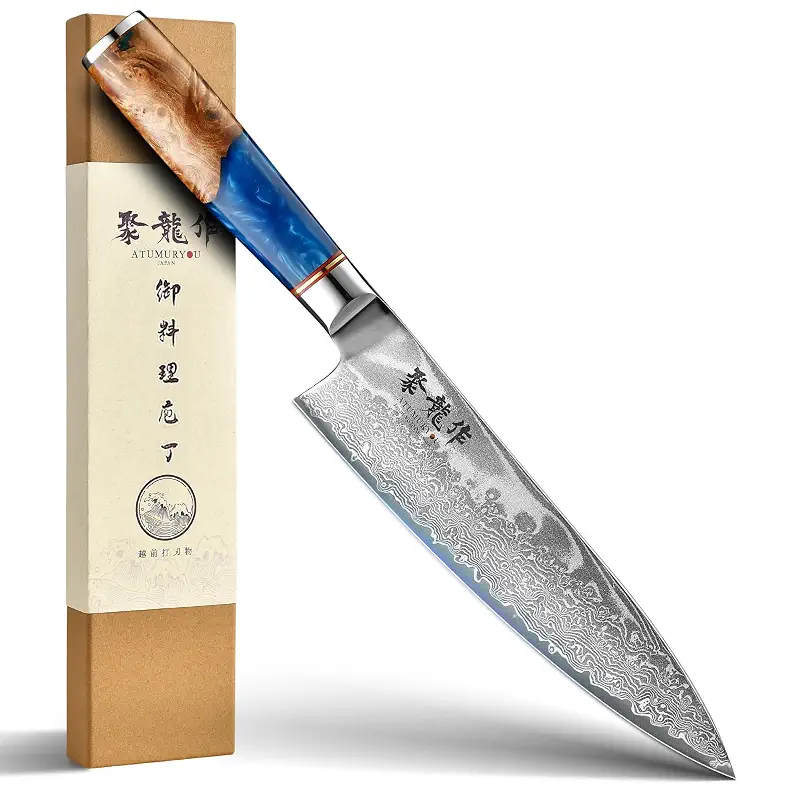
Atumuryou
Japanese Chef Knife, 8 Inch Damascus Kitchen Knife with VG10 Steel, Ultra Sharp Professional Cooking Knives with Resin Wood Handle, Gift Box for Home & Restaurant
4.8(124)
Hand-forged Damascus with VG-10 core delivers stunning aesthetics and uncompromising sharpness at a fair price.
Ideal for: Cooks who value aesthetics and edge performance and don't mind hand-drying their blades.
The Atumuryou stands out for the care baked into every detail. The 62 HRC VG-10 core is a legitimate workhorse steel, paired with 67 layers of Damascus cladding that genuinely improves corrosion resistance while creating those striking visual patterns. Owners consistently report that this knife arrives sharp enough to shave arm hair and maintains that edge through serious kitchen work. The stabilized wood and resin handle feels substantial without being heavy, and the ergonomic dimpling at the grip really does reduce hand fatigue during extended prep sessions.
What separates this from the Shan Zu is the VG-10 steel itself. The Shan Zu uses 10Cr15MoV, which is respectable, but VG-10 is a step up in edge retention and corrosion resistance, a distinction that shows over months of use. The presentation (from the cushioned velvet box to the included care cloth) signals that this maker respects the craft. Professional chefs have adopted this knife as their personal blade, and that endorsement carries real weight.
The main caveat: this is a premium option at the higher end of the under-100 range. If budget is your primary constraint, the imarku models offer similar daily performance for less. Also, the Damascus pattern, while beautiful, requires hand-drying after washing to prevent spotting; owners who don't mind a care routine will get years of service, but those seeking a truly fuss-free knife should look elsewhere.
Pros
VG-10 steel core holds sharpness significantly longer than budget alternatives
67-layer Damascus cladding reduces corrosion and looks striking
Exceptional right-out-of-box sharpness praised across reviews
Ergonomic handle with genuine dimpling reduces hand fatigue
Cons
Requires hand-drying to prevent spotting on Damascus pattern
Premium pricing places it at the upper end of the budget range
Key features
VG-10 steel core at 62 HRC with 67-layer Damascus cladding for corrosion resistance
Hand-sharpened using traditional Japanese techniques for surgical precision
Stabilized wood and resin handle with ergonomic dimpled grip design
8-inch blade length ideal for slicing, dicing, and general prep work
Arrives in cushioned velvet gift box with care cloth included
#2 Pick
Best Long-Term Value: Proven Durability with Lifetime Warranty
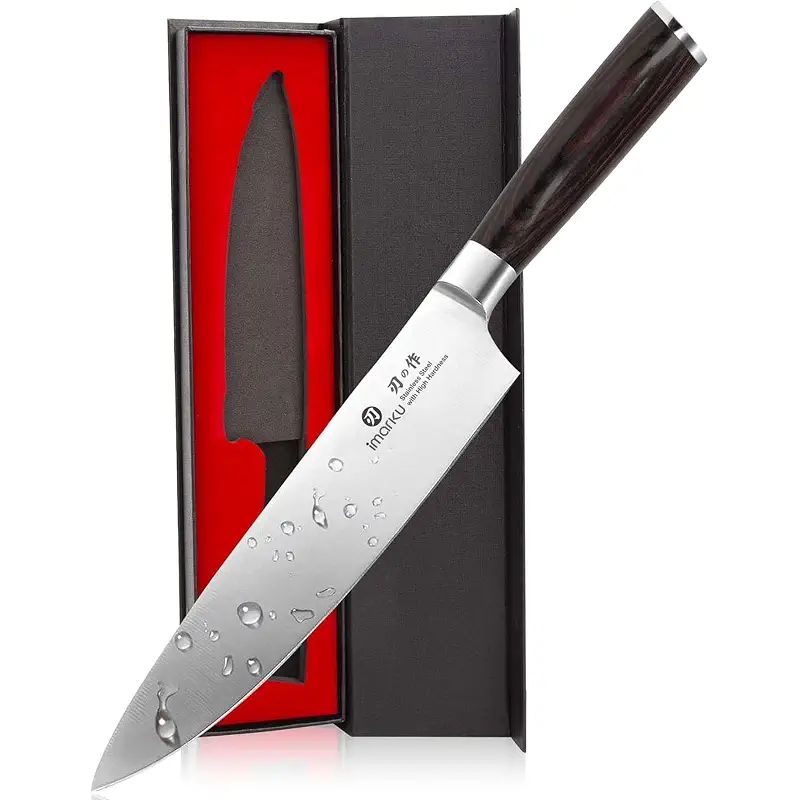
imarku
imarku Japanese Chef Knife-Sharp Kitchen Knife 8 Inch, Gift for Mom & Dad | Chef's Knives HC Steel Paring Knife, Unique Gifts for Men and Women, Kitchen Gadgets with Gift Box, Gyutou Knives
4.6(10,469)
Trusted by serious home cooks for a decade-plus; imarku's lifetime warranty backs a high-carbon stainless blade that performs.
Ideal for: Cooks who prioritize reliability and warranty support over cutting-edge steel specs.
The imarku gyutou (here in its original lineup) has accumulated over 10,000 reviews, and that volume tells a story. What owners emphasize isn't hype but reliability. High-carbon stainless (56-58 HRC) means a slightly softer blade than the Atumuryou's VG-10, but the tradeoff is genuine durability and easier sharpening. The FSC-certified Pakkawood handle is proven to withstand years of daily work; this isn't a showpiece, it's a workhorse.
The lifetime warranty is real. Owners report that imarku honors claims without argument and ships replacements quickly. That peace of mind matters if you cook regularly and want to know a blade failure won't leave you without recourse. Compared to the Mitsumoto Sakari, which emphasizes hand-forged aesthetics, the imarku prioritizes reliable, repeatable performance at a lower price. If you're torn between premium Damascus and practical all-purpose work, the choice often comes down to whether you prefer the look of a best kiritsuke knife or a no-fuss workhorse that simply cuts well year after year.
This knife loses some sharpness faster than premium options and requires more frequent honing, but owners clearly accept that trade. The design philosophy is pragmatic: give cooks a sharp, balanced blade they can hand-wash, rely on, and replace if something goes wrong.
Pros
Proven track record across thousands of long-term users
Legitimate lifetime warranty with fast replacement service
High-carbon stainless is easier to sharpen than premium steels
Comfortable Pakkawood handle proven durable over years of use
Cons
Lower hardness (56-58 HRC) means more frequent honing needed
Not hand-forged; more industrial production approach
Key features
High-carbon stainless steel blade with 56-58 HRC hardness for edge retention
16-18% chromium content resists corrosion and tarnishing over time
Ideal for: Cooks who appreciate hand-forged aesthetics and want a blade that feels special without breaking the bank.
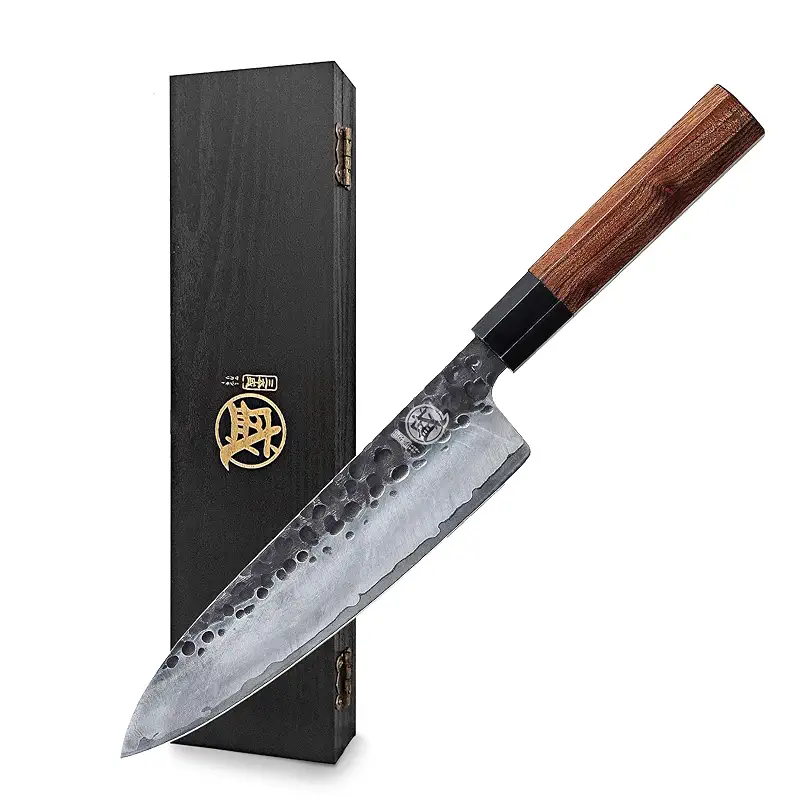
The Mitsumoto Sakari appeals to cooks who want their knife to feel like an investment in craft. The three-layer San-Mai structure uses a core flanked by softer steel, a design borrowed from traditional Japanese bladesmithing. The hand-forged tsuchime hammered texture and black kurouchi finish aren't just for looks; the textured blade face reduces food contact during slicing, which genuinely helps with suction and makes prep cleaner. At 60±2 HRC hardness, the blade is harder than the imarku and approaches the Atumuryou's performance.
Where this knife stands out is in the total package. The octagonal rosewood handle is beautifully finished and functionally smart: the angles guide hand placement and reduce wrist repositioning strain. The presentation in a sandalwood box signals respect for the user. Professional chefs and home cooks alike praise the balance and the way the hammered texture catches light. It feels more like a Japanese knife than the budget alternatives, even though the manufacturing is in China by a Japanese company.
Compared to the Shan Zu's 67-layer Damascus approach, the Mitsumoto Sakari takes a more minimalist path: fewer layers, but cleaner aesthetics and arguably more practical blade geometry. The main drawback is that high-carbon stainless requires hand-drying and occasional oiling (owners note this in reviews), and the blade needs care similar to the Atumuryou if you want to avoid spotting.
Pros
Three-layer San-Mai construction reduces food sticking during slicing
Octagonal rosewood handle provides superior grip and hand guidance
Hand-forged tsuchime finish looks beautiful and reduces surface friction
60±2 HRC hardness balances edge retention with durability
Cons
Requires hand-drying and occasional oiling to prevent spotting
High-carbon stainless needs more maintenance than budget options
Key features
San-Mai three-layer blade with core and cladding steel
Tsuchime hammered texture and kurouchi black forged finish reduce food adhesion
Deep-cryo treated to 60±2 HRC hardness for consistent edge performance
Octagonal rosewood handle with secure full-tang construction
Includes sandalwood storage box and care cloth
#4 Pick
Best Lightweight Option: Ultra-Sharp for Smaller Hands and Longer Sessions
imarku
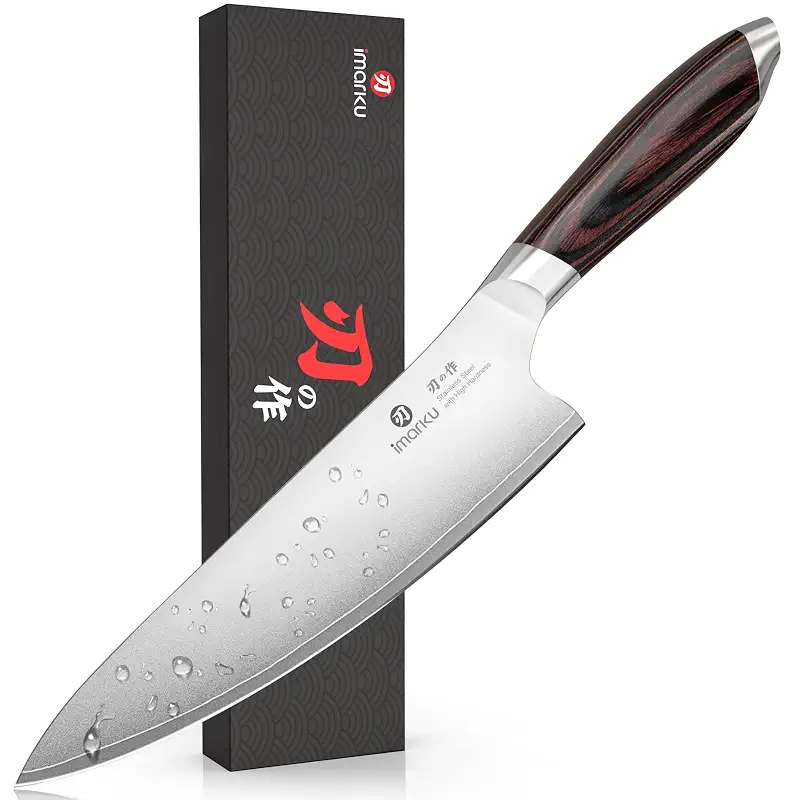
imarku Japanese Chef Knife 8 Inch, Sharp Kitchen Knife in Japanese HC Steel | Ultra Sharp Chef's Knives for Easy Cutting,Ergonomic Pakkawood Handle,Kitchen Gadgets with Gift Box,Home Gifts for Men Women
4.7(2,259)
Triple-layer clad 10Cr15CoMoV at just 210g delivers razor-sharp cuts without hand fatigue for extended prep.
Ideal for: Home cooks with smaller hands or anyone who preps vegetables for extended periods without fatigue.
This newer imarku offering takes a different direction from its older sibling: it prioritizes lightness and the non-stick properties of a matte-finish blade. At 210 grams, it's noticeably lighter than other options here, which matters if you have smaller hands or find yourself slicing for hours. The triple-layer clad construction with 10Cr15CoMoV core and 59±2 HRC hardness is sharp right out of the box and holds an edge well through daily use. The sandblasted matte finish is the differentiator: foods like fish, cheese, and potatoes genuinely slide off the blade without the sticking that plagues some chef knives.
Where this knife shines is in ease of use during repetitive work. The curved blade and light weight reduce the micro-adjustments your hand has to make, which translates to less fatigue even after 30 minutes of solid chopping. If you're considering chef knives under 50 alongside premium options, understand that this lightweight model sits in the mid-range: it outperforms budget stainless but doesn't match the VG-10 steel's staying power. Compared to the Shan Zu's 270-gram G10-handled knife, this feels almost delicate, though still sturdy. The trade is that the lighter blade doesn't have quite the heft for aggressive work like breaking down larger cuts of meat or pushing through root vegetables, but for a primary home-cooking knife, that rarely matters.
The sandblasted finish does require a bit more attention to maintenance (similar care to the Atumuryou), and the blade isn't meant for bones or frozen foods. Imarku's lifetime warranty applies here too, so the coverage is solid.
Pros
Ultra-light at 210g reduces hand and wrist fatigue during long prep sessions
Non-stick matte finish prevents foods from sticking to the blade
Triple-layer clad construction with 59±2 HRC delivers sharp, reliable cuts
Precise 12°±2° double-bevel edge minimizes sharpening frequency
Cons
Lighter weight means less heft for tougher cutting tasks
Matte finish requires hand-drying and occasional oiling like premium knives
Key features
Japanese 10Cr15CoMoV high-carbon stainless steel core with triple-layer clad
Sandblasted non-stick matte finish reduces food adhesion during slicing
Ultra-lightweight at 210g with perfect balance for extended use
FSC-certified pakkawood handle designed for smaller hands and ergonomic comfort
Lifetime warranty with no-hassle refund within 3 months of purchase
#5 Pick
Best Budget-Friendly Damascus: Stunning Looks with Strong Daily Performance
Shan Zu
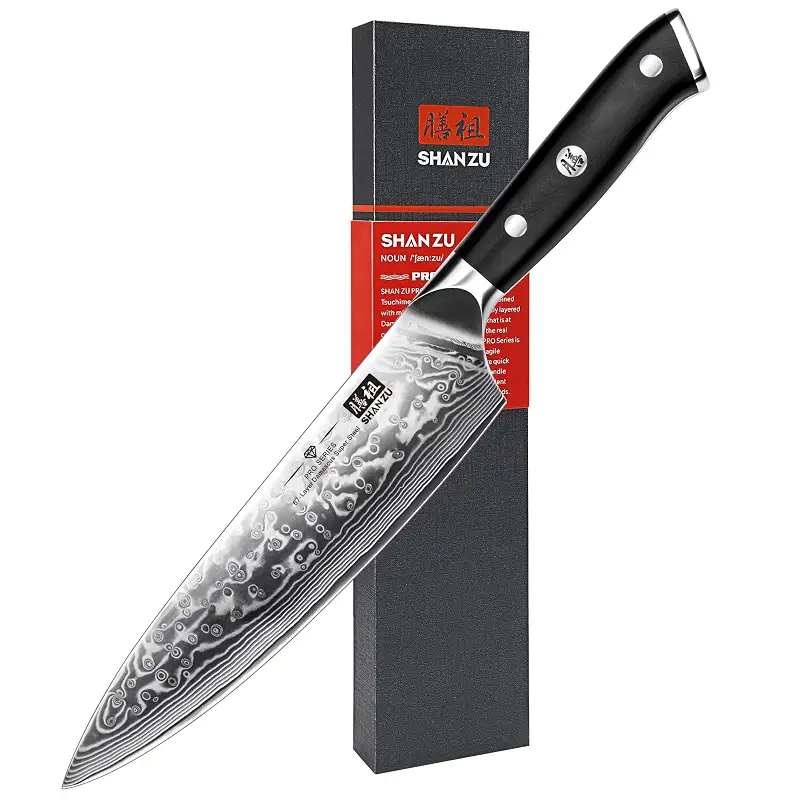
SHAN ZU Chef Knife 8 Inch Japanese Steel Damascus Kitchen Knife | Professional Kitchen Knives Ultra Sharp High Carbon Super Steel Kitchen Utility Knife
4.8(5,606)
67-layer Damascus steel with 62 HRC hardness and G10 handle delivers premium aesthetics and solid cutting power for the price.
Ideal for: Budget-conscious cooks who want Damascus aesthetics without premium-steel pricing and don't mind synthetic handles.
The Shan Zu is the value Damascus knife in this lineup. Owners consistently note the surprise factor: this knife looks and cuts like something two or three times the price. The 10Cr15MoV core at 62 HRC is respectable, and the 67-layer Damascus construction is real, not laser-etched imitation. The repeated heating and folding creates actual layered steel, which shows in durability. The G10 frosted glass-fiber handle is more durable than wood in high-volume kitchens and doesn't require the same care as stabilized wood or rosewood.
What you're getting here is a Damascus knife for less than most single-layer chef knives. Owners who've worked with much pricier German knives and even Japanese imports say this punches well above its price class. The balance is solid, the cut is clean, and the Damascus pattern is genuinely visible and attractive. The 15-degree cutting angle (standard for Japanese knives) means finer, more controlled slicing than many Western blades.
The main trade versus the Atumuryou is the steel: 10Cr15MoV is good but not VG-10 tier in edge retention. You'll hone it more frequently and resharpen sooner. The G10 handle, while durable, lacks the warmth of wood and doesn't feel quite as refined. Compared to the budget imarku, the Shan Zu offers more visual appeal and comparable cutting performance, so it's really about whether you prefer the industrial look of G10 or the traditional feel of wood.
Pros
Real 67-layer Damascus construction with visible pattern, not laser etching
62 HRC hardness delivers edge performance close to premium options
G10 handle is extremely durable and requires minimal maintenance
Exceptional value; aesthetic quality well above typical price point
Cons
10Cr15MoV steel requires more frequent honing than VG-10 alternatives
G10 handle lacks the warmth and refinement of wood or resin handles
Key features
67-layer forged Damascus steel with 10Cr15MoV high-carbon core
62 HRC hardness for strong edge retention and wear resistance
Frosted G10 handle offers durability and slip resistance without wood care
8-inch blade with 15-degree cutting angle for precise Japanese-style slicing
12-month manufacturer warranty with full tang construction
How to Choose a Japanese Chef Knife
Four trade-offs that actually matter when matching a japanese chef knives under 100 to your kitchen.
Steel Type and Hardness Matter for Edge Retention
Japanese chef knives typically use high-carbon stainless or carbon steel, and the hardness rating (HRC) tells you how long the edge lasts between sharpenings. VG-10 steel at 62 HRC holds an edge longer than 56-58 HRC stainless, but it requires hand-drying to prevent spotting. If you want minimal maintenance, a lower-HRC stainless (56-58) is more forgiving and easier to resharpen yourself. Most cooks in this price range will find 58-62 HRC is the sweet spot between edge retention and practical upkeep.
Handle Material Affects Comfort and Longevity
Wood handles (stabilized wood, rosewood, pakkawood) offer warmth and traditional aesthetics but require hand-drying and occasional oiling. G10 synthetic handles are virtually maintenance-free and extremely durable in busy kitchens but lack the refined feel of wood. For home cooks who cook several times a week, wood or resin handles are pleasant; for high-volume use, G10 makes sense. Consider your hand size too: lighter, slimmer handles suit smaller hands, while thicker grips reduce fatigue during long sessions.
Damascus Aesthetics Come with Care Requirements
Real Damascus blades (67 layers or more, created by repeated folding and forging) are genuinely stronger and more corrosion-resistant than single-layer steel. The visible patterns are beautiful and a legitimate mark of craftsmanship. But Damascus requires hand-drying after washing and occasional oiling to prevent spotting. If you want the look without the maintenance, consider laser-etched imitation Damascus (not represented in this lineup), though it lacks the structural benefits. The gyuto versus santoku comparison explains how blade shape affects your cutting style, which matters more than whether you choose Damascus or solid steel.
Blade Hardness and Weight Trade With Ease of Sharpening
Harder blades (60+ HRC) hold an edge longer but require professional sharpening or a good whetstone; softer blades (56-58 HRC) dull faster but are easier to resharpen at home with a honing steel. Lighter blades reduce hand fatigue over long sessions but have less heft for tougher ingredients. Consider your sharpening willingness and hand strength: if you hate sharpening, pick a premium steel and accept professional sharpening costs; if you enjoy maintenance, a softer blade invites more frequent tuning. Most home cooks find the middle ground most practical.
Warranty and Reputation Signal Maker Confidence
Lifetime warranties (imarku, some others) reflect maker confidence and provide peace of mind if a blade fails. Brand reputation built over thousands of reviews is worth more than a single glowing endorsement. Check whether the maker honors claims quickly and whether users report improvements after purchase. Japanese company backing (even if made in China) and transparent communication about manufacturing location tend to signal higher standards than brands that hide their sourcing.
Frequently asked
Quick answers to the questions readers ask most.
Do Japanese chef knives need special care compared to Western knives?
Japanese blades are typically harder (60+ HRC) and thinner than German knives, which means they hold a sharper edge longer but need hand-washing and hand-drying, never dishwashers. High-carbon stainless and Damascus varieties require occasional oiling or drying immediately after washing to prevent spotting. In exchange, you get finer cuts and less honing. Most owners find the minimal care routine worthwhile for the cutting performance.
What's the difference between gyuto and santoku, and which should I buy?
Gyuto is the Japanese chef knife (what you're looking at here): 8 inches, curved belly, designed for slicing and rocking motions on vegetables and meat. Santoku is smaller (7 inches), flatter-profiled, and better for precise chopping and finer work. A gyuto is more versatile for everyday cooking; santoku excels if you chop more than you slice. Most home cooks start with a gyuto, and the advice in any gyuto versus santoku comparison will help you decide if you need both.
How often should I sharpen a Japanese chef knife?
It depends on steel hardness and usage. A VG-10 blade (62 HRC) in regular home use typically stays sharp 2-3 months before professional sharpening. A softer stainless blade (56-58 HRC) might need sharpening every 4-6 weeks. Most owners use a honing steel weekly to realign the edge between sharpenings, which keeps the blade performing longer. Professional sharpening (done 1-2 times yearly) extends blade life significantly.
Can I put a Japanese chef knife in the dishwasher?
No. Dishwashers expose blades to harsh detergents, high heat, and contact with other utensils, all of which dull and damage Japanese steel. Hand-wash in warm soapy water, dry immediately with a soft cloth, and store blade-up in a knife block or sheath. This simple routine takes 30 seconds and keeps your blade in restaurant condition for years.
What's the real difference between a 67-layer Damascus and single-layer steel?
Real Damascus (repeated folding and forging) creates layered steel that is genuinely stronger, more corrosion-resistant, and more durable than single-layer construction. The visible pattern is a side effect of the process, not the benefit. At the budget level (under 100), you're comparing genuine Damascus with respectable high-carbon stainless, both of which perform well. Damascus looks more striking and lasts slightly longer; single-layer is simpler to maintain and sharpen.