Kitchen & Dining · Small
Best Horizontal Bread Machine
Seven bread makers sized up on pan shape, loaf size, programs and cleanup, with who each suits and the complaints owners raise.
Affiliate disclosure: As an Amazon Associate I earn from qualifying purchases.
At a glance
3
Traditional Horizontal PanWest Bend
4
Most CustomizableKitchenarm
5
Easiest for BeginnersOsipoto
Detailed reviews
This is the machine for a small counter and a simple routine. The pan is vertical, so the loaf comes out tall rather than in the wide sandwich shape a horizontal machine gives you, which is worth knowing before you buy. In exchange you get a compact body, 12 programs including a gluten-free one, three loaf sizes from 1 lb to 2 lb, three crust shades, a viewing window with an interior light, and a 13-hour delay start followed by 60 minutes of keep warm. A beep signals the moment to pull out the kneading paddle ahead of the last rise.
Owners report that the controls and readout are easy to follow, that first loaves come out well, and that the slices suit a toaster. A gluten-free loaf is among the results they praise. A common complaint is durability: the rubber feet are reported to break early, and some loaves collapse after baking. Noise is another sore point, with owners describing both a very quiet machine and loud beeps that sound like a dishwasher.
Pros
- Compact body fits countertops and cupboards
- Readout makes programming simple to follow
- Gluten-free program among twelve presets
- Delay start with an hour of keep warm
Cons
- Rubber feet reported breaking early
- Loaves can collapse after baking
- Beeps and running noise draw complaints
Key features (4)
- Vertical non-stick pan with three loaf sizes, 1 lb to 2 lb
- Twelve preset programs with a choice of three crust shades
- Viewing window and interior light for watching the rise
- Beep signaling when to take out the paddle before final rise
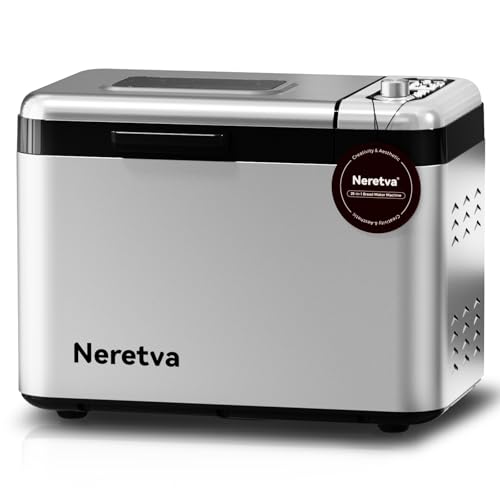
Capacity is the reason to choose this one. Loaves come in 2.2 lb, 2.76 lb and 3.3 lb, a range aimed at larger households and anyone meal prepping, and the West Bend Hi-Rise Bread Maker Machine 3-Lb, the next largest here, stops at 3 lb. The rest of the feature list is generous too: 15 programs, three crust colors, heaters above and below the pan, two kneading paddles, a ceramic pan, a detachable fruit and nut dispenser and a 15-hour delay timer.
Owners report a great loaf every time, and they like both the size of the loaf and the look of the machine. The complaints are specific, though. The screen can be hard to stop once a program starts, bread can stick to the pan, and the paddles can detach mid-knead and get lost in the dough. Owners also split on the mixing noise and on how long the machine lasts, with reports of it giving out within a year.
Pros
- Three loaf sizes up to 3.3 lb
- Dual heaters above and below pan
- Automatic fruit and nut dispenser
- Great loaf reported every time
Cons
- Screen hard to stop mid-program
- Bread can stick to the pan
- Paddles can detach into the dough
Key features (4)
- Fifteen automatic programs with light, medium and dark crust colors
- Ceramic non-stick pan paired with two kneading paddles for thorough mixing
- Fifteen-hour delay timer for loaves ready after an overnight wait
- Package with glove, measuring tools and paddle removal tool
If the horizontal loaf is the whole point, this is the clearest fit. The bread pan is traditionally shaped and horizontal, it offers three loaf sizes between 2 lb and 3 lb, and two knead blades handle the mixing. Unlike the Cuisinart Bread Maker 2 Lb, whose upright pan keeps the footprint small, this machine takes more room (11 × 15.5 × 13.5 inches) in return for the wider loaf. It has 12 digital programs including gluten-free, three crust levels, and a delayed start that can be programmed up to 13 hours; the manual adds recipes for bagel and pasta dough as well as wheat, low-carb and gluten-free loaves.
Owners report evenly cooked, tasty loaves that are not chewy, oversized loaves done well, and easy cleanup. The durability complaints are the serious part: there are reports of units breaking within two to three months, and of the pan failing to snap into place while dough sticks to it.
Pros
- Traditional horizontal pan for wide loaves
- Three loaf sizes up to 3 lb
- Evenly cooked, tasty loaves reported
- Easy to clean after baking
Cons
- Units reported breaking within months
- Pan can fail to snap into place
- Dough can stick to the pan
Key features (4)
- Dual knead blades for a higher, lighter rise
- Twelve digital settings with light, medium and dark crust levels
- Programmable delay start that can be set up to 13 hours
- Manual with recipes including bagel and pasta dough
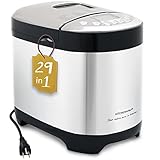
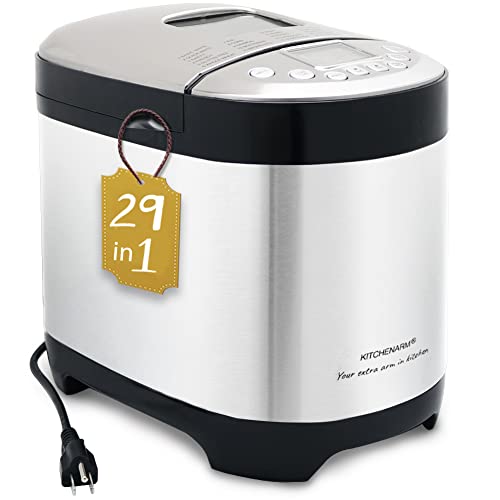
Tinkerers get the most from this machine. It offers 29 menus (21 bread menus, 7 non-bread menus and a customizable home-made one), and you can build up to four personalized menus by choosing how long each knead, rest, rise and bake stage runs. It also remembers your last menu, loaf size and crust color, so repeating a recipe takes one press. Loaves come in three sizes from 1 lb to 2 lb, with a 15-hour delay timer, an hour of keep warm, 15 minutes of power-interruption recovery and alarms for adding nuts and removing the paddle. A 77-recipe book rounds it out.
The Cuisinart Convection Bread Maker Machine 2 Lb. offers 16 programs, which is well below this machine's 29, and only this one lets you edit cycle times. Owners report easy operation, loaves that come out right, a reliable manual and recipe book, and straightforward cleanup; support also earns praise. Two practical cautions come up: the paddle can stay inside the loaf and needs to be fished out before slicing, and the supplied metal removal tool can scratch it.
Pros
- Twenty-nine menus plus four personal ones
- Saves your last settings for one-press baking
- Detailed manual and recipe book
- Responsive customer support reported by owners
Cons
- Paddle can stay baked into the loaf
- Metal removal tool can scratch paddle
Key features (4)
- Cycle-level editing of knead, rest, rise and bake times
- Fifteen-hour delay timer backed by short power-interruption recovery
- Add-nuts and remove-paddle alarms that sound during the running cycle
- Large LCD display on a stainless steel exterior with ETL certification
This is the easiest machine on the list to recommend to a first-time owner: add the ingredients, choose one of 17 programs, pick a loaf size from 1 lb to 2 lb, and the machine handles kneading through baking. It has three crust settings, a 15-hour delay timer, keep warm for up to an hour, a non-stick pan, and overheat protection that pauses the machine until it has cooled for about 20 to 30 minutes. A 2 lb loaf on the basic program takes about 3 hours 45 minutes.
Both this machine and the Kitchenarm 29-in-1 Bread Machine span the same range of loaf sizes, but the Osipoto keeps things simpler with 17 programs against 29. Owners report moist, evenly baked bread that releases from the pan easily, a machine that stays put thanks to suction cups on the base, and easy cleanup. The complaints are practical: the bake setting can be slow to start and may leave the machine only keeping warm, the manual leaves out the time for each step of each program, and there are reports of parts failing after about a year.
Pros
- Beginner-friendly automatic operation from kneading to baking
- Seventeen programs with three crust settings
- Non-stick pan wipes clean easily
- Overheat protection pauses the motor
Cons
- Bake setting can be slow to start
- Manual omits per-step cycle timings
- Parts reported failing after about a year
Key features (4)
- Three loaf sizes from 1 lb to 2 lb
- Fifteen-hour delay timer with hour of keep warm
- Stated baking times for each of the three loaf sizes
- Stainless steel body driven by a 600W motor with overheat protection
The pitch here is a ceramic pan and ceramic paddle instead of a Teflon-type coating, plus a stainless dispenser that adds fruit and nuts on its own. A 710W motor drives a kneading blade with ribs, heating is 360° convection, and you get 17 programs plus a custom setting, loaves from 1 lb up to 2.2 lb, a 15-hour delay timer, an hour of keep warm, 15 minutes of power-failure backup and a 53-recipe book. The exterior is brushed 316 stainless steel with a tempered glass touch panel, and at 14.7 pounds it is the heaviest unit in this lineup.
If a ceramic pan with an automatic nut dispenser appeals, the Neretva 3.3LB Bread Maker offers the same pairing with a bigger loaf, while this one stops at 2.2 lb. Owners report perfect, tasty loaves with a crisp texture, and a baking canister that cleans with just a sponge. The complaints are the instructions, which owners find confusing, and durability: there are reports of the machine breaking after a handful of uses and of the ceramic coating flaking.
Pros
- Ceramic pan and paddle
- Automatic fruit and nut dispenser
- Crisp, tasty loaves reported
- Pan cleans easily with a sponge
Cons
- Instructions reported confusing to follow
- Ceramic coating reported flaking off
- Reports of breaking after few uses
Key features (4)
- Seventeen automatic programs plus one custom baking setting for experiments
- Ribbed kneading blade driven by a 710W motor
- Fifteen-hour delay timer with fifteen-minute power-failure backup and keep warm
- Large viewing window and tempered glass touch panel
Convection is what sets this machine apart: a fan inside the baking chamber moves hot air around so the crust browns more evenly, with three crust shades to choose from. The mix-in dispenser has room for three-quarters of a cup of add-ins and releases them at the second knead. Its 16 programs cover everyday bread, gluten-free and low-carb recipes, and even a sourdough starter cycle, while a Custom Memory slot stores one personal recipe. Three loaf sizes top out at 2 lb, the delay timer reaches 13 hours, and a glass top lets you follow the entire rise.
The Cuisinart Bread Maker 2 Lb is the simpler sibling, running 12 programs against this machine's 16 in a vertical pan. Owners report perfect loaves, good-tasting bread and egg bread in particular. The complaints cluster around handling: owners say the pan cannot manage a bigger loaf, the settings can be hard to adjust and navigate, and removing the pan is difficult for some bakers. Where loaf size is the priority, the Neretva 3.3LB Bread Maker is the better fit.
Pros
- Convection fan for even crust color
- Mix-in dispenser holds three-quarters of a cup
- Sourdough starter and low-carb programs
- Glass top shows the whole rise
Cons
- Pan limits larger loaves
- Settings reported hard to adjust
- Pan removal reported difficult
Key features (4)
- Sixteen menu programs plus a Custom Memory slot for one recipe
- Three crust shades and three loaf sizes up to 2 lb
- Delay timer scheduling bread up to 13 hours ahead
- Removable paddle lifted out before the final rise
Side by side
| Pick | Item weight | Item dimensions |
|---|
| #1 Most Compact | 11.02 pounds | 10.25 × 13.25 × 11.25 inches |
#2 Largest Capacity
Neretva | 8.37 pounds | 14.37 × 11.26 × 12.99 inches |
#3 Traditional Horizontal Pan
West Bend | — | 11 × 15.5 × 13.5 inches |
#4 Most Customizable
Kitchenarm | 9.6 pounds | 14.2 × 10.2 × 12 inches |
#5 Easiest for Beginners
Osipoto | 11.68 pounds | 13.78 × 11.42 × 10.04 inches |
#6 Ceramic Pan Pick
KBS | 14.7 pounds | 13.7 × 8.6 × 11.8 inches |
| #7 Convection Pick | 10.8 pounds | 12.25 × 8.85 × 13 inches |
How to Choose a Horizontal Bread Machine
Does pan shape really change the loaf?
Pan orientation decides what comes out. A horizontal pan gives a wider, traditional sandwich-style loaf that slices evenly and fits a slice of toast, while an upright pan makes a taller loaf in a smaller footprint. In this lineup the West Bend Hi-Rise Bread Maker Machine 3-Lb is the horizontal-pan choice, and the Cuisinart Bread Maker 2 Lb is the upright, compact one.
Pan shape is only the starting point, though. Even kneading and an evenly heated chamber matter just as much for a consistent crumb, especially with enriched doughs and loaves with add-ins.
How much do heaters and crust settings matter?
Even heat keeps the top from browning before the center sets, and it matters most for dense whole-grain doughs that need a longer bake. Machines solve it differently: the Neretva 3.3LB Bread Maker places heaters above and below the pan, while the Cuisinart Convection Bread Maker Machine 2 Lb. moves air with a fan. Every pick here offers three crust shades, so the real question is whether a light, medium or dark choice is enough or you want to set cycle times yourself, which the Kitchenarm 29-in-1 Bread Machine allows.
Which programs and timer features are worth having?
Start with the cycles you will bake every week, then look at what extends the machine beyond bread. A dedicated gluten-free setting matters because those doughs need different mixing and baking than wheat, and every machine in this lineup has one; the bread machine gluten free picks go deeper on that setting across more machines. Delay timers reach 13 hours on three of these machines and 15 hours on the other four, and a long delay works best with a recipe designed for it, cold water and no perishable mix-ins.
- Basic, whole wheat and French cycles for everyday loaves
- A dedicated gluten-free cycle with its own mixing profile
- Dough, jam and cake cycles for non-bread jobs
- A delay start long enough for overnight baking
- Keep warm after the bake finishes
- A custom slot for your own recipe
How big a loaf do you actually need?
Pick the capacity you will use every time, since oversized loaves you never finish are a poor use of ingredients. Settings on these machines run from 1 lb up to 3.3 lb. For large households or meal prep, the Neretva 3.3LB Bread Maker is the largest, with the West Bend Hi-Rise Bread Maker Machine 3-Lb at 3 lb; for one or two people, the Cuisinart Bread Maker 2 Lb tops out at 2 lb in a compact body.
What makes a pan and paddle easy to live with?
Look for a non-stick, removable pan and a paddle you can lift out, and clean both after every bake with a damp soft cloth and mild dish soap rather than scouring pads, which can damage the coating. Seat the paddle fully on its shaft before each batch. Coatings differ: the KBS Pro 2LB Bread Maker uses ceramic for both pan and paddle, while the Osipoto 2LB Bread Maker has a non-stick pan that owners find quick to wipe clean.
Our picks at a glance
3
Traditional Horizontal PanWest Bend
4
Most CustomizableKitchenarm
5
Easiest for BeginnersOsipoto
Frequently asked
Can I use the delay timer with any recipe?
Not safely with all of them. Yeast keeps working while the dough waits, so a long delay is best with a recipe designed for it, cold water to slow fermentation, and no perishable mix-ins in the pan. If overnight baking is your main use, the Kitchenarm 29-in-1 Bread Machine offers a 15-hour delay timer and 15 minutes of power-interruption recovery.
Do gluten-free loaves need their own program?
Yes, in general. Gluten-free dough lacks the structure of wheat dough and needs a different mixing and baking profile, so a dedicated setting gives better results than a standard cycle. Every machine here includes one, and the Kitchenarm 29-in-1 Bread Machine adds several gluten-free bread menus to its larger menu list.
How should I clean the pan and paddle?
Take the paddle out as soon as the loaf slides free, then wipe the pan and paddle with a damp cloth and a little mild dish soap after each use. Skip abrasive pads, which can scratch non-stick surfaces, and keep the paddle shaft free of caught dough. The Osipoto 2LB Bread Maker's non-stick pan is a good example of a pan that owners describe as quick to wipe clean.