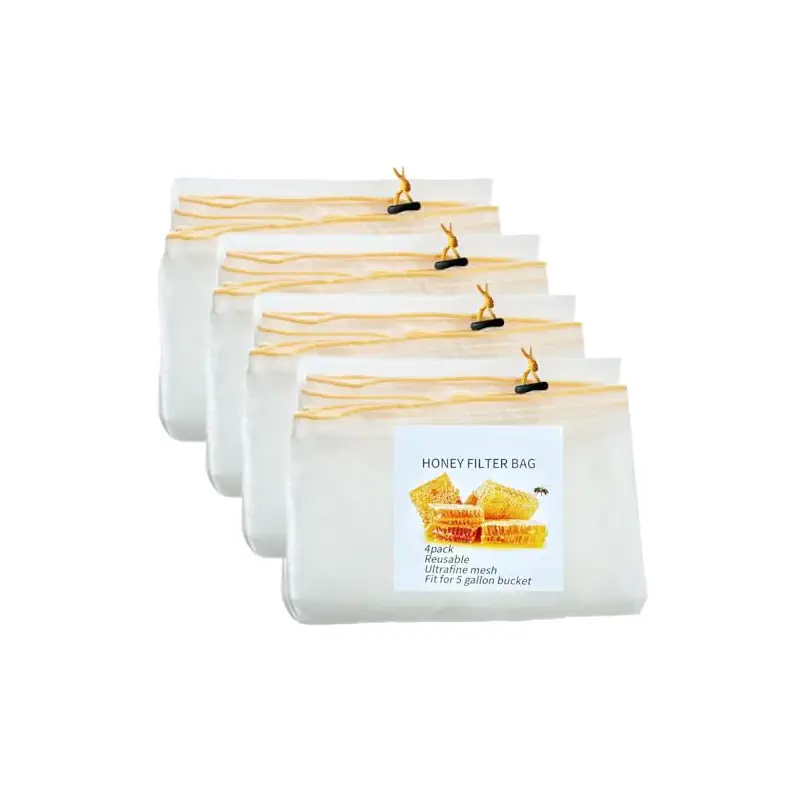
Ideal for: Hobby beekeepers with small harvests, cost-conscious beginners, or those with limited storage space.
The Spmktqk strainer bags offer straightforward, low-cost filtration for small-scale beekeepers. These are fabric pouches with a 125-micron mesh that stretches over the rim of a 5-gallon bucket via an elastic band, letting gravity do the work without any rigid hardware to store or clean. Owners consistently praise them for fitting snugly and producing smooth, clean honey, though one reviewer noted that the fabric can tear after a single use under heavy or rough handling.
Where this approach shines is simplicity and reusability (wash in warm water and dry between seasons). The trade-off is capacity and flow rate: once wax and debris build up inside the bag, the honey slows considerably, and you may need to pause, gently agitate the bag, or swap it out mid-harvest if you're processing large volumes. This makes the bags ideal for smaller harvests or hobbyists who don't mind taking their time.
Compared to the stainless steel double-sieve models, these bags are far lighter on your wallet but require more active attention during straining. If you value speed and hands-off filtering over cost, the double-sieve options will suit you better. But if you want a simple, space-saving solution that works for occasional use, these bags deliver.
Pros
Extremely affordable entry point for beginners
Reusable and washable for multiple seasons
Fits securely over 5-gallon buckets with elastic band
Cons
Fabric can tear with rough handling or heavy loads
Flow rate slows as wax and debris accumulate
Key features
125-micron ultra-fine mesh captures wax, pollen, and particles
Four reusable bags included per package
Food-grade nylon that doesn't absorb honey or degrade
Elastic band secures to bucket rim without fasteners
Ideal for: Multi-hive beekeepers, commercial operations, and anyone prioritizing fast, easy cleanup over ultra-fine filtration.
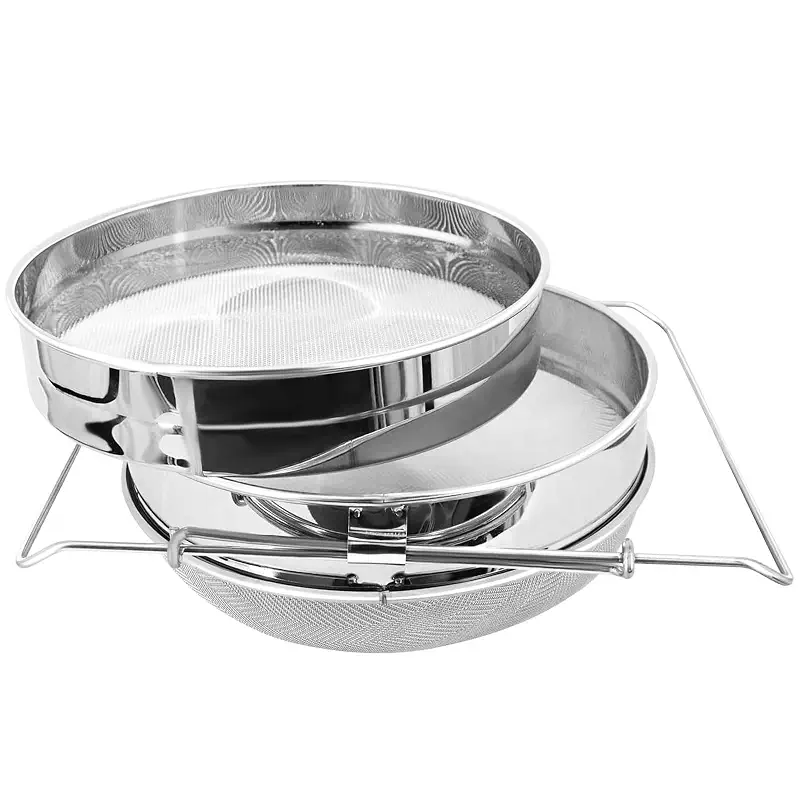
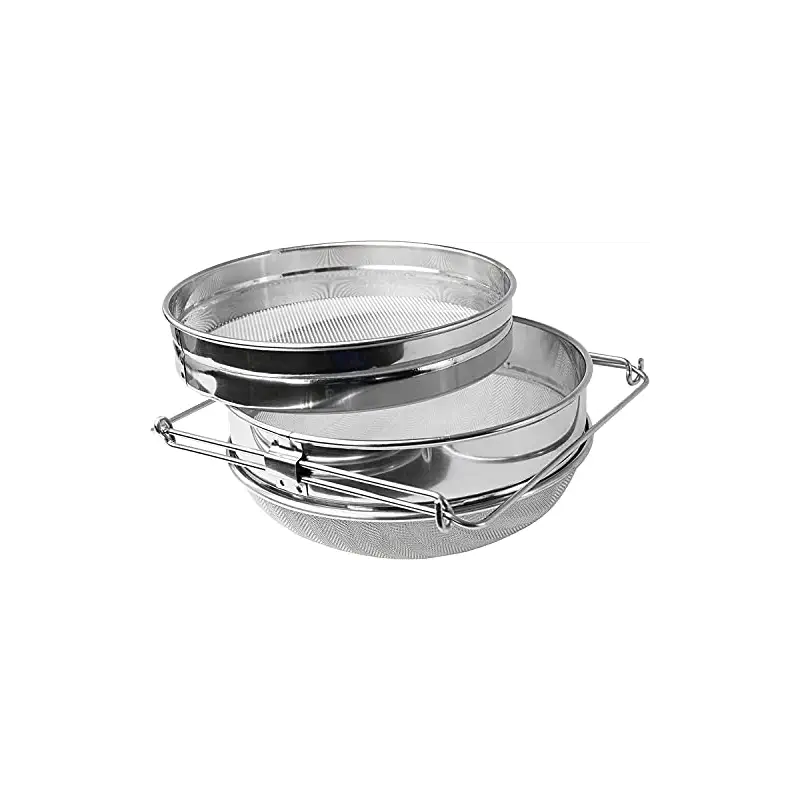
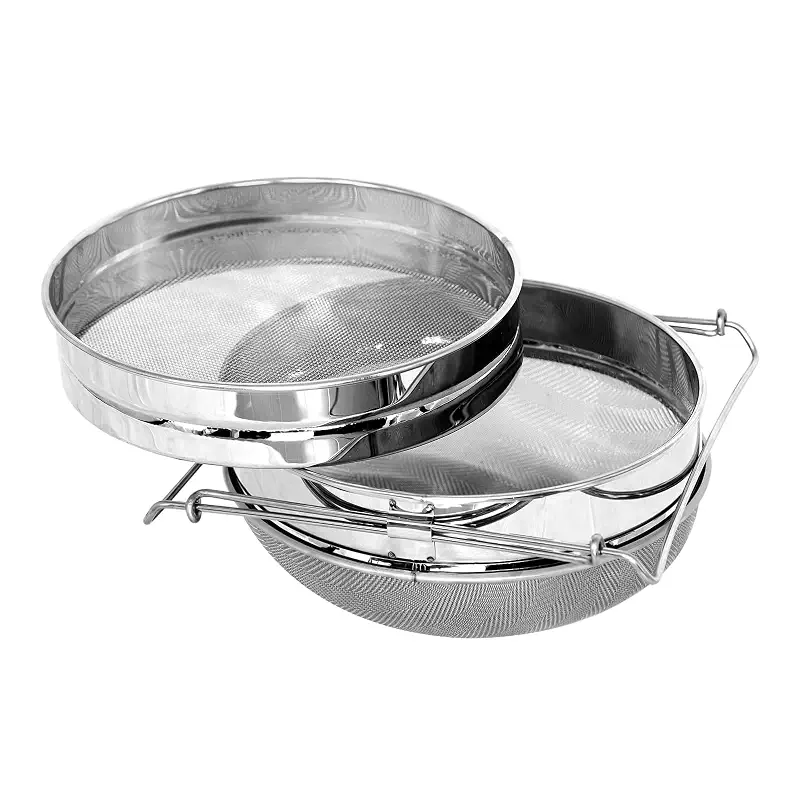
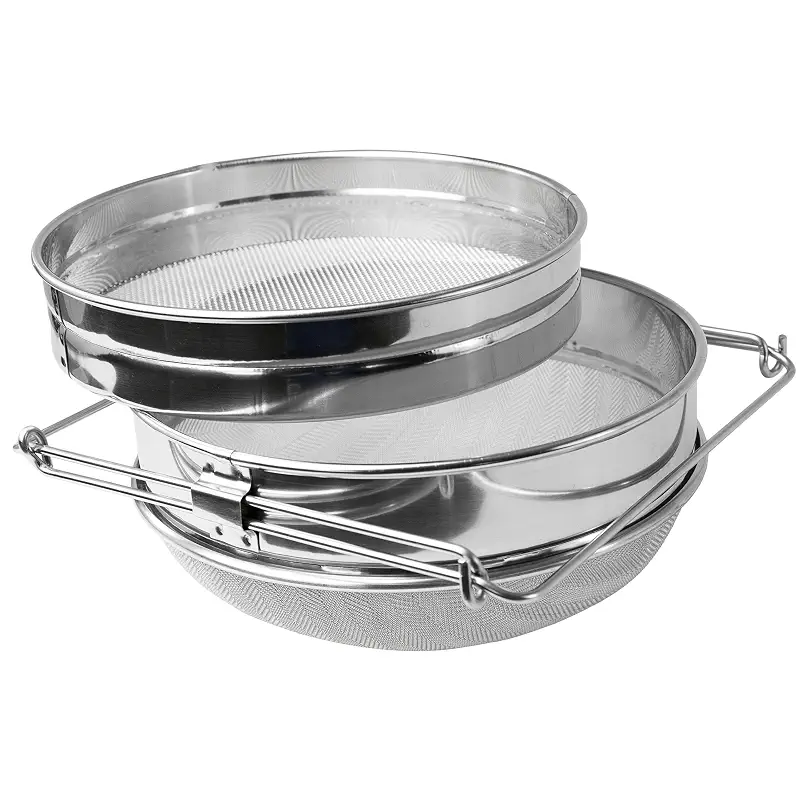
The Beeknows stainless steel strainer employs a two-stage approach: a coarse 1875-micron upper mesh yanks out beeswax and large debris, then the 650-micron lower mesh catches finer impurities. With a 9.4-inch bowl diameter and extendable arms reaching 16 inches, this strainer handles 5-gallon buckets with room to spare. The 304 stainless steel construction resists rust and meets food safety standards, so it's built to outlast several harvests without degradation.
Owners who process significant volumes consistently highlight the speed and ease of cleanup compared to bag-style filters. The two-stage design means wax accumulation is less likely to choke the flow partway through a pour, and you can clean debris from the upper mesh without waiting for the entire strainer to empty. One reviewer who runs four hives called it their new go-to tool after years of using pricier, harder-to-clean steel bucket filters.
The Beeknows does retain slightly more pollen than ultra-fine filters, which some buyers see as a plus (more of the honey's natural profile remains) and others might skip if they demand crystal-clear results. If your primary goal is speed and durability over medical-grade clarity, this strainer punches above its price. It also works for coffee and tea, making it a versatile kitchen tool when not in use for honey.
Ideal for: Beekeepers of any scale seeking proven durability, fast cleanup, and multi-purpose kitchen use.
The Beextm strainer represents the sweet spot where durability meets accessible cost. It pairs 304 stainless steel construction (the same corrosion-resistant grade as higher-priced competitors) with a generous 9.8-inch mesh bowl and adjustable arms spanning 9 to 16 inches. The dual-mesh design mirrors what you'll find in premium alternatives: a 1875-micron coarse layer removes beeswax and large debris, while the 650-micron fine mesh traps smaller particles, resulting in smooth, translucent honey ready for bottling.
With 343 reviews at 4.7 stars, this strainer has proven itself across small hobbyist setups and larger multi-hive operations. Owners praise its sturdy construction, ease of storage, and the fact that it washes clean in a dishwasher. One reviewer mentioned using it for years across multiple harvest seasons without degradation, while another noted it works equally well for kitchen tasks like straining yogurt or milk.
The Beextm holds its own against the Beeknows in design and filtration finesse, but typically costs less. The main practical difference is that the Beeknows bowl is slightly smaller (9.4 inches versus 9.8), which matters if you're pouring large volumes at once. For most beekeepers balancing quality and price, the Beextm delivers the most flexibility.
Ideal for: Single or dual-hive beekeepers, small-space beekeepers, or anyone who values a lightweight, easy-to-store tool.
BeeCastle offers a stripped-down version of the dual-mesh strainer that keeps all the essential filtering power while trimming the footprint. The 9.4-inch bowl diameter and 4-inch depth sit at the smaller end of the spectrum, and the extendable arms reach from 9 to 16 inches, similar to mid-range competitors. The 304 stainless steel construction and two-stage mesh (1875 micron upper, 650 micron lower) handle the same filtration tasks as larger models, just at a pace suited to smaller batches or tighter workspaces.
One reviewer noted it's "a bit small for a 5 gallon bucket" but still does the job, while others used it for tallow rendering and other kitchen applications, highlighting its versatility. The 4.7-star rating across 38 reviews suggests solid reliability, though the lower review count means fewer long-term durability reports compared to the Beextm or Beeknows.
If you're managing one or two hives, have limited storage, or simply prefer a lighter tool to handle and clean, this model won't slow you down. It processes honey at a reasonable pace and cleans easily. However, if you're pulling honey from four or more hives in a single session or frequently handle large harvest volumes, stepping up to the Beextm or Beeknows' larger bowls will save you time.
Pros
Compact size fits tight kitchen or storage spaces
304 stainless steel construction matches premium durability
Ideal for: Beekeepers who value proven track record and community feedback, or those setting up their first honey-processing workflow.
VIVO's double-sieve has amassed nearly 2,950 reviews at 4.8 stars, making it the most publicly vetted honey strainer on the market. The 201 stainless steel mesh (a slightly lower grade than 304 but still rust-resistant and food-safe) pairs with the familiar two-stage design: 1875-micron coarse mesh followed by 650-micron fine mesh. The 9-inch bowl and 15.5-inch arm reach fit standard 5-gallon buckets, though VIVO's own reviews suggest buying two strainers if you're processing more than one bucket per harvest to keep the flow steady while cleaning debris.
Owners consistently report using this strainer for multiple harvests without degradation, and many emphasize the sturdy expandable arms that hold steady without tipping. One reviewer with significant experience advised a warm-water soak to handle crystallized honey during cleanup, which is a minor trade-off for the quality of the filtration and the proven track record. The fine mesh excels at removing wax, but that same precision means rinsing takes slightly longer if honey hardens on the screen.
Compared to the Beextm or Beeknows, the VIVO uses 201 stainless steel rather than 304, which is adequate but not quite as corrosion-resistant over decades. However, the sheer volume of real-world feedback and the number of beekeepers who've stuck with this model for years makes it a safe choice if you value time-tested reliability over marginally premium materials.
Pros
Nearly 3,000 verified reviews provide extensive real-world evidence
Sturdy expandable arms maintain stability on buckets during extraction
201 stainless steel resists rust and cleans in cold water quickly
Cons
201 stainless steel is slightly less corrosion-resistant than 304 grade
Fine mesh requires patient rinsing if honey crystallizes between uses
Key features
Two-stage mesh with 1875 micron coarse and 650 micron fine screens
9-inch diameter bowl and 4-inch depth over 5-gallon buckets
Extendable arms reach 15.5 inches for stable, low-profile fit
201 stainless steel construction resists rust and oxidation
How to Choose a Honey Strainer
Four trade-offs that actually matter when matching a honey filter to your kitchen.
Mesh Type: Single, Double, or Bag
The choice between single versus double sieve strainers hinges on how fine you want the honey and how much flow matters. Bag strainers use a single 125-micron mesh and rely on gravity alone, making them slow but very fine. Double-sieve stainless steel models employ two stages: a coarse upper mesh (1875 micron) that catches wax and large debris, then a finer lower mesh (650 micron) that traps particles. This two-stage design keeps flow moving faster than a single ultra-fine mesh alone. If you're processing small amounts and patience isn't an issue, bags work. For anything more than a couple gallons or if you're managing multiple hives, a double-sieve strainer saves hours.
Material and Durability
Stainless steel strainers come in two grades: 304 and 201. Both resist rust and are food-safe, but 304 is slightly more corrosion-resistant over decades of repeated exposure to moisture and honey residue. Mesh bags are typically food-grade nylon or polyester and last through multiple washes if handled gently, though rough handling or pressure can tear them. If you plan to use your strainer for 5+ harvest seasons or process honey frequently, stainless steel is the long-term investment. For casual, occasional use or as a backup tool, bags are economical.
Bucket Fit and Capacity
Most strainers are designed to rest on top of a 5-gallon bucket without fastening. Check the bowl diameter (typically 9 to 9.8 inches) and the reach of the extendable arms (usually 9 to 16 inches) to ensure stable placement. A larger bowl (9.8 inches) lets you pour more honey at once before wax and debris clog the mesh. Smaller bowls (9.4 inches) work fine for single-hive harvests but may require you to pause and clear debris if you're processing 4+ hives in one session. Straining honey into buckets guide resources cover setup in detail if you're new to the process.
Cleaning and Maintenance
Stainless steel strainers rinse quickly under cold water for initial cleanup and are often dishwasher-safe, though a soak in warm water helps if honey crystallizes on the mesh. Bag strainers wash by hand in warm water and need to dry completely before storage. The finer the mesh, the longer rinsing takes, so if you prioritize speed, a coarser two-stage strainer (like a 1875/650 micron model) cleans faster than an ultra-fine single mesh. Plan 10-15 minutes for stainless cleanup versus 5-10 minutes for bags.
Multi-Purpose Use
Stainless steel strainers work equally well for kitchen tasks like straining yogurt, coffee, tea, or tallow rendering. If your strainer will spend time in the kitchen between harvests, this versatility justifies the investment. Bag strainers are typically reserved for honey alone because fabric is harder to clean thoroughly of non-honey residues. Consider whether you'll use the tool year-round or only during harvest season.
Frequently asked
Quick answers to the questions readers ask most.
What's the difference between a 1875-micron and 650-micron mesh?
The 1875-micron (coarse) mesh removes large wax chunks and debris in the first stage. The 650-micron (fine) mesh catches smaller particles that slip through the first stage. Together, they produce smooth, translucent honey without the slow flow of a single ultra-fine mesh. A lower micron count (finer mesh) filters more thoroughly but slows honey flow.
How often do I need to replace a honey strainer?
Stainless steel strainers last 10+ years with proper rinsing and drying after each use. Bag strainers typically last 1-3 years depending on handling; rough agitation or pressure can tear the fabric sooner. Neither requires replacement if maintained well. The investment in stainless steel pays off over multiple seasons if you harvest annually.
Can I use a honey strainer for other foods?
Yes, stainless steel strainers work for yogurt, milk, tallow, and tea. Bag strainers are best reserved for honey alone because fabric fibers can absorb flavors and are harder to sanitize between different foods. If you plan multi-purpose use, choose a stainless steel model and rinse thoroughly between applications.
Do I need more than one strainer?
If you're processing more than one 5-gallon bucket of honey per session, having two strainers lets you continue filtering while cleaning wax from the first one. Many beekeepers with 3+ hives buy two. For single-hive operations, one strainer is sufficient if you have patience for pauses.
Why does my filtered honey still have particles?
A 650-micron fine mesh (the standard in double-sieve strainers) allows very fine pollen and particles smaller than 650 microns to pass through. For crystal-clear honey, some beekeepers add a third stage with a 400-micron mesh or use ultra-fine bag strainers. Most raw honey retains some fine particles; transparency improves after settling for 24-48 hours as particles fall to the bottom.