Kitchen & Dining · Small
Best Home Slicer
Electric deli slicers, a cheese slicer, a mandoline and an onion holder compared by blade, safety and cleanup, so you can match one to your cooking.
Affiliate disclosure: As an Amazon Associate I earn from qualifying purchases.
At a glance
3
Best for Thin Deli SlicesVevor
4
Best for Quiet KitchensBorlebbi
5
Best for Cheese BoardsBoska
6
Best for VegetablesGramercy Kitchen Company
7
Best Hand-Safety GadgetQPEY
Detailed reviews
We'd steer first-time buyers toward this one because it covers the basics well: a 200W motor, a removable 7.5-inch stainless steel blade, a thickness dial that runs from 0 to 15 mm, and a food pusher with a safety guard. The carriage and blade detach for washing, and the compact 13.9 × 9.9 × 10.9 inch body is easier to find cabinet space for than a bigger machine.
Owners report that it slices deli meat, cheese, bread and even fruit, and that the controls are easy to pick up. A common complaint is that the thickness setting can shift while a cut is underway, and that the base slides around on the counter. Durability reports run both ways, since it is described as sturdy and also as not durable at all, so it suits a household that slices a few times a week better than one planning daily use.
Pros
- Removable 7.5-inch stainless steel blade
- Adjustable dial from 0 to 15 mm
- Safety guard and food pusher included
Cons
- Thickness setting can drift mid-cut
- Base can slide on the counter
- Durability reports are inconsistent
Key features (4)
- 200W motor driving a removable 7.5-inch stainless steel blade
- Dial-controlled cutting range of 0 to 15 mm for varied foods
- Detachable food carriage and blade that simplify cleaning after use
- Safety guard and food pusher keeping hands clear of the blade
Next to the NutriChef Electric Meat Slicer, this model gives you a larger 8.7-inch blade and a thickness range that runs from 1 to 20 mm, plus both a serrated and a non-serrated blade in the box. That pairing matters in practice: the serrated one grips bread and tougher cooked cuts, while the smooth one suits lean meat and cheese. Frozen meat is among the foods it is meant for, and owners making jerky report even strips from a partly frozen top round.
Owners report clean, even slices of meat and homemade bread, thin settings that work, and a food carriage, pusher and blade that come off easily for washing. A common complaint is stability: meat can slip along the carriage, the plastic gripper struggles with larger cuts, and the suction feet can lift on a smooth stone counter. The thickness dial is also reported to be stiff to turn. The frame is larger and heavier than the NutriChef's, so set aside the counter room.
Pros
- Serrated and non-serrated blades included
- Larger 8.7-inch blade for wider cuts
- Blade, pusher and carriage detach for washing
Cons
- Food can slide along the carriage
- Thickness dial can be stiff to turn
- Blade speed is slower than commercial machines
Key features (4)
- Two 8.7-inch blades, one serrated and one smooth
- Thickness adjustment from ultra-thin to roughly three-quarters of an inch
- 200W motor with an upgraded stainless steel 304 blade
- Removable blade, food pusher and food carriage for cleaning
Like the Cusimax Meat Slicer, it ships with a serrated and a non-serrated blade, but here they are 7.5 inches across, run by a 200W motor at 70 to 100 RPM. The thickness knob covers 0 to 0.6 inches, the blade sits recessed by 1 mm, and suction cup feet and a reversible meat tray round out a sensible safety and cleaning setup.
Owners report very even, thin slices, including paper-thin chilled roast beef, and describe it as quiet while running. The weak spots are in the details. A common complaint is that the blade is hard to remove, and the written instructions do not explain the step well, which makes cleaning a chore at first. Durability reports also run both ways: it is described as a heavy-duty, stable build, and also as falling apart repeatedly. We'd pick it for sandwich meat and cheese rather than heavy, frequent slicing.
Pros
- Quiet while the motor is running
- Serrated and smooth blades included
- Suction cup feet add stability
Cons
- Blade removal can be difficult
- Instructions are poorly written
- Durability reports are inconsistent
Key features (4)
- 200W motor running at 70 to 100 RPM for smooth cutting
- Thickness knob covering 0 to 0.6 inches for thin or thicker cuts
- Recessed blade with a food pusher for safer slicing
- Removable blade, pusher and slide bar extender for cleaning
The Vevor Electric Meat Slicer 7.5" matches its pair of 7.5-inch blades, but this one adds a 200W DC motor built for steadier torque and lower noise, along with a child safety lock, a blade cover and non-slip feet. The thickness range is 0 to 15 mm, and the stainless steel tray comes off for washing.
Owners report a quiet machine that handles cheese, bread and sandwich meat well, with slices that stay even from start to finish. Owners who cut brisket and pork belly thin for hot pot partly froze the meat first, and warn that fully frozen meat strains the machine. A common complaint is that very thin, prosciutto-style slices are hard to get, and the unit can shift while running. A stubborn blade lock is also reported along with meat working its way behind the blade, which complicates cleanup. It makes the most sense where low noise and a lighter body matter more than shaving cuts as thin as possible.
Pros
- 200W DC motor for lower noise
- Child safety lock and blade cover
- Two removable 7.5-inch blades
Cons
- Very thin slices are hard to get
- Unit can shift on the counter
- Build quality reports are inconsistent
Key features (4)
- 200W DC motor delivering stable torque at lower noise
- Serrated and non-serrated 7.5-inch stainless steel blades, both removable
- Thickness adjustment from 0 to 15 mm for varied foods
- Stainless steel tray and detachable parts for cleaning
The Boska Copenhagen Cheese Slicer is a hand tool, so it belongs beside the electric machines rather than against them: it will not touch meat or bread, but for a block of semi-hard or hard cheese it is far simpler than any motorized option. The hollow handle keeps it light, the stainless steel construction is dishwasher safe, and it carries a lifetime warranty.
Owners report clean, thin, uniform slices for sandwiches, crackers and boards, and an easy rinse or dishwasher cycle afterward. A common complaint is that very hard cheeses can break during slicing and the slices crumble. It also works on cucumber, carrots and other hard vegetables. We'd add it for cheese boards and everyday snacking rather than expecting it to replace a deli slicer.
Pros
- Dishwasher safe stainless steel build
- Light hollow handle for control
- Lifetime warranty backing the stainless build
Cons
- Very hard cheeses can break or crumble
Key features (4)
- One-piece stainless steel blade for semi-hard and hard cheese
- Hollow handle design that keeps the tool light
- Dishwasher-safe stainless steel body for quick, easy cleanup
- Usable on cucumber, carrots and other hard vegetables
A step up in range from the Boska Copenhagen Cheese Slicer, this mandoline cuts potatoes, onions and similar produce through a rotating blade cylinder with a built-in thickness dial and 12 settings. A 4CR15 stainless steel blade, non-slip base, removable blade guard, cleaning brush and cut-resistant gloves are all part of the package, and the parts are top-rack dishwasher safe.
Owners report that it works well for cabbage and that it cleans up easily, including removing the julienne section. The feedback on cutting itself is less settled: a common complaint is uneven slices and trouble with firm potatoes and carrots, along with blade sharpness that that falls short of expectations and a dial that has failed early. Working out the blade adjustment takes effort at first. The motorized route for vegetables is the electric vegetable slicer, a separate kind of appliance from this mandoline, so choose by how much hand work you are happy to do.
Pros
- 12 slice settings with built-in dial
- Cut-resistant gloves and blade guard included
- Top-rack dishwasher safe parts
Cons
- Uneven slices and struggles with firm vegetables
- Dial reported to break early
- Blade sharpness reports vary
Key features (4)
- Rotating blade cylinder that switches between different cutting styles
- Professional 4CR15 stainless steel blade that holds its edge
- Non-slip base with anti-slip feet to keep the slicer steady
- Cut-resistant gloves, blade guard and cleaning brush included
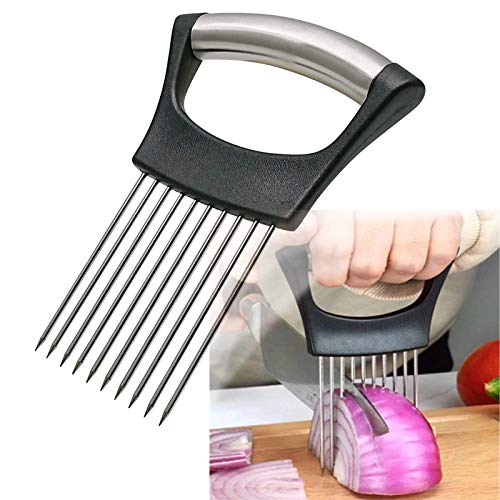
This is not a slicer at all but an accessory, which is why it sits last on the list. It pins an onion, tomato or piece of meat with stainless steel fork tines and a wide non-slip handle, keeping fingers clear of the knife. It is also described as a meat tenderizer, and the handle and tines are dishwasher safe.
Owners report that it holds onions, meat and other produce firmly, makes uniform cuts easier, and helps people with limited knife skills or hand strength. Of the hand-protection options here, the Gramercy Kitchen Company Mandoline Slicer ships with cut-resistant gloves, whereas this one is the lighter, simpler fork. We'd consider it a small, useful add-on for any cook who slices by knife, not a replacement for a slicing machine.
Pros
- Sharp fork tines hold food steady
- Wide non-slip handle for grip
- Dishwasher safe handle and tines
Key features (4)
- Stainless steel fork tines that pin onions and meat
- Extra wide plastic handle with a non-slip grip
- Doubles as a meat tenderizer for deeper flavor
- Dishwasher-safe construction for easy cleaning after every use
Side by side
| Pick | Item weight | Item dimensions |
|---|
#1 Best Overall
NutriChef | 7.94 pounds | 13.9 × 9.9 × 10.9 inches |
#2 Most Versatile
Cusimax | 10.8 pounds | 17.72 × 12 × 14.13 inches |
#3 Best for Thin Deli Slices
Vevor | 8.38 pounds | 14.96 × 9.65 × 10.83 inches |
#4 Best for Quiet Kitchens
Borlebbi | — | 14.6 × 9.4 × 10.2 inches |
#5 Best for Cheese Boards
Boska | 0.13 pounds | 11.42 × 3.15 × 0.79 inches |
#6 Best for Vegetables
Gramercy Kitchen Company | 1.9 pounds | 16.54 × 6.69 × 3.15 inches |
#7 Best Hand-Safety Gadget
QPEY | 0.13 pounds | — |
How to Choose a Home Slicer
Which kind of slicer matches what you cut?
Start with the food, not the machine. Electric deli slicers handle meat, cheese and bread in even sheets, and the Cusimax Meat Slicer is the one we'd choose when the household cuts all three, since it brings two blades to the job. Hand tools are narrower: a cheese plane only works on cheese, a mandoline only on produce, and an onion holder only steadies food for a knife. Matching the tool to the task avoids buying capability you never use.
| Type | Best for |
|---|
| Electric deli slicer | Meat, cheese and bread |
| Cheese plane | Semi-hard and hard cheese |
| Mandoline | Firm vegetables and produce |
| Onion holder | Steadying food under a knife |
How much blade and motor do you actually need?
Blade width sets what fits in the carriage, so a larger blade helps with wide roasts and loaves; the 8.7-inch Cusimax Meat Slicer has more room than the 7.5-inch machines. The motor figure is less telling than it looks, since all four electric picks here share the same 200W rating, and build, carriage stability and blade type end up deciding the result.
A serrated blade grips bread and tougher cooked cuts, while a smooth one suits lean meat and cheese. The Vevor Electric Meat Slicer 7.5" includes both, so one machine can switch between jobs without a second purchase. Check the thickness range too: a dial that tops out near 15 mm is plenty for sandwich meat but limits thicker cuts.
Which safety features are worth checking?
Any slicer with an exposed blade should offer several layers of protection, and the Borlebbi Meat Slicer 200W is the pick here that adds a child safety lock on top of a blade cover and non-slip feet. Look for these before you buy:
- A blade guard or cover when the carriage is parked
- A food pusher so your hand stays clear of the blade
- Suction or non-slip feet that hold the base still
- A child lock or recessed blade setting
- Cut-resistant gloves for mandoline use
How should you clean a slicer?
Cleaning decides whether a slicer gets used, and removable parts make it far easier; the Borlebbi Meat Slicer 200W detaches its blades and tray for exactly this reason. Follow the same order every time:
- Switch off and unplug the machine.
- Remove the blade using the method in the manual.
- Take off the carriage and food pusher.
- Wash the removable parts with warm soapy water.
- Wipe the base with a damp cloth and let everything dry.
- Reassemble only when every piece is fully dry.
Our picks at a glance
3
Best for Thin Deli SlicesVevor
4
Best for Quiet KitchensBorlebbi
5
Best for Cheese BoardsBoska
6
Best for VegetablesGramercy Kitchen Company
7
Best Hand-Safety GadgetQPEY
Frequently asked
Can a home slicer cut frozen meat?
Partly chilled or firm meat works better than rock-hard meat, which strains the motor and blade. Owners of home machines suggest partly freezing fresh cuts before slicing, and the Cusimax Meat Slicer lists frozen meat as something it can handle, so it is the electric pick here we'd try for that job.
Can a meat slicer cut through bone?
No. Home electric slicers are made for boneless food, and slicing through bone or joints can chip the blade and overload the motor. Trim bones and cartilage off before slicing.
Should I choose a serrated or smooth blade?
A serrated blade grips bread and tougher cooked meats, though it leaves a slightly rougher surface. A smooth blade gives cleaner cuts on lean meat and cheese. The Vevor Electric Meat Slicer 7.5" includes both, so it answers the question without forcing a choice.
How do I clean a slicer safely?
Unplug it first, take the blade off carefully, and wash removable parts by hand. The Borlebbi Meat Slicer 200W is a good example of a design built around detachable parts, which keeps the job simple.