Best Electric Vegetable Slicer: Commercial & Home Models
Find the best electric vegetable slicer for your kitchen. Compare commercial-grade and compact models with adjustable thickness, safety features, and durability.
Verdict, analysis, and key features for each pick.
#1 Pick
Best for High-Volume Prep
Vevor
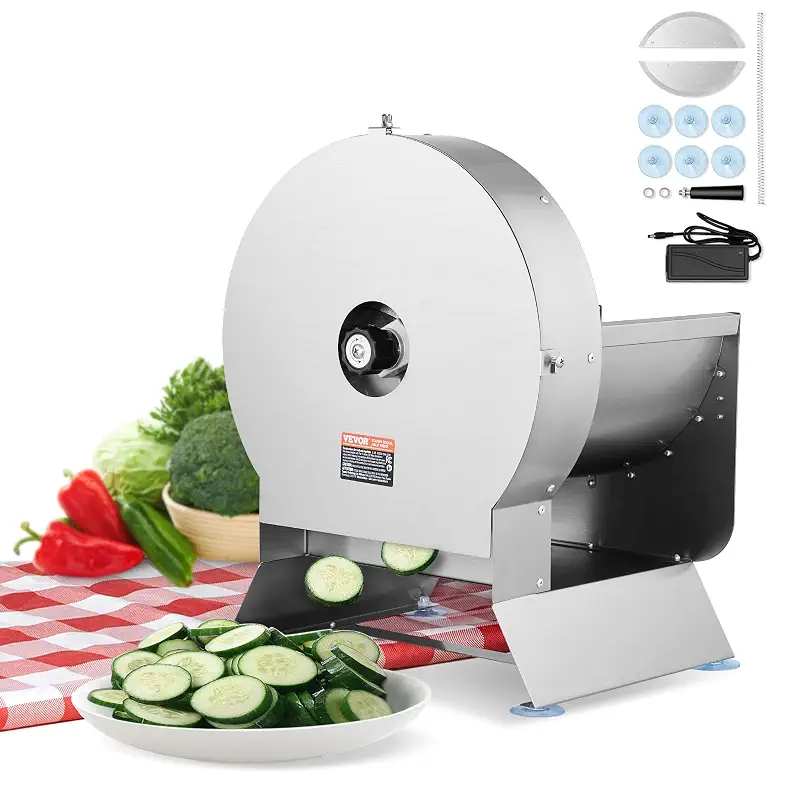
VEVOR Electric Vegetable Slicer, 0-0.5"/0-12mm Thickness Adjustable Commercial Slicer Machine, Convertible to Manual, Stainless Steel Food Cutter Slicing Machine, Large Feed Port for Potato, Tomato
4.4(57)
Commercial-grade durability with dual electric and manual modes for serious slicing operations.
The Vevor model is purpose-built for users who process large quantities of produce regularly. The 420J2 stainless steel blades stay sharp through extended use, and the spring-feed mechanism in electric mode removes the need for constant hand pressure. The large 8.7-by-5.1-inch feed port handles whole potatoes, large cabbage heads, and other oversized items without preprocessing. Owners report cutting sweet potato prep time from hours to minutes, and the uniform thickness adjustable from 0 to 0.5 inches meets both chip-making and salad-slicing needs.
Where this slicer excels is consistency at volume. The machine plows through tough vegetables that frustrate handheld mandolines, and the soft spring prevents delicate items like tomatoes and strawberries from flattening. Unlike the Empculd model's conveyor design, which is purpose-built for leafy greens and softer vegetables, the Vevor trades specialization for raw cutting power across a wider ingredient range.
The main trade-off is size. Owners consistently note that storage is challenging without a dedicated shelf or cart. The manual mode option adds versatility for outdoor use or power-limited settings, though the instruction manual quality has drawn criticism. For commercial kitchens, dehydrator businesses, and serious home food processors, the footprint is a worthwhile investment.
Pros
Handles tough vegetables like sweet potatoes effortlessly
Large feed port accommodates oversized whole produce
Dual electric and manual modes for flexibility
Spring-feed prevents delicate items from bruising
Cons
Large footprint makes storage difficult without dedicated space
Requires hand pressure on feed plate in some conditions
Key features
0-0.5" adjustable thickness with large center knob control
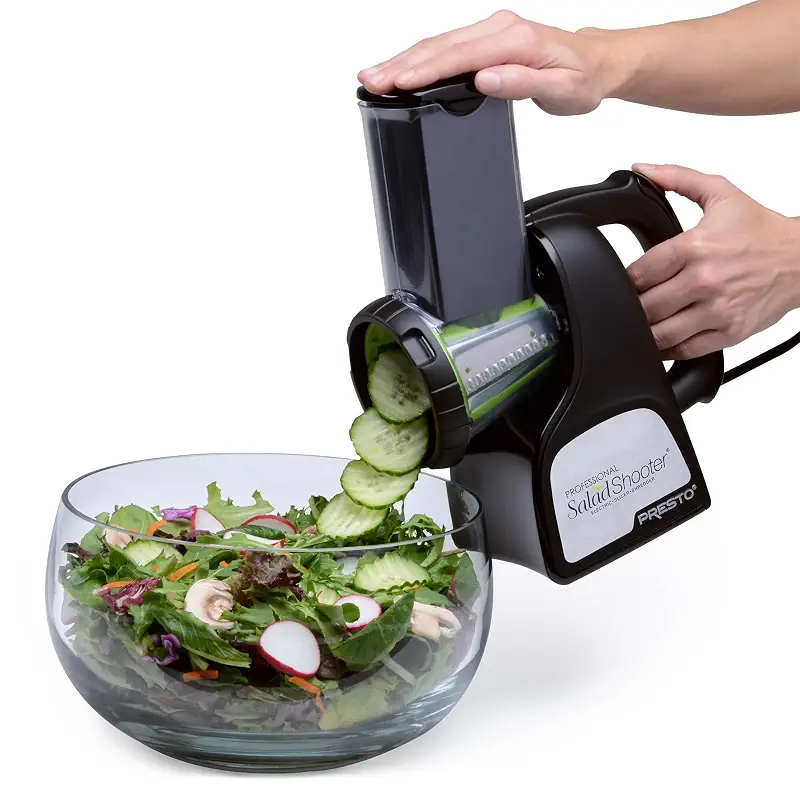
Ideal for: Home cooks wanting cheese shredding, salad prep, and multiple slice/shred options
The Presto SaladShooter is the category standard for home cooks who want to slice, shred, and grate without buying separate appliances. Four interchangeable cones handle thick slices for apple desserts, ripple cuts for vegetable platters, medium shreds for hash browns, and super shreds for coleslaw and stir-fry. Owners report using it for years without failure; multiple reviewers cite 7, 12, and even 15 years of reliable service. The handheld design also means less counter clutter and faster retrieval than cabinet-stored commercial machines.
Compared to the Vevor's high-volume approach, the SaladShooter prioritizes kitchen versatility over raw processing speed. It excels at cheese shredding (a task many commercial slicers don't optimize for), and the adjustable food guide adapts to both large blocks and small loads. The dishwasher-safe parts and easy base wipe-down keep cleanup minimal. However, some food residue gets trapped in the cone-joint crevices: a trade-off shared by nearly all cone-based systems, including the Twomeow model.
The noise level can be a drawback for sound-sensitive households. The motor is audible but not excessive. The large food chamber is marketed for whole potatoes, but realistically it processes smaller cuts more efficiently than the commercial units. For families managing daily salads, cheese storage, and occasional dehydrator prep, this is the longest-proven choice.
Pros
Four cone options cover slicing, ripple cuts, and two shred sizes
Proven 15-year lifespan with no motor degradation reported
Dishwasher-safe parts and minimal base cleanup
Handheld design saves counter and storage space
Cons
Some food residue collects in cone joints and crevices
Motor noise may be noticeable for sound-sensitive users
Key features
Four interchangeable cones plus funnel guide for slicing and shredding
Powerful motor with large food chamber for batch processing
Adjustable food guide adapts to large and small ingredient loads
Dishwasher-safe components, motorized base wipes clean
#3 Pick
Best for Speed and Capacity
Anatole
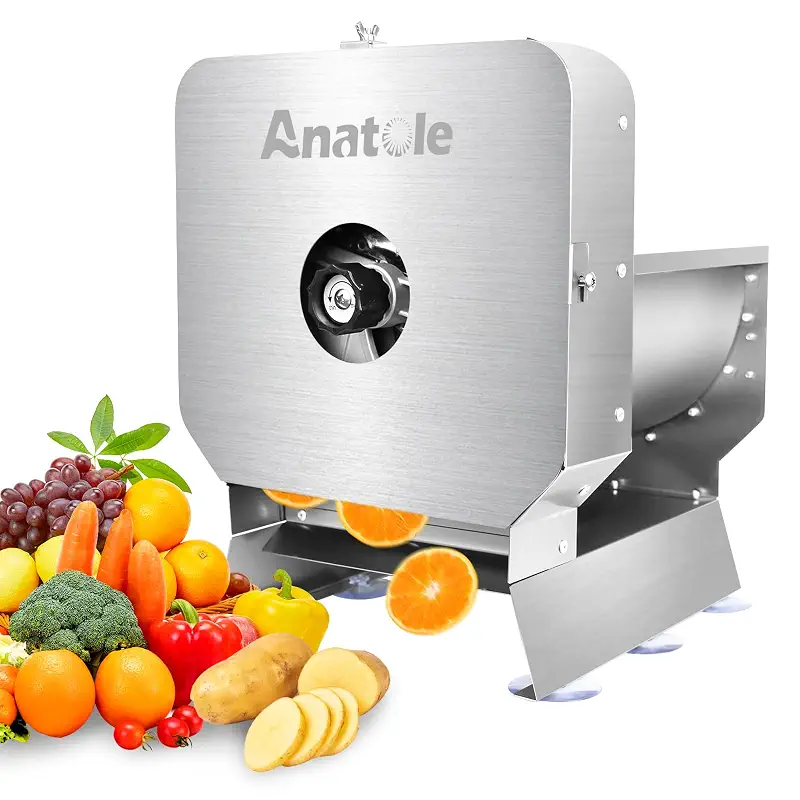
Anatole Electric Vegetable Slicer Commercial Fruit Veggie Cutter 0-0.4" | Stainless Steel, Thickness Adjustable, 300lb/h, Electric & Manual Dual Mode, Large Feed Inlet, for Onion Potato Lime Cabbage
4.6(18)
Commercial-grade dual-mode slicer processing up to 300 lb/h with low-noise DC motor and easy thickness control.
The Anatole model is engineered for speed. The continuous 45-minute runtime and 300 lb/h capacity make it a workhorse for restaurants and serious home food preservation. Owners report slicing 15 pounds of beets, 20 pounds of onions, and 40 bell peppers for dehydration in under an hour. The 0 to 0.4-inch thickness range suits both thin salad slices and chip-cutting. The large feed inlet at 9.84 by 3.94 inches handles up to six whole lemons or potatoes without cutting, and the removable pusher adapts to different produce sizes and textures.
While the Vevor also offers manual mode and large capacity, the Anatole's DC motor and lower noise profile make it better suited for service environments where customer comfort matters. However, the Empculd model's conveyor-belt system achieves higher output (440 lb/h) for leafy greens and softer vegetables, trading blade-sharpness consistency for specialized handling of lighter produce. The Anatole occupies a middle ground: commercial power without the footprint of a true belt-feed system.
One caution from owners: the feeder assembly and spring feel less solid than the main body, not a functional issue, but worth noting if you prioritize premium feel. The stainless steel construction ensures durability, and the sharp blades cut vegetables and fruits evenly. Cleaning is straightforward; the blade disc removes easily.
Pros
Processes up to 300 lb/h with continuous 45-minute runtime
DC motor delivers low noise for commercial kitchen environments
Removable pusher adapts to different produce sizes and softness
0-0.4" thickness adjustable via easy-turn knob
Cons
Feeder assembly and spring feel less rigid than main body
Cannot slice thicker than 0.4 inches if maximum thickness is needed
Key features
300 lb/h continuous processing capacity with 45-minute runtime
Low-noise DC motor suitable for commercial kitchen environments
Large 9.84" x 3.94" feed inlet accommodates whole produce
Stainless steel body and blades with removable blade disc
#4 Pick
Best for Leafy Greens and Delicate Vegetables
Empculd
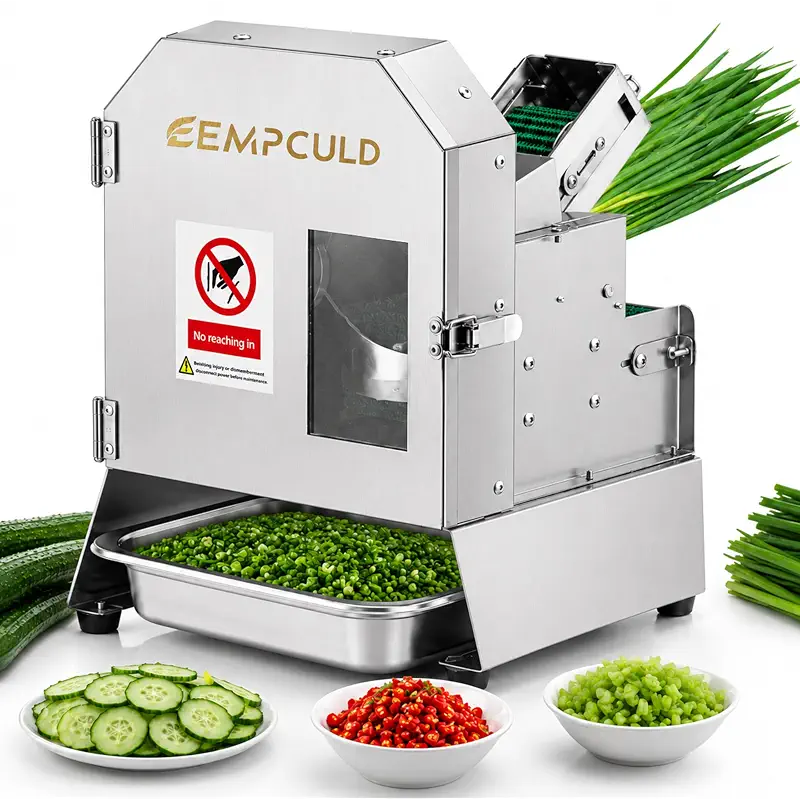
Electric Vegetable Slicer, 300W High-efficiency Automatic Fruit Slicer, 1-35mm Adjustable Thickness Vegetable Cutter for Home and Commercial Use, Track and Blade Rotation Speed Adjustable
3.9(10)
Conveyor-belt design with adjustable blade and feed speeds, ideal for processing long greens and soft vegetables.
Ideal for: Restaurants prioritizing leafy greens, soft vegetables, and specialized produce processing
The Empculd model stands apart with its conveyor-belt system rather than the stationary-blade design of the Vevor and Anatole models. This architecture excels at leafy greens, soft vegetables, and delicate produce that might jam or bruise under spring-feed pressure. The dual adjustment knobs control both blade and conveyor speed independently, so you can fine-tune handling for everything from tender lettuce to firmer root vegetables. Owners rave about its effectiveness on potato leaves, cucumbers, and soft herbs where traditional cone or disc slicers struggle.
The 440 lb/h output capacity is the highest in this lineup, making it superior to the Anatole for pure throughput in specialized vegetable applications. However, the Empculd is electric-only, with no manual fallback mode like the Vevor offers. For restaurants focused on soft-vegetable prep (pickled mustard greens, celery, long onions), this is the right tool. The stainless steel construction and food-grade conveyor ensure durability, and the lid-activated auto-shutoff adds a safety layer the other models lack.
The trade-off is specificity. Hard root vegetables like dense potatoes are not this machine's forte; the conveyor design prioritizes gentleness over crushing force. If your workflow is mixed (hard and soft produce), the Vevor or Anatole will serve you better. For restaurant salad lines or specialized processing (green onions, delicate herbs, thin pepper slices), this pays for itself.
Pros
Conveyor system handles long greens and delicate vegetables without damage
Highest throughput at 440 lb/h for specialized produce types
Adjustable blade and conveyor speeds for precise thickness control
Lid-activated auto-shutoff and large viewing window for safe operation
Cons
Electric-only operation with no manual mode for power outages
Not optimized for hard root vegetables like dense potatoes
Key features
Conveyor-belt system with adjustable blade and feed speeds
440 lb/h capacity with 1.5–35mm thickness adjustment
Lid-activated auto-shutoff and large viewing window for safety
Heavy-duty stainless steel blades and food-grade belt
#5 Pick
Best for Compact Kitchens and Cheese
Twomeow
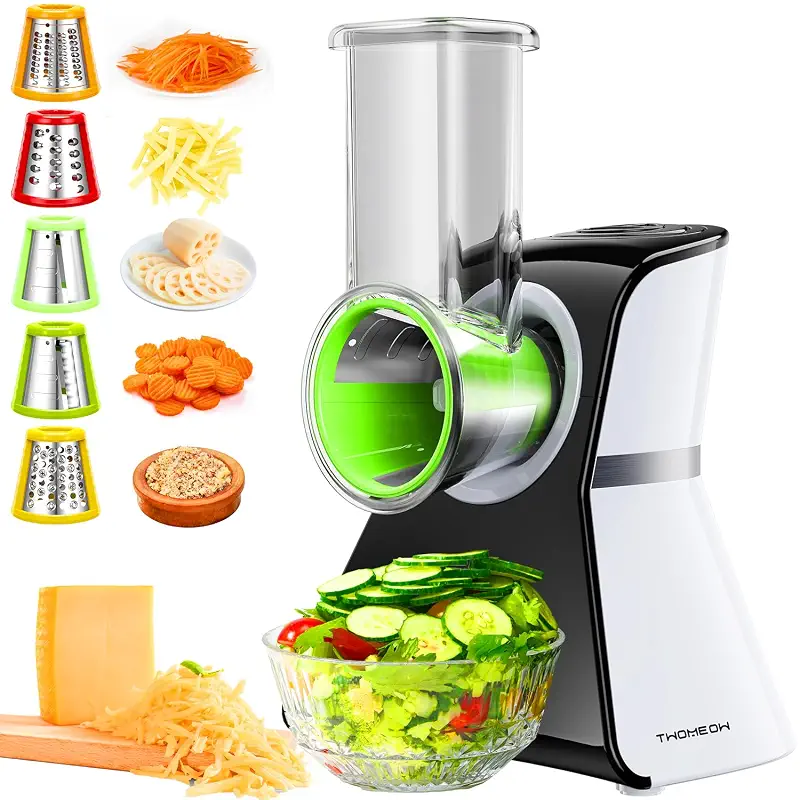
Electric Cheese Grater Salad Shooter,5-In-1 Electric Slicer For Home Kitchen,One-Touch Easy Control,With Safety Push Bar Cheese Grater Electric For Zucchini,Cheese,Vegetables And Smoothie
4.3(593)
Five-in-one handheld unit with wavy, slicing, and grating blades optimized for cheese and shredding.
Ideal for: Small kitchens, cheese enthusiasts, households with limited storage space
The Twomeow is the most space-efficient option, purpose-built for kitchens where counter real estate is premium. The five interchangeable cones cover coarse and fine shredding, wavy slicing, standard slicing, and grating: nearly matching the Presto's versatility in half the footprint. The 150-watt motor runs smoothly and quietly compared to larger commercial units, making it ideal for apartments or shared kitchens. Owners report shredding two pounds of cheese in the time the manual grater took for half a pound, a significant advantage for households consuming large quantities of block cheese.
Where this differs from the Presto SaladShooter is feed-tube size. Multiple owners note the inlet is smaller and requires cheese or vegetables to be cut into manageable pieces before feeding. The Presto accepts larger whole blocks if frozen first, giving it an edge for batch processing. However, the Twomeow's inclusion of a safety push bar and one-touch blade switching make it slightly more user-friendly for beginners. The dishwasher-safe attachments and easy cleaning brush are identical to the Presto's convenience.
The trade-off is raw capacity. At 150 watts, this is not a commercial tool, and high-volume dehydrator work would wear it out faster than the Vevor or Anatole. For daily home cheese shredding, vegetable prep for two to four servings, and compact-kitchen practicality, it hits a sweet spot. The 4-star rating (versus 5-star for the Presto) reflects the smaller feed port as a minor limitation, not a failure. If you also need a top cabbage shredder for fermentation or bulk slaw, however, you'll want the larger Presto or a dedicated manual tool instead.
Pros
Compact handheld design fits small kitchens and tight storage
Five interchangeable cones cover slicing, wavy cuts, and multiple shred sizes
Quiet, efficient motor with powerful sustained performance
One-touch blade switching and safety push bar for ease of use
Cons
Small feed tube requires pre-cutting larger cheese blocks and vegetables
150-watt motor limits high-volume or commercial-grade use
Key features
Five interchangeable stainless steel cones for diverse cutting needs
Compact waist design for easy storage in small kitchens
One-touch operation with safety push bar prevents hand contact
Dishwasher-safe attachments and included cleaning brush
How to Choose an Electric Vegetable Slicer
Four trade-offs that actually matter when matching a electric vegetable slicer to your kitchen.
Processing Volume and Speed
Start with how much produce you typically process at once. Home cooks managing daily salads and occasional batch cooking benefit from compact models like the Twomeow or Presto. Restaurants, catering operations, or food-preservation businesses processing 10+ pounds in a session need commercial capacity like the Vevor, Anatole, or Empculd. The Empculd reaches 440 lb/h for leafy greens; the Anatole tops 300 lb/h across mixed vegetables. For sporadic use, invest in versatility over speed. For regular high-volume work, speed pays for itself in time savings.
Produce Type and Thickness Needs
Consider what you slice most. If your workflow includes hard root vegetables (potatoes, sweet potatoes, carrots), the Vevor and Anatole excel. If you focus on leafy greens and soft vegetables, the Empculd's conveyor system prevents damage that blade slicers risk. The thickness settings guide helps you understand how different machines handle your preferred cut size. Most models adjust from paper-thin (0.04 inches) to thick (0.5 inches), but the Empculd's upper range reaches 35mm, offering more options for chunky cuts if that matters for soups or hand-held chip preparations.
Space and Storage Constraints
Commercial models like the Vevor are large and require dedicated counter or cart space. Handheld units like the Presto and Twomeow store in cabinets or drawers. If counter space is tight, the Twomeow's compact waist design or the Presto's traditional footprint (both roughly shoebox-sized) are practical. The Empculd and Anatole occupy more room but less than the Vevor. Measure your actual storage before buying; several owners regret purchasing large slicers they cannot comfortably house.
Electric Versus Manual Comparison
Most modern slicers offer electric-only operation, but the Vevor uniquely switches to manual mode by removing the protective cover and installing a handle. This matters for outdoor use, power outages, or situations where electricity is unavailable. The electric versus manual comparison lets you choose based on your kitchen setup. If you always have power and value consistent force, electric-only models like the Empculd simplify design. If you value flexibility, the Vevor's dual mode adds real utility at minimal cost.
Durability and Maintenance
Stainless steel bodies and blades resist rust and discoloration during frequent washing. The Presto has proven 15-year longevity for many users; stainless construction keeps it reliable even with daily commercial use. All models here use dishwasher-safe or easily hand-washable parts. Check whether the blade disc or cones remove for thorough cleaning. Food residue in hard-to-reach crevices can harbor bacteria, so verify the design allows full disassembly. The Twomeow includes a cleaning brush; others expect hand-washing or kitchen-sink access.
Frequently asked
Quick answers to the questions readers ask most.
Can these slicers handle both hard and soft vegetables?
Most models handle a range, but with trade-offs. The Vevor, Presto, and Anatole excel at hard vegetables like potatoes and carrots using stationary blades or cone systems. The Empculd's conveyor prioritizes soft, leafy vegetables and can damage firmer produce if pushed. If you mix hard and soft vegetables, the Vevor or Anatole is the safest choice. The Twomeow sits between: it handles both adequately but favors shredding and softer items.
How do I clean these slicers after use?
Most parts are dishwasher-safe on the top rack or hand-wash easily. Remove the blade disc or cones immediately after use to prevent food from drying. For stubborn residue, soak the blade assembly in warm soapy water for 15 minutes. Wipe motorized bases with a damp cloth only (do not submerge). A cleaning brush, included with some models, helps remove debris from cone joints. Dry parts thoroughly before storage to prevent rust, especially if stainless steel shows patina over time.
What thickness range is typical for these slicers?
Most models adjust from roughly 0.04 inches to 0.5 inches, covering thin salad slices through thick chip cuts. The Empculd extends to 35mm (about 1.4 inches) for chunkier cuts. Check the product specs if you need specialty thicknesses; not all slicers offer the same granularity. The thickness settings guide can help you understand how different machines control precision at various cut sizes.
Are these slicers safe to use regularly?
Yes, all models include safety features like pusher bars, non-slip bases, or suction cups to prevent hand contact with blades. The Empculd adds lid-activated auto-shutoff for extra protection. Follow the manual's feeding instructions and never override guards. Handheld models like the Twomeow and Presto require less setup but demand more user attention. Commercial units are designed for multiple daily users, so they meet food-service safety standards. Injuries are rare when using the intended pusher or feeder mechanism.
How long does an electric vegetable slicer typically last?
Durability depends on use frequency and build quality. The Presto has documented 15-year lifespans in home kitchens with regular use. Commercial models like the Vevor and Anatole are engineered for 8-10 years of heavy daily use if maintained. Handheld units like the Twomeow typically last 5-7 years with normal home use. Stainless steel construction and removable parts that resist corrosion extend lifespan. Most manufacturers include 1-2 year warranties; registering the product and following care instructions often qualifies you for support if issues arise.