Kitchen & Dining · Espresso
Best Coffee Refractometer
Seven TDS and Brix meters sorted by range, precision, app support and sample handling, so you can match one to how you brew espresso or pour over.
Affiliate disclosure: As an Amazon Associate I earn from qualifying purchases.
At a glance
2
Simplest Bench Meteryowexa
3
Wide-Range Brix PickLafmate
4
Lab-Brand ChoiceAnton Paar
5
DiFluid-Style AlternativeCoffmeter
6
Value-Minded Sugar MeterFlagfront
7
Best Brewing BundleCoffmeter
Detailed reviews
We'd steer dedicated home brewers and small cafe teams toward the DiFluid R2 Extract Coffee TDS Refractometer. The listing gives a 0-30% TDS range, 0.01% resolution and ±0.02% precision, a figure matched on this page only by the Coffmeter listings. A CMOS sensor and an aluminum sample dish are described as settling readings quickly, and the CoffeeOS app calculates extraction yield, plots brews and stores recipes. The body rinses under the tap and charges over USB-C, which suits a wet coffee bar.
Owners report steady readings, an app that handles the yield math so brews can be compared and repeated, an easy-to-rinse dish and a compact, solid build. We'd add that no meter rescues a cup built on a poor grind or inconsistent puck prep, so this is a tool for people already dialing in. A one-year warranty is listed.
Pros
- 0-30% range with 0.01% resolution
- App calculates extraction yield automatically
- body rinses under the tap
- Compact, solid, readable build
Key features (4)
- CMOS sensor with aluminum sample dish
- CoffeeOS app with brew control chart
- USB-C rechargeable 430mAh battery
- Pocket-sized body, one-year warranty
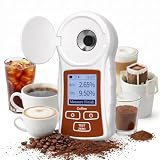
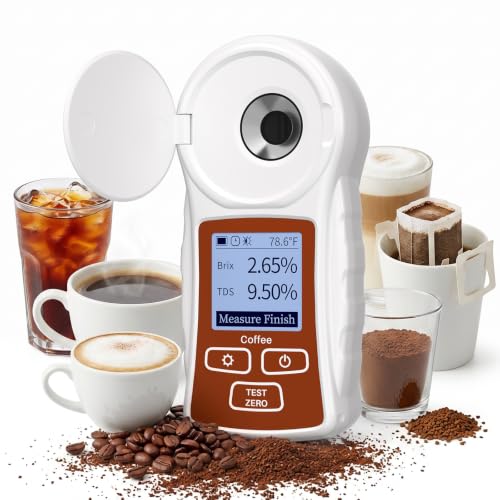
The yowexa Coffee TDS Refractometer suits coffee lovers who want a straightforward meter; its listing mentions no app. It shows TDS, Brix and sensor temperature, covers 0-22% TDS at ±0.2% accuracy with 0.01% resolution, and uses built-in ATC plus a one-touch zero button. A lid cuts glare and evaporation. Charging is by USB cable, and the kit includes a dropper and cleaning cloth.
Owners report that operation is quick, that temperature correction happens on its own and that cleaning is easy. A theme in the feedback is that measuring every brew only makes sense while you are changing beans or recipes. The DiFluid R2 Extract Coffee TDS Refractometer states a tenth of the yowexa's figure for precision and a wider range, though the yowexa's numbers are plenty for filter strength checks. Its listing asks for filtered, bubble-free samples and a cleaned tank between solutions.
Pros
- Reads TDS, Brix and temperature
- One-touch zero calibration
- Lid blocks glare and dust
- Kit includes dropper and cloth
Cons
- Grounds and bubbles can skew readings
- Tank must be cleaned between samples
Key features (4)
- 0-22% TDS range, 0.01% resolution
- Built-in automatic temperature compensation
- Rechargeable with USB cable
- rated body
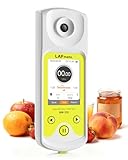
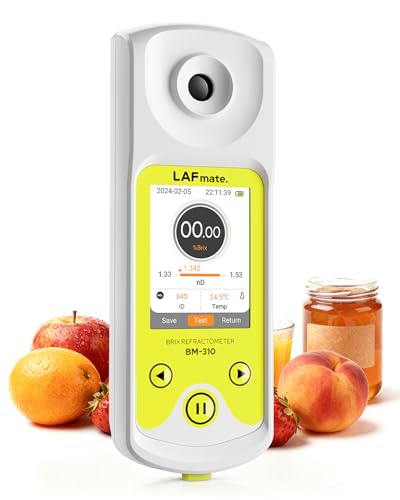
The Lafmate Digital Brix Refractometer 0-95% is the pick for a household that measures more than coffee. It covers 0-95% Brix at ±0.2% accuracy and 0.05% resolution, compensates for temperature from 5°C to 40°C, and calibrates with plain distilled water. The backlit TFT screen stores up to 100 records, and a 750mAh battery is rated for up to 12 hours of use, with an IP65 rating.
Our read rests on the listing alone. The Anton Paar SmartRef Digital Refractometer reports coffee TDS directly, whereas this meter speaks in Brix, so it suits those who want a relative reading for beverages, brewing and wine. It ships with a carrying case, dropper and cloth, plus a 12-month service guarantee.
Pros
- 0-95% Brix range
- Stores up to 100 records
- Calibrates with distilled water
- Includes carrying case and dropper
Cons
- Reports Brix, not coffee TDS
Key features (4)
- Backlit TFT display with multiple units
- 750mAh Type-C rechargeable battery
- Automatic temperature compensation, 5°C to 40°C
- IP65 rating, 12-month service guarantee
The Anton Paar SmartRef Digital Refractometer is aimed at brewers who want a coffee-calibrated meter with a guaranteed figure. It guarantees 0.03% TDS precision at 0.01% resolution, needs only 0.4 mL of coffee, and works on hot, cold or in-between samples thanks to built-in ATC. The free Coffee Meister app guides measurements, calculates extraction yield and stores data in the cloud, and the meter supports over 40 units, including °Brix and refractive index. protection keeps dust and water jets out.
Set beside the DiFluid R2 Extract Coffee TDS Refractometer, the stated precision is a little looser and the range tops out at 20% TDS, the narrowest TDS span among the picks, though espresso and filter coffee both fit inside it.
Pros
- Measures hot or cold samples
- Needs only 0.4 mL sample
- Free app calculates extraction yield
- Over 40 measurement units
Cons
- Narrowest TDS range of these picks
Key features (4)
- 0-20% TDS range, 0.01% resolution
- Built-in automatic temperature compensation
- Coffee Meister app with cloud storage
- dust-tight and water-jet protected
The Coffmeter Coffee TDS Refractometer repeats the 0-30% range, 0.01% resolution and ±0.02% precision found on the DiFluid listing, adds ±0.03% accuracy, and offers Standard, Multi-Test and Auto-Test modes. An rating lets you rinse the sample dish, and an app saves brew data and recipes. Its listed dimensions are 0.91 × 0.57 × 3.31 inches, identical to those on the DiFluid R2 Extract Coffee TDS Refractometer.
Owners report that it is quick and easy to use, compact and accurate, and that a small spoon helps mix and cool a sample. A buyer choosing between it and the DiFluid R2 Extract Coffee TDS Refractometer should know a complaint is that readings wander while a sample is cooling, and another is that results can stray from the documented values. Support responsiveness also draws criticism.
Pros
- 0-30% range, 0.01% resolution
- dish rinses under water
- Standard, Multi-Test and Auto-Test modes
- Compact and easy to use
Cons
- Readings drift while samples cool
- Results can stray from documented values
- Support questions reportedly go unanswered
Key features (4)
- ±0.02% precision, ±0.03% accuracy
- App sync for recipes and brew data
- Calibrates with distilled water
- Portable body, 0.91 × 0.57 × 3.31 inches
The Flagfront Digital Brix Refractometer 0-55% is a no-frills choice for people who also test fruit, food and drinks. It reads 0-55% Brix at ±0.1% accuracy in about 3 seconds using two buttons, compensates for temperature, and has a stainless steel sample tank with an IP58 sealed body and anti-glare design. The kit adds a cloth, a manual and three dipping tubes, with a one-year warranty.
Owners report that it measures accurately and offers good value. Its listing mentions no app and presents sugar content instead of coffee TDS, so it fits general Brix checks better than the extraction tracking the Coffmeter Coffee TDS Refractometer supports.
Pros
- Two-button operation, about 3-second reading
- ±0.1% stated accuracy
- Stainless steel sample tank
- Owners report good value
Cons
- Reports Brix, not coffee TDS
Key features (4)
- 0-55% Brix measurement range
- Automatic temperature compensation
- IP58 sealed body with anti-glare design
- Includes cloth, manual and three tubes
The Coffmeter Coffee Brewing Control System is the most complete setup of the seven for someone starting from scratch. It combines a TDS refractometer, rated at 0.02% precision, with a digital scale that resolves 0.1g and tracks time, weight and flow rate, with the timer starting at the first drip. Both devices connect to the app to log brews and recipes, and the refractometer is waterproof. The listing shows 7.87 × 3.94 × 5.91 inches and a weight of 1 pounds.
Extraction yield needs dose and beverage weight as well as TDS, so this bundle saves buying a scale separately, something the DiFluid R2 Extract Coffee TDS Refractometer leaves to you.
Pros
- Includes scale with 0.1g resolution
- Tracks flow rate and brew time
- Timer starts automatically at first drip
- Both devices sync to one app
Key features (4)
- TDS refractometer with 0.02% precision
- Digital scale with timer
- Rechargeable batteries in both devices
- waterproof refractometer
Side by side
| Pick | Measuring range | Resolution |
|---|
#1 Best Overall
DiFluid | 0-30% | 0.01% |
#2 Simplest Bench Meter
yowexa | 0-22%(TDS)/0-25%(BRIX) | 0.01% |
#3 Wide-Range Brix Pick
Lafmate | — | 0.05% |
#4 Lab-Brand Choice
Anton Paar | 0–20% TDS | 0.01% |
#5 DiFluid-Style Alternative
Coffmeter | 0-30% | 0.01% |
#6 Value-Minded Sugar Meter
Flagfront | 0-55% | — |
#7 Best Brewing Bundle
Coffmeter | — | — |
How to Choose a Coffee Refractometer
Should you buy one yet?
A refractometer reports how concentrated a brew is, not whether it tastes good. If grind consistency, water and ratio are still shifting from day to day, the numbers will describe chaos with false precision, and a scale or grinder upgrade does more. Meters earn their place for people who compare recipes, roast their own coffee or want to separate strength from extraction.
Sample temperature matters here more than water temperature, so the brewing thermometer is useful only for logging the brew itself, never for correcting a reading.
Why does coffee-specific calibration matter?
Coffee meters turn a refractive reading into a TDS percentage using a coffee curve, while generic sugar meters report Brix, which is calibrated for sugar solutions. That is why the Lafmate Digital Brix Refractometer 0-95% and the Flagfront Digital Brix Refractometer 0-55% are better for wide-ranging tasks than for tracking extraction. If extraction yield is the goal, lean toward the Anton Paar SmartRef Digital Refractometer, the Coffmeter Coffee TDS Refractometer or the DiFluid R2 Extract Coffee TDS Refractometer, which all work in TDS.
Resolution and precision matter because brewed coffee sits at low percentages; a 0.2% error is large when filter coffee is only a little over 1%. Range matters at the other end, since espresso runs far more concentrated than filter coffee.
What do TDS and extraction yield tell you?
TDS is the strength of the drink: the share of dissolved coffee in the liquid. Extraction yield is the share of the dry grounds that ended up dissolved, found by multiplying TDS by the beverage weight and dividing by the dose. Two cups can share a strength while extracting very differently, which is why a meter plus a scale is more useful than a meter alone. The Coffmeter Coffee Brewing Control System covers both inputs in one purchase.
| What you taste | What the data may show | What to adjust |
|---|
| Thin, weak cup | Low TDS | Ratio or dilution |
| Sharp, hollow cup | Low extraction yield | Finer grind, more contact |
| Dry, harsh cup | High or uneven extraction | Coarser grind, gentler pour |
| Strong but sour | High TDS, low yield | Raise yield |
Which sample habits keep readings honest?
Sampling errors multiply through the yield calculation, so a careful routine counts for more than extra button presses. Espresso in particular needs filtering to remove fines and bubbles, a point the yowexa Coffee TDS Refractometer spells out in its own notes, while the Anton Paar SmartRef Digital Refractometer is built to take hot samples. If the coffee server sits between the brewer and your sample cup, stir what is in it before drawing a sample, because coffee left standing can settle unevenly.
- Calibrate the meter with distilled water
- Record dose and beverage weight
- Stir the finished beverage thoroughly
- Draw a small sample promptly
- Filter espresso to remove fines and bubbles
- Let the sample approach the meter's temperature
- Read, wipe the dish clean, and repeat
- Note the stable value and taste the coffee
Our picks at a glance
2
Simplest Bench Meteryowexa
3
Wide-Range Brix PickLafmate
4
Lab-Brand ChoiceAnton Paar
5
DiFluid-Style AlternativeCoffmeter
6
Value-Minded Sugar MeterFlagfront
7
Best Brewing BundleCoffmeter
Frequently asked
Can a regular Brix refractometer measure coffee?
It can give a relative sugar-scale reading, but it is not calibrated to report coffee TDS, so extraction yield figures will be less trustworthy. For TDS work we'd choose the DiFluid R2 Extract Coffee TDS Refractometer or the Anton Paar SmartRef Digital Refractometer; the Lafmate Digital Brix Refractometer 0-95% fits better as an all-round beverage meter.
Which pick copes best with hot samples?
The Anton Paar SmartRef Digital Refractometer is the one whose listing explicitly says you can measure hot, cold or anything between. The yowexa Coffee TDS Refractometer also has temperature compensation, though it advises a short wait on very hot or cold liquids, and owners of the Coffmeter Coffee TDS Refractometer report drifting values while samples cool.
What if I don't own a brewing scale?
You need dose and beverage weight to turn TDS into extraction yield, so a scale is part of the setup. The Coffmeter Coffee Brewing Control System includes one with a flow-rate readout and auto-start timer, which makes it the most practical starting point from scratch.
Does espresso need filtering before a reading?
Generally yes, since fines and bubbles can distort an optical reading. The yowexa Coffee TDS Refractometer states this in its own notes, advising filtered, bubble-free samples, and the same habit helps with any pick here.
What do TDS and extraction yield tell you that taste does not?
TDS shows how concentrated the cup is, and extraction yield shows how much of the grounds dissolved, so together they separate a recipe problem from a grind problem. The Anton Paar SmartRef Digital Refractometer and the Coffmeter Coffee Brewing Control System both calculate yield in their apps.