Kitchen & Dining · Espresso
Best Brewing Thermometer
Find the best brewing thermometer for homebrewing, candy making, and frying. Compare digital, dial, and weldless options with expert reviews.
Affiliate disclosure: As an Amazon Associate I earn from qualifying purchases.
At a glance
2
Best Budget PickCRBrewBeer
3
Most Popular with HomebrewersHome Brew Stuff
4
Best for Permanent InstallationFerroday
5
Best for Precision Candy WorkCraft911
Detailed reviews
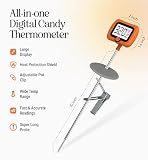
The TempPro TempDip stands out because it delivers what matters most in the kitchen: speed and precision without fuss. A one-second readout means you're not standing over the pot timing the thermometer; you get your answer immediately. The ±0.9°F accuracy is tight enough for candy stages and brewing temperature steps, and owners report it reading consistently across boiling water tests and multiple batches of fudge and brittle. The 10-inch stainless probe reaches well into a kettle or pot without requiring you to lean over steam, and the rotating LCD screen (with 90-degree tilt) adjusts to whatever angle works for your setup.
The pot clip is a genuine game-changer. Rather than holding the thermometer steady with your hand or rigging it awkwardly, you clip it to the side of your pot, freeing you to stir, monitor other elements, or just step back and watch. Buyers who've moved from dial thermometers or analog candy thermometers note how much simpler the clip system is than balancing a probe by hand. The IPX5 waterproof rating means a quick rinse under running water doesn't require you to dry each component separately or worry about moisture creeping into the display.
One caveat: a handful of owners experienced the display blinking or failing after extended use, but notably, simply changing the battery resolved the issue. The large, easy-to-read LCD and sturdy plastic-and-stainless construction suggest this thermometer will last years if you attend to battery maintenance. For homebrewers moving from dial thermometers and candy makers tired of guesswork, this is the thermometer that pays for itself in confidence and consistency.
Pros
- One-second temperature reading with ±0.9°F accuracy
- Pot clip keeps probe steady without hand-holding
- Long 10" probe extends safely above steam and heat
Cons
- Battery replacement needed occasionally; display may blink when depleted
- Requires holding at correct height to avoid bottom-pan contact
Key features (5)
- Digital LCD display with 1.5" rotating screen tilts 90 degrees
- 10-inch stainless steel probe with secure pot clip
- Temperature range -58°F to 572°F in 1-second intervals
- IPX5 waterproof design for easy cleaning under running water
- Measures in both Fahrenheit and Celsius
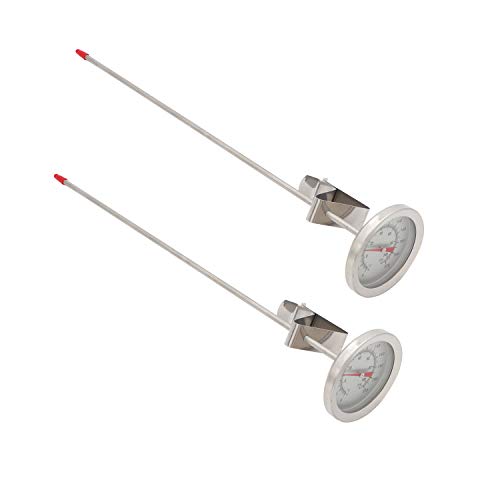
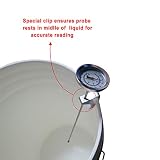
The CRBrewBeer dial thermometer arrives as a pair, which immediately appeals to brewers managing multiple mash pots or those who want redundancy without spending heavily. At this price point, dual-scale reading in both Fahrenheit and Celsius is genuinely practical, and the 12-inch stainless stem reaches into a full kettle without crowding your space. The clip attachment works quickly, and once set, you don't need to fuss with it through the brew day.
Accuracy is the trade-off you make with dial thermometers, and buyers here report variance of 3–5 degrees depending on the individual unit. One experienced brewer ran both units on the same pot of boiling water and saw them read 212°F consistently, yet at room temperature they diverged by 3 degrees. Another found it reads 3 degrees low compared to a PID controller but close enough for typical brewing work. Most owners calibrate at the boil point before brew day, which takes seconds with a small wrench included in the package, the same disciplined dialing-in that coffee grinder for chemex picks demand to match grind consistency to a brewer's exacting needs. What separates these from cheaper alternatives is that buyers say they hold calibration across batches, unlike some competitors that drift significantly after a few uses.
Compared to the Ferroday weldless option, this clip-on design requires no kettle modification, making it ideal if you're renting brewing equipment or want to move thermometers between pots. However, the dial face is smaller and takes a few seconds to stabilize, whereas the digital TempPro reads in one second. For homebrewers on a tighter budget who don't mind waiting a few seconds and can accept 3–5 degree variance, this pair offers reliable performance and backup redundancy.
Pros
- Comes as a pair for multiple kettles or redundancy
- Adjustable with small wrench if calibration drifts
- Stainless clip attaches easily without kettle modification
Cons
- 3–5 degree variance between units and from true temperature
- Dial stabilization takes several seconds longer than digital options
Key features (5)
- Dual-scale dial reading: 0–220°F and -10–100°C
- 12-inch stainless steel stem for deep kettle insertion
- 2-inch diameter easy-read dial face
- Clip design attaches to any brew pot without drilling
- Includes two thermometers in single purchase
The Home Brew Stuff dial thermometer has earned its popularity through consistent performance across hundreds of brew days. Owners frequently compare it favorably to entry-level digital options, and many have kept the same unit for years without drift or rust. The 12-inch probe is appropriately long for a full kettle, and the clip grips the edge securely without tilting or sliding as you stir or lift the pot. The large 2-degree increment markings keep reading straightforward, even when steam fogs the dial face (which happens when you drape foil over the kettle, but the fog clears quickly).
Accuracy hovers within ±2–4 degrees when calibrated correctly, which one owner demonstrated by testing against an instant-read digital thermometer and finding whole-degree agreement. Several brewers note that this thermometer handles the mash-step precision needed for grain extraction far better than cheaper alternatives, and the feedback reflects respect for the value. One owner bought two additional units for compost monitoring after trusting the brewing model, testament to durability across temperature extremes.
Where this dial model trails the TempPro digital is speed and precision: you're reading an analog needle, not a precise digital number, so if your recipe calls for a specific temperature (say, 148°F for a protein rest), you're approximating slightly. Compared to the Ferroday weldless thermometer with its permanent installation, this clip design stays portable across equipment. For brewers who want a thermometer they can rely on for years, move between kettles, and read in a glance without batteries or recalibration worries, this Home Brew Stuff model remains the standard choice.
Pros
- Large dial face reads clearly even through steam
- Accurate within ±2°F when properly calibrated
- Durable stainless construction holds up to years of brew days
Cons
- Needle requires visual interpretation; not as precise as digital display
- Takes a few seconds to stabilize to liquid temperature
Key features (5)
- 12-inch stainless steel probe with secure kettle clip
- Large 2-inch diameter dial with 2-degree incremental markings
- Temperature range 0–220°F suitable for brewing and cooling
- Calibration adjustment nut allows recalibration at boil or freeze
- Reusable across brew kettles, mash tuns, and fermenters
The Ferroday weldless thermometer is purpose-built for brewers who have drilled a 1/2-inch hole into their kettle and want a thermometer that stays integrated with the equipment. Unlike clip-on designs, this sits flush with a kettle port, eliminating probe contact with the bottom and keeping the liquid from settling around the sensor. The 3-inch glass dial is the largest in this lineup, making it readable from several feet away, and the high-contrast black numerals on white background hold visibility even under bright kitchen or brewing-space lights. The 2-inch probe is shorter than clip-on alternatives, but that brevity actually aids accuracy in deeper kettles by placing the sensor in the true wort body rather than near the surface.
Owners consistently praise the ease of installation once a hole is drilled; the 1/2 NPT fitting and nut thread easily into place, though several note that adding plumber's tape to the threads prevents weeping at the seal. The stainless steel construction and food-safe silicone washer suggest longevity, and buyers report the thermometer holding calibration across multiple brew seasons. Where it differs from the Home Brew Stuff dial clip is permanence: once installed, you're committed to that kettle. A few owners experienced initial water seepage or fogging inside the dial, but these issues typically resolve or remain cosmetic if the unit is installed with proper sealing tape.
Compared to the dial versus digital brewing thermometer options available, the Ferroday sits at the intersection of precision and integration: you get excellent readability and no battery dependency, but you sacrifice portability. For brewers building or upgrading a dedicated kettle, this is the professional-grade choice that reflects a commitment to consistent brewing infrastructure.
Pros
- Largest 3-inch glass dial face, most readable from distance
- 1/2 NPT fitting integrates into kettle port permanently
- 2-inch probe placed in true liquid body avoids surface fluctuations
Cons
- Requires drilling kettle; not portable across equipment
- May require plumber's tape to prevent initial leaking at threads
Key features (5)
- 3-inch glass dial with dual-scale reading: 0–220°F and -10–100°C
- 1/2 NPT male-threaded fitting with food-safe silicone O-rings
- 2-inch stainless steel probe for accurate wort measurement
- Stainless steel 304 construction with lifetime corrosion resistance
- Large high-contrast dial markings: 2-degree increments for easy reading
The Craft911 digital candy thermometer brings features borrowed from professional kitchen tools down to the home cook's budget. The 10-inch stainless probe is long enough to keep your hand safely above steam, and the instant-read digital display updates every 3–5 seconds, which matters enormously when you're pulling a candy batch to soft-ball, hard-ball, or hard-crack stage. Unlike some digital thermometers that show every half-degree fluctuation in a volatile environment, this one settles to a reliable number quickly, giving you confidence to pull the pan when you hit the target.
A standout feature is the recalibration function using ice water, which one owner called a trust-builder. If you're skeptical of a new digital thermometer or notice drift after months of use, you can recalibrate it yourself without tools or returning it. The pot clip holds the probe at a consistent depth so you don't have to steady it while stirring fudge or caramel, and the waterproof design means you can rinse it immediately without worry. Owners making marshmallows, toffee, and chocolate work have found it precise and reliable.
One caveat worth noting: a couple of reviewers experienced overheating issues with the plastic body during extended oil-frying use, with the display becoming unreadable. For candy work (which rarely exceeds 300°F) and occasional deep frying, this is less of an issue; but if you're planning sustained oil frying at near-maximum temperatures, the TempPro might be more tolerant. A few owners also reported accuracy off by 1–2 degrees, though that's within acceptable tolerance for most candy and cooking work. Where this model differs from the TempPro is the recalibration option and slightly lower feature count, making it a solid second choice if the TempPro is unavailable, and a natural pick for cooks prioritizing candy precision over multi-use versatility.
Pros
- Recalibration feature with ice water builds trust and extends accuracy
- 3–5 second response time gives stable readings in boiling sugar
- Pot clip keeps probe positioned without hand-holding
Cons
- Plastic body can overheat during extended high-temperature oil frying
- May read 1–2 degrees off depending on unit; recalibration helps
Key features (5)
- 10-inch stainless steel probe with secure pot clip attachment
- Digital LCD display with instant 3–5 second readings
- Wide temperature range -58°F to 572°F covers candy, frying, and baking
- Recalibration function using ice water maintains long-term accuracy
- IP65 waterproof rating for easy cleanup under running water
How to Choose a Brewing Thermometer
Digital vs. Dial: Speed and Precision Trade-offs
The choice between a dial versus digital brewing thermometer hinges on your workflow. Digital thermometers like the TempPro read in one second and display exact numbers, making them ideal for candy stages (soft-ball, hard-crack) where a few degrees shift the outcome. Dial thermometers read more slowly and require visual interpretation, but they need no batteries and hold calibration reliably across years of use. For homebrewing grain mashing, both work well; brewers accept ±2–4 degree variance as normal. Candy makers and precise oil-frying work favor digital. Budget-conscious brewers often choose dial pairs for redundancy. Consider how much precision your recipes demand and whether you'll tolerate occasional battery changes.
Probe Length and Clip Design Matter
A 10–12 inch probe reaches comfortably into a standard 5–10 gallon kettle without forcing your hand over steam. Clip-on designs (like the TempPro and Home Brew Stuff models) attach to the kettle side, freeing your hands to stir and manage the burner. Weldless 1/2 NPT thermometers, like the Ferroday, install permanently into a drilled kettle port, eliminating probe contact with the bottom and improving accuracy. Choose clip-on if you move thermometers between pots or haven't drilled your kettle yet; weldless if you've built dedicated brewing equipment. Long probes also reduce the chance of plastic body overheating in high-temperature oil or prolonged boiling.
Accuracy and Calibration Needs
Dial thermometers typically hold ±2–4°F accuracy and can be recalibrated using boiling water or ice water and a small wrench. Digital thermometers offer ±0.9°F precision, though some units drift 1–2 degrees over time. Most homebrewers find dial accuracy 'good enough' for grain work; candy makers and frying cooks prefer digital. Check whether your thermometer includes a recalibration method (some dial models include a wrench, some digital models allow ice-water recalibration). Higher price doesn't always mean better long-term accuracy: it often reflects durability and ease of use instead.
Durability and Waterproof Rating
Stainless steel probes resist rust and corrosion across repeated brew days. IPX5 waterproof ratings (digital) mean you can rinse under running water without worry. Dial thermometers' stainless construction is inherently durable; some owners report the same unit working reliably after a decade. Weldless thermometers should use food-safe silicone washers to prevent leaking at the port seal. Check whether the dial face is protected from splash (some fogging under foil is normal and clears). Digital displays can overheat if the plastic body stays exposed to sustained high-temperature oil or steam, so reserve digital options for candy and occasional frying rather than constant high-heat work.
Portability vs. Permanent Installation
Clip-on and handheld thermometers move freely between any pot, kettle, or vessel you own, making them ideal if you brew in borrowed equipment or experiment with different kettles. Weldless threaded thermometers integrate into a single drilled kettle and stay there, creating a dedicated brewing setup that professional brewers favor. Consider how many kettles you own and whether you plan to expand your brewing equipment. If you're just starting, clip-on flexibility is worth more than early permanent installation.
Our picks at a glance
2
Best Budget PickCRBrewBeer
3
Most Popular with HomebrewersHome Brew Stuff
4
Best for Permanent InstallationFerroday
5
Best for Precision Candy WorkCraft911
Frequently asked
Can I use a brewing thermometer for candy making?
Yes. Dial brewing thermometers read up to 220°F, which covers most candy work (soft-ball stage is 235–245°F, hard-crack is 300–310°F). However, digital candy thermometers extend to 572°F and respond faster, making them better for precise candy stages. A 10-inch probe keeps your hand safely out of steam either way. If you brew and make candy, a digital thermometer covers both better than dial alone.
How do I recalibrate a dial thermometer?
Place the thermometer in a cup of boiling water (with the tip submerged) or crushed ice water. Wait for the reading to stabilize. If it reads above 212°F (boiling) or below 32°F (ice), use a small wrench to turn the adjustment nut on the back of the dial until the needle points to the correct temperature. Most clip-on dial models include a wrench. Recalibration takes under a minute and can be done before each brew day if needed.
Do I need to drill my kettle for a weldless thermometer?
Yes. Weldless thermometers like the Ferroday screw into a 1/2-inch NPT hole you drill into the kettle side. Clip-on thermometers require no drilling. If you're not comfortable drilling or don't own a dedicated kettle, choose a clip-on model. Weldless installation is permanent and professional-looking but commits you to one kettle.
How long do digital thermometer batteries last?
Most digital thermometer batteries last 1–3 years of regular use. If the display blinks or dims, replacing the battery (usually a standard LR44 or AAA) restores function immediately. Keep a spare battery on hand during brew season. Dial thermometers require no batteries, which appeals to brewers who prefer zero maintenance.
Can a brewing thermometer measure room temperature and body temperature?
Most brewing thermometers measure 0–220°F, which covers boiling and chilled wort but not precise body temperature (normal is 98.6°F; fever readings need 0.1°F precision). Some digital candy thermometers extend to -58°F and can read lower ranges, but they aren't calibrated for medical use. Use a dedicated meat or clinical thermometer for body temperature. Brewing thermometers are designed for kitchen liquid and oil work.