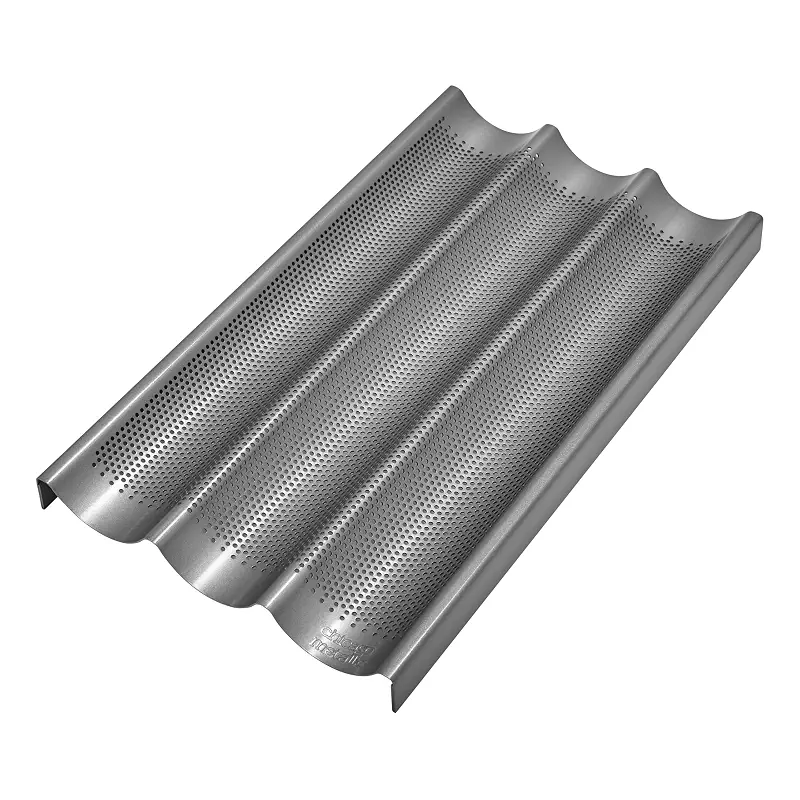
Ideal for: Home bakers who bake regularly and don't mind hand-washing and light oiling for longevity.
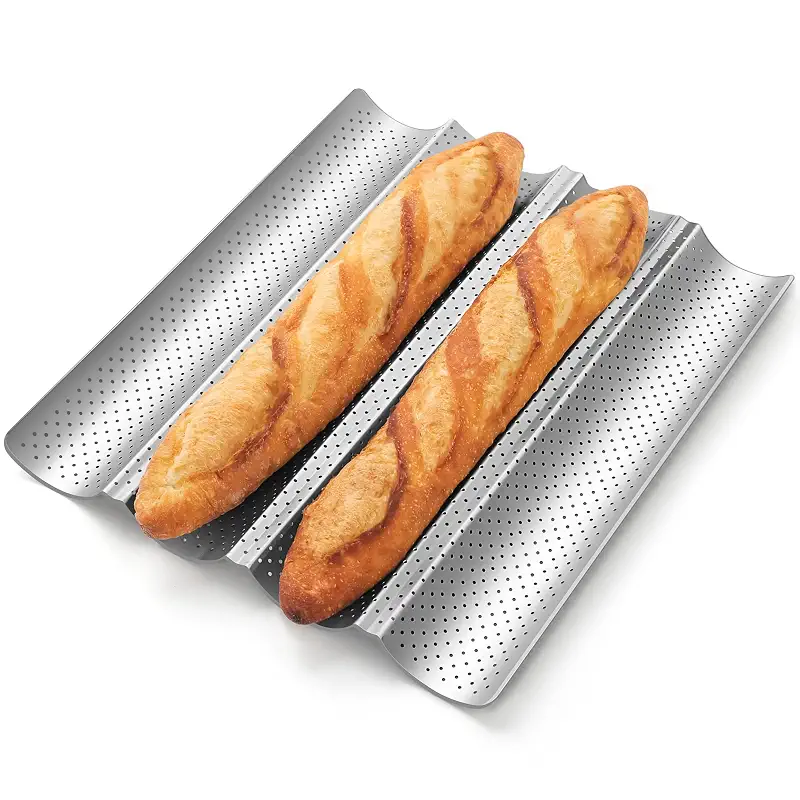
The Chicago Metallic Commercial II has earned its reputation through straightforward engineering and materials that perform. Owners consistently report that bread releases cleanly, and the perforated design delivers the bottom-to-top browning home bakers want. The dual-layer nonstick coating holds up better than many competitors when treated with care: hand washing and light oiling between uses keeps it in working order for years. Heavy-weight aluminum conducts heat evenly, so you don't face the hot spots that plague thinner pans.
One real trade-off: the nonstick coating demands respect. Unlike some modern finishes, this one benefits from a protective routine: a thin layer of coconut or olive oil applied after washing extends its life, the same humidity-conscious thinking behind choosing the right pizza dough proofing box to prevent dough from drying out. Some bakers see the pan as fragile in this regard; others view that maintenance as the price of reliable performance. The perforations do create a textured impression on the underside of loaves, which appeals to some bakers and annoys others who prefer an unmarked bottom.
I'd choose this over the Pavsrmy or Kitessensu if you value proven durability and don't mind a small maintenance ritual, the same even heat distribution that pan for flan picks prioritize matters just as much for bread. It bakes three loaves at once, making it practical for entertaining or meal prep, and the consistent results owners report suggest the engineering justifies the care it requires.
Pros
Perforated aluminum heats evenly, no hot spots
Proven nonstick coating lasts with proper care
Fits three full-size baguettes or sub rolls
Cons
Nonstick coating requires hand washing and light oiling
Bottom texture transfer visible on bread undersides
Key features
Heavy-weight aluminum construction with superior heat conduction
Dual-layer nonstick coating designed for easy release
Perforated bottom facilitates air circulation and moisture escape
Accommodates three 16-inch baguettes or sub rolls in one bake
Dishwasher safe, though hand washing preserves nonstick finish
#2 Pick
Best for High Volume
Pavsrmy
Pavsrmy Baguette Bread Pan, Premium Nonstick Perforated Baguette Pan for French Bread Baking, 4 Loaves Baguette Baking Tray for Sourdough, Italian Bread, Perfect for Creating Crisp Golden-Brown Crust
4.6(1,469)
Largest capacity at four loaves per bake, though build quality varies and edges need care.
Ideal for: High-volume home bakers with large ovens and ample storage who proof dough in the pan.
The Pavsrmy offers the most baguette capacity of any pan in this lineup (four loaves at once) which appeals to serious home bakers, people meal-prepping, and anyone hosting. The carbon steel construction conducts heat quickly, and owners who've shaped it correctly report excellent browning and crust formation. The perforations are small enough that slack or wet dough stays put, letting you proof right in the pan and slide straight into the oven. For bakers committed to sourdough or high-hydration doughs, that workflow saves a proofing basket step.
Build quality has real variance. Multiple owners flagged sharp edges (one person was cut upon unboxing), and some units arrived bent or warped. The pan also feels thin to some users, though it performs well once in the oven. The larger footprint (15 by 13 inches) won't fit all proof boxes or standard half-sheet dimensions, which limits logistics for some home bakers. Hand washing only; dishwasher claims apply to some versions but not this one.
Compared to the Chicago Metallic, this trades a bit of structural heft for four-loaf throughput. If your oven is large enough and you're willing to inspect for shipping damage, the capacity is a real advantage. But the quality-control variance and sharp-edge issue warrant caution: check reviews for your specific batch and consider where you'll store it.
Pros
Bakes four loaves simultaneously, largest capacity
Carbon steel heats quickly for browning crusts
Small perforations prevent slack dough escape
Cons
Sharp edges and quality-control variance reported
Doesn't fit standard half-sheet dimensions or proof boxes
Key features
Heavy-duty carbon steel for rapid, even heat distribution
Four-loaf capacity (15 by 13 inches) in one bake
Professional perforation holes for air circulation
BPA-free nonstick coating, hand wash recommended
Withstands temperatures to 446°F, dough-proofing ready
#3 Pick
Best for Precision
USA Pan
USA Pan Bakeware Aluminum Perforated Nonstick French Baguette Bread Pan, 3-Loaf
4.6(747)
Commercial-grade aluminum with a PFAS-free silicone coating and three slim wells for traditional thin baguettes.
Ideal for: Bakers who want traditional thin-baguette proportions and prefer PFAS-free nonstick coatings.
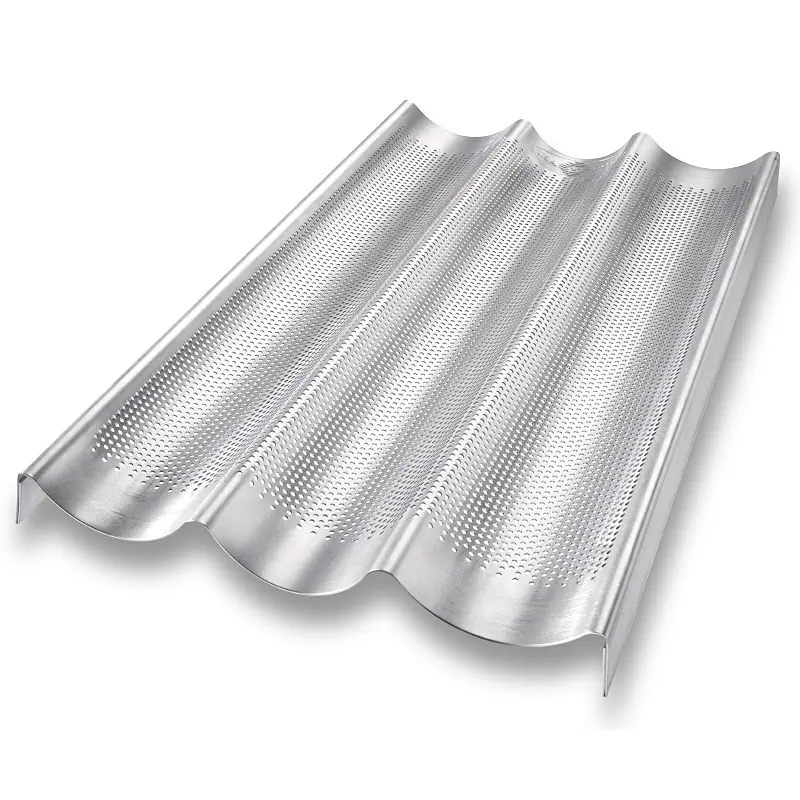
USA Pan's design targets bakers who want authentic baguette proportions: three narrow, long wells (3 inches across, 16 inches long) that shape traditional French loaves precisely. The proprietary silicone-based nonstick coating avoids PFAS, PTFE, PFOA, and BPA, a detail that matters to health-conscious bakers. Aluminum perforated construction heats quickly and evenly, and owners report reliable release without pre-treatment, though many still use a light spray for insurance. The pan is oven-safe to 450°F, which covers most bread-baking temperatures.
The trade-off is loaf count: three loaves instead of four, and the narrow profile means you can't adapt it to rolls or square shapes as easily as wider pans. One reviewer received a unit with a chip on the edge, and the edges are noted as sharp, so inspection upon arrival matters. Compared to the de Buyer, which also bakes two baguettes, this pan gives you more capacity but with different proportions: the USA Pan suits traditional French shapes, while the de Buyer's wells are broader.
I'd reach for this if precision shape and food-safety coatings are priorities. The commercial heritage shows in build quality, and the three-loaf count gives you flexibility without the heft of larger pans.
Pros
PFAS-free silicone nonstick coating
Three wells sized for traditional French proportions
Aluminum heats evenly, oven safe to 450°F
Cons
Sharp edges require careful handling
Narrow wells limit versatility for rolls or other shapes
Key features
Perforated aluminum construction for quick, even heating
Three 3-inch-wide by 16-inch-long wells for thin baguettes
PFAS-, PTFE-, PFOA-, and BPA-free silicone nonstick
Proprietary coating for easy food release and cleanup
Oven safe to 450°F, designed for traditional loaf proofing
#4 Pick
Best Compact Option
de Buyer
de Buyer Baguette Pan - Creates 2 Perfectly Crispy, Golden Baguettes - Nonstick & Easy to Use - Naturally Non-Stick Finish
4.6(503)
French heritage steel pan for two baguettes, simple design with proven durability from a 194-year-old maker.
Ideal for: Heritage-minded bakers making two baguettes or specialty rolls who value traditional steel cookware.
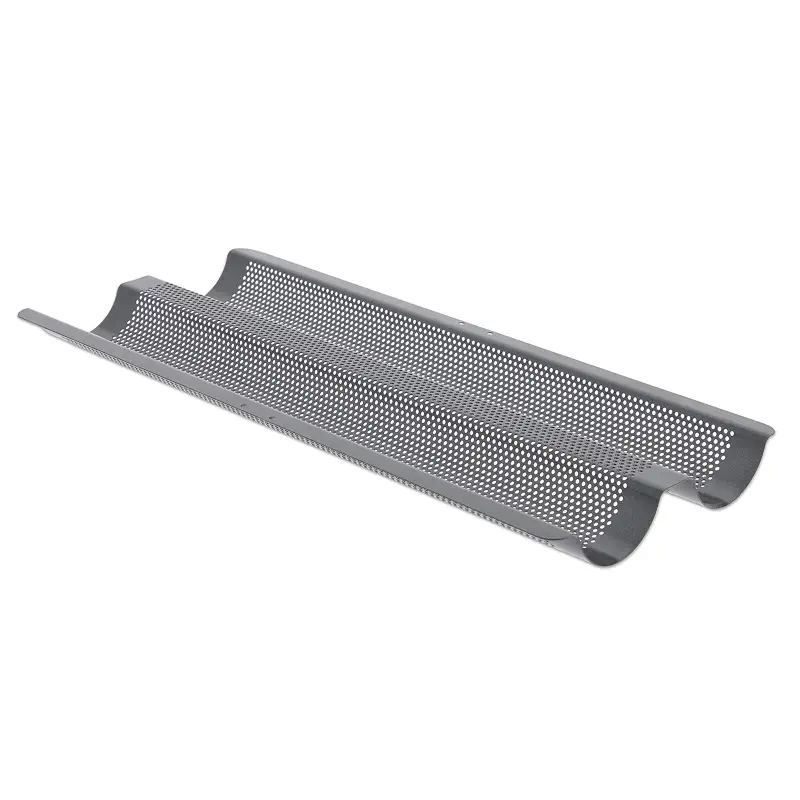
de Buyer brings nearly two centuries of French cookware tradition to a straightforward two-loaf pan. The steel construction conducts heat well, and owners report excellent browning and crust formation, especially for specialty shapes like banh mi rolls. The naturally nonstick finish (no chemical coating) appeals to bakers wary of modern coatings. Perforations are distributed evenly, supporting the crust texture owners seek. Extended edges make pan handling safer than some competitor designs.
Quality control has been spotty. One reviewer received two units so severely bent that one was practically flat: a manufacturing concern that suggests you should verify condition immediately upon receipt. The pan is lightweight, which some users see as elegant and others view as fragile. Compared to the Kitessensu, which also bakes two loaves, the de Buyer emphasizes heritage and natural finishing, while the Kitessensu focuses on curved grooves and warranty. If you get a good unit, de Buyer's pedigree and steel feel genuine. If yours arrives damaged, returns are necessary.
I'd choose this over the Kitessensu if you prioritize traditional French manufacturing and appreciate the simplicity of a steel pan without a coating. But inspect carefully upon delivery: the bending reports are too frequent to ignore.
Pros
Natural steel nonstick finish without chemical coating
French-heritage manufacturing since 1830
Extended edges simplify safe oven handling
Cons
Quality-control variance; some units arrive severely bent
Lightweight feel raises durability concerns for some users
Key features
Steel construction with naturally nonstick patina
Two-well design for side-by-side baguette baking
Perforated bottom for air conduction and moisture release
Even heat distribution for crispy, golden crust
Extended edges for safe insertion and removal from oven
#5 Pick
Best Budget-Friendly
Kitessensu
KITESSENSU Nonstick Baguette Pans for French Bread Baking, Perforated 2 Loaves Baguettes Bakery Tray, 15" x 6.3", Silver
4.6(2,476)
Compact two-loaf pan with curved grooves and a 10-year warranty at an accessible entry point.
Ideal for: Budget-conscious beginners and small-oven bakers who value warranty protection and minimal fuss.
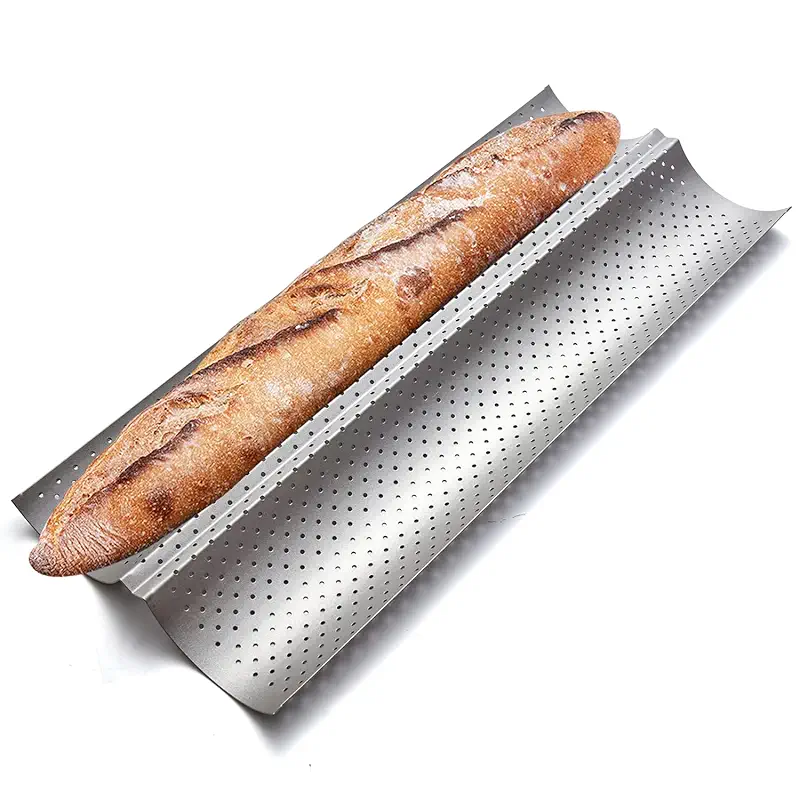
Kitessensu delivers solid performance at a lower price point without skimping on basics. The curved grooves on the bottom intentionally shape the underside of each loaf into an arc, a design touch that appeals to bakers who want defined loaves without fussing with proofing baskets. Perforations are evenly distributed, supporting even browning. The nonstick finish releases bread cleanly, and owners consistently praise how easy it is to unmold without sticking or tearing. The 15-inch length fits most standard loaves, and the groove width suits rolls or smaller shapes if you want to adapt.
The compact footprint (15 by 6.3 inches) fits tighter storage and smaller ovens than three- or four-loaf pans. One reviewer wished for more depth and noted the pan could be sturdier, but most owners report reliable performance and durability. The 10-year warranty is a strong signal of confidence and provides recourse if defects emerge. Compared to the de Buyer, the Kitessensu leans toward ease and value rather than heritage, but it bakes two baguettes just as well and comes with longer-term protection.
I'd recommend this for budget-conscious bakers starting their bread journey or those with small ovens. The warranty removes risk, and the nonstick and groove design simplify the learning curve.
Pros
Curved grooves shape bread undersides naturally
Even perforation distribution for consistent browning
10-year warranty covers manufacturing defects
Cons
Lightweight construction may feel less durable than heavier pans
15-inch length limits loaf options for larger baguettes
Key features
Nonstick surface with curved grooves for loaf shaping
Two-loaf capacity at 15 by 6.3 inches
Perforated bottom for even heat and crust development
Compact design fits small ovens and tight storage
10-year manufacturer warranty on all defects
How to Choose a Baguette Pan
Four trade-offs that actually matter when matching a baguette pan to your kitchen.
Loaf Capacity and Oven Size
The number of loaves you bake at once depends on your oven size and baking frequency. The Chicago Metallic and Pavsrmy fit three and four loaves respectively, ideal for entertaining or meal prep, but they consume more oven real estate. The two-loaf pans (de Buyer and Kitessensu) suit smaller ovens and everyday bakers. USA Pan's three-loaf design splits the difference. Measure your oven's interior and consider how many loaves you realistically bake in a session, overshooting capacity wastes shelf space, while undersizing limits your workflow.
Material and Heat Conduction
Aluminum and carbon steel are the dominant materials. Aluminum (Chicago Metallic, USA Pan) heats quickly and evenly, ideal for crispy crusts. Steel (de Buyer, Pavsrmy) conducts heat well but feels heavier and may require seasoning. The choice affects bake time and crust texture: test with your recipe to see which suits your oven's behavior. Heavier pans often inspire confidence, but they also take longer to cool and store. Lightweight pans are convenient but can feel fragile if you're accustomed to commercial cookware.
Nonstick Coatings and Maintenance
Nonstick finishes range from traditional coatings (Chicago Metallic's dual-layer) to modern PFAS-free silicone (USA Pan) to natural steel patina (de Buyer). Traditional coatings perform well but require careful hand washing and occasional light oiling to extend life. PFAS-free options appeal to health-conscious bakers but vary in durability. Perforated vs. solid baguette pans each demand different care: perforated designs collect dough bits in the holes, so rinsing must be thorough. Check nonstick baguette pan care instructions specific to your model to avoid coating damage and premature wear.
Perforation Size and Loaf Flexibility
Perforation size affects how much dough can escape the bottom and how evenly air circulates. Small holes (Pavsrmy, Kitessensu) prevent slack or wet dough from poking through, letting you proof right in the pan. Larger holes (Chicago Metallic, USA Pan) prioritize air flow and crust crispness but require shaped dough that holds its form. Consider your usual dough hydration and shaping style: high-hydration sourdough bakers favor smaller perforations, while traditional French-bread bakers often prefer standard sizes. The groove or well design also affects versatility; narrow wells (USA Pan) suit traditional thin baguettes, while broader grooves (Kitessensu, de Buyer) adapt to rolls or wider shapes.
Warranty and Build Quality
Warranty is a marker of manufacturer confidence. Kitessensu's 10-year warranty stands out. Chicago Metallic and USA Pan stand behind their commercial-grade pedigree through reputation rather than stated terms. Inspect pans upon arrival for dents, bends, or sharp edges: several reviewers noted quality-control variance, especially with the Pavsrmy and de Buyer. A damaged pan on arrival often signals manufacturing issues worth returning rather than accepting. Check return policies and customer-service responsiveness before buying, particularly for higher-capacity pans.
Frequently asked
Quick answers to the questions readers ask most.
Do I really need a perforated baguette pan, or will a regular baking sheet work?
A perforated pan is worth it if you want traditional crispy crust and even browning. The holes allow moisture to escape from the bottom and sides, and they promote air circulation that regular sheets can't match. You can proof dough and bake in the same pan, which saves cleanup and keeps loaves in shape. Regular sheets work in a pinch, but you'll sacrifice the crust quality that makes baguettes special.
Can I use parchment paper in a perforated baguette pan?
Yes. Parchment is especially useful for wet doughs that might stick to the nonstick coating or seep through perforations. Line the pan before shaping your loaves. The parchment doesn't block airflow from the perforations: holes are small enough that heat and moisture still circulate well. It also simplifies cleanup, though it defeats the purpose of testing your nonstick finish.
What's the best way to prevent bread from sticking if the nonstick coating is wearing?
A light spray of cooking oil or a thin brush of melted butter before shaping works reliably. If you're hand-washing and maintaining a traditional nonstick coating, apply a thin layer of coconut or olive oil after drying to restore the surface. Some bakers season their pans like cast iron, building up a patina over time. If the coating is severely compromised, replacement is often cheaper than fighting sticking.
How do I know if a baguette pan is durable enough for years of use?
Heavy-weight aluminum and steel are more durable than thin gauges. Inspect for burrs, sharp edges, or uneven seams when it arrives: these indicate quality-control issues that may hint at other durability problems. Warranty length (like Kitessensu's 10-year coverage) provides recourse. Heavy pans that feel solid in your hands usually outlast lightweight ones, but proper care (hand washing, light oiling, avoiding abrasive scrubbing) extends any pan's life.
Can I use a baguette pan for things other than baguettes?
Absolutely. The perforated design and nonstick finish work well for sub rolls, hoagie rolls, banh mi sandwiches, hot dog buns, breadsticks, and even cinnamon roll baguettes. Some owners use them as cooling racks or for draining greasy foods. The grooved or well design shapes loaves but doesn't restrict you to that purpose: think of it as a versatile baking vessel that happens to excel at thin breads.