Verdict, analysis, and key features for each pick.
#1 Pick
Best Overall
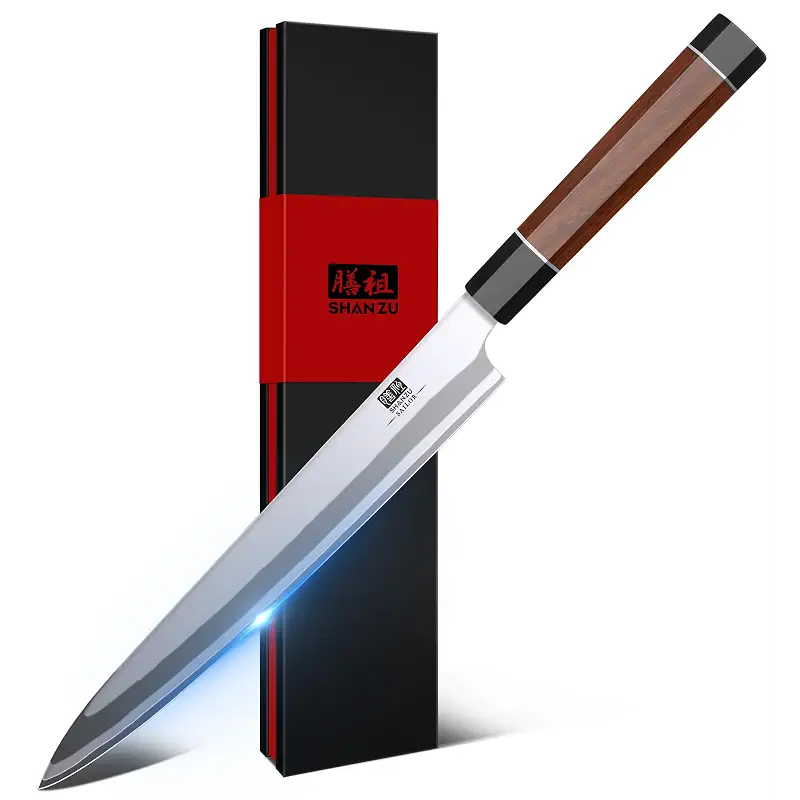
Shan Zu
SHAN ZU 10 Inch Japanese Sushi Knife, 9 Layers 10Cr15MoV High Carbon Steel | Sashimi Knife, Sharp Cutting Yanagiba Knives with Red Sandalwood Handle for Sushi Making, Slicing & Fish Knives
4.6(385)
Sharp out of the box, stays keen through regular use, and handles both professional and home kitchen demands.
Ideal for: Home sushi enthusiasts and cooks who want proven sharpness without professional-grade maintenance demands.
The Shan Zu 10 Inch brings together what matters most in a yanagiba: genuine sharpness, reliable edge retention, and a handle that doesn't fatigue your hand after thirty minutes of slicing. The nine-layer forged steel core hardened to 62 HRC gives this knife the kind of bite that buyers consistently report slices through sashimi paper-thin and effortlessly. The matte blade finish is practical, too, cutting down on fingerprints and debris sticking to the steel.
What sets this knife apart is the build quality consistency. Owners report minimal variation in grind and blade straightness out of the box, which matters more than it sounds. A twisted or uneven edge forces you to compromise your cuts or spend time on a whetstone before you even start cooking. The 12-degree blade angle and octagonal sandalwood handle deliver control without the hand cramps that come with poorly balanced designs.
One caveat: this is a multi-layer construction with softer outer layers, so it requires hand washing and immediate drying. Carbon-steel-at-heart knives are maintenance-forward, and the natural sandalwood handle can be sensitive to prolonged moisture. If you're looking for a low-maintenance, all-stainless alternative, you'd trade some of the sharpness performance that makes this knife stand out.
Pros
Razor-sharp edge straight from unboxing, minimal honing needed initially
Nine-layer steel construction resists chips and maintains edge through repeated use
Octagonal red sandalwood handle reduces fatigue during extended prep sessions
Cons
Requires immediate hand washing and drying to prevent rust spots
Needs periodic whetstone maintenance to preserve the single-bevel edge geometry
Key features
Nine-layer high-carbon steel hardened to 62 HRC
12-degree single-bevel edge for effortless sashimi slicing
Octagonal red sandalwood handle with full tang construction
Matte blade finish reduces fingerprints and food residue buildup
Luxury presentation box suitable for gifting
#2 Pick
Best Value
Kyoku
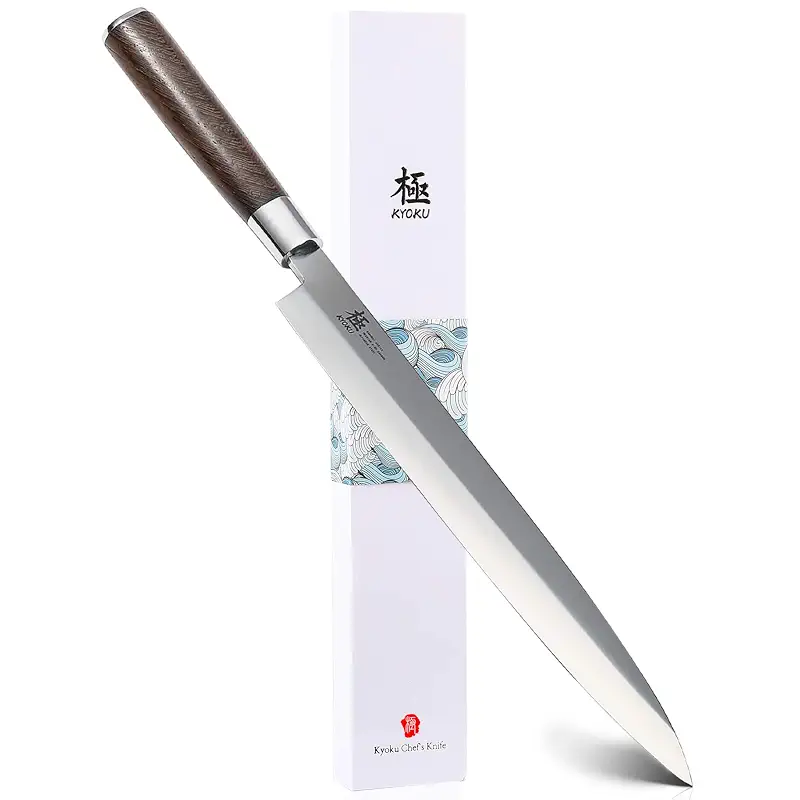
KYOKU Samurai Series - 10.5" Yanagiba Knife Japanese Sushi Sashimi Knives - Superior Japanese Steel - Wenge Wood Handle - with Case | 56-58 Hrc Single Bevel Japanese Steel Blade, Ergonomic Wenge Wood Handle, Precision Raw Fish Slicing Tool With Case
4.5(1,171)
Entry-level yanagiba that surprises with professional-caliber steel and balance, delivering real value at an approachable price.
Ideal for: Budget-conscious home cooks and sushi enthusiasts who don't mind basic maintenance and occasional sharpening.
The Kyoku Samurai Series hits that rare sweet spot where affordability doesn't mean compromised fundamentals. The cobalt-added, cryogenically treated steel at 56-58 HRC hardness is legitimate Japanese metallurgy, and owners who've actually worked with yanagibas note that this knife performs at a level that usually costs twice as much. The cryogenic treatment improves toughness without sacrificing edge retention, which means the knife forgives occasional mishaps better than many pricier options.
Balance and handling shine here. Multiple owners report that the slightly front-heavy weight distribution makes the knife feel stable and controlled without exhausting your wrist. It arrives less sharp than the Shan Zu, but that's partly the manufacturing tolerance you accept at this entry level. Several users who sharpen their own blades report that once they've worked it on a whetstone, the Kyoku outperforms its price tag significantly. The included sheath and case add real value if you plan to store this safely.
Compared to the Shun further down this list, the Kyoku trades some refinement for that exceptional value ratio. You won't get the Damascus visual appeal or the pedigree of free sharpening service, but you'll get a working yanagiba that handles sashimi prep with genuine competence. The main trade-off: quality control can be uneven: some units arrive with minor cosmetic gaps or slight edge twist, which means inspecting it carefully on arrival matters.
Pros
Cobalt-added Japanese steel rivals blades costing significantly more
Well-balanced weight distribution supports steady, controlled slicing
Includes protective sheath and presentation case for safe storage
Cons
May arrive with minor cosmetic gaps or uneven edge geometry requiring whetstone work
Heavier than some competitive yanagibas, which some users find fatiguing over long sessions
Key features
10.5-inch cryogenically treated cobalt-added Japanese steel blade
HRC 56-58 hardness with 11-13 degree single-bevel edge
Wenge wood handle with ergonomic octagonal profile
Included sheath and padded case for storage and transport
Well-balanced blade-forward weight distribution for controlled cuts
#3 Pick
Best for Low Maintenance
Keemake
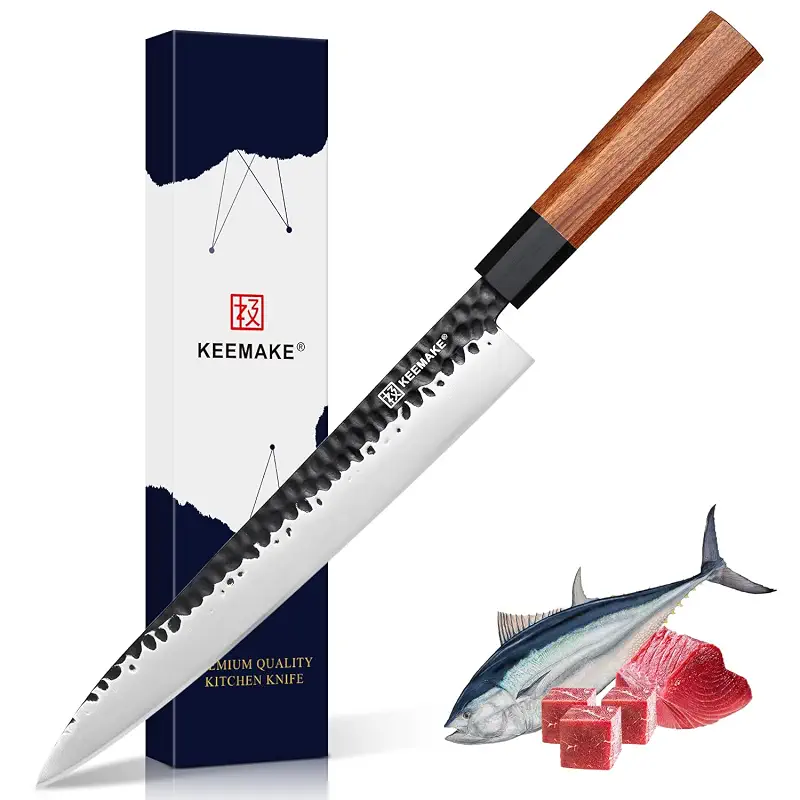
KEEMAKE 10 Inch Sashimi Knife, Japanese Yanagiba | Pro Grade 440C Steel Sushi Knife for Fish Filleting, Non-Stick Blade, Rosewood Handle, Gift for Home Chefs
4.6(661)
Non-stick coated blade cuts corrosion and cleanup hassle, ideal for cooks who want yanagiba performance without constant drying fuss.
Ideal for: Home cooks who prioritize ease of care and want yanagiba cuts without constant maintenance discipline.
The Keemake 10 Inch addresses one real pain point: the obsessive drying routine that high-carbon yanagibas demand. The hydrophobic non-stick black coating handles rust resistance so you're not rushing to dry the blade after every fish slice. In practice, this matters: it lowers the barrier to actually using the knife without anxiety. The stainless steel at 58 HRC sits in a middle ground between pure stainless (easier care, less responsive) and traditional carbon (sharper, demands ritual).
The handle construction uses rosewood with G10 carbon-fiber bolsters, which is more robust than sandalwood alone and adds structural integrity without the moisture sensitivity. Buyers report the balance point at the bolster feels intuitive, and the rosewood provides warmth and grip without being slippery. The knife arrives reasonably sharp and maintains its edge through normal home use before needing honing.
Where this knife doesn't quite match the Shan Zu is sustained sharpness and that ultimate sashimi finesse. A professional sushi chef noted that while it cuts sushi rolls beautifully and handles general fish prep, it's not optimized for breaking down whole loins or achieving the transparency-thin sashimi slices that mark mastery. It's pitched honestly as a capable hybrid: more precise than a chef's knife, more forgiving than a true pro yanagiba. If you're splitting the difference between specialty performance and everyday usability, this is your trade-off.
Pros
Non-stick hydrophobic coating resists rust and simplifies cleanup routine
stainless steel balances sharpness with corrosion resistance and durability
Carbon-fiber G10 bolster strengthens handle and improves blade-to-handle transition
Cons
Non-stick coating eventually wears with repeated sharpening, reducing unique advantage
Edge retention falls short of carbon-steel options; honing needed more frequently for sashimi work
Key features
Japanese high-carbon stainless steel hardened to 58 HRC
Hydrophobic non-stick black coating for corrosion resistance and easy cleanup
Rosewood handle with carbon-fiber G10 bolster for durability and comfort
Perfectly balanced at the bolster for stable, controlled slicing motion
10-inch single-bevel blade optimized for fish and sashimi prep
#4 Pick
Best Premium
Shun
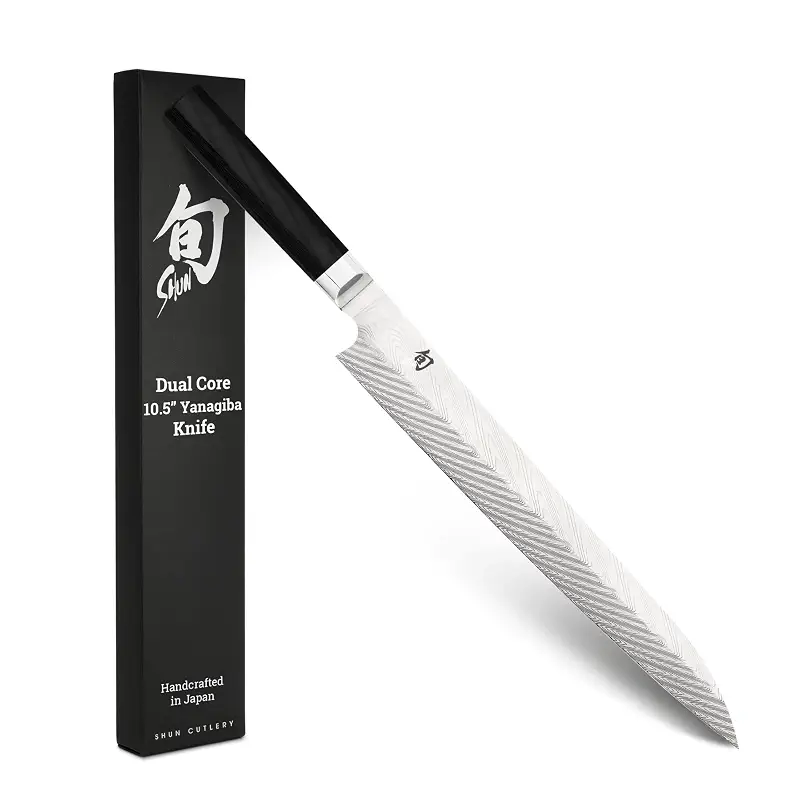
Shun Dual Core 10.5" Yanagiba Knife, Handcrafted Japanese Sashimi Knife, VG10 and VG2 Damascus Steel Blade, Pakkawood Handle, Versatile Japanese Kitchen Tool | Handcrafted Japanese Sashimi Knife, VG10 and VG2 Damascus Steel Blade, Pakkawood Handle.
4.1(23)
Handcrafted Damascus blade with exceptional edge retention and professional-grade performance, backed by free sharpening service.
Ideal for: Discerning home cooks and professionals who value handcrafted quality, edge retention, and hands-off maintenance.
The Shun Dual Core 10.5 Inch Yanagiba sits at the premium end of this comparison, and the investment buys you both tangible performance and brand confidence. The 71-layer Damascus construction of and VG2 stainless steel is partly visual artistry, but it's also functional: those micro-layers allow the blade to maintain an exceptionally sharp edge while resisting chipping. The 16-degree edge angle is slightly steeper than traditional yanagibas, which trades some finesse for durability: you get a knife that forgives occasional contact with harder ingredients without rolling or chipping.
The key differentiator is Shun's free sharpening and honing service. If you send the knife back to their workshop, they handle professional maintenance at no cost, which removes the learning curve from single-bevel honing. That service alone justifies part of the premium for cooks who want zero maintenance anxiety. The Pakkawood handle is engineered composite that won't crack or warp, unlike natural wood, and the octagonal shape suits both right and left-handed cooks.
One honest caveat: reviewers split on whether the weight and rigidity suit true sashimi work. Some professional sushi chefs report the blade feels slightly stiff compared to a lighter yanagiba, which can affect the delicate, almost meditative feel of traditional sashimi slicing. When comparing against top yanagiba knives in this roundup, the Shun is the premium choice, but if your focus is presentation-perfect home sashimi with minimal maintenance stress, it delivers.
Pros
71-layer Damascus blade maintains exceptional edge retention and resists chipping
Free factory sharpening service removes honing learning curve and long-term upkeep cost
Pakkawood handle resists cracking and warping better than natural wood alternatives
Cons
Slightly stiffer blade feel compared to lighter yanagibas; some find it less suited for delicate sashimi slicing
Premium positioning makes this a significant investment compared to entry-level alternatives
Key features
71 micro-layers of and VG2 Damascus stainless steel blend
16-degree single-bevel edge optimized for clean cuts and durability
Handcrafted in Japan with traditional knife-making techniques and standards
Octagonal Pakkawood handle with engineered durability and zero-crack guarantee
Includes protective sheath and backed by free professional sharpening service
#5 Pick
Best for Beginners
Rondauno
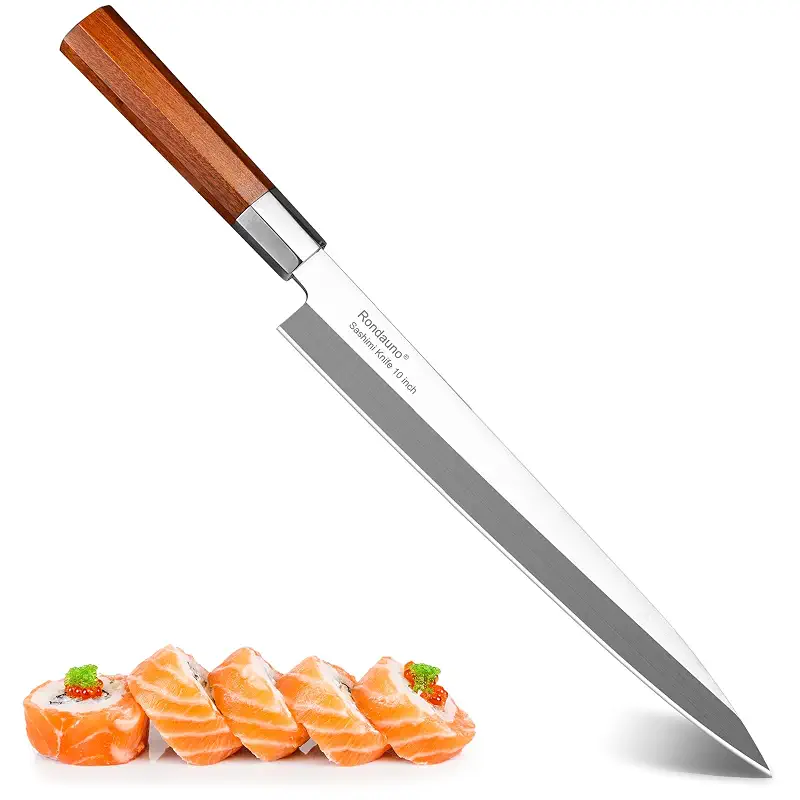
Rondauno Sashimi Knife, Yanagiba Sushi Knife 10 in Precision Fish Slicing | Japanese High Carbon Stainless Steel, Filleting with Ergonomic Wooden Handle
4.5(90)
Approachable yanagiba with clean single-bevel design and intuitive balance, ideal for learning proper sashimi technique.
Ideal for: Beginning sushi enthusiasts and home cooks ready to learn single-bevel sharpening and care routines.
The Rondauno Sashimi Knife occupies a genuine entry point for cooks stepping into yanagiba territory for the first time. High-carbon Japanese stainless steel at a moderate hardness makes this forgiving during the learning curve: you can use it without the dread of ruining an expensive blade, and it teaches you proper technique without fighting you. The 10-inch blade length is comfortable for home work, not so long that it feels unwieldy, and the single-bevel edge, once you understand the mechanics, shows you immediately why this design matters for fish.
The octagonal red sandalwood handle with full tang construction is sturdy without being fussy, and users report the ergonomics suit extended practice sessions without fatigue. The well-balanced design positions the pivot naturally, so you're not fighting the knife's weight distribution while you're concentrating on technique. This matters when you're learning: muscle memory builds faster when the tool cooperates.
Where the Rondauno asks you to invest effort is maintenance and upkeep. Compared to the Keemake's non-stick coating, this blade requires the traditional yanagiba ritual: hand wash, immediate dry, regular honing to maintain the single-bevel edge. One buyer who compared it to professional-grade tools noted the blade is thicker and heavier than high-end yanagibas, so it trades nimbleness for stability. If you're serious enough to commit to learning proper yanagiba technique and the care that goes with it, this knife delivers genuine value. If you're just testing the waters, the investment in maintenance discipline might feel like more than you want.
Balanced weight and ergonomic handle reduce fatigue during learning and extended practice
Clean single-bevel design lets you immediately see why this edge geometry matters for fish
Cons
Thicker, heavier blade requires more maintenance discipline than premium options
Edge retention demands frequent honing; less suitable for high-volume or professional prep
Key features
High-carbon Japanese stainless steel with excellent corrosion resistance
10-inch single-bevel blade designed for precise, clean sashimi cuts
Octagonal red sandalwood handle with full tang for strength and stability
Well-balanced design with optimal weight distribution at the bolster
Forgiving hardness supports skill development without blade fragility concerns
How to Choose a Yanagiba Knife
Four trade-offs that actually matter when matching a yanagiba to your kitchen.
Blade Steel and Hardness Matter More Than You Think
A yanagiba's steel type determines how sharp it gets and how long it holds that edge. High-carbon options (like the Shan Zu's or the Kyoku's cobalt-added steel) get wickedly sharp and stay that way through multiple uses, but they demand vigilant drying to prevent rust. Stainless blends (like the Keemake's or Shun's /VG2 Damascus) trade some ultimate sharpness for easier care and corrosion resistance. Hardness measured in HRC (Rockwell Hardness) typically ranges 56-62 for yanagibas. Higher hardness means better edge retention but more brittleness; lower hardness forgives mishaps but needs resharpening sooner. Your choice depends on how much maintenance you'll realistically commit to.
This is the yanagiba's signature and its non-negotiable feature. Unlike a chef's knife's two-sided edge, a yanagiba has a cutting bevel on one side and a nearly flat back, which creates that clean, tissue-thin slice. The catch: if you want to keep it working, you need to understand how to maintain it. Most home cooks use a whetstone rather than an electric sharpener, which means learning the angle and rhythm. If you're not ready for yanagiba sharpening and care, you might want to explore the Shun's free sharpening service or the Keemake's non-stick coating as alternatives that lower the learning curve. Otherwise, budget time for basic honing skills.
Handle Comfort and Balance Compound Over Time
You don't notice handle fit in the first thirty seconds, but after slicing for an hour, poor design shows up as hand fatigue or loss of control. Yanagiba handles typically come in octagonal shapes from rosewood or sandalwood, and the weight distribution should sit near the bolster where blade meets handle. A well-balanced knife lets the weight do the work for you; a poorly balanced one forces your arm to compensate. This is why testing ergonomics in person matters, but since you're shopping online, read buyer feedback specifically about fatigue and how the knife feels after extended use. If you're exploring options, the best yanagiba knives share this design principle of putting the balance point at the bolster.
Carbon-heavy yanagibas deliver superior performance but require immediate hand washing and drying after every use. Stainless options are more forgiving but sometimes feel slightly less responsive in the hand. Consider your actual habits: if you cook sporadically or tend to leave dishes in the sink, a stainless or non-stick coated blade prevents rust spots and regret. If you're meticulous and enjoy the ritual of care, a high-carbon blade rewards that attention with exceptional sharpness. Yanagiba sharpening and care is not negotiable: it's part of owning the tool, not an occasional inconvenience.
Blade Length and Kitchen Space Trade Off
Most yanagibas in this comparison run 10 to 10.5 inches. That length gives you the reach and leverage professionals need for clean, single-pull cuts through whole fish. But it also demands drawer or block space and a cutting board large enough to work without bumping the tip. If your kitchen is compact, a 10-inch blade is the practical minimum; anything shorter sacrifices the leverage that defines the yanagiba. Measure your cutting board and storage before ordering; a blade that doesn't fit your space becomes a beautiful but unused knife.
Frequently asked
Quick answers to the questions readers ask most.
Can I use a yanagiba for vegetables and other kitchen tasks, or only fish?
A yanagiba can slice vegetables, but it's designed specifically for raw fish and not optimized for tougher ingredients. The single-bevel edge and thin blade aren't meant to contact bones or hard surfaces, which can chip the edge. Think of it like using a fine paintbrush to patch drywall: it works, but you're not using the tool for what it excels at. Use your yanagiba for sashimi, sushi, and delicate fish prep; reach for a chef's knife or santoku for everything else.
What's the difference between a yanagiba and a santoku, and which should I buy?
A yanagiba is a single-bevel, long-bladed Japanese specialist knife designed for raw fish. A santoku is shorter, double-beveled, and more versatile across proteins and vegetables. If you're primarily slicing sashimi and want that clean, effortless cut that only a single-bevel delivers, get the yanagiba. If you want one knife that handles fish, chicken, vegetables, and general kitchen work competently, the santoku is broader. Many home cooks own both; they serve genuinely different purposes.
How often do I need to sharpen a yanagiba, and can a beginner do it?
Frequency depends on how often you cook and the blade steel, but most home cooks hone every two to four weeks with a whetstone and sharpen fully every few months. Beginners can absolutely learn, but it requires patience and decent stones. The single-bevel angle (typically 12-16 degrees) is steeper than a double-beveled knife, which means the learning curve is real. Some buyers find it easier to use a professional service or send it to the manufacturer (Shun offers free service, for example). Don't let sharpening fear stop you from buying: there are resources and services designed for exactly this.
Is a yanagiba worth the cost compared to a regular chef's knife?
If you're making sashimi or sushi regularly, absolutely yes. A chef's knife tears and crushes raw fish; a yanagiba's single-bevel edge glides through without damaging the flesh, which affects both texture and taste: you notice the difference immediately. If you never plan to slice raw fish and want a general-purpose knife, a yanagiba is specialty equipment you don't need. But if sashimi or sushi is part of your cooking life, the performance difference justifies the investment in a way that's genuinely tangible.
What's the best way to store a yanagiba safely?
Never put a yanagiba in a dish rack or loose in a drawer: the blade will dull or chip. Use the included sheath if one came with the knife, store it blade-up in a magnetic strip mounted on the wall or on a counter, or use a knife block or drawer insert designed for it. A yanagiba's thin, sharp edge is more fragile than a chef's knife, so storage protection matters. And always hand wash and dry immediately before storing; moisture sitting under a sheath invites rust.