Kitchen & Dining · Gadgets
Best Wire Cheese Cutter: Top Picks for Home & Professional Use
Find the best wire cheese cutter for slicing block cheese evenly. Compare adjustable slicers, premium German-made cutters, and professional-grade options.
Affiliate disclosure: As an Amazon Associate I earn from qualifying purchases.
At a glance
1
Best OverallZulay Kitchen
2
Best for Precision & ConsistencyKitchendao
3
Best Budget-Friendly Handheld OptionS Aeon Design
4
Best Premium German-Made SlicerWestmark
5
Best Professional-Grade ToolWinco
Detailed reviews
The Zulay Kitchen slicer hits the balance most home cooks need: sturdy build, adjustable thickness, and practical accessories. You can slice cheese from paper-thin to a quarter-inch thick, which covers sandwich slices, cheese boards, and everything in between. The one-piece zinc-aluminum alloy frame feels substantial in hand, and the large roller lets you dial in thickness without fussy mechanics.
Owners consistently praise the adjustability and the fact that it comes with two replacement wires: a real advantage since wire wears with heavy use. Many report great results with everyday cheeses like cheddar, mozzarella, and Swiss. The slicer does struggle with extra-hard varieties (parmesan and grana padano are off the menu), but for the 80% of home cooks buying mid-range blocks, that's not a dealbreaker. A few reviewers noted that consistency takes practice, holding the slicer at a 45-degree angle and warming the cheese slightly before slicing helps.
One wear point: the adjustment screws can be fiddly to tighten, and at least one owner experienced a screw breaking after impact. The company honors warranty claims, but it's worth treating the mechanism gently. For most households, this slicer will outlast cheaper plastic alternatives and deliver cleaner cuts than a knife.
Pros
- Adjustable thickness from paper-thin to ¼ inch
- Two extra replacement wires included
- Sturdy zinc-aluminum and stainless steel construction
- Ergonomic grip and large roller for easy control
Cons
- Adjustment screws can be difficult to tighten evenly
- Not suitable for very hard aged cheeses
Key features (4)
- Adjustable slice thickness for sandwich to charcuterie cuts
- Accommodates cheese blocks up to 3.8 inches wide
- Hand-wash recommended; lifetime warranty
- Comes with two stainless steel replacement wires
Kitchendao's design adds practical features you won't find on most handheld slicers: a measuring grid printed on the base and a three-point wire-fixing mechanism that claims 50% stronger hold than competitors. The grid lines take guesswork out of slice width, which is especially useful when you're prepping a large cheese board and want visual uniformity. The stainless steel base feels professional and cleans easily.
Reviewers rave about the wire strength and smooth cutting action through both soft and hard cheeses. The quick-replacement mechanism works as advertised: you can swap a worn wire in about a minute without tools. Several owners mention using it for non-cheese items (banana, avocado, even canned meats like spam), which speaks to the wire's versatility. The slicer is dishwasher-safe, a convenience the Zulay model doesn't offer, and it ships with two spare wires in a dedicated storage case.
Where it diverges from the Zulay is adjustability: there's no thickness dial on the Kitchendao: the grid helps, but you control slice width mainly by the angle at which you push and the tightness of the wire adjustment screws. For someone who wants exact consistency on repeat cuts, this is an asset. However, if you like quick, one-handed tweaking of thickness mid-session, the Zulay's roller approach may feel more intuitive. Compared to the Westmark slicer, which relies on hand angle alone, the Kitchendao gives you both angle control and measurable reference lines.
Pros
- Measuring grid on base ensures consistent slice widths
- Three-point wire-hold mechanism resists deformation
- Quick wire-replacement system, no tools needed
- Dishwasher-safe stainless steel base and handle
Cons
- Requires more hand-angle control than dial-type slicers
- Wire replacement and tightness adjustment have a learning curve
Key features (4)
- Measuring grid printed on stainless steel base for uniformity
- Reinforced three-point wire-fixing mechanism
- Quick-swap wire replacement without tools in under one minute
- Includes two replacement wires in storage case; dishwasher safe
The Aeon Design slicer takes a minimalist approach: no base, no adjustable screws, no measuring grid. It's a straightforward U-shaped frame with a stainless steel wire, wooden handles, and two replacement wires. You hold it over a cutting board, press down, and the angle of the tool controls slice thickness. This simplicity is both strength and limitation.
Owners appreciate the light weight and handheld design: it's easy to store in a drawer and works well for sandwich-width slices and cheese boards. The wire holds up to frequent use on soft and semi-firm cheeses, and the price point is very accessible. A few reviewers even repurposed it for hard-boiled eggs and other kitchen tasks, suggesting the wire's thinness lets it glide through softer items without crushing.
The trade-off is durability and control precision. Several buyers report wires and fasteners arriving broken or failing quickly, likely due to brittle plastic packaging or manufacturing inconsistency. Replacing a broken wire requires either a vise or careful hand-clamping of the frame: messier than the Kitchendao's tool-free swap. Unlike the Zulay or Westmark, there's no adjustable mechanism, so you can't dial in thickness; you adapt by changing your hand angle. For occasional use or soft cheeses, this limitation hardly matters. But if you're slicing thick blocks of aged cheddar regularly, the Zulay or Westmark will frustrate you less. Compared to the Kitchendao's reinforced build and grid system, the Aeon Design is lighter on features and price, but also on reassurance.
Pros
- Lightweight and compact for easy storage
- Affordable entry point for casual cheese slicing
- Stainless steel wire resists rust and corrosion
- Two replacement wires included
Cons
- No adjustable thickness control; relies on hand angle
- Wire and fastener breakage reported in shipping; replacement is tool-intensive
Key features (4)
- Simple U-frame handheld design, no base or board required
- Stainless steel wire with wooden handles
- No moving parts to adjust; works through hand pressure and angle
- Includes two spare wires; compact for drawer storage
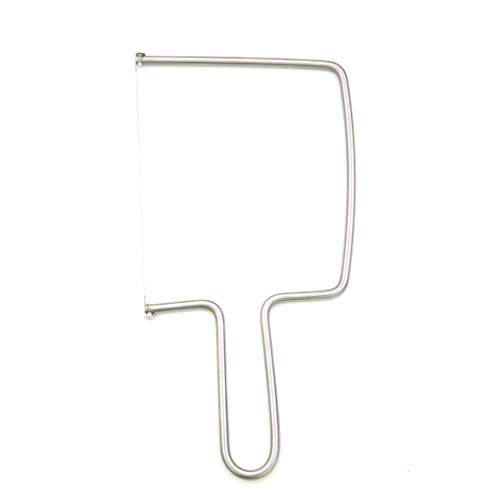
Westmark is the name that appears in kitchen history forums. Made in Germany for over 50 years, this slicer is closer to a precision tool than a gadget. It's all stainless steel wire and cast aluminum, with zero plastic and zero adjustable screws. You control slice thickness entirely by the angle at which you hold the slicer: steeper angle equals thinner slices. No dials, no grids, no complexity.
Owners describe reliability that borders on legendary: reviewers with units lasting 9, 10, or even 15+ years are common. The simplicity means there are almost no failure points. The wire is exceptionally strong and holds tension beautifully, which is why it cuts through hard cheeses like aged Gouda and Jarlsberg with far less effort than cheaper slicers. The handle is comfortable and the whole tool feels like it belongs in a butcher shop, not a bargain bin.
The only real caveat is the learning curve. Without a dial to twist or a grid to reference, you need to develop a feel for what angle gives you the thickness you want. Most users report it takes a few slices to dial in, then it's second nature. A few reviewers note that the aluminum handle can discolor in the dishwasher (the wire and housing are stainless, but the handle isn't fully dishwasher-proof). Hand wash is safer. Compared to the Kitchendao with its measuring grid and quick-wire system, the Westmark trades convenience and adjustability for durability and understated elegance. If you're slicing block cheese 20 years from now, this is the slicer that will still be waiting in your drawer.
Pros
- Legendary durability: many users report 10+ years of daily use
- All-metal construction with zero plastic components
- Exceptionally strong stainless steel wire handles hard cheeses easily
- Simple design means no screws, springs, or mechanisms to fail
Cons
- No adjustable thickness dial; requires learning hand-angle technique
- Aluminum handle not fully dishwasher-safe; hand wash recommended
Key features (4)
- Cast aluminum handle paired with premium stainless steel wire
- Angle-adjustable thickness control through hand positioning
- Made in Germany; backed by 5-year warranty
- No plastic, no moving parts: pure mechanical simplicity
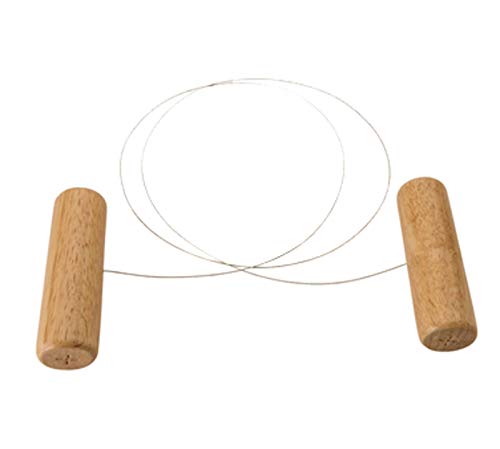
The Winco slicer is purpose-built for professional kitchens and commercial cheese shops. A full 44 inches of 18/8 stainless steel wire stretched between two wooden handles means you can tackle entire wheels and very large blocks in one or two strokes. The wire is designed for repeated, high-volume use, and the durable construction holds up in busy environments where equipment is pushed hard every single day.
Owners in catering and restaurant settings report solid performance slicing 40-pound cheddar and mozzarella blocks. Several say they buy new wires every 2 to 3 months and accept that as part of professional food service. The wooden handles offer a secure grip during long slicing sessions, and the uniform-slice design helps maintain consistency across hundreds of cuts.
However, home cooks should be cautious. The 44-inch length is a liability for anyone with average arm span; you can't hold it taut enough to slice cheese cleanly, and the thin wire kinks under pressure if you can't tension it properly. Commercial users have the counter space, the upper-body strength habit, and the volume to justify buying replacements regularly. Home slicers in this review, like the Westmark or Zulay, are far more practical for residential use. Compared to the Kitchendao with its reinforced, compact design, the Winco is overkill for home use and underdeveloped for true pro work: it sits in an awkward middle ground. Buy this only if you're running a cheese counter or catering operation and your team has the technique to keep the wire taut.
Pros
- 44-inch stainless steel wire handles large cheese wheels and blocks
- 18/8 stainless steel resists corrosion in high-volume use
- Sturdy wooden handles provide secure grip during long sessions
- Designed for professional-grade durability and consistency
Cons
- Too long for home cooks; difficult to maintain wire tension with standard arm span
- Wire breakage reported; professional users expect frequent replacement costs
Key features (4)
- 44-inch stainless steel wire for large wheels and blocks
- Wooden handles for secure grip during high-volume use
- 18/8 stainless steel construction resists corrosion
- Engineered for commercial food service and repetitive cuts
How to Choose a Wire Cheese Cutter
Adjustability vs. Simplicity
Some slicers let you dial in thickness with a knob or screw (the Zulay and Kitchendao models). Others rely on you angling the tool to control slice width (the Westmark). Adjustable designs are friendlier for beginners and let you switch between thin and thick cuts quickly. Simple slicers demand a learning curve but offer fewer mechanical parts to wear out or break. Think about your patience with setup versus your comfort learning hand technique.
Cheese Type Matters
Soft cheeses like fresh mozzarella and brie slice cleanly with any wire slicer. Semi-firm varieties (cheddar, gouda, edam) are the sweet spot for most tools reviewed here. Very hard aged cheeses like parmesan and grana padano can stretch or break thinner wires unless you have a robust slicer like the Westmark. A wire cheese cutter maintenance guide will walk you through caring for wires to extend their life, but the material strength of the wire itself determines what cheese you can tackle comfortably.
Frequency of Use
If you slice block cheese once a week for sandwiches, a budget handheld like the Aeon Design works fine. If you're a charcuterie enthusiast building boards weekly or slicing large blocks for your family, invest in the Zulay or Kitchendao for adjustability and wire strength. Professional cooks should look at the Winco only if they have the arm span and volume to justify its length. Occasional users don't need the reinforced features that daily slicers demand.
Durability and Long-Term Value
The Westmark costs a few dollars more upfront but is famous for lasting 10+ years or even decades with hand washing. The Zulay and Kitchendao offer strong mid-range durability and come with replacement wires, spreading replacement costs over years rather than months. The Winco and Aeon designs are lower-cost but face more wire-breakage reports. Wire versus blade cheese cutters each have strengths: wire slicers excel at clean, uniform cuts with minimal crushing, while the wire eventually wears and needs replacing. Budget for replacements if you slice frequently.
Our picks at a glance
1
Best OverallZulay Kitchen
2
Best for Precision & ConsistencyKitchendao
3
Best Budget-Friendly Handheld OptionS Aeon Design
4
Best Premium German-Made SlicerWestmark
5
Best Professional-Grade ToolWinco
Frequently asked
Can I use a wire cheese cutter on hard cheeses like parmesan?
Most wire slicers handle semi-firm cheeses (cheddar, gouda) beautifully but struggle with very hard aged varieties like parmesan and grana padano. The wire may stretch or break under the pressure needed. The Westmark is stronger than most and can manage harder cheeses if you angle it correctly and apply steady pressure. For true hard-cheese slicing, a microplane or a blade slicer designed for aged cheese is a safer bet. Check the product description before buying if hard cheese is your main use case.
Do I need replacement wires, or will one wire last years?
Heavy users (slicing multiple times per week) may wear through a wire in a year or two. Casual users might not replace a wire for 5+ years. Most wire slicers come with one or two spares. The Westmark and Kitchendao are known for wire longevity; cheaper models may need replacement sooner. Keep replacement wires on hand if you slice often, but don't stress about immediate replacement costs: it's a small expense compared to buying a whole new slicer.
Is hand washing necessary, or can I put it in the dishwasher?
The Kitchendao is fully dishwasher-safe. Most others (Zulay, Westmark, Aeon) are best hand-washed. Dishwashers can corrode aluminum handles and dull stainless steel faster than hand washing with soap and water. If the slicer has been used and cheese has dried on the wire, rinse or hand-wash promptly to prevent buildup. Dry immediately to avoid water spots and corrosion. Hand washing takes about a minute and will extend the life of any slicer by years.
Why do some slicers come with extra wires and others don't?
Manufacturers include spare wires because the wire is the part most likely to wear out or break. If a slicer has a reputation for wire breakage (the Winco, for example), the manufacturer includes spares to reduce warranty claims and customer frustration. Stronger slicers like the Westmark rarely include extras because the wire lasts so long that most users never need a replacement. Included spares are a convenience, not a sign the wire is weak: they just acknowledge that over a slicer's lifetime, you might need one.
What's the difference between a handheld slicer and one with a board base?
Handheld slicers (like the Aeon and Westmark) are lightweight, compact, and work anywhere you set a cutting board. Slicers with a board base (Kitchendao) stay stable on the counter, provide measuring guides, and are less tiring on your hands during long slicing sessions. Board-base models take more counter space but feel more like a dedicated tool. For occasional use, handheld is fine. For frequent slicing, a base-model slicer reduces hand fatigue and improves consistency.