Verdict, analysis, and key features for each pick.
#1 Pick
Best Overall
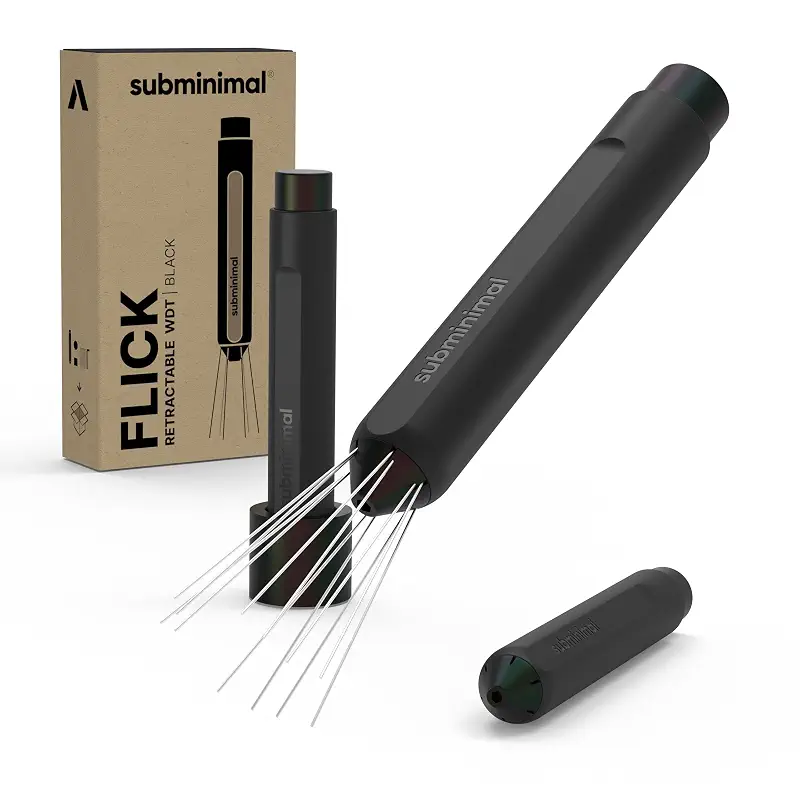
Subminimal
Subminimal Flick WDT Espresso Distribution Tool - Retractable Needle Tamper | Barista stirrer tool, coffee & espresso machine parts, includes two sets of replacement needles and base, magnetic release
4.7(803)
Premium retractable design with magnetic mount; smooth needle deployment and rock-solid build justify the investment.
Ideal for: Home and cafe baristas who value durability, design, and protected needle storage in daily workflow.
The Subminimal Flick stands out because it solves a real problem: traditional WDT tools leave needles exposed and prone to bending in storage or travel. The one-click retractable mechanism here keeps needles protected until you need them, and the magnetic release feels satisfying to use. The thicker stock needles come paired with thinner replacements (hairpin style, curved), so you can swap to your preferred gauge. Owners report the flick motion is intuitive and almost meditative: there's a fidget-spinner quality to it that makes the prep step feel less like a chore.
Build quality is noticeably refined. The aluminum construction, magnetic stand, wall-mount bracket, and included base all suggest this is a tool designed by people who actually pull espresso every day. Replacement needles swap via a simple Allen key, and the magnetic mechanism inside the handle that triggers the flick is clever engineering. For daily baristas or anyone who values a polished coffee setup, this feels like the logical step up from budget options.
The trade-off is price; you'll pay more than a basic needle tool. Some users found the stock needles thicker than expected, though the included thinner pairs solve that. If counter space or portability matters (or if you simply appreciate gear that works as well as it looks) the Flick earns that premium positioning.
Pros
Retractable needles stay protected when stored
Magnetic mount integrates seamlessly with machines
Two sets of replacement needles included
Satisfying flick deployment mechanism
Cons
Higher price point than basic WDT tools
Stock needles thicker than some prefer
Key features
Retractable needle design with one-click magnetic release mechanism
Magnetic stand plus wall-mount bracket and heavy aluminum base included
Two complete needle sets with thin and curved options
Premium aluminum construction with refined aesthetic
#2 Pick
Best Value
Wissxoer
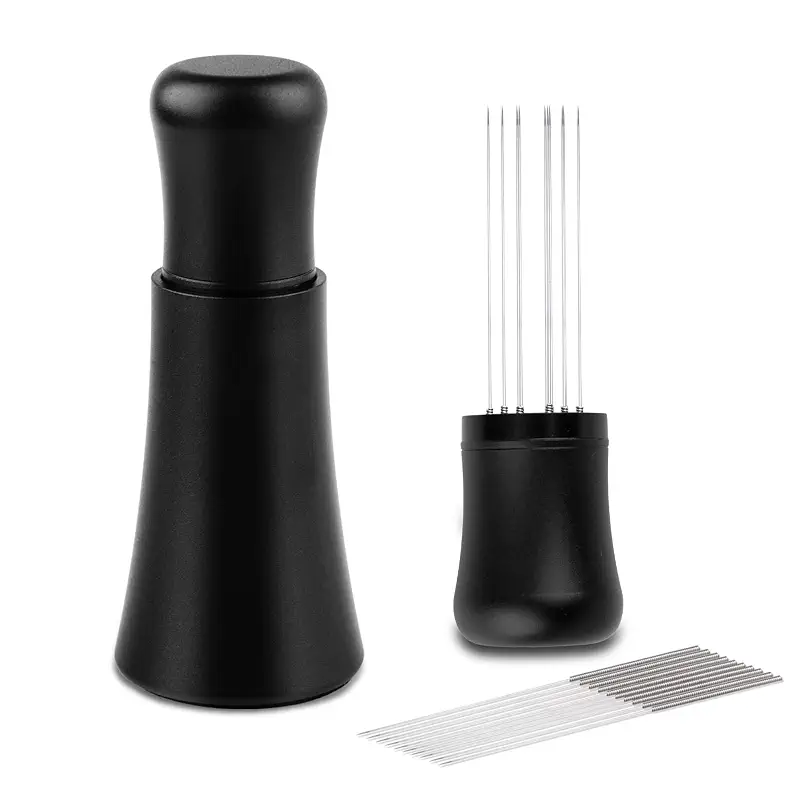
WDT tool, Espresso Distribution tools, 10 x 0.35mm 304 Stainless Steel Needles Installed with 10 Extra needles for Espresso Stirrer Replacement, Aluminum Alloy Handle with Stand (Matte black)
4.7(1,325)
Thick, durable needles with 20 total spares and adjustable count; solid workhorse for daily espresso at a fair price.
Ideal for: Daily espresso drinkers who want solid performance, abundant spares, and no unnecessary bells or whistles.
The Wissxoer delivers what many home baristas want: a straightforward distribution tool that doesn't ask much and doesn't cost extra for features you don't need. It ships with 10 needles installed (0.35mm stainless steel) and 10 spares: that's double the typical replacement set, which matters if you bend needles or want to keep spares on hand without reordering. The aluminum handle and stand feel substantial without being fussy, the same quality-without-fuss thinking that lather bowl picks reward, and the matte finish doesn't show coffee dust or water spots.
A key strength is that you can remove and reconfigure the needle count. If 10 needles feel like overkill for your dose, pull a few out. Most users report the tool breaks clumps and distributes grounds evenly without drama. It fits standard portafilters and the design is compact enough to live on the counter without taking up real estate. Unlike some budget options that feel hollow or cheap, owners consistently praise the heft and stability of this one: the base sits flat and doesn't tip when you're stirring.
Compared to the Subminimal Flick, you lose the retractable design and the fidget-spinner appeal, but you also lose the price premium and get more spare needles. For someone brewing espresso 5-6 days a week who wants a tool that just works without fuss, this is a smarter buy than chasing premium brands.
Ideal for: Home baristas refining espresso technique who value adjustable needle spread and one-handed access.
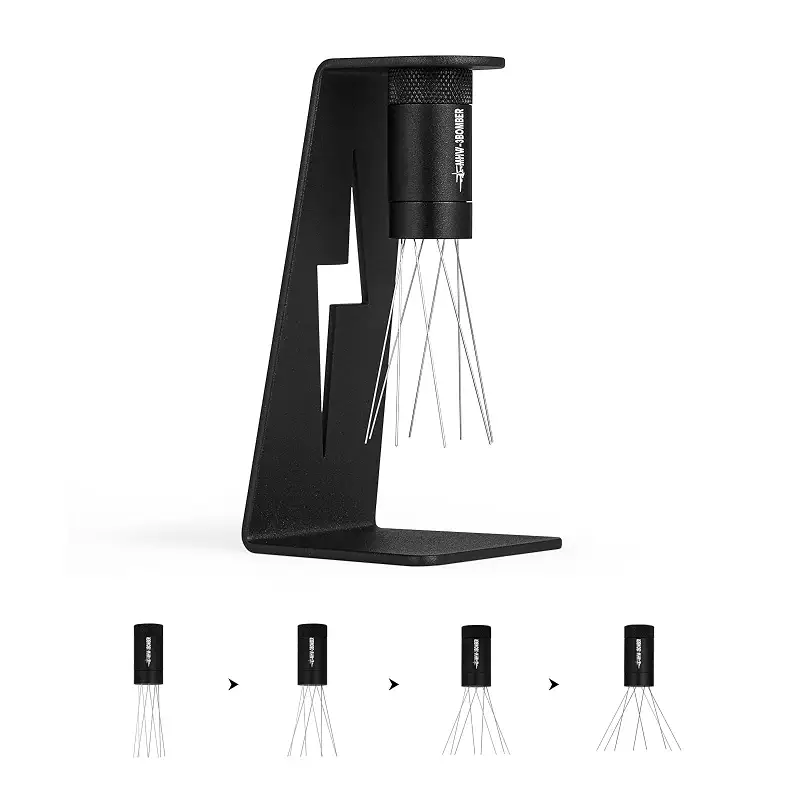
The MHW-3BOMBER excels where precision matters most: you can adjust the needle spread to control coverage and how aggressively you stir the puck. This is subtle but important. With 8 needles that fan in and out, you can use tight spread for gentle distribution or wider for more vigorous breakup of dense clumps. The 0.4mm gauge sits between thin (which can be fragile) and standard (which can feel blunt), giving you needles that resist bending while still cutting through fine espresso grinds cleanly.
The magnetic stand is a real workflow win. Unlike tools that nest into a hole or require a separate holder, this one hangs on any metal surface near your machine: grab it one-handed without fumbling. Owners with over a year of daily use report zero needle fallout and minimal maintenance. The all-metal build (aluminum handle, stainless steel needles) feels professional and looks clean on the counter. Six spare needles come included, which is reasonable for a tool in this price range.
Where it differs from the Subminimal is the focus: MHW-3BOMBER prioritizes adjustability and magnetic convenience over retractable protection. If you're constantly dialing in (trying different spreads or needle counts) the adjustable range is a feature. The Wissxoer is simpler and cheaper; the Subminimal is more premium and protective. This one lands in the middle, rewarding users who want control without complexity.
Pros
Adjustable needle spread for customized coverage
Magnetic stand allows one-handed grab and hang
0.4mm needles balance finesse and durability
6 spare needles included; simple replacement
Cons
Needles exposed when not on stand
Disassembly needed to adjust spread, not instant change
Key features
8 adjustable 0.4mm stainless steel needles with variable spread control
Magnetic stand for secure one-handed access during workflow
Full aluminum alloy and stainless steel metal construction
Compatible with 51mm, 54mm, and 58mm portafilters
#4 Pick
Best Budget Pick
Apexstone
Coffee Stirrer Tool, Coffee Stirring Tamper WDT Distribution Tool, Needle Distribution Tool Espresso, WDT Tool Espresso with Stand Black, WDT Tool Espresso Needle
4.6(112)
Ultra-simple, no-fuss distribution at entry-level price; works reliably for occasional and daily brewers alike.
Ideal for: Budget-conscious beginners and occasional espresso brewers testing whether distribution tools justify the investment.
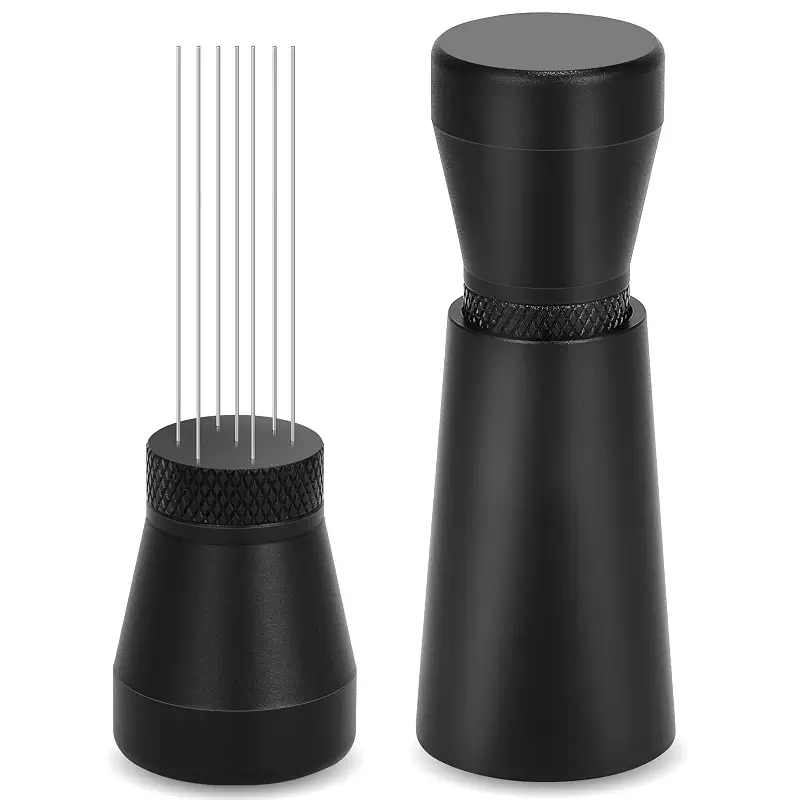
The Apexstone is the tool you buy when you want to test whether WDT even matters to your shots before spending heavily. It's stripped down to essentials: seven 0.3mm stainless steel needles in a small aluminum handle, a matching base, and three spare needles. No magnetic mount, no adjustable spread, no cleaning brushes. Just a handle you grip and a base where it rests between uses.
What's instructive is that owners report it works. Clumps break up, distribution improves, extraction becomes more consistent. The needles are thin (0.3mm is finer than most), which requires a lighter touch but cuts through even dense grinds. Assembly is genuinely easy: the tool unscrews, you load needles, you tighten. Because there's so little to go wrong, new baristas often find this less intimidating than tools with more moving parts. The ergonomic handle fits most hand sizes, and the base is heavy enough to sit stable on the counter.
The drawback: packaging has been problematic for some buyers: needles arriving loose or stuck to the inside of the box rather than safely in the storage vial. Inspect your shipment immediately. Also, seven needles is on the light side if you're brewing into larger baskets, and the tool tips over easily if bumped. Compared to the Wissxoer's abundance of spares or the MHW-3BOMBER's adjustability, you're sacrificing convenience. But if your budget is tight or you're just starting out, this tool proves you don't need bells and whistles to improve puck preparation.
Pros
Ultra-low entry price for testing WDT benefits
Fine 0.3mm needles cut through dense grinds effectively
Simple assembly and minimal parts to maintain
Lightweight and compact for tight spaces
Cons
Packaging issues result in loose or misplaced needles on arrival
Only seven needles; light on spares compared to competitors
Key features
Seven 0.3mm stainless steel needles plus three spare replacements
Simple screw-together aluminum handle and base design
Ergonomic grip handle for comfortable daily use
Lightweight, compact footprint for counter storage
#5 Pick
Best with Integrated Cleaning
Nessus
Nessus WDT Espresso Distribution Tool, Espresso Accessories with Built-in Cleaning Brush, 0.35mm 10 Needle Distributor and Extra 10 Needles for Espresso Stirrer, Aluminum Handle with Stand for Barista
4.4(572)
Built-in brush cleans needles during insertion; configurable 5–9 needle count for personalized prep.
Ideal for: Multi-shot brewers who prioritize quick cleaning and appreciate configurable needle counts for different grinds.
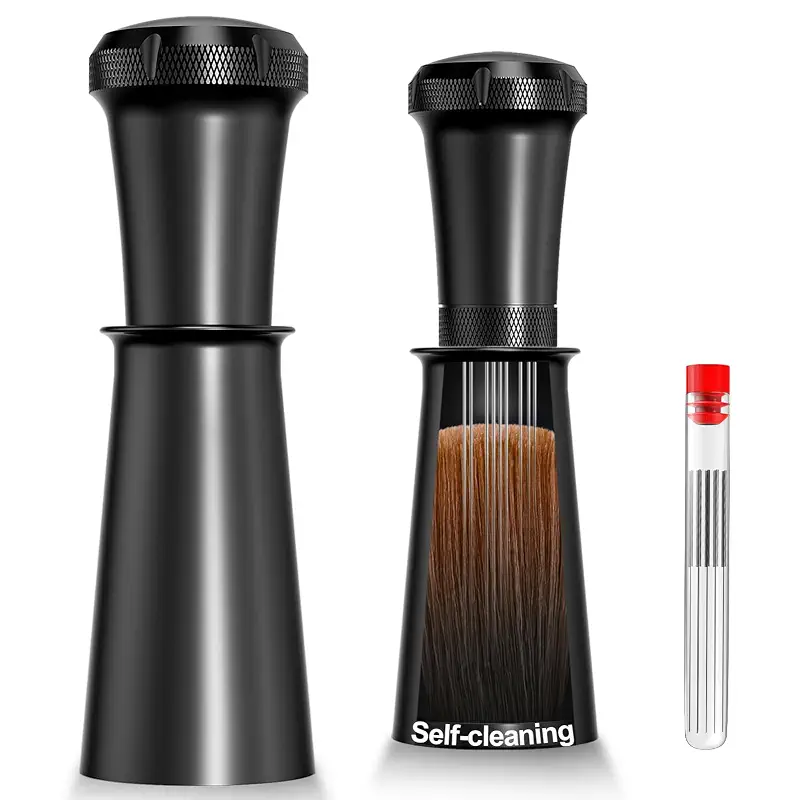
The Nessus is engineered around one insight: cleaning is friction in your espresso routine, so bake it in. Insert the needle cluster into the base and a built-in brush sweeps the grounds away automatically: no separate wash, no sink time. This matters if you brew multiple shots back-to-back or rotate between different beans. The brush is silicone (quiet, no rust) and removable if it needs cleaning itself.
The 10 pre-installed needles are 0.35mm stainless and paired with 10 spares, giving you the flexibility to configure anywhere from 5 to 9 needles depending on grind size or basket capacity. Owners appreciate this customization; finer grinds benefit from fewer needles, while coursers work better with more. The aluminum handle is ergonomic and the silicone base feet are noise-dampening: subtle details that add up during daily use.
The catch is assembly. Some early buyers reported tight tolerance issues: needles refusing to push through holes cleanly, requiring pliers or patience to seat them properly. This suggests quality control can be inconsistent. Once assembled, the tool works well, and the self-cleaning feature is genuinely time-saving. But compared to the Subminimal (which requires zero assembly), the MHW-3BOMBER (magnetic convenience), or the Wissxoer (tons of spares), the Nessus's value proposition hinges on loving that integrated brush. If you make espresso multiple times daily and value less cleanup, it's worth the trade-off. If assembly hassles feel like a dealbreaker, look elsewhere.
Configurable 5–9 needle count for custom puck preparation
10 spare needles included for extended use between orders
Silicone base feet keep tool quiet and stable
Cons
Assembly tolerance issues reported; needles can be tight to install
Brush can collect residue requiring periodic manual cleaning
Key features
10 pre-installed 0.35mm needles with 10 spare replacements included
Built-in silicone cleaning brush auto-cleans needles during insertion
Adjustable 5–9 needle configuration for custom puck preparation
Non-hollow aluminum base with silicone feet for quiet operation
How to Choose a WDT Tool
Four trade-offs that actually matter when matching a wdt tool to your kitchen.
Needle Gauge and Count Matter
Needle diameter ranges from 0.3mm to 0.4mm: thinner needles (0.3–0.35mm) cut through fine espresso grinds more precisely but bend more easily, while thicker needles resist deformation but can feel blunt on light, fluffy grinds. Most people start with 0.35mm as the sweet spot. Needle count varies from 5 to 10; more needles give denser coverage, fewer needles offer lighter touch and faster stirring. If you brew into a 18g basket, seven to eight needles suffice. For 21g or larger baskets, ten needles help prevent missed high spots.
Design: Protection vs. Simplicity
Retractable designs (like the Subminimal Flick) shield needles from damage during storage and travel, but they cost more and add complexity. Open designs (standard WDT tools) are simpler and cheaper, exposing needles to potential bending. Magnetic mounts offer one-handed access and clean aesthetics, while traditional stands or bases require you to nest the tool back into a holder. Choose retractable if you value durability and portability; choose open if you want low cost and low maintenance.
Assembly and Maintenance Ease
Some tools arrive fully assembled (Subminimal, Apexstone); others require you to thread needles into a handle (Nessus, Wissxoer, MHW-3BOMBER). If tight tolerances frustrate you, look for pre-assembled options or reviews mentioning smooth assembly. For wdt tool cleaning and maintenance, verify whether needles pull straight out or require tools to swap. Built-in cleaning features (like Nessus's brush) reduce sink time; traditional designs simply need a quick rinse. Check if the brand offers spare needles and replacement guidance.
Budget and Longevity
Budget tools (Apexstone) work fine for testing but offer fewer spares and less heft. Mid-range options (Wissxoer, MHW-3BOMBER, Nessus) balance price, durability, and features: expect years of daily use. Premium tools (Subminimal Flick) justify higher cost through refined materials, innovative design, and protection that extends needle life. Factor in long-term needle replacement costs; tools shipping 10+ spares offset slightly higher upfront price.
Compatibility with Your Setup
Most WDT tools work universally across portafilter sizes (51mm, 54mm, 58mm) and espresso machine brands. The real question is whether your counter has space for a permanent stand or if you prefer a tool that hangs magnetically on the machine itself. If you rotate beans frequently, a tool with configurable needle count or an integrated espresso distribution method comparison helps you adapt quickly to different grinds without buying multiple tools.
Frequently asked
Quick answers to the questions readers ask most.
Do I really need a WDT tool, or can I just tap the portafilter?
Tapping works in a pinch, but a WDT tool is faster and more consistent. Tapping redistributes grounds unevenly; needle tools break clumps into individual particles and settle them evenly across the basket. Most baristas who commit to a WDT report noticeably better shot consistency and fewer sour or channeled shots within a week. It's one of the highest-return investments for espresso prep.
How often do I need to replace WDT needles?
With daily use, needles last 6–12 months before bending or micro-fracturing becomes noticeable. Tools that ship with 10+ spare needles mean you won't need to reorder for years. If you bend needles frequently, consider thicker gauge (0.4mm) or a retractable design that protects them. Inspect needles every month or two; a bent needle affects distribution quality subtly, so swap it early.
Should I buy a magnetic mount or a stand?
Magnetic mounts (MHW-3BOMBER, Subminimal Flick) integrate with your espresso machine and save counter space; you grab the tool one-handed without reaching for a holder. Traditional stands (Wissxoer, Apexstone) keep the tool visible and accessible but use more space. If your machine is steel, magnetic is cleaner. If you prefer visual separation of tools, a stand works fine and costs less.
Can a WDT tool work for pour-over or French press coffee?
Yes. Although designed for espresso, needle tools break up clumps in any brewing method. Pour-over brewers especially benefit because channeling destroys evenness just as it does in espresso. Some owners report using WDT tools for moka pots, AeroPresses, and Turkish coffee with success. The needle count and technique differ slightly, but the principle (breaking clumps and distributing grounds evenly) applies universally.
What's the difference between a WDT tool and a distribution tamper or leveler?
A WDT (needle tool) breaks clumps by stirring. A distribution tamper flattens and evens grounds by pressing. A leveler rotates to settle grounds without compacting. Most baristas use WDT first (to break clumps), then a leveler or distribution tamper (to settle and compress). They're complementary, not competing. A good WDT makes the tamping step more effective because grounds are already evenly distributed.