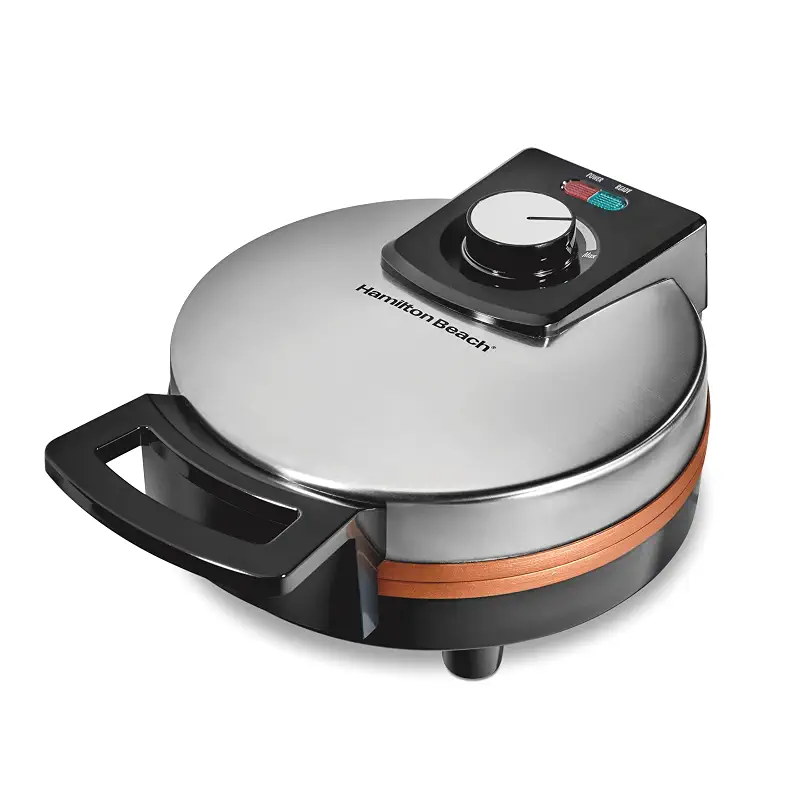
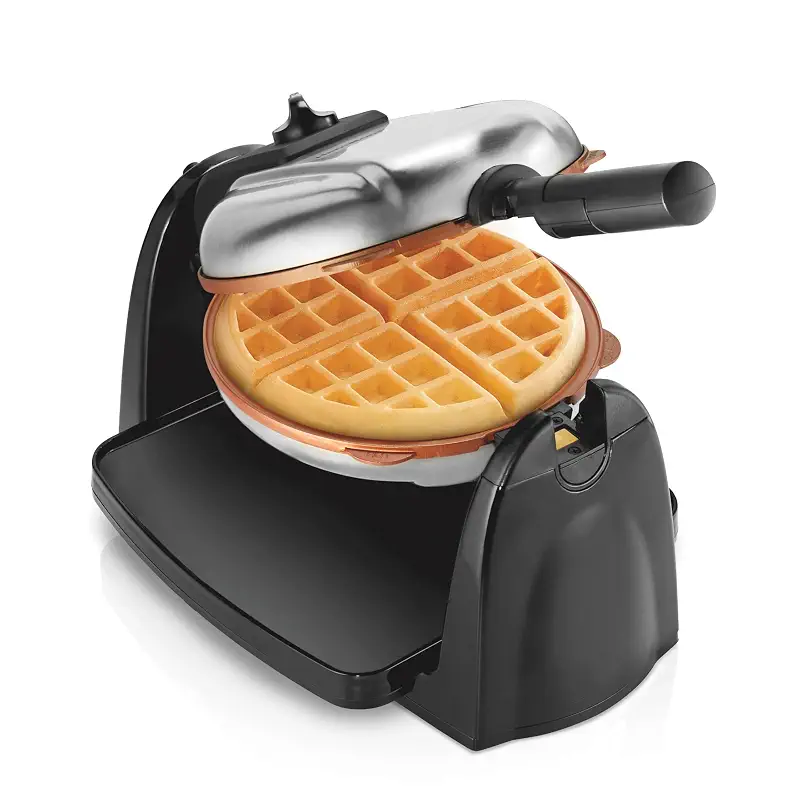
Ideal for: Home cooks who want proven durability and don't mind the extra step of flipping during cooking.
The Hamilton Beach 26031 stands out because it does one thing exceptionally well: flip waffles during cooking to ensure even browning and that signature fluffy interior. The ceramic Durathon coating is genuinely durable: owners who've used this model report it holds up far better than cheaper non-stick surfaces, and the plates stay nonstick even after regular use. The removable grids and drip tray go straight into the dishwasher, though a few owners note that hand-washing and occasional light oiling between batches gives the best long-term results.
What I appreciate about this model is the straightforward design. You're not paying for a multi-function machine; you're paying for a flip mechanism that works, browning control that actually matters, and a ceramic surface that forgives casual use. The stainless steel housing feels built to last, and the price sits in a place where most households won't hesitate to replace it if something goes wrong years down the line.
The main trade-off is that flipping adds a step to the cooking routine: some cooks love it, others find it unnecessary. If you want a set-and-forget waffle maker, the Hamilton Beach 26081 (our fifth pick) or the GreenPan Elite offer simpler operation. But for owners committed to achieving restaurant-style waffles, this flip mechanism genuinely delivers.
Pros
Ceramic Durathon coating resists peeling and cracking over years
Flip feature ensures even cooking and fluffy centers
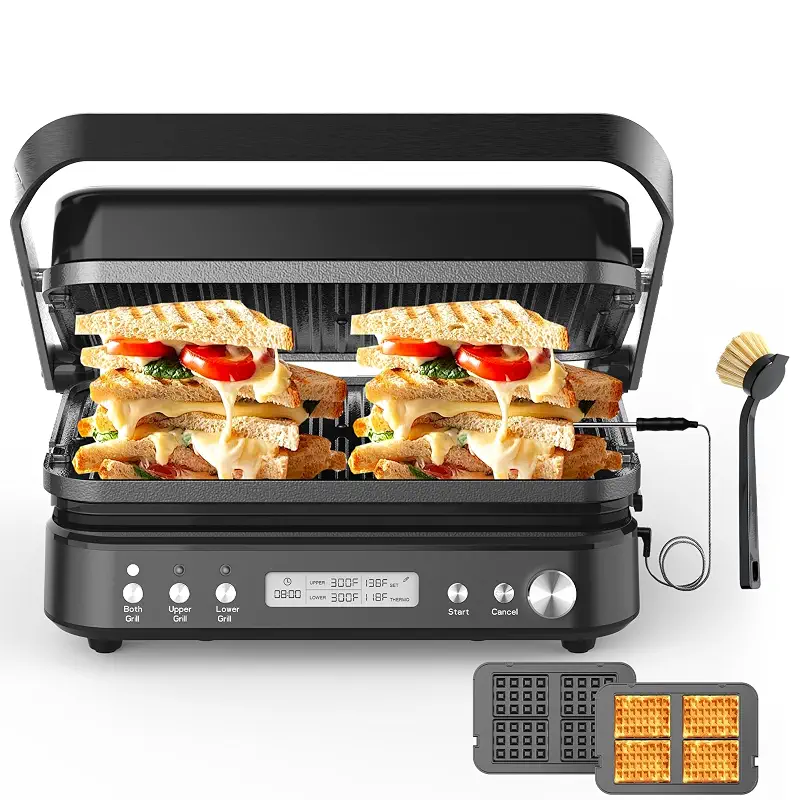
Ideal for: Multitasking cooks who grill, make paninis, and want breakfast versatility without buying separate appliances.
The Cattleman Cuisine is built for households that want one appliance to handle multiple cooking tasks. The reversible plates let you switch between striped grill surfaces for searing and smooth surfaces for pancakes or waffles. The 180-degree flat design opens completely, and the temperature control system lets you set upper and lower plates independently: a feature that genuinely matters when you're trying to grill delicate foods or press paninis without burning the bread.
Owners who've committed to learning this machine report impressive results: even browning on burgers, crispy grilled cheese (it handles four sandwiches at once), and the ceramic surface cleans easily because grease doesn't bond to it the way it does on traditional griddles. The included meat thermometer is a nice touch, though it's really the secondary feature; the core strength is the flexibility to cook breakfast, lunch, or dinner on the same counter footprint.
Compared to the simpler Hamilton Beach flip model, the Cattleman asks more of you upfront. The learning curve includes understanding the preheat mode (which can take time on lower temperatures) and managing the LCD display. One owner flagged extended preheat times as frustrating, and another noted concerns about company support. But if you're willing to spend the extra time mastering the machine, you get a tool that replaces a waffle maker, indoor grill, panini press, and griddle all at once.
Pros
Reversible ceramic plates handle grilling, griddle, and waffle functions
Independent temperature control for upper and lower plates
Flat 180-degree design opens fully for easy plate access
Cons
Preheat mode can take significantly longer on lower settings
Steeper learning curve than dedicated waffle makers
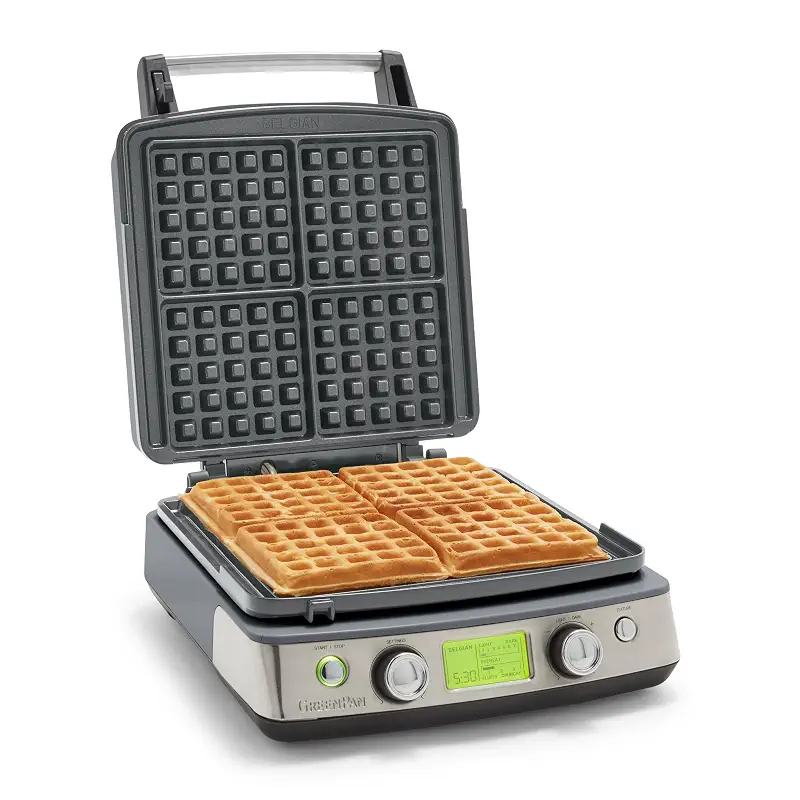
Ideal for: Serious breakfast makers who cook waffles weekly and want precision, speed, and long-term ceramic durability.
GreenPan's Elite sits at the top of the price range, and owners who've compared it to budget models make clear why: it delivers more even heat distribution, faster cooking times, and a ceramic coating engineered specifically for durability. The Thermolon Volt coating is diamond-infused, which isn't marketing hype: it genuinely resists the wear that softer ceramic coatings show after months of heavy use. The machine comes with both Belgian and classic waffle plates, and they store right in the unit so you're not hunting through cabinets.
What separates this from the Hamilton Beach 26031 is precision. The XL LCD display lets you dial in exact browning and crunch levels, and owners consistently report that the machine cooks more evenly across all four squares. The extra-large moat around the plates catches overflow before it hits the heating element, keeping cleanup focused on the plates themselves rather than digging out the base.
The downsides are real. One owner experienced a design flaw where the plate-retention mechanism bent after just six uses: a manufacturing issue that could have been catastrophic. The cooking time is longer than some models (five-plus minutes depending on settings), and the premium price means you're making a bigger bet on durability. If you find the GreenPan appealing but nervous about the design issue, the Hamilton Beach 26031 offers proven track record at a fraction of the cost.
Pros
Diamond-infused Thermolon Volt ceramic coating for durability
Two complete waffle-plate sets included with in-unit storage
Even heat distribution and consistent browning across all squares
Cons
Longer cooking times compared to higher-wattage models
Premium price with some reported plate-retention issues
Key features
Removable Belgian and classic waffle plates store inside the unit
XL LCD display with shade and crunch control presets
Diamond-infused ceramic nonstick, PFAS and PFOA free
Extra-large batter moat prevents overflow onto heating element
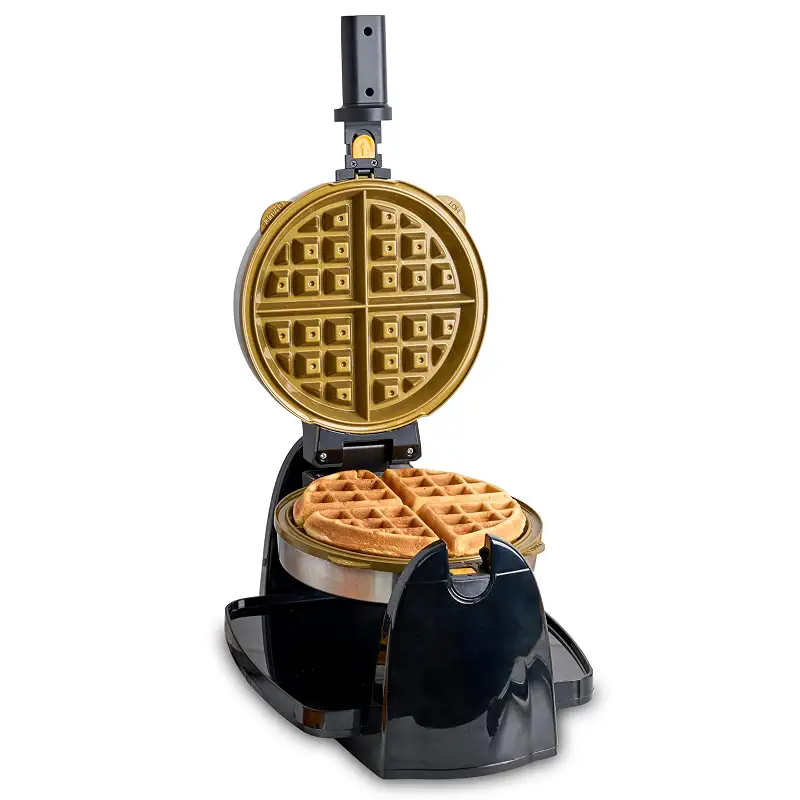
Ideal for: Cooks who want automatic even browning and don't need heavy-duty power or extensive customization.
Krups takes a different approach than the Hamilton Beach flip model: instead of you flipping mid-cook, the waffle maker rotates on its own. This 180-degree rotation is a smart mechanical solution to the same problem, ensuring batter doesn't pool in one corner. Owners report that it genuinely works; waffles come out evenly browned rather than darker on one side and pale on the other. The ceramic nonstick plates are removable, and the drip tray catches mess.
The build quality is split. The rotating mechanism and stainless steel top feel solid, but the cradle and drip tray are plastic, not what you'd expect at this price point. More problematically, a few owners note that the heating power feels anemic. Even at the highest setting, waffles come out pale or undercooked, and you end up running them through again or adjusting batter consistency to compensate. This is the opposite problem from high-wattage machines that risk burning; it's a slow cooker that plays it very safe.
Compared to the GreenPan Elite's rotating design, the Krups is significantly simpler and less expensive. But it also means fewer customization options and less heating muscle. If your recipe is forgiving and you prefer waffles on the lighter side, rotation alone solves evenness. If you want thick, crispy exteriors, you may feel frustrated waiting for adequate browning.
Pros
180-degree rotation spreads batter evenly without manual flipping
Ceramic nonstick plates are removable and hand-washable
Ready-light indicator signals when the waffle is done
Cons
Heating power feels insufficient, leading to pale or undercooked results
Plastic cradle and drip tray feel less durable than metal alternatives
Key features
Smooth 180-degree rotating mechanism for even batter distribution
Ideal for: Budget-conscious first-time buyers and small households who value simplicity, compact storage, and reliable daily use.
The Hamilton Beach 26081 is where most first-time waffle-maker buyers should start. It lacks the flip mechanism of the 26031, the versatility of the Cattleman, or the precision of the GreenPan Elite. What it does is deliver consistent Belgian waffles with zero fuss, minimal counter footprint, and a price that makes you comfortable using it daily without guilt. The ceramic Durathon coating is the same proven formula from the 26031, so you're not compromising on nonstick durability: you're just skipping extra features.
Owners consistently praise the simplicity. You plug it in, wait for the green light, pour batter, close the lid, wait about five to six minutes (depending on your browning preference and recipe), and pull out a waffle. There's no flipping, no rotating, no LCD display to interpret. The browning control dial is intuitive, and the nonstick surface truly releases waffles without sticking. Cleanup is a quick wipe with a damp cloth. The upright storage is a genuine convenience for apartments or small kitchens.
The trade-off is cooking time and capacity. At 560 watts, this machine is slow compared to higher-powered models, and it makes smaller waffles (seven inches) than some competitors. But owners who accept this as the intended design love it for that exact reason: lower wattage means less burning risk and a more forgiving learning curve. If you're comparing this to the best non toxic waffle maker options, you're looking at a machine that prioritizes safety and simplicity over speed or size.
Pros
PFAS-free ceramic coating proven across thousands of owner reviews
Compact upright design fits tight kitchen spaces and cabinets
Simple operation with no flipping, rotating, or complex controls
Cons
Slower cooking time than high-wattage competitors
Smaller seven-inch waffles compared to larger models
Key features
Removable ceramic-coated grids release waffles without sticking
Adjustable browning control from light to dark
Compact upright storage design for small kitchens
Durable stainless steel housing with indicator lights
How to Choose a Waffle Maker with Removable Ceramic Plates
Four trade-offs that actually matter when matching a waffle maker with removable ceramic plates to your kitchen.
Ceramic Coating vs. Traditional Nonstick
Ceramic nonstick coatings like Durathon (Hamilton Beach) and Thermolon Volt (GreenPan) are PFAS and PFOA free, making them safer for regular use and better if you have birds or live in a household concerned about off-gassing. Traditional PTFE coatings are cheaper and sometimes easier to keep slippery, but they carry a health question many buyers now want to avoid. When comparing ceramic versus PTFE waffle coatings, the durability difference is real: ceramic won't crack or peel as quickly, though it does require occasional light oiling (not cooking spray) to maintain peak performance. Most owners find the trade-off worthwhile.
Removable Plates and Cleaning
The whole point of removable plates is effortless cleanup. All five options here let you pull the plates out and either hand-wash or run them through the dishwasher. Hand-washing by warm soapy water is gentler and extends ceramic life, though most plates survive the dishwasher fine if you let them cool first. The ceramic waffle plate cleaning guide covers the step-by-step approach that keeps coatings in top shape longest. Beyond the plates themselves, check whether the base has an integrated drip tray (like the Hamilton Beach 26081 and Krups) or a removable one (like the Cattleman). Removable trays are easier to empty and rinse.
Cooking Style: Flip, Rotation, or Set-and-Forget
The Hamilton Beach 26031 flip model asks you to rotate the waffle halfway through cooking, which spreads batter evenly and prevents uneven browning. The Krups uses automatic 180-degree rotation instead. The Cattleman and GreenPan Elite don't rotate or flip; they rely on powerful heating and even heat distribution. The Hamilton Beach 26081 is purely set-and-forget with no movement. Your choice depends on patience and counter habits. If you enjoy hands-on cooking, a flip model feels interactive. If you want to walk away and start the coffee, choose a non-flip design. Rotation is a middle ground that works well but adds mechanical complexity.
Size, Power, and Counter Space
Wattage directly affects cooking speed. The Cattleman (1600W) and GreenPan Elite (implied high wattage from owner reports of five-minute cooks) are quick. The Hamilton Beach models (560W for the 26081, higher for the 26031) are slower (sometimes six to seven minutes) but that slowness means less burning risk for beginners. Waffle size also varies: the 26081 makes seven-inch waffles, while the 26031 makes thicker Belgian sizes. If your counter is tight, the 26081's upright design saves space. If you cook for a crowd or want larger portions, look at the Hamilton Beach 26031 or Cattleman. Measure your counter and cabinet space before ordering.
Budget and Long-Term Value
Entry-level options like the Hamilton Beach 26081 cost a fraction of the GreenPan Elite, but both use proven ceramic coatings. The real question is feature density: if you want a waffle-only machine with minimal fuss, the 26081 or 26031 offer exceptional value. If you grill, make paninis, or want precision controls, the Cattleman or GreenPan justify the higher investment. For most households making waffles once a week, the Hamilton Beach 26031 or 26081 deliver better value per dollar spent. The GreenPan Elite is the choice if cost is secondary to long-term durability and precision.
Frequently asked
Quick answers to the questions readers ask most.
Do ceramic nonstick waffle plates really need oil, or is that just a myth?
Ceramic coatings are genuinely nonstick without any oil, but owners of high-use machines often apply a light dab of oil before the first waffle of a session, especially if the machine sat unused for weeks. The key is using actual oil (not cooking spray, which damages coatings) and using very little. Cooking spray contains silicone and additives that build up on ceramic and eventually degrade it. If your batter contains fat (eggs, butter, oil), you usually don't need any extra oil at all.
Can I put ceramic waffle plates in the dishwasher without damaging them?
Most ceramic plates survive the dishwasher, but hand-washing in warm soapy water extends their life significantly. Dishwasher detergent is harsh and can gradually dull the coating. If you do use the dishwasher, allow the plates to cool completely first and skip the heat-dry cycle. For daily cooking, a quick hand-wash takes two minutes and keeps the ceramic in showroom condition longer.
Why do some waffle makers take so much longer to cook than others?
Wattage is the primary driver. A 560-watt machine like the Hamilton Beach 26081 takes longer to heat and cook than a 1600-watt machine like the Cattleman. Lower wattage machines are more forgiving (they rarely burn waffles) but they require patience. Higher-wattage machines cook faster but demand closer attention to avoid over-browning. Recipe thickness also matters: thin batter cooks faster than thick batter. Check the machine's wattage before ordering if cooking speed is a priority.
What's the difference between Belgian and classic waffle plates?
Belgian waffle plates have deeper pockets and create thicker, fluffier waffles with more surface area for toppings. Classic (American-style) plates are shallower and create thinner, crispier waffles. Some machines like the GreenPan Elite come with both sets so you can choose. If you prefer one style, look for machines that match: the Hamilton Beach 26031 and 26081 make Belgian-style waffles, while the GreenPan offers flexibility.
Are waffle makers with removable plates worth the extra cost compared to fixed plates?
Yes, especially if you cook waffles weekly. Removable plates let you clean both the top and bottom surfaces thoroughly, and they dry faster outside the machine. Fixed plates force you to wipe around the grids, which leaves batter bits in crevices. The slight premium for removable plates pays for itself in time saved on cleanup and longer overall machine lifespan because you can properly maintain the coating.