Kitchen & Dining · Small
Best Unpowered Mixer
Channel count, USB and Bluetooth, onboard effects and size separate seven audio desks built for gigs, streaming, submixing and home recording.
Affiliate disclosure: As an Amazon Associate I earn from qualifying purchases.
At a glance
2
Best with Built-In EffectsYamaha
3
Best for Larger RigsMackie
4
Best Starter BundleMackie
5
Best Line Mixer for SubmixingMoukey
6
Best for Streaming and RecordingMackie
Detailed reviews
We'd start most buyers with the Mackie Mix Series Mix8 Mixer because it asks little and delivers clean results. It offers eight channels, two mic/line inputs with phantom power for condenser mics, two stereo 1/4-inch line inputs, a 3-band EQ on every channel and one aux send with stereo returns. The metal chassis and a weight of 2.43 pounds make it easy to move between a rehearsal room and a stage.
Owners report clean, quiet output without hiss, a build that feels like a tank, and a good fit for submixing guitars or running a small performance. A common complaint is the missing power on/off switch, and the volume control draws mixed reactions: owners like its range, but also report dead spots and popping on channel one.
Pros
- Clean, quiet output without hiss
- Rugged metal chassis feels sturdy
- Phantom power on mic/line inputs
- 3-band EQ on every channel
Cons
- No power on/off switch
- Volume control dead spots reported
Key features (4)
- Eight channels with two mic/line inputs and phantom power
- Two stereo 1/4-inch line inputs for keyboards or playback
- 3-band EQ on all channels for tone shaping
- One aux send with stereo 1/4-inch returns
The Yamaha Unpowered Mixer is the step up for anyone who wants effects and dynamics control without adding outboard gear. It takes up to 12 inputs with a 2-bus layout, uses discrete Class-A microphone preamps, and includes a built-in digital effects engine with 24 programs plus single-knob compression on four channels. Switchable +48V phantom power covers condenser mics, and a footswitch input lets you mute the effects hands-free.
The powder-coated steel chassis is built for durability, which suits a mixer that will travel. At 12.8 pounds, it is far heavier than the Mackie Mix Series Mix8 Mixer, so it suits a bag or a rack better than a pocket; we'd choose it when the extra inputs and effects will actually get used.
Pros
- Built-in effects engine with 24 programs
- Discrete Class-A microphone preamps
- Single-knob compression on four channels
- Rugged powder-coated steel chassis
Key features (4)
- Twelve inputs with a 2-bus layout and stereo output
- Built-in digital effects with 24 programs and footswitch muting
- Switchable +48V phantom power for condenser microphones
- Powder-coated steel chassis with lit channel on/off switches
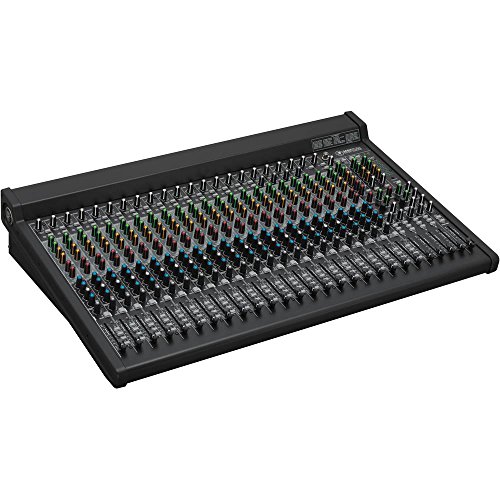
Bigger rigs are where the Mackie 24 Channel FX Mixer earns its place. It is a 24-channel, 4-bus design with 20 Onyx mic preamps, phantom power for condenser mics, improved RF rejection for broadcast work and inline compression on channels 17 to 20. Owners report low noise, a good bass and treble range and an EQ that impresses, and they describe the build as solid and robust.
It is also described as compact for a desk with this many channels, and as versatile enough for small to medium gigs and home studio use. Still, nothing here is small: at 31 pounds and 33.9 inches wide it is the heaviest and largest pick on this list, so the Yamaha Unpowered Mixer is the easier fit if twelve inputs are plenty. A common complaint is the controls on inputs 3/4, which lack pan and treble/bass adjustment, and the linear volume controls draw both praise and criticism.
Pros
- Twenty Onyx mic preamps
- Low noise with a strong EQ
- Solid, robust construction
- Inline compression on channels 17 to 20
Cons
- Heaviest and largest pick here
- Inputs 3/4 lack pan and tone controls
Key features (4)
- Twenty-four channels with four buses for larger band setups
- Onyx mic preamps with high-headroom, low-noise design
- Phantom power and improved RF rejection for broadcast use
- Dedicated inline compression on channels 17 to 20
If you are building a first rig from scratch, the Mackie 10-Channel Unpowered Mixer w/USB Bluetooth removes the shopping list. It pairs a 10-channel mixer with USB and Bluetooth connectivity, built-in effects, premium preamps and a 3-band EQ with three microphones, six XLR cables and three 1/4-inch to XLR cables.
The same mixer, sold on its own, is the Mackie 10-Channel Mixer, so the real question is whether you want the mics and cabling included or would rather choose your own. For podcasters and live-sound beginners who have neither, we think the bundle makes the most sense; if you already own microphones and cables, the standalone listing is the more sensible route.
Pros
- Includes three microphones and plenty of cable
- USB and Bluetooth connectivity built in
- Suited to both live and studio use
Key features (4)
- Ten-channel mixer with USB and Bluetooth connectivity
- Built-in effects and a 3-band EQ for tone control
- Three microphones included for vocals and instruments
- Six XLR cables and three 1/4-inch to XLR cables
The Moukey Audio Mixer is a different tool from the mic-focused desks above: it combines line-level sources such as keyboards, guitars, bass and drum machines into one output, with an independent volume control on every channel. It handles stereo and mono, runs from a 5V power supply, weighs 0.79 pounds and measures 4.53 × 7.68 × 2.17 inches, about the size of a deck of cards by owners' account.
Owners praise the sturdy jacks, the flexibility of six stereo channels, and a quality that surprised them. Experiences with noise and clarity diverge, though: a common complaint is hiss across channels and a loud pop at power-up, while others hear no hum at all. The micro USB power connection also draws grumbles. Because it only combines line-level sources, we'd pair it with a mic desk like the Mackie Mix Series Mix8 Mixer rather than treat it as a replacement.
Pros
- Six stereo channels with independent volume
- Sturdy input and output jacks
- Handles both stereo and mono signals
Cons
- Hiss and power-up pop reported
- Micro USB power connection draws complaints
Key features (4)
- Six stereo line channels with independent volume controls
- Stereo/mono switching for flexible routing
- 5V power supply operation
- Compact body suited to sub-mixing and small stages
The Mackie 10-Channel Mixer is built for people who capture what they play. It offers Bluetooth for wireless playback, multi-mode USB recording, Onyx preamps on every mic channel across its 10 channels, and an effects engine with 24 effects and tap tempo. It works straight away with mics, instruments, phones and computers, which makes it a good bridge between a live set and a stream.
Owners praise the mixing quality, the sound, a fast Bluetooth connection and reliable behavior on video calls, and they note it suits DJ setups. Weighing 4.9 pounds, it is heavier than the Bomge Ultra-Portable 4 Channel Audio Mixer, but it offers more channels and the Onyx preamps. For DJ-focused rigs, the best rotary mixer is worth a separate look.
Pros
- Bluetooth with fast, reliable connection
- Multi-mode USB recording for streams
- Onyx preamps on every mic channel
- Twenty-four effects with tap tempo
Key features (4)
- Ten channels with Onyx preamps on each mic input
- Bluetooth wireless playback plus multi-mode USB recording
- Effects engine with 24 effects and tap tempo
- Works directly with mics, instruments, phones and computers
The Bomge Ultra-Portable 4 Channel Audio Mixer is the one to consider when weight and power outlets are the problem. It weighs 1.32 pounds, has a lightweight ABS plastic chassis, and runs from a 5V USB source such as a laptop or power bank, with an adapter included. Two combo XLR/1/4-inch inputs with +48V phantom power and two stereo RCA inputs cover mics and playback, and the built-in 24-bit audio interface feeds streams and recordings.
Owners report solid functionality for home studios and live gigs, with USB battery power working fine, and they rate its quality highly. The noise picture is weaker: a common complaint is a lot of hiss, and reports on sound quality, volume level and Bluetooth stability vary from flawless to troublesome. The 99 preset DSP effects are listed, yet a common complaint is that the effects boil down to little more than echo. Compared with the Mackie 10-Channel Mixer, it gives up channels and refinement for a much smaller footprint.
Pros
- Lightweight ABS body, 1.32 pounds
- Runs from 5V USB power
- Phantom power on two combo inputs
- Built-in 24-bit audio interface
Cons
- Hiss and noise reported
- Effects reported as limited to echo
- Bluetooth connection issues reported
Key features (4)
- Four channels with two combo XLR/1/4-inch mic inputs
- +48V phantom power for condenser microphones
- Built-in 24-bit audio interface for computer recording
- Bluetooth streaming with front-panel playback controls
Side by side
| Pick | Item weight | Item dimensions |
|---|
#1 Best Overall
Mackie | 2.43 pounds | 13.31 × 9.09 × 3.27 inches |
#2 Best with Built-In Effects
Yamaha | 12.8 pounds | 12 × 12 × 5 inches |
#3 Best for Larger Rigs
Mackie | 31 pounds | 33.9 × 22.95 × 10.63 inches |
#4 Best Starter Bundle
Mackie | — | — |
#5 Best Line Mixer for Submixing
Moukey | 0.79 pounds | 4.53 × 7.68 × 2.17 inches |
#6 Best for Streaming and Recording
Mackie | 4.9 pounds | 10.7 × 3.3 × 11.9 inches |
#7 Most Portable
Bomge | 1.32 pounds | 7.2 × 6.1 × 1.73 inches |
How to Choose an Unpowered Mixer
What does unpowered actually mean for your setup?
An unpowered mixer has no amplifier inside, so it sends a line-level signal to an external amp or powered speakers. That gives you control over the amplification, though a powered mixer is simpler for small, self-contained setups. The word here means audio mixing desks, so the best formula mixer for baby bottles is a different search entirely.
It still needs electricity: even unpowered mixers run from a wall adapter or a 5V USB supply, so check your outlet or battery options before buying. The Moukey Audio Mixer and the Bomge Ultra-Portable 4 Channel Audio Mixer are the two picks that run from 5V power.
How many channels and which inputs do you need?
Count the sources you will plug in at once, then add a little headroom. Input type matters as much as the number, because a mic and a keyboard need different connections.
The Mackie Mix Series Mix8 Mixer fits a handful of sources, while the Mackie 24 Channel FX Mixer suits a full band; the Moukey Audio Mixer is the one to pick when every source is already line level. Check these points:
- XLR or combo inputs for microphones
- Phantom power for condenser mics
- Stereo line inputs for keyboards and playback
- Aux sends and returns for outboard effects
Are USB, Bluetooth and built-in effects worth it?
Analog desks give hands-on, knob-per-function control, and many now add USB recording, Bluetooth and effects. Streamers and podcasters usually benefit most, since a USB connection lets the mixer double as a computer interface.
The Mackie 10-Channel Mixer is our pick when you want Bluetooth, multi-mode USB recording and effects in one desk, and the Yamaha Unpowered Mixer is the one for a bigger set of built-in effects and compression. Not every USB mixer records the same way, so confirm what the connection carries before relying on it.
How portable and tough does it need to be?
A mixer that travels needs a sturdy chassis and a weight you will actually carry. Metal and steel bodies stand up to heavier use, while light plastic bodies trade some toughness for easy transport.
The Bomge Ultra-Portable 4 Channel Audio Mixer is the lightest pick with phantom power, and the Mackie Mix Series Mix8 Mixer pairs a metal chassis with a modest size. Leave the heavy desks for a permanent spot.
Our picks at a glance
2
Best with Built-In EffectsYamaha
3
Best for Larger RigsMackie
4
Best Starter BundleMackie
5
Best Line Mixer for SubmixingMoukey
6
Best for Streaming and RecordingMackie