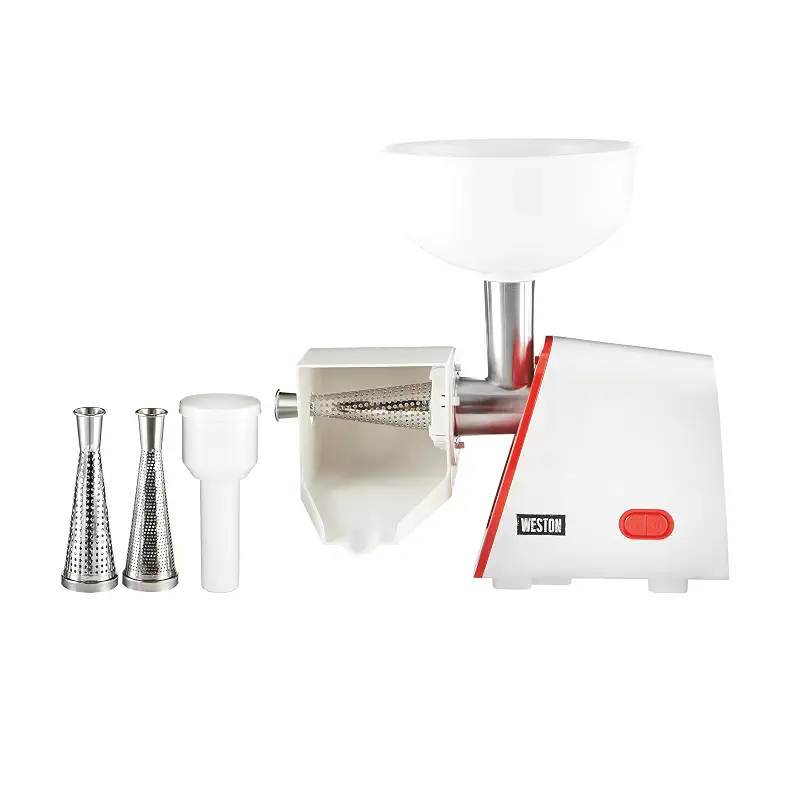
Ideal for: Home gardeners and canning enthusiasts processing 30-100 lbs of tomatoes per season.
The Weston Deluxe has earned consistent five-star ratings from serious home canners who process 30+ pounds of tomatoes at a time. Owners praise the 250-watt motor's steady power and the reverse function that prevents jamming, which is critical when you're working through cooled batches. The 1-gallon hopper means fewer refills, and the three interchangeable screens (1.5mm, 3mm, 6mm) let you adjust output from smooth tomato passata to chunky salsa without swapping machines.
Assembly takes about 10 minutes if you follow the instructions carefully, and the manual is detailed enough that even first-time users feel confident. Most buyers report processing 7 quarts of sauce in 30 minutes, which aligns with what you'd expect from the motor's speed rating. The aluminum head does require a light coat of food-grade oil to prevent gray oxidation, but it's a small maintenance step that takes seconds.
The main trade-off is that the machine isn't stainless steel throughout, and a few owners noted the chute height could be taller if you want to position a large bowl underneath without using the sink. This is manageable with minor workarounds, and the lightweight build makes it easy to move or store when not in use. Compared to the Imperia OMRA Spremy, the Weston is more affordable and easier to assemble, making it the smarter choice if you're canning 50-100 pounds per season.
Pros
Three screens for multiple sauce textures and consistency levels
Reverse motor prevents jamming during high-volume runs
7 quarts of sauce in 30 minutes with steady power
Easy assembly and readable instruction manual
Cons
Aluminum head oxidizes; requires light oil coating to prevent graying
Lower chute height limits bowl size underneath
Key features
250-watt dual-speed motor with forward and reverse function
1-gallon capacity hopper reduces refills during processing
Three stainless steel screens for purees, salsa, or pumpkin
Food-grade plastic parts dishwasher safe for quick cleanup
#2 Pick
Best Commercial Performance
Arinoo
Electric Tomato Strainer, 450W Tomato Juicer Maker Machine | Commercial Stainless Steel Tomato Press & Sauce Maker with Pure Copper Motor for Blueberry Strawberry Jam, 200-350 lbs/h 110V
4.1(15)
High-capacity copper-motor strainer for farms and kitchens processing 200+ pounds of tomatoes.
Ideal for: Small farms, restaurants, and bulk canners processing 200+ pounds per day.
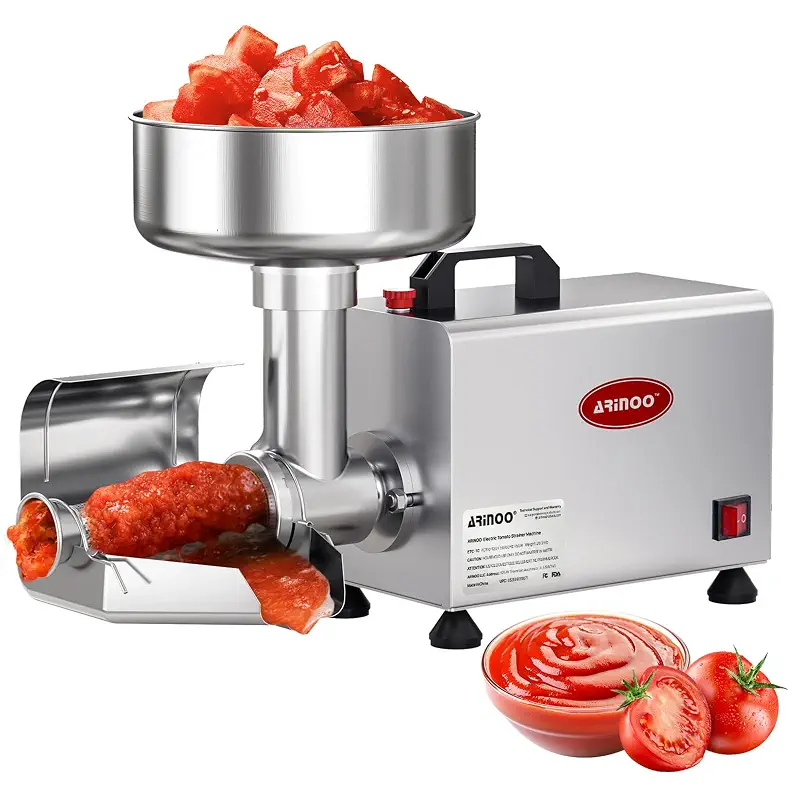
The Arinoo steps into commercial territory with a 0.6 horsepower motor and 304 stainless steel construction top to bottom. At 330 pounds per hour throughput, it's engineered for serious volume that would exhaust the Weston in a morning shift. Buyers who run small farms or restaurants report clean separation of seeds and pulp without extra filtering, and the dual-channel design means the waste stream stays distinct from the juice stream.
Where it excels is consistency: owners describe it handling Roma, heirloom, and smaller cherry tomatoes with equal ease once you dial in your prep method. The fully enclosed motor housing and safety guard feel more robust than home-grade machines, and the five-year warranty plus lifetime support suggest the manufacturer expects years of heavy use. Detachable parts mean you can take it apart for thorough cleaning after a long processing day.
The downsides center on setup and initial reliability. A handful of early buyers reported assembly issues with parts that didn't align or click properly, and one received a unit with loose shipping plugs that leaked oil before opening. The discharge chute's angle requires trial-and-error to position correctly, and the machine's weight means you'll need dedicated counter space or a sturdy rolling cart. If you're jumping from home canning to farm-volume processing, weigh whether the Arinoo's higher speed justifies the cost premium over the Weston's proven durability and easier operation.
Pros
330 lbs/hour throughput cuts processing time significantly
Food-grade 304 stainless steel body and hopper throughout
Dual-channel design separates seeds and skins automatically
Five-year warranty and lifetime customer support
Cons
Assembly quality varies; some units arrive with loose fittings
Discharge chute requires angle adjustment for optimal fit
Key features
0.6 horsepower pure copper motor rated for 330 lbs/hour
Fully enclosed safety guard and motor housing for protection
Detachable 304 stainless steel parts for thorough cleaning
Adjustable discharge trough to direct pulp or juice to your bowl
#3 Pick
Premium Pick for Serious Canners
Imperia
OMRA Spremy Electric Tomato Strainer 1/4 HP Model 850
4.5(1,042)
Italian-made masticating strainer with proven durability, handling 300+ pounds per season.
Ideal for: Serious home gardeners and small-batch canners prioritizing sauce quality over speed.
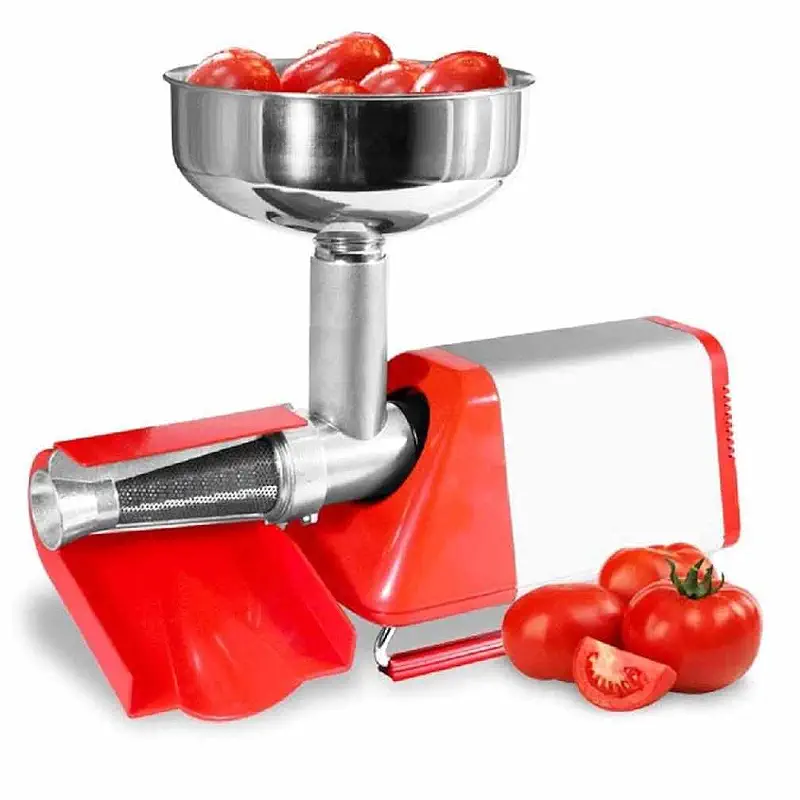
The Imperia OMRA Spremy carries the heft and precision of a machine built in Italy, and owners who've run it through multiple seasons consistently report it as an investment that pays back in sauce quality. The 1/4 horsepower motor drives a slow 110 RPM auger, which preserves enzymes and creates a notably rich tomato puree compared to faster machines that shear the fruit. Buyers describe results so good friends have asked if they're Italian.
What sets it apart is the masticating approach: the low-speed worm gently presses fruit against the perforated drum rather than chopping it, which explains why reviewers get smoother, less bitter sauce even when running cooked tomatoes. The die-cast metal body and stainless hopper suggest longevity, and owners report zero jamming issues even after 50+ kg runs. The build quality justifies the premium price if you plan to use it year after year.
The catch is that it sits quite low to the counter, so you'll need to elevate it on a step stool or cutting board to fit a full bowl underneath. The plastic spiral and chute aren't stainless (unlike the Arinoo), and some owners wish the chute were longer. The plunger is awkward to grip once it's deep in the hopper, though a few resourceful users have swapped in a different design. Where the Vbenlem focuses on quick volume with short duty cycles, the Spremy prioritizes texture and enzyme preservation over throughput: a worthwhile trade for home canning but overkill if you're just processing 20 pounds once a year.
Pros
Low-speed 110 RPM masticating auger preserves enzymes and flavor
Die-cast metal body and stainless hopper built for multi-season use
Handles 300+ kg per season without jamming or slowing
Produces visibly smoother, richer puree than faster motors
Cons
Sits low to table; requires elevation for adequate bowl clearance
Plastic spiral and chute reduce durability compared to all-stainless designs
Key features
1/4 HP motor operating at 110 RPM for gentle masticating action
Stainless steel hopper with die-cast metal housing for durability
Processes up to 330 lbs per hour with consistent quality
Made in Italy with reputation for multi-season longevity
#4 Pick
Best Budget Option
CucinaPro
Tomato Strainer, Easily Juices w No Peeling Deseeding or Coring Necessary | Suction Cup Base, Food Mill Press- Make Homemade Pasta Sauces, Fresh Salsa Potato Puree- Easy to Use, Cooking Supplies Gift
4.0(2,416)
Manual suction-mounted strainer for small batches and occasional home use.
Ideal for: Occasional home cooks making fresh salsa or small batches of sauce a few times yearly.
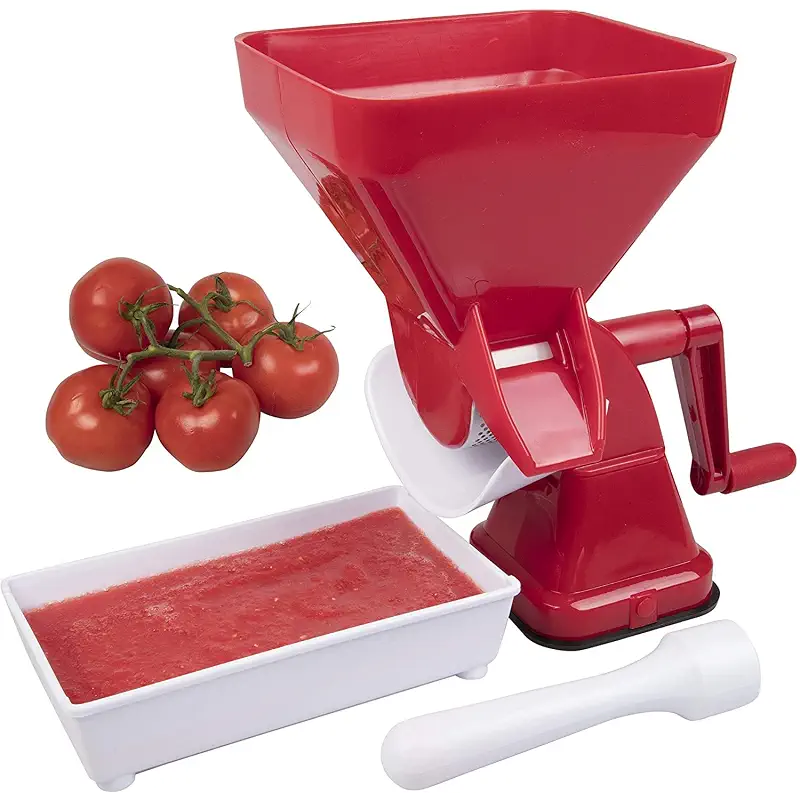
The CucinaPro trades the motor for a heavy-duty suction cup base, making it a manual press that clamps to your countertop. For cooks who process tomatoes just a few times per season or who want to avoid electricity and storage fuss, the simplicity is appealing. The stainless steel pusher guides fruit into the hopper, and skins and seeds eject to the side while juice runs into a tray below.
Manual machines have endured for good reason: no motor means no clogging, no motor noise, and no electricity cost. The suction cup holds firm if your countertop is smooth and level, and the low price means less financial commitment than any electric option. Owners who've used both manual and electric models often say they reach for the manual when they're doing a quick batch and don't want to haul out the heavier machine.
The trade-off is labor: you're providing the force that drives the auger, which becomes tiring after 15-20 minutes of steady cranking. This is why it suits occasional cooks far better than anyone processing 50+ pounds in a session. The electric versus manual tomato juicers debate often comes down to volume and shoulder endurance, and this model concedes both to the motorized alternatives. If you're deciding between this and the Weston Deluxe, ask yourself: will I be doing this more than three or four times per year? If yes, the electric pays for itself in saved time and effort.
Pros
No motor means no clogging, quieter operation, and minimal maintenance
Compact suction-cup design stores easily in small kitchens
Stainless steel pusher and simple design built to last
Entry-level price for first-time tomato processing
Cons
Manual cranking tires quickly on batches over 15-20 pounds
Suction cup requires smooth, level countertop for secure hold
Key features
Suction-cup base clamped to countertop for hands-free stability
Manual auger driven by hand crank without electricity
Stainless steel pusher and tray for durability
Compact footprint ideal for small kitchens and seasonal storage
#5 Pick
Best Value Commercial Strainer
Vbenlem
VBENLEM 110V Electric Tomato Strainer 370W Commercial Grade Tomato Milling Machine Stainless Steel Tomato Press and Strainer 90-160 Kg/H Pure Copper Motor Food Strainer and Sauce Maker | Stainless Steel Tomato Press with 90-160 kg/h Output and Pure Copper Motor for Straining Tomatoes and Preparing Fresh Sauces
3.9(288)
Affordable stainless steel electric strainer for 50-100 pound batches with short cool-down intervals.
Ideal for: Bulk canners processing 50-100 pounds per session with access to short cool-down intervals.
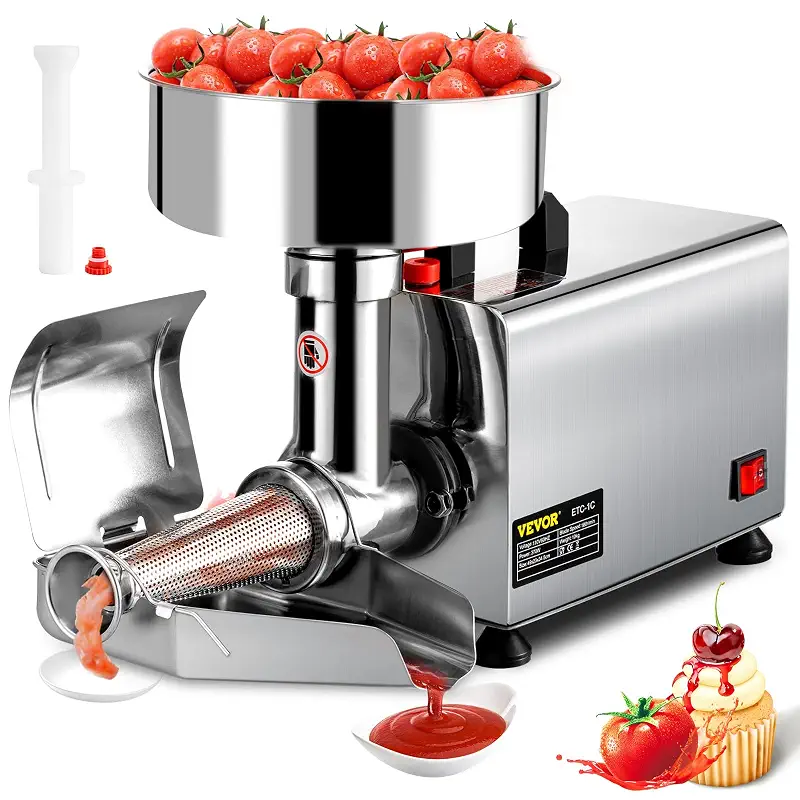
The Vbenlem sits between the home-grade Weston and the full commercial Arinoo, offering stainless steel construction and a 370-watt pure copper motor at a lower price point. Owners who've processed 50+ pounds of tomatoes report clean separation of seeds and skin from pulp, and the adjustable discharge trough helps position output into your bowl or pan without splashing. The 90-160 kilogram per hour rating is solid for weekend canners and small farms.
What makes it attractive is the all-stainless build: the hopper, housing, and food-contact parts resist rust and staining, which matters if you're running acidic tomato pulp repeatedly. Buyers describe fast cleanup and low noise operation, and one reviewer appreciated how pre-processing frozen thawed tomatoes yielded cleaner results than cooking them down first. The waterproof level II rating suggests reasonable protection against splashing during use.
However, the motor has a hard 15-minute duty cycle before it must cool, which constrains true high-volume work. Several owners noted the outer motor cover becomes very hot after extended runs, and the plastic auger (not stainless) grinds seeds into a bitter paste if tomatoes aren't prepped correctly or are undercooked. The cone strainer wobbles slightly during operation, and you'll need your own wrench to remove the feed housing for cleaning. If you're torn between this and the Weston, consider: do you value all-stainless durability enough to accept the shorter running window and higher heat output? The Weston runs longer per cycle and costs less, making it the smarter pick for most home canners.
Pros
Full stainless steel construction resists rust and tomato staining
370-watt pure copper motor with 90-160 kg/hour throughput
Adjustable discharge trough prevents splashing into collection bowl
Waterproof motor housing rated for splashing and outdoor use
Cons
Hard 15-minute duty cycle requires cool-down before next batch
Plastic auger grinds seeds into pulp if tomatoes aren't fully softened
Key features
370-watt pure copper motor with stainless steel outer casing
Fully stainless steel hopper and food-contact parts throughout
Adjustable discharge trough and brace to direct output and prevent splashing
9-inch diameter funnel for sufficient fruit feeding capacity
How to Choose the Best Tomato Juicer
Four trade-offs that actually matter when matching a tomato juicer to your kitchen.
Manual or Electric
Manual presses like the CucinaPro demand your muscle and work best for 10–20 pound batches a few times per year. Electric machines let you process 50+ pounds in an afternoon, but they require counter space and cost more upfront. The electric versus manual tomato juicers debate hinges on frequency: once or twice annually, save money with manual. Twice monthly or more, go electric. Most home gardeners with productive plants find that electric becomes essential by their second or third harvest season.
Motor Power and Throughput
Entry-level home machines like the Weston deliver 250 watts and handle 7 quarts in 30 minutes. Commercial-grade options reach 370–450 watts and promise 90–330 pounds per hour. Your actual needs rarely demand the top rating. Ask: how many pounds of tomatoes will I process in a single day? If 30–50 pounds, the Weston or Vbenlem handles it fine. If 100+ pounds or you're running a farm stand, step up to the Arinoo. More power doesn't always mean faster throughput for home use; it often means the motor stays cooler under load.
Material and Durability
Aluminum heads and plastic augers (like the Weston) keep costs low but require maintenance and light oil coating. All-stainless designs cost more upfront but resist rust and tomato staining over years of use. If you're canning 50+ pounds annually and plan to keep the machine five years or longer, stainless justifies the premium. For casual once-a-year batches, aluminum or plastic parts will outlast your interest in the hobby. Italian-made models like the Imperia OMRA Spremy earn loyalty from multi-season users who value consistent, enzyme-preserving performance.
Screen Options and Output Texture
The Weston includes three interchangeable screens (1.5mm, 3mm, 6mm) so you can switch between silky tomato passata and chunky salsa without buying a second machine. Most competitors offer one or two screen sizes. If you alternate between sauce, jam, and salsa recipes, screen variety saves money and storage space. Masticating machines like the Imperia OMRA Spremy produce smoother, richer pulp than faster-spinning motors because they gently press rather than shear the fruit. For tomato juicer cleaning and care, simpler designs with fewer parts assemble faster and rinse out more easily after use.
Space and Setup
Manual presses clamp to your counter with a suction cup and fold away when done. Electric machines need dedicated counter space or a rolling cart, and most sit low: you'll need a step stool or cutting board underneath to fit a full bowl. Commercial models like the Arinoo and Vbenlem weigh more and run hotter, so ventilation matters. If you're also chopping tomatoes before processing, pairing your strainer with the best tomato dicer ensures efficient prep and consistent sizing for faster, more uniform results. Measure your counter, check cabinet height, and consider where you'll store the machine between seasons. A compact design means nothing if you can't fit it in your kitchen or pantry.
Frequently asked
Quick answers to the questions readers ask most.
Can I run frozen tomatoes through a tomato juicer?
No. Frozen tomatoes will jam most machines or damage the auger because ice doesn't compress the way soft flesh does. Thaw them overnight in the refrigerator before processing. Some owners report that frozen-then-thawed tomatoes actually produce cleaner sauce because the ice crystals rupture cell walls, making seeds and skins separate more easily during straining.
Do I need to peel tomatoes before using a juicer?
Not with a quality strainer. The whole point is that the machine separates skins and seeds automatically. Raw tomatoes work fine if they're soft and ripe; cooked or roasted tomatoes produce richer sauce faster because heat softens cell walls. Most canners cook their tomatoes down for an hour before running them through to concentrate flavor and reduce processing time.
How long can I run a tomato juicer continuously?
Most home machines are rated for 15–30 minute continuous runs before requiring a cool-down. Commercial models may handle longer cycles, but even stainless steel motors need breaks to avoid overheating. Process in batches: fill the hopper, run for 15 minutes, shut it off, clear the discharge, and let it cool for 5 minutes before the next batch. This routine prevents motor strain and extends machine life.
What's the difference between a tomato strainer and a tomato press?
Strainers use an auger or worm to push fruit against a perforated screen, separating pulp from seeds and skins automatically. Presses apply downward force to extract juice but require you to remove solids manually afterward. Most machines marketed as juicers or strainers function as strainers. They're faster and less messy than presses if you want sauce rather than juice alone.
Can I use a tomato juicer to make juice instead of sauce?
Yes, but it's not ideal. A juicer extracts pulp and liquid together, giving you more texture than a traditional juice. For clear tomato juice, you'd run the strainer output through cheesecloth or a fine sieve afterward, which adds an extra step. If juice is your main goal, a dedicated centrifugal juicer works faster. Tomato strainers excel at sauce and puree where pulp and liquid together are the finished product.