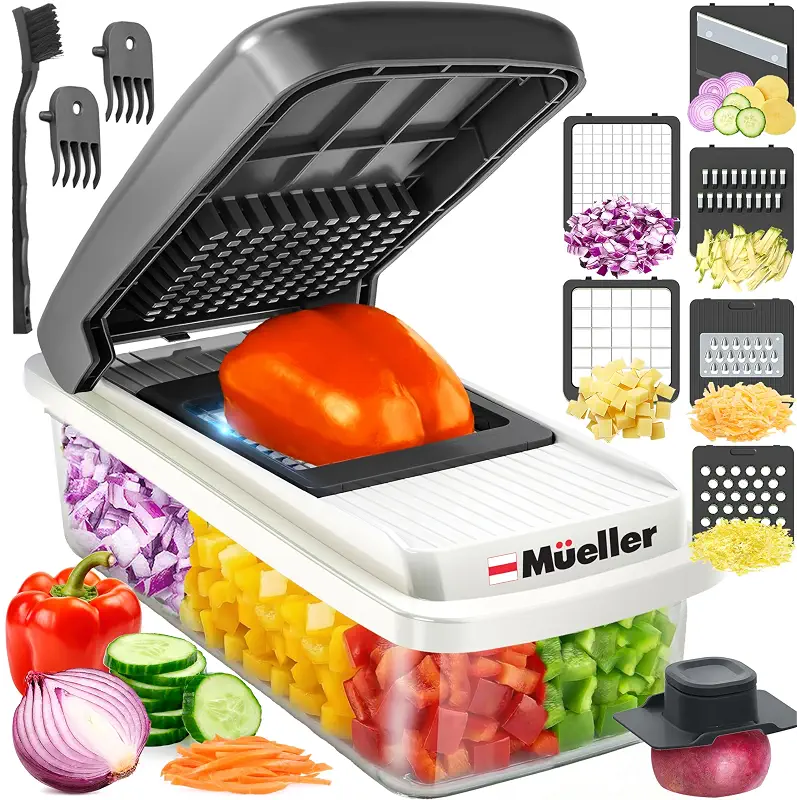
Ideal for: Home cooks who want one tool for multiple cuts and prep tasks.
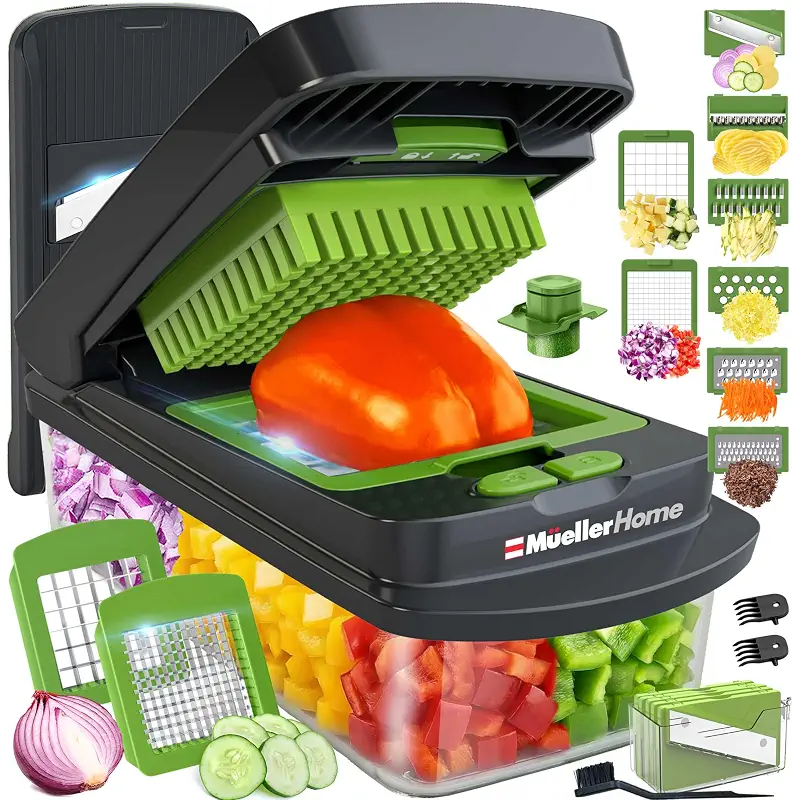
The Mueller Home mandoline slicer sits at the intersection of versatility and ease of use. It comes with two different chopper blade sizes plus four slicing and grating options, meaning you're not buying five separate tools. What buyers consistently praise is how quickly it handles firm vegetables (Roma tomatoes, peppers, onions) and how the included container catches everything so your counter stays clean. The grid design produces uniform pieces, which matters both for presentation and for even cooking.
Cleaning requires attention; the cutting grids trap bits of vegetable that need a brush to dislodge, and some buyers hand wash the blades rather than trust them to the dishwasher. That said, the included brush and care tools make the process manageable, and the whole unit disassembles for thorough rinsing. Buyers with arthritis or hand weakness appreciate how little force you need: you're pressing down on a lid, not gripping and chopping.
If you want to slice as well as dice, or if you make salsa regularly, this delivers. It's sturdier than budget options and less intimidating than the full-size mandoline slicers that restaurant cooks use. Where it falls short is with very soft tomatoes; they tend to get crushed rather than cleanly cut, so Roma or heirloom paste varieties work better than beefsteak.
Pros
Six interchangeable blades for dicing, slicing, julienne, grating
Built-in container catches all chopped vegetables
Works beautifully on firm vegetables and onions
Included cleaning brush and food holder
Cons
Cutting grids can trap small pieces requiring careful cleaning
Soft tomatoes tend to get crushed rather than sliced cleanly
Key features
Two chopper blade sizes plus four interchangeable cutting attachments
Clear plastic container with food holder to prevent slipping
Ideal for: Meal preppers who chop the same vegetables repeatedly and value compact size.
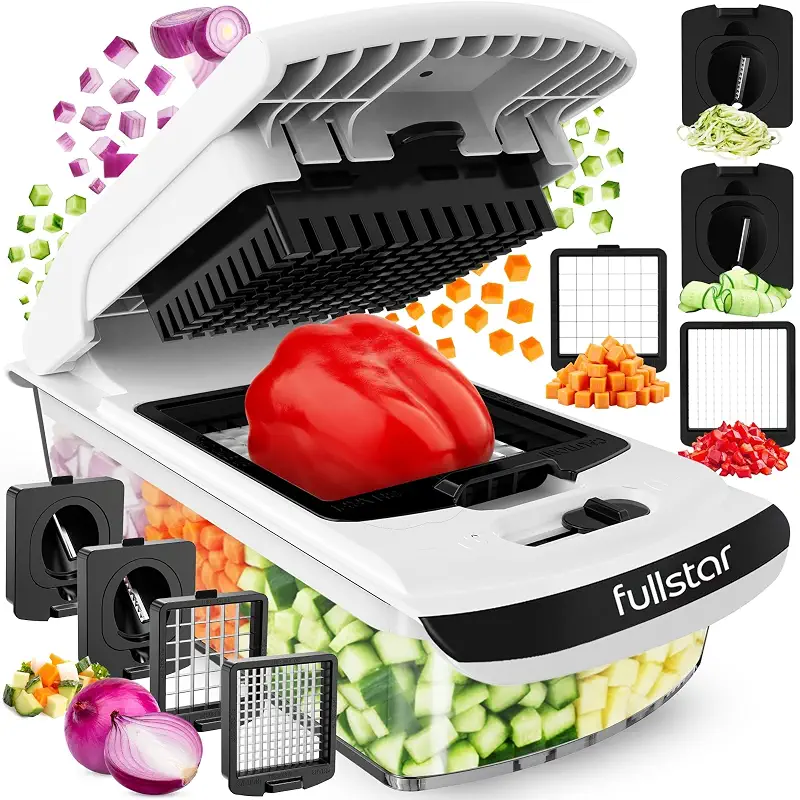
The fullstar Pro delivers results fast. Its main blade configuration excels at dicing: bell peppers, onions, and firm vegetables come out uniform in seconds with minimal effort. The 5-cup capacity means you can prep a large batch without stopping to empty it, and the catch tray keeps debris contained. Buyers report it's become their most-used kitchen gadget, particularly for weekly meal prep and batch cooking.
However, tomatoes and softer produce tell a different story. Several reviewers note that soft vegetables like tomatoes get smashed rather than cleanly diced, and carrots require pre-cutting into smaller pieces before they'll feed through. The learning curve is real: you need to apply firm downward pressure, and the tool isn't forgiving if you don't prep vegetables to the right size first. That said, buyers who adapted their technique report it saves them 90 percent of their chopping time.
Compared to the Mueller Pro-Series, which offers more blade variety, this fullstar model specializes in dicing and does it exceptionally well. It's also more compact, a genuine advantage if counter space is tight. Cleanup is straightforward (dishwasher safe on top rack) and the included comb tool removes stubborn bits. The main trade-off is versatility for speed.
Pros
Dices large batches in seconds with minimal effort
5-cup capacity reduces need for emptying during prep
Compact design fits easily in drawers and small kitchens
Dishwasher safe for quick cleanup
Cons
Soft vegetables and tomatoes get smashed rather than cleanly cut
Requires pre-cutting harder vegetables into smaller pieces first
Ideal for: Cooks who prep multiple types of vegetables and want slicing and grating in one tool.
Mueller's Pro-Series is the utility player. It comes with two chopper blades and six additional options for slicing, julienne, grating, and shredding, which means you can prep vegetables five different ways without swapping tools. Buyers lean on it for soups (diced potatoes are faster), salsas, slaws, and canning prep where consistency matters. The container holds finished vegetables, and the mandoline attachment gives you thin-slice capability the basic Mueller model doesn't have.
The trade-off is complexity and storage. With eight blades, you're managing more pieces, and the food holder requires assembly. Some buyers find the initial setup daunting compared to simpler one-blade choppers. That said, reviews consistently note that once you understand which blade does what, the tool becomes indispensable. The blades are extremely sharp (several reviewers mention needing caution during cleaning) but that sharpness means clean cuts instead of crushed vegetables.
If you compare this to the fullstar Pro Original, you're trading dedicated speed for flexibility. The Mueller gives you more ways to cut; the fullstar dices faster. For tomato work specifically, the slicing blades on this Mueller handle firmer varieties well, and the finer grids work for uniform dicing when you're making salsa or pico de gallo in larger quantities.
Pros
Eight blades offer slicing, julienne, grating, and shredding options
Mandoline attachment for thin, uniform slices
Food holder prevents small vegetables from slipping
Stainless steel blades produce restaurant-quality uniformity
Cons
More blades and parts mean greater storage footprint
Blades require careful handling during cleaning to avoid cuts
Key features
Two interchangeable chopper blades plus six additional cutting attachments
Mandoline slicer for thin, precise cuts and specialty preparations
Food holder with non-slip grip for safe handling of small items
Container and all parts dishwasher safe for easy cleanup
#4 Pick
Best Electric
Hamilton Beach
Hamilton Beach 3 Cup Electric Vegetable Chopper & Mini Food Processor | Simple Stack & Press Design | 350 Watts & Stainless Steel Blades For Dicing, Mincing & Puree | Dishwasher Safe | Black
4.6(37,011)
A 350-watt powered chopper that minces onions and garlic in seconds with one-touch operation and compact size.
Ideal for: Cooks with limited hand strength or those prepping small quantities for one or two people.
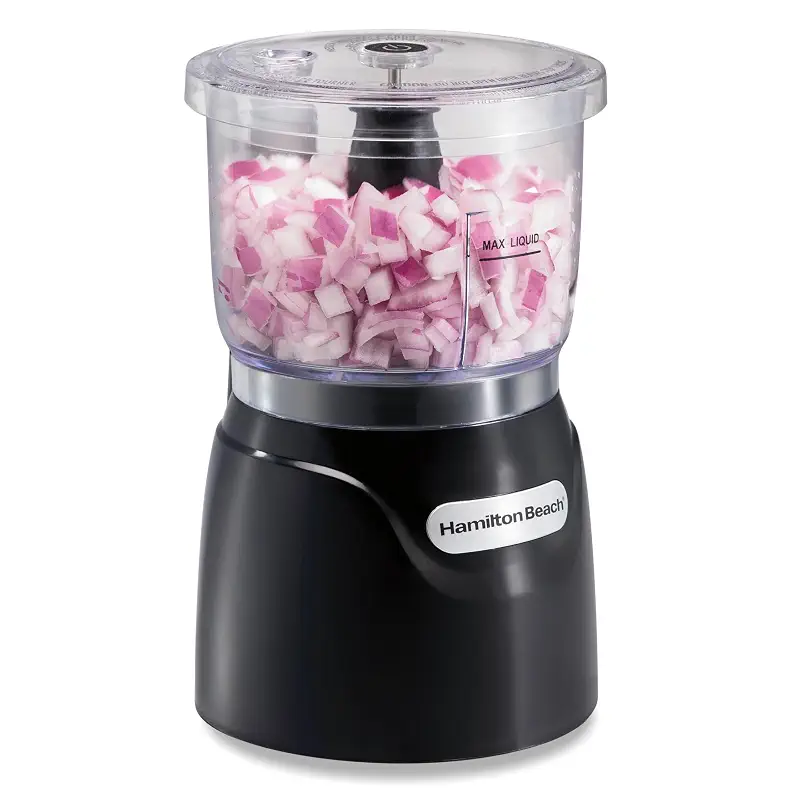
The Hamilton Beach electric chopper is the tool to reach for when you want power with no effort. Its patented stack-and-press design means you assemble it in seconds: add vegetables, place the lid, and press. It chops in pulses or continuous mode depending on what you need. For onions and garlic, buyers report it works beautifully. The 350-watt motor is surprisingly strong for the compact footprint, and cleanup is genuinely easy: the bowl, lid, and blades are all dishwasher safe.
However, this chopper is not the solution for large-batch prep or for soft vegetables like ripe tomatoes. The 3-cup capacity is small, which means repeat batches if you're prepping for canning or meal prep in volume. Several reviewers also note that the powerful motor can over-process soft vegetables into a pulp rather than leaving them in clean, defined pieces. It's purpose-built for small households and quick chops, not for standing in front of it and processing a pile of vegetables.
Where this differs from the manual choppers is the learning curve with texture. You have to pulse carefully; hold the button too long and onions become mush. But once you dial in the rhythm, it's faster than pressing down six times on a manual chopper. It's also the safest option if you have hand weakness or arthritis, since the motor does all the work. For tomato work, it's best used for finer mincing rather than discrete dice.
Pros
350-watt motor minces garlic and onions in two pulses
3-cup capacity holds enough for small batches
Stack-and-press design assembles in seconds with no twist-locking
All removable parts are dishwasher safe
Cons
Powerful motor can over-process soft vegetables into pulp
Small 3-cup capacity requires multiple batches for large prep
Key features
Patented stack-and-press design with simple one-touch operation
350-watt motor handles garlic, herbs, nuts, and vegetable prep
3-cup stainless steel bowl fits compact kitchens and storage
Oil dispenser on lid for emulsifying dressings and sauces
#5 Pick
Best Budget Option
Yusshn
Yusshn Vegetable Chopper, 12-in-1 Food Veggie Chopper Cutter with Container | 7 Sharp Blades Dice, Slice, Shred and Grate for Salads, Onions and Meal Prep, with a Non-Slip Base and Drain Basket
4.4(6,279)
A manual chopper with seven blades, drain basket, and integrated 2-in-1 container at an entry-level investment.
Ideal for: Budget-conscious cooks and beginners testing whether a chopper suits their cooking style.
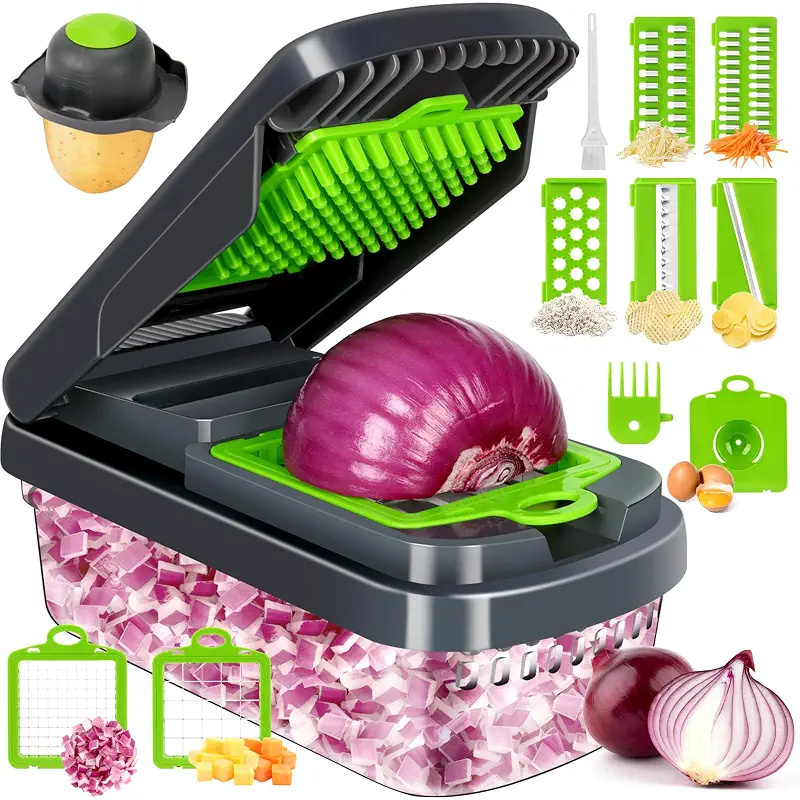
The Yusshn vegetable chopper packs impressive versatility into a simple manual tool. Twelve pieces total (seven blades plus cleaning brush, hand protector, egg separator, drain basket, and container) give you dicing, slicing, shredding, and grating without premium pricing. Buyers praise how fast it works on firm vegetables (potatoes, carrots, bell peppers) and the integrated drain basket means you can rinse vegetables right in the container without extra steps. The non-slip rubber base keeps it stable during use, and the angle-incline design helps ingredients feed into the blades more easily.
The downsides are real enough to matter. Soft vegetables like ripe tomatoes require a light hand; press too hard and you crush them. Harder vegetables like carrots need pre-cutting into smaller pieces, and you have to apply firm pressure on the handle: it's not as effortless as the fullstar Pro. Several reviewers mention that some accessories (particularly the finer grids) can be finicky to clean, and the plastic construction, while durable, doesn't feel as substantial as stainless steel on the Mueller models. There's also no electric option here; this is pure mechanical effort.
If you're new to kitchen gadgets and want to test whether a chopper fits your workflow before investing more, this is a sensible starting point. The drain basket is genuinely useful, and the variety of blades means you're not limited to dicing. If you're looking for a specialized tool, the top tomato dicer offers single-purpose precision for tomato-heavy work, while this Yusshn gives you broader vegetable versatility at lower cost. Compared to the Hamilton Beach electric, you'll invest less money but more physical effort.
Pros
Seven interchangeable blades for dicing, slicing, shredding, grating
Integrated drain basket lets you rinse vegetables in container
Non-slip rubber base and angled design for stable, efficient cutting
Hand protector and cleaning brush included for safety and maintenance
Cons
Requires firm hand pressure on harder vegetables like carrots
Soft vegetables like tomatoes can get crushed with heavy pressure
Key features
Seven sharp 420J2 stainless steel blades for multiple cutting styles
system includes drain basket, hand protector, and cleaning brush
Non-slip base with 15-degree angled design for easier ingredient feeding
How to Choose a Tomato Chopper
Four trade-offs that actually matter when matching a tomato chopper to your kitchen.
Manual vs. Electric: What Fits Your Kitchen
Manual choppers like the Mueller and Yusshn require hand pressure but excel at control and texture. You can pulse gently for a coarse chop or press firmly for fine dice. Electric models like the Hamilton Beach take the effort out (perfect if hand strength is a concern) but you sacrifice some control over how finely ingredients are processed. Consider your typical prep volume: if you're dicing three onions a week, a manual chopper is efficient and takes seconds. If you're prepping vegetables daily or in large batches, an electric model saves cumulative effort. A manual versus electric chopper comparison can help clarify which style suits your cooking frequency and kitchen space.
Blade Count and Versatility
Single-blade choppers like the fullstar Pro do one job exceptionally well: dice. Multi-blade systems like the Mueller Pro-Series offer slicing, julienne, and grating, which means you're not buying separate tools. More blades = more storage space needed and more to clean. Ask yourself what cuts you actually use. If salsa and slaw are frequent projects, multiple blades earn their space. If you mostly dice for soups and stir-fries, a focused tool is simpler. The Yusshn hits a middle ground with seven blades at budget pricing.
Container Size and Meal-Prep Needs
The Mueller models and Yusshn include built-in containers that catch chopped vegetables, eliminating counter mess. The fullstar Pro holds 5 cups; the Hamilton Beach holds 3 cups. Container size matters if you're prepping a week's salads at once or canning tomatoes in volume. A smaller container means more emptying and refilling. Conversely, a compact footprint is an asset in tight kitchens. The drain basket in the Yusshn lets you rinse vegetables without transferring them, a practical detail for fresh salsa or pico de gallo.
Safety, Cleaning Vegetable Chopper Blades, and Durability
Every blade-equipped chopper in this lineup has blades sharp enough to cut skin; that's what makes them effective. What differs is how easy they are to handle safely during cleaning. The Mueller models include a special brush and food-holder tool designed to manage blade exposure. The fullstar Pro comes with a comb for extracting stubborn bits. Hand-washing blades is safer than trusting them to the dishwasher if you're nervous about cuts. All these tools will last years with proper care, but stainless steel blades hold an edge longer than softer materials. If durability is your priority, the Mueller and fullstar models have more proven track records with higher review counts.
Frequently asked
Quick answers to the questions readers ask most.
Why does my tomato chopper crush soft tomatoes instead of dicing them cleanly?
Soft, juicy tomatoes lack the firmness that makes clean cuts possible. The blade presses through yielding flesh rather than cutting it. Firmer varieties like Roma or paste tomatoes hold their shape better. You can also partially freeze tomatoes for 30 minutes before chopping to increase firmness temporarily. If you're making salsa regularly, buying plum tomatoes at peak ripeness (firm but not hard) gives you the best result.
Are manual and electric choppers both safe to clean?
Both are safe if you respect the blades. Manual choppers are generally safer to clean because you control the pace and can inspect the blades visually as you work. Always use the included comb or brush to dislodge food, and let the chopper soak in hot soapy water first to soften stuck bits. For electric choppers, unplug before cleaning and avoid submerging the motor base. Most have dishwasher-safe bowls and removable blades, but hand-washing the blades themselves prevents accidental contact with your hands.
Do I need to pre-cut vegetables before using a chopper?
It depends on the tool and vegetable size. Softer items like peppers and onions usually fit whole into most choppers. Harder items like carrots and potatoes need quartering or cutting into flat pieces first so they feed into the blade chamber properly. The Hamilton Beach electric has the smallest opening and needs the smallest pre-cut pieces. Manual choppers like Mueller handle larger chunks better. Check the instruction manual for your specific model's recommended prep size to avoid jamming the mechanism.
Can I use a vegetable chopper for herbs and garlic, or just harder vegetables?
You can use most choppers for herbs and garlic, but results vary. Hard ingredients like garlic benefit from electric choppers and those with very sharp blades. Softer herbs like cilantro and parsley are better minced by hand or with a knife because a chopper can bruise them and release bitterness. The Hamilton Beach electric handles garlic beautifully in two pulses. For a manual chopper, finely minced garlic works well, but delicate herbs tend to get mashed rather than evenly cut.
How often should I replace the blades on a vegetable chopper?
Quality stainless steel blades last years with regular use. You'll notice a blade has dulled when vegetables start getting crushed instead of cut cleanly, or when you have to apply significantly more pressure than before. Most manufacturers sell replacement blade sets affordably, making it practical to refresh your chopper rather than buy a new one. Proper cleaning and hand-washing blades (rather than repeated dishwasher cycles) extends blade life considerably. Most home cooks replace blades every 3 to 5 years with daily use.