Kitchen & Dining · Small
Best Toaster Oven Under $50: Top Budget-Friendly Picks
Find the best toaster oven under $50. Compare compact 2-slice and 4-slice models with top ratings. Perfect for dorms, RVs, and small kitchens.
Affiliate disclosure: As an Amazon Associate I earn from qualifying purchases.
At a glance
1
Best Overall ValueElite Gourmet
2
Best Air Fry OptionBlack+Decker
3
Best for BakingElite Gourmet
4
Best All-Around PerformerBlack+Decker
5
Best Budget-Friendly StarterElite Gourmet
Detailed reviews
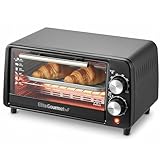
The Elite Gourmet Compact 2-Slice is what you get when a manufacturer commits to actual miniaturization. At 650 watts, it heats fast and includes a bake pan and rack right out of the box. The 15-minute timer suits quick tasks (toasting, warming pizza, reheating a muffin) though you'll need to flip bread halfway for even browning because the heating coils sit close to the rack. Space between the top coil and food is tight, so thicker items or rising pastry can kiss the element, which calls for aluminum foil shields or careful timing. That said, owners who understand the unit's physical constraints report solid results: perfectly crisped cheese toast, warm croissants, and reheated pizza that beats a microwave. The build feels modest but durable; a few owners report it still works after years of daily use.
We'd steer first-time budget buyers toward this model because it's honest about what it is. You're not paying for features you don't need, and at this price point, the trade-off between compactness and versatility lands exactly where it should. Compared to the Black+Decker 4-Slice Air Fry model, this trades cooking volume and function count for a genuinely tiny footprint that fits dorm windowsills and RV counters. If you need to bake larger items or want air-fry capability, step up; if you're toasting for one or two and space is real, this is the one.
The main caveat is learning curve. Rotating the tray halfway, using foil covers, and timing by eye take practice. But that's the cost of fitting serious cooking into 15 cubic inches. Owners who accept this consistently praise the results.
Pros
- Extremely compact footprint fits tight spaces
- Fast heating and included accessories
- Reliable daily use for years per reviews
Cons
- Heating elements very close to food; requires technique
- Limited interior height restricts baking options
Key features (4)
- 650-watt heating with 15-minute timer and thermostat
- Temperature range 200°F–450°F for toast, bake, broil
- Includes non-stick bake pan and wire rack
- Compact design under 15 cubic inches capacity
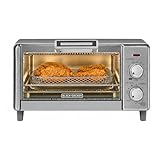
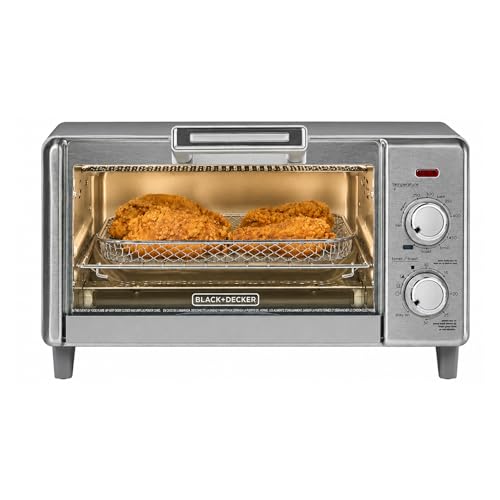
The Black+Decker 4-Slice Air Fry raises the ceiling on what you can do. Air-fry mode is the draw here: it uses high-velocity hot air to crisp frozen fries, chicken nuggets, and other snacks with minimal or no oil, which appeals to cooks tracking calories or texture. The EvenToast technology addresses a real pain point in small ovens: uneven browning. Owners report toast that comes out uniformly golden, not pale on one end and charred on the other. The included air-fry mesh tray, wire rack, and bake pan give you flexibility without buying extra hardware.
The catch is that this unit demands respect and attention. The interior is compact, so food sitting directly below the heating coils can scorch if you're not watching. Several owners flagged that leaving it unattended risks burning or, in rare cases, fires, especially when oil splatters onto the coils. The air-fry setting has a fixed temperature (no dial), so timing relies on watching the window. Preheating helps avoid hot-spot cooking, and the included drip tray is essential to keep beneath anything greasy. That said, owners who follow the manual report excellent results: crispy fries rivaling a dedicated fryer, evenly toasted bagels, and quick reheats.
Compared to the Elite Gourmet Compact 2-Slice, the Black+Decker trades ultra-compact size for multifunctionality and better toast consistency. If air frying and even browning matter to you, the trade-off is worth it; if you just need basic toast, the smaller Elite saves counter space. The real dividing line is whether you'll read and follow the manual: owners who do love it, those who don't often report problems.
Pros
- Air-fry mode produces crispy results with minimal oil
- EvenToast technology eliminates hot-spot browning
- Fits 9-inch pizza; more cooking flexibility than 2-slice models
Cons
- Close heating elements require active monitoring and care
- Air-fry temperature is fixed; timing relies on watching
Key features (4)
- 5 cooking functions: air fry, bake, broil, toast, keep warm
- EvenToast technology with dual heating elements
- 30-minute timer with removable crumb tray
- Air-fry mesh tray and multiple racks included
The Elite Gourmet splits the difference between the 2-slice and air-fry models by bumping wattage to 800 and extending the timer to 30 minutes. That extra power and time matter for actual baking: muffins, small loaves, batch reheats. The 9-liter capacity means you can fit a half-loaf pan or two modest cake layers, and the dual rack positions let you choose interior height depending on what you're cooking. Owners report heating up faster than competitors and reaching temperature reliably, which cuts prep time for both warming and baking tasks.
The interior layout is still compact but slightly less claustrophobic than the Elite Compact 2-Slice. You can technically fit four slices of bread, though two per rack is more realistic without overlapping. The removable crumb tray slides out from the bottom, making cleanup straightforward. Temperature control spans 200°F–450°F with a dial you set by feel, not a digital readout: simple, reliable, and immune to electronic glitches.
Where this sits in the lineup: against the Elite Gourmet Compact 2-Slice, it offers more wattage and timer length for bakers willing to accept slightly less compactness. Against the Black+Decker air-fry model, it drops the air-fry feature in favor of straightforward heat and more wattage. One owner noted that timing toast requires a light hand and some trial-and-error, similar to the 2-slice Elite, so even heating isn't guaranteed: you're relying on proper rack position and food placement.
Pros
- 800-watt power heats faster than smaller models
- 30-minute timer accommodates longer baking sessions
- Dual rack positions adjust interior height flexibly
Cons
- Toast timing remains unpredictable without preheating
- Still compact inside; large items require careful placement
Key features (4)
- 800-watt heating with 30-minute adjustable timer
- Temperature range 200°F–450°F with thermostat
- 9-liter capacity with dual rack positions
- Includes bake pan, wire rack, and crumb tray
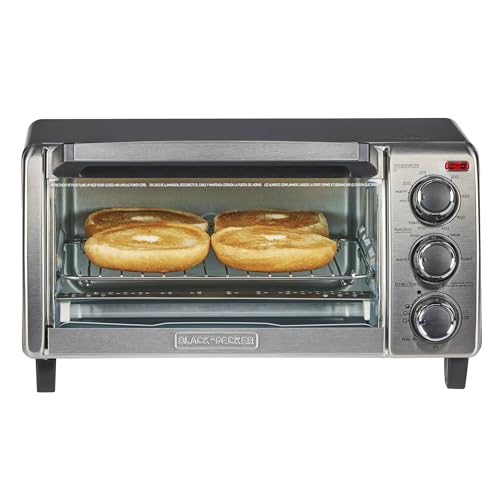
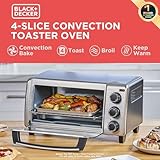
The Black+Decker is the workhorse here. It's been a best-seller for years, and thousands of reviews confirm why: it toasts evenly, fits a 9-inch pizza, and the convection airflow (activated on bake) distributes heat more uniformly than entry-level units. Owners consistently praise how it handles its core job (daily toast, reheating, occasional baking) without fuss. The removable crumb tray is thoughtfully placed and easy to clean, and the stainless-steel finish looks more polished than plastic competitors. The 30-minute timer with stay-on function gives you control; the mechanical bell is a nice touch (retro but honest).
One owner noted this is their third Black+Decker toaster oven over decades, which speaks to durability. Another called it a gas-oven replacement for small-batch baking. The convection mode requires a learning curve (you typically reduce oven temperature by 25°F or baking time by 25%) but owners who read the manual and experiment report excellent results. The outer surfaces do get hot during use, so proper ventilation and clearance matter.
Compared to the Elite Gourmet, the Black+Decker adds convection circulation and a proven track record of longevity, though they're priced similarly. Compared to the budget Elite 2-Slice, this is a step up in interior space, heating consistency, and features. For specialty uses like crafts or thermal transfer printing, you'd want to research the best toaster oven for sublimation separately, as those applications require precise temperature stability and larger interior depth than general-purpose models provide. If you bake occasionally or reheat frequently, convection wins; if you want crispy fries, air-fry wins.
The honest drawback: instructions are sparse, and the learning curve for convection baking can frustrate new users. But owners who invested time report it becomes indispensable.
Pros
- Convection airflow ensures even heat distribution and baking
- Proven durability; users report 15+ years of service
- Fits 9-inch pizza with roomy 4-slice capacity
Cons
- Convection mode requires reading manual and temperature adjustments
- Exterior surfaces get hot; needs clearance for safe operation
Key features (4)
- Natural convection circulates heat for even baking and toasting
- 4 cooking modes: bake, broil, toast, keep warm
- 30-minute timer with stay-on function and toast settings
- Removable crumb tray and included baking/broiler pan
The Elite Gourmet is the bare-bones champion. At 800 watts with quartz heating elements, it covers the essentials (bake, broil, toast, keep warm) in a footprint smaller than full-size ovens but larger than the 2-slice. The dual analog dials (temperature and 30-minute timer) are intuitive; there's no digital interface to malfunction or confuse. The matte black finish, cool-touch handle, and tempered glass door feel refined for the price. Owners praise how quickly it heats and how evenly it cooks, with several noting it's ideal for dorm and office use.
This is a straightforward tool that doesn't try to be an air fryer or convection specialist. It toasts, bakes, and reheats. The dual quartz elements heat fast, but like all compact ovens, interior space is snug: fit an 8-inch pizza or four slices with modest overlap. One owner rightly flagged it's "basic," which isn't a fault if you accept what you're buying. Another warned to monitor toast closely since it can overcook quickly if you're not watching.
Compared to the Black+Decker Convection model, this trades convection circulation and proven longevity for simplicity and lower cost. Compared to the Elite Compact 2-Slice, it gives you more interior volume and the same straightforward operation. If you want to avoid air-fry complexity and just need reliable heat, this hits the mark. The barrier to ownership is low: no learning curve, no manual deep-dive required. You set the temp, set the timer, and go.
Pros
- Simple dual-dial controls with no learning curve
- 800-watt quartz heating element heats quickly and evenly
- Modern design with tempered glass and cool-touch handle
Cons
- Very basic feature set; no air-fry or advanced functions
- Still requires monitoring toast; no EvenToast technology
Key features (4)
- 800-watt quartz heating with dual elements
- Analog temperature dial (200°F–450°F) and 30-minute timer
- 4 cooking functions: bake, broil, toast, keep warm
- Includes bake pan, wire rack, and drop-down crumb tray
How to Choose a Toaster Oven Under $50
Size and Counter Space
The biggest trade-off in this price range is interior volume versus footprint. A 2-slice compact model (like the Elite Gourmet Compact) occupies minimal space (ideal for studios, RVs, and dorm rooms) but you'll flip bread halfway and rotate trays for even browning. A 4-slice model (Elite, Black+Decker, or Elite ) gives you room for an 8- or 9-inch pizza and dual rack positions, making baking less finicky. Measure your counter before ordering; some models measure under 15 inches wide, while others approach 16 inches. If space is genuinely tight, the 2-slice wins; if you have even modest clearance, the 4-slice versatility pays off.
Core Functions You Actually Need
Every model here toasts, bakes, and broils. The question is whether you want air-fry or convection. Air fry (Black+Decker 4-Slice Air Fry) uses intense direct heat to crisp foods with little oil: a genuine asset if you eat frozen snacks or want healthier fried alternatives. When considering air fry versus convection ovens, remember that convection (Black+Decker ) circulates steady heat for even baking and is the mode you'd choose if you bake bread, cookies, or casseroles regularly. Standard baking (all models) works fine for reheating and light baking but can produce hot spots. Consider how you actually cook: daily toast plus occasional pizza reheat? Standard or basic is fine. Weekly baking? Convection helps. Crispy fries every week? Go air-fry.
Heating Consistency and Even Browning
Budget models under $50 rarely distribute heat perfectly. The elite Gourmet Compact 2-Slice and require you to flip bread and rotate trays halfway: you're managing the heating elements' proximity. The Black+Decker models (both the 4-Slice Air Fry and the Convection) employ EvenToast or convection airflow to minimize this work, but they cost slightly more and occupy more space. If you're patient and don't mind technique, any model works. If you want to load toast and walk away, Black+Decker is worth the trade-off. Preheating for 10 minutes before baking also helps all models perform more evenly.
Wattage and Timer Length
Wattage ranges from 650 to 800 watts here. Higher wattage heats faster and maintains temperature more consistently, especially when you open the door. The 650-watt Elite Compact 2-Slice is sufficient for its size but takes slightly longer to preheat. The 800-watt models (Elite and ) heat in under 5 minutes and hold temperature better during cooking. For timer, 15 minutes (Elite Compact) is tight if you're baking anything; a 30-minute timer (all other models) lets you bake small loaves, reheat casseroles, or roast veggies without restarting mid-cook. If you're only toasting and reheating, 15 minutes suffices. For baking, 30 is essential.
Durability and Toaster Oven Cleaning and Maintenance
All five models come with removable crumb trays, which is essential because budget ovens do accumulate crumbs quickly. The Black+Decker has the longest owner-reported lifespan (10–30 years), likely due to convection's gentler heating cycle. Elite Gourmet models are consistently reported as durable for 2–5 years with daily use. Quartz and standard coil elements are equally reliable; quartz heats slightly faster. To extend any model's life through proper toaster oven cleaning and maintenance, wipe the crumb tray after each use, keep the interior dry, and don't let grease pool. Glass doors stain easily in compact ovens; prevent this by lining the crumb tray with foil or a silicone mat.
Our picks at a glance
1
Best Overall ValueElite Gourmet
2
Best Air Fry OptionBlack+Decker
3
Best for BakingElite Gourmet
4
Best All-Around PerformerBlack+Decker
5
Best Budget-Friendly StarterElite Gourmet
Frequently asked
Can a budget toaster oven really fit a 9-inch pizza?
Yes, but snugly. The 4-slice models (Black+Decker, Elite, and Black+Decker Air Fry) advertise 9-inch pizza capacity, and owners confirm pizzas fit, though there's minimal clearance at the sides. The Elite Compact 2-Slice and Elite cap out around 8 inches. Measure your pizza box beforehand if this matters to you, and expect some trial-and-error with rack position on first use.
Do I need to preheat a budget toaster oven?
For toasting and reheating, no. For baking, yes: 10 minutes at your target temperature ensures the heating elements reach full strength and heat distributes evenly. Skipping preheat on baked goods often means a pale exterior and undercooked center. Toasting can happen immediately, though letting the coils warm for 2–3 minutes reduces the chance of burnt edges.
Why do some reviews say budget toaster ovens burn food easily?
Compact ovens place heating elements very close to food, and they don't distribute heat as evenly as full-size ovens. The solution is flipping bread halfway through toasting, rotating trays during baking, and using foil shields on pastries to block the top coil. Once you learn the unit's quirks, burning becomes rare. Owners who follow these steps consistently report excellent results.
Is air-fry technology worth the extra cost?
It depends on what you cook. If you regularly eat frozen fries, wings, or chicken nuggets, air-fry is genuinely useful and reduces oil compared to pan-frying. If you mostly reheat and toast, you're paying for a feature you won't use. The Black+Decker Air Fry model is the only one under $50 with this function; the others are standard bake/broil ovens.
How long do budget toaster ovens typically last?
With daily use, expect 2–5 years for Elite Gourmet models and 10+ years for Black+Decker (based on owner reports). Longevity depends on how much you use it and whether you keep the interior clean. Heating elements are the first to degrade, but they rarely fail catastrophically: performance just gradually softens over time. At this price point, replacement is usually cheaper than repair.