Kitchen & Dining · Drinkware
Best Steaming Pitcher
Compare seven stainless steel jugs by capacity, spout shape, handle design and how well the finish holds up, from single-drink sizes to large batches.
Affiliate disclosure: As an Amazon Associate I earn from qualifying purchases.
At a glance
2
Best for Big BatchesZowie King
3
Best for Single DrinksCamkyde
5
Best for Espresso Machine OwnersDe'Longhi
6
Best Everyday PitcherApexstone
Detailed reviews
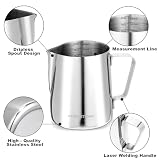
We'd steer most home cooks who steam for one to three drinks toward the Umuaccan Milk Frothing Pitcher. Its narrow V-shaped mouth is built for controlled pours, the handle is designed to stay cool, and double scale lines inside make it easier to repeat the same milk volume. A decorating pen is included for etching designs into the foam.
Owner feedback lines up on size and function. Owners report that a cup of milk can be frothed without it sloshing over, that it works with a handheld frother as well as an espresso machine's steam wand, and that it cleans easily. The steel is described as solid in the hand. A common complaint, though, is longevity: rust after a single use and a coating that peels off both come up, so we'd rinse and dry it promptly after each session.
The 20.3 oz capacity also makes it a handy all-rounder for batters, smoothies and other hot or cold liquids when the milk jug is idle.
Pros
- Narrow mouth suited to latte art
- Handle designed to stay cool
- Double scale lines inside the jug
- Latte art pen included
Cons
- Rust reported after a single use
- Coating reported to peel off
Key features (4)
- 304 stainless steel body in a 20.3 oz capacity
- Narrow V-shaped mouth designed for controlled pouring and clean latte art lines
- Double scale lines inside for tracking pour speed and milk volume
- Included decorating pen for etching designs into milk foam
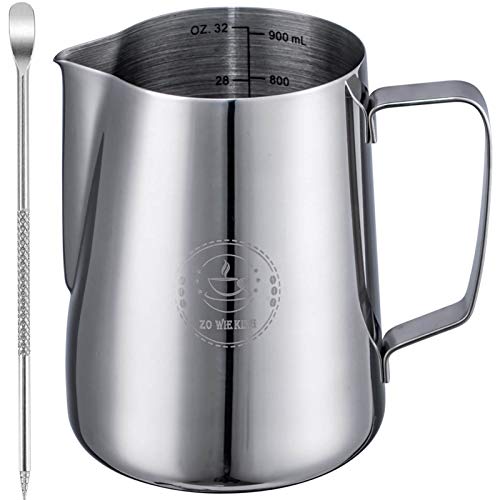
Like the Umuaccan Milk Frothing Pitcher, this one pairs a narrow mouth with a handle meant to stay cool, but it scales everything up to the 32oz class. The listing pitches it for three or four cappuccinos or espressos at a time, with liquid measurements engraved on both sides so the level is readable from either hand. A latte art pen is included as well.
Owners praise the finish and the solid feel of the stainless body, describe it as excellent for steaming milk for lattes, and say it rinses clean and dries quickly. A common complaint is durability: it is called heavy-duty by one side of the feedback, while the other side reports rust appearing after a couple of uses. We'd treat it as a gentle-use jug that gets dried after every wash rather than something left damp on a busy counter.
If you steam for a group or make oversized drinks, the capacity is the reason to choose it; for a single cup it is more pitcher than you need.
Pros
- Large capacity for several cappuccinos
- Measurements engraved on both sides
- Narrow mouth for controlled pouring
- Finish and solid feel praised
Cons
- Rust reported after a couple of uses
Key features (4)
- 304 stainless steel body marketed as rust and corrosion resistant
- Liquid measurements engraved on both sides of the 32oz body
- Narrow pouring mouth with a heat-safe handle for latte art work
- Latte art pen included for decorating foam
The Zowie King Milk Frothing Pitcher 32oz holds well over twice as much as this one, and that gap is the point: at 12 oz, the Camkyde Milk Frothing Pitcher 12 oz is the smallest on the page and the one we'd choose for a single cappuccino or latte rather than a batch. The spout is designed to be dripless, with a diversion trough to keep the stream smooth, and the oversized handle is meant to stay comfortable through long sessions.
Inside, markings in US and metric units run up to 12 oz (350 mL), so the fill level is easy to repeat. The body is 18/8 stainless steel and is listed as dishwasher safe. Owners report that it froths just enough for one person, that it looks good, and that it washes well in the dishwasher.
The size gets a mixed reaction, and that is the thing to weigh: it suits a one-cup routine perfectly but is reported as smaller than expected by buyers who wanted more milk, so measure your usual drink before choosing it.
Pros
- Dripless spout with diversion trough
- Marks in oz and mL inside
- Dishwasher safe 18/8 stainless
- Oversized handle for comfortable grip
Cons
- Size reported smaller than expected
- Smallest capacity of the page's picks
Key features (4)
- Food grade 18/8 stainless steel body in a 12 oz capacity
- Dripless eagle spout with a diversion trough for smoother pours
- Interior US and metric measurements up to 12 oz (350 mL)
- Larger ergonomic handle designed for comfort during daily use
Beginners are who we'd point to first with the Welkor Milk Frothing Pitcher 32oz. A laser-etched scale in ounces and milliliters takes the guesswork out of filling, the tapered spout is built to pour without drips, and the weight-balanced handle is designed to stay comfortable as the steel heats up. The body is 18/8 stainless, it is listed as dishwasher safe, and a latte art pen comes along for etching hearts and tulips.
Both it and the Zowie King Milk Frothing Pitcher 32oz sit in the 32 oz class with a pen included, and the Welkor is marginally heavier at 0.59 pounds against 0.58. The steel is described as 1.2 mm thick, which gives it a substantial feel in the hand.
Beyond coffee, it works for measuring ingredients, serving cream or warming a small amount of chocolate, so it earns its place on a home coffee bar and in the wider kitchen.
Pros
- Laser-etched oz and mL scale inside
- Drip-free spout for clean pours
- Dishwasher safe 18/8 stainless
- Weight-balanced, heat-resistant handle
Key features (5)
- 18/8 stainless steel body in a 32 oz capacity
- Laser-etched interior scale in ounces and milliliters for volume control
- Tapered precision spout built to pour without drips or spills
- Textured, weight-balanced handle designed to stay comfortable during steaming
- Latte art pen included for etching hearts and tulips
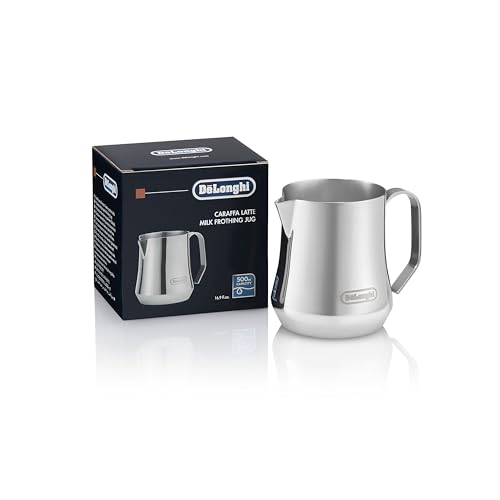
Sized between the Camkyde Milk Frothing Pitcher 12 oz and the 20 oz jugs, the De'Longhi Milk Frothing Pitcher 17 oz (500 ml) is the choice for anyone who already runs an espresso machine, particularly one from the same brand. The handle is designed so you can grip either the handle or the jug itself, the spout is shaped for latte art, and it is listed as dishwasher safe.
Owners report that it froths well for lattes and cappuccinos, that it can handle milk for two cappuccinos at once, that it layers steamed milk neatly and that it is easy to clean. The look draws praise too. Where owners disagree is on lifespan: reports include rust appearing within a couple of weeks and a handle that broke off after about six weeks, while others describe it as lasting for years.
Capacity is the other point to weigh, since a reviewer who makes big morning lattes found it too small for a full cup. For cappuccinos and smaller drinks it fits well.
Pros
- Double-grip handle design
- Spout shaped for latte art
- Dishwasher safe stainless steel
- Works well with espresso machines
Cons
- Handle breakage reported after about six weeks
- Rust reported after a couple of weeks
- Too small for a full-size latte
Key features (4)
- 17 oz (500 ml) stainless steel body with a polished finish
- Handle designed for a double grip on the handle or the jug
- Pouring spout shaped for easier latte art control
- Dishwasher-safe construction that keeps cleanup simple after daily use
Anyone weighing it against the Umuaccan Milk Frothing Pitcher will find the same 20 oz class, with the Apexstone Milk Frothing Pitcher 20 oz slightly heavier at 0.55 pounds against 0.53. It is made of 304 stainless steel, with a curved spout for controlled pouring and an ergonomic handle for a secure grip, and it is listed as dishwasher safe.
The interior markings are the feature owners mention most warmly: they describe the scale as helpful and accurate, and say it makes controlling the amount of milk simple and latte art a little easier. Owners also report that it works well with espresso machines, cleans easily and keeps a shiny finish.
Two points deserve attention. The size gets mixed reactions, with one side calling it ideal for single or double servings and the other calling it too small. And the listing advises keeping the steel clean and away from salty liquids, since that is how rust is prevented.
Pros
- Accurate interior measurement markings
- Shiny finish that cleans easily
- Dishwasher safe 304 stainless
- Curved spout aids controlled pours
Cons
- Size reported as too small
- Needs care to avoid rust
Key features (4)
- 304 stainless steel body holding 20 oz (600 ml)
- Curved pour spout shaped to direct milk and foam precisely
- Interior measurement markings for milk, water and other liquids
- Ergonomic handle for a secure grip while pouring hot milk
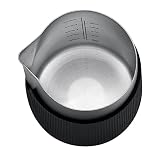
The handled jugs, from the De'Longhi Milk Frothing Pitcher 17 oz to the Apexstone Milk Frothing Pitcher 20 oz, are the easier place to start; the Normcore Handleless Milk Pitcher 20.3 oz is for pourers who already know why they want to drop the handle. It is 18/8 stainless steel about 1 mm thick with a double-coated Teflon finish, a silicone heat-resistant grip around the middle and a patch of exposed metal at the base for checking the milk's temperature. The round spout is wide enough to balance against a steam wand.
Owners report surprising control when pouring, say the lack of a handle gives a better grip for precise designs, and find the 600 ml size enough for milk for two lattes. Complaints centre on the finish and the grip: the black coating is reported as not durable and peeling, and the body is reported to slide from the hand. Handleless pitchers also take practice before the pour feels natural.
It is a specialty tool, strong for experienced hands and a steeper learning curve for everyone else.
Pros
- Handleless body aids precise pouring control
- Silicone grip with exposed metal for heat checks
- Wide round spout balances a steam wand
- Holds enough milk for two lattes
Cons
- Black finish reported not durable
- Grip reported to slide in the hand
- Handleless design takes practice
Key features (5)
- 18/8 stainless steel, 1 mm thick, with a double-coated Teflon black finish
- Silicone heat-resistant grip band around the middle of the body
- Round spout wide enough to rest against a steam wand
- Exposed metal patch at the base for checking milk temperature
- 600 ml (20.3 oz) capacity with a body weight of 267 g
Side by side
| Pick | Item weight | Size |
|---|
#1 Best Overall
Umuaccan | 0.53 pounds | 20.3 Ounces |
#2 Best for Big Batches
Zowie King | 0.58 pounds | 30.4 Ounces |
#3 Best for Single Drinks
Camkyde | 0.34 pounds | 12 Ounces |
#4 Best for Beginners
Welkor | 0.59 pounds | 32 Ounces |
#5 Best for Espresso Machine Owners
De'Longhi | 0.56 pounds | 16.9 Ounces |
#6 Best Everyday Pitcher
Apexstone | 0.55 pounds | 20 Ounces |
#7 Specialty Pick
Normcore | 0.56 pounds | 20.3 Ounces |
How to Choose a Steaming Pitcher
How big should a steaming pitcher be?
Size changes your results more than any other choice. A good rule is a pitcher roughly two to three times the volume of the cup you pour into, filled only about a third of the way so the milk has room to swirl and expand. Too much pitcher for a small pour leaves the wand without enough milk to whirl, and too little sends foam over the rim.
For single drinks, the Camkyde Milk Frothing Pitcher 12 oz is the right scale. For two drinks at once or one big latte, the 20 oz class fits better, and the Apexstone Milk Frothing Pitcher 20 oz is the pick with the most praised inside markings. If you pour for a group, the Zowie King Milk Frothing Pitcher 32oz settles it. Steaming pitchers and frothing pitchers are the same tool under two names, so the sizing advice here carries over to the best milk frothing pitcher lineup as well.
| Size | Suits | Watch for |
|---|
| About 12 oz | One small drink | Runs short for a large latte |
| About 17 oz | One large latte or two small drinks | Wand must reach shallow milk |
| About 20 oz | Two drinks at once | Oversized for a single cup |
| About 32 oz | Batches for a group | Awkward on a compact machine |
Sharp, round or handleless: which pouring style fits?
The spout and handle decide how the milk leaves the jug. A narrow spout slows the stream for fine lines, a round spout flows broader and faster, and a handleless body trades the handle for a direct feel. Learners usually do better with a handled jug, and the narrow V-shaped mouth on the Umuaccan Milk Frothing Pitcher is a clear example of the fine-detail style. Pourers who already know why they want to drop the handle should look at the Normcore Handleless Milk Pitcher 20.3 oz.
- Narrow spout: slower stream and finer detail for rosettas
- Round spout: broader, faster flow for hearts and bold shapes
- Handled jug: keeps your hand off hot steel and eases angling
- Handleless jug: direct control, but needs a sleeve or coating
- Dripless or tapered tip: cleaner finish at the end of a pour
Does the finish affect how long a pitcher lasts?
Stainless steel is the standard, and the grades listed here are 304 or 18/8, both marketed as rust resistant. Even so, owner reports on these pitchers include rust and peeling coatings, so rinse and dry the jug after each use and keep salty liquids out of it.
Coated or colored finishes make cleanup easier on paper but add a surface that can wear, which is the trade-off with the Normcore Handleless Milk Pitcher 20.3 oz. Plain steel also lets you feel the milk heat through the wall, which helps you judge when to stop steaming.
Are interior measurement marks worth having?
They repeat the same starting volume, cut down on wasted milk and take the guesswork out of filling to the right level. A kitchen scale does the same job, so they are convenient rather than essential. The Welkor Milk Frothing Pitcher 32oz has a laser-etched scale in ounces and milliliters, and the Camkyde Milk Frothing Pitcher 12 oz carries markings up to its full capacity.
Our picks at a glance
2
Best for Big BatchesZowie King
3
Best for Single DrinksCamkyde
5
Best for Espresso Machine OwnersDe'Longhi
6
Best Everyday PitcherApexstone
Frequently asked
Is a steaming pitcher different from a frothing pitcher?
No. Both names describe the same stainless jug used with a steam wand or a handheld frother, and a jug-style electric frother or a handheld whisk is a different appliance that does not replace it. The Umuaccan Milk Frothing Pitcher is a good example of the crossover, since owners use it with a handheld frother as well as an espresso machine's wand.
How full should the pitcher be before steaming?
Aim for roughly a third of the way up, to the base of the spout, so the milk has space to expand and swirl. Overfilling sends foam over the rim and underfilling leaves the wand without enough milk to roll. The etched scale inside the Welkor Milk Frothing Pitcher 32oz makes that fill line easy to repeat.
How can you practice steaming without wasting milk?
Warm water with a small drop of dish soap foams to a texture close to milk, so you can rehearse the whirlpool and the pour as often as you like. Once the motion feels natural, move to milk and begin working on the shapes.