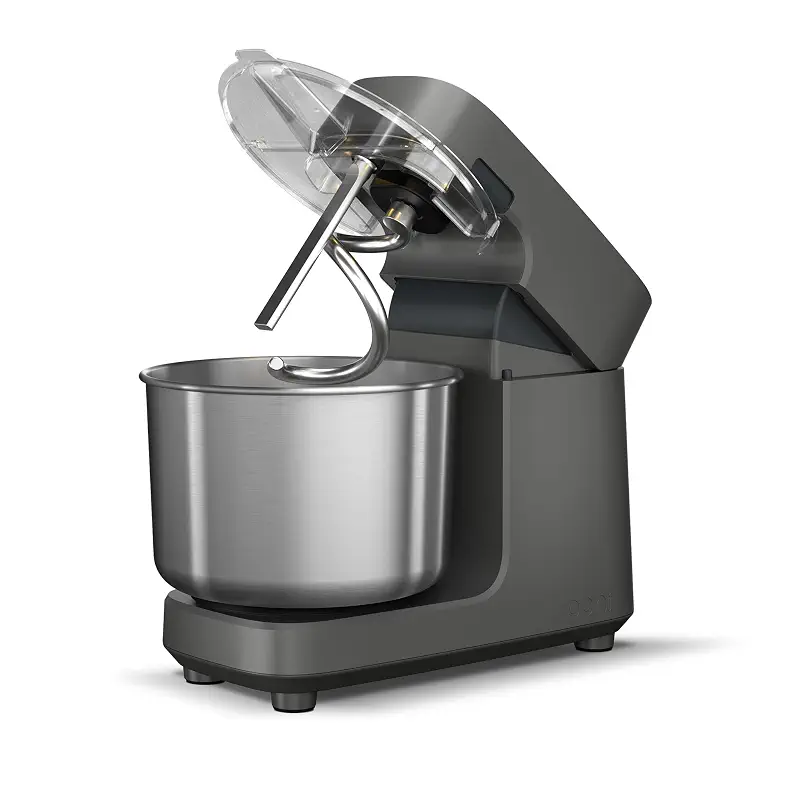
Ideal for: Serious home bakers and small pizzeria operators who prioritize gluten development and consistency.
The ooni Halo Pro stands out as the most refined spiral mixer designed for serious home bakers. Its patent-pending removable breaker bar is the feature that sets it apart, actively strengthening gluten networks during the mix cycle in a way that few competitors match. The 58 speed settings give you precision from gentle mixing at 60 RPM to aggressive kneading over 1,000 RPM, letting you dial in the exact tempo each dough demands. The spiral hook, rotating bowl, and breaker bar combination delivers the kind of dough structure you'd expect from a commercial bakery environment, yet it stays compact enough to leave on the counter.
Where this mixer excels is consistency and ease of use. The removable bowl fits in the dishwasher, the LED interior lighting lets you watch gluten develop in real time, and the timer function keeps you from over-mixing. The included flexible beater and whisk attachments expand your range, though owners note the whisk doesn't perform like a dedicated planetary mixer if you regularly whip cream or beat egg whites. For daily bread and pizza work, though, it handles everything beautifully.
Owners across the board report that the upfront investment pays for itself quickly if you bake multiple loaves or make pizza dough regularly. The build quality feels substantial, and the cooling fan that runs after shutdown suggests the engineers thought through longevity. Setup requires a bit of care with the lift mechanism, but once running, it becomes an indispensable tool.
Ideal for: Bakery operations, pizzeria owners, and home bakers making 25+ loaves or batches per week.
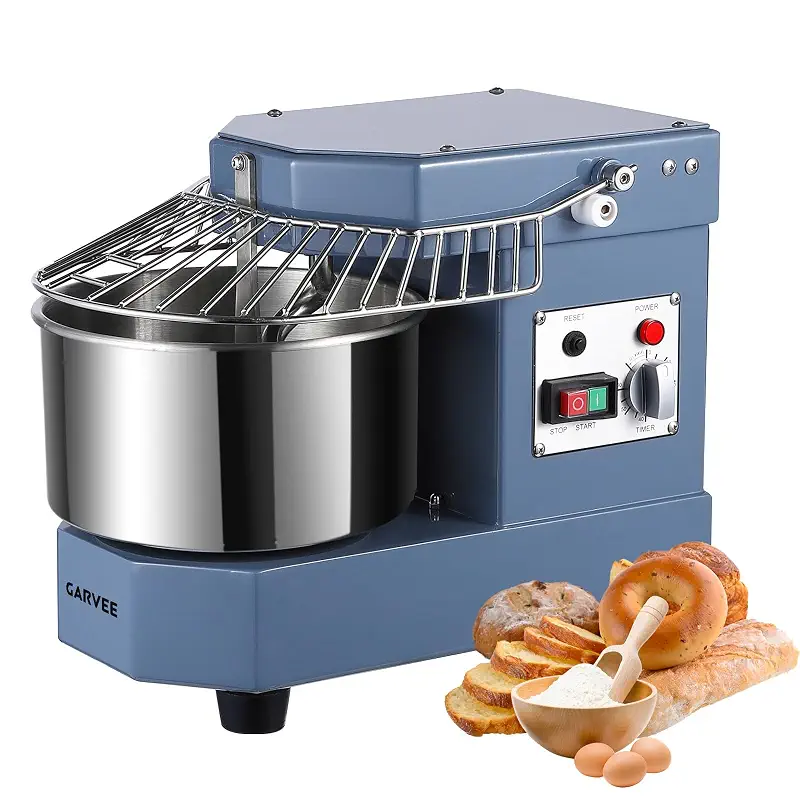
The Garvee Commercial handles 11 pounds of dough in a single batch, making it the workhorse choice if you're scaling from home experiments to feeding a pizza operation or catering regular bread orders. The 650W dual-rotation system pairs a slow-turning bowl (21 RPM) with a faster spiral hook (129 RPM), simulating the hand-kneading action that builds strong gluten without generating excessive heat. Owners who've switched from KitchenAid-style mixers praise the speed and consistency; one reviewer noted it replaced hours of manual kneading and hand-folding with a reliable, repeatable dough profile.
The trade-off is simplicity. This mixer offers one speed, not adjustable settings, which means you're working within the manufacturer's mixing parameters rather than fine-tuning RPM for different hydration or flour types. The fixed bowl also stays mounted to the unit, requiring you to clean it in place rather than pulling it free. For dough production, that's rarely a limitation, but it does make deep cleaning less convenient compared to models like the ooni. The non-slip feet and security shield address safety and stability well. Owners recommend batching at least 1,500 grams (about 3 pounds) of dough to prevent the mixer from tossing lighter loads around.
If you're serious about volume and willing to accept a simpler interface and larger kitchen footprint, this delivers reliable results at a fraction of premium-brand pricing.
Ideal for: Small bakeries and home operations seeking commercial-scale capacity with dual-rotation mixing.
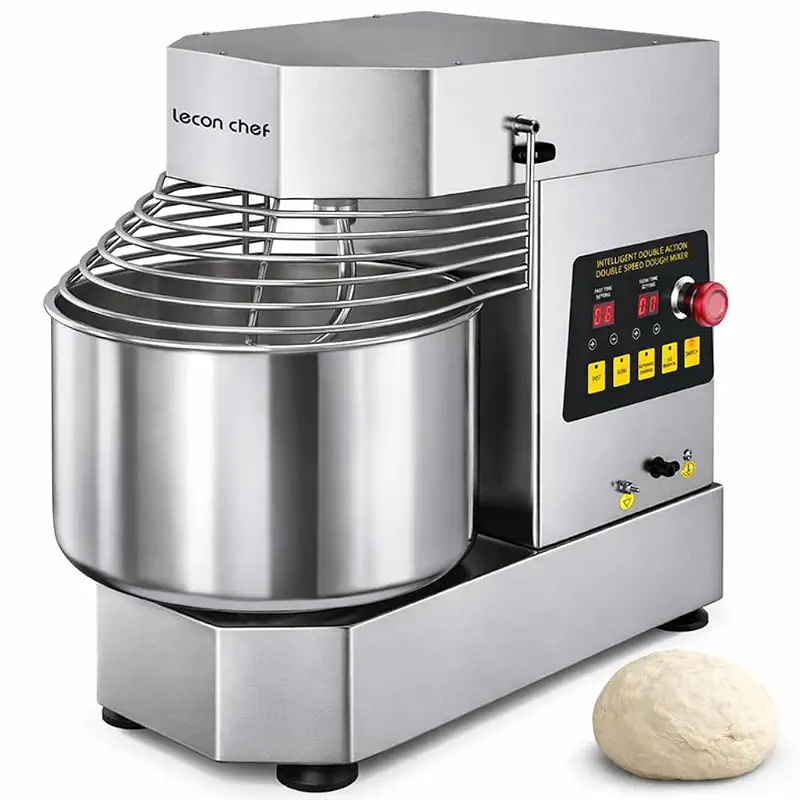
The lecon chef Commercial Spiral prioritizes consistent results through a straightforward design. The 750W motor and dual-rotation system (rotating bowl plus spiral hook) work in tandem to simulate manual kneading, and owners who've used it report that dough emerges smooth and evenly mixed without the uneven development common in lighter planetary systems. The 10.5-quart food-grade stainless-steel bowl accommodates up to 11 pounds of dough, putting this in the commercial-scale range. The built-in timer control and safety shield with automatic shutoff follow best practices for bakery equipment.
With only three reviews available, the lecon chef has limited real-world feedback compared to more established competitors. The two positive reviews praise reliability and ease of use, but the broader track record is unclear. In comparison to the Garvee, which has over 40 reviews and a proven reputation among pizza makers, the lecon chef remains less proven. That said, the 750W motor is slightly more powerful than the Garvee's 650W unit, suggesting stronger torque reserve for dense doughs. If you prioritize a bit more motor power and value dual rotation highly, this is worth considering, though the Garvee's longer review history provides more confidence.
Best suited to someone comfortable with limited user feedback and willing to rely on specifications and the few detailed owner reports available.
Pros
750W motor provides strong torque for dense or high-hydration doughs
Dual rotation system ensures even gluten development throughout batch
Stainless-steel construction and timer control for reliable operation
Cons
Very limited owner reviews; track record is not yet established
Fixed bowl; no detachable option for easier cleaning
Key features
10.5-quart food-grade stainless-steel bowl with 11 lb capacity
750W copper motor with dual rotation for thorough mixing
Adjustable speed settings and 60-minute timer
Protective safety shield and automatic shutoff system
Designed for pizza dough, bread, pastry, fillings, and cream mixing
#4 Pick
Best for Digital Control
Garvee
Garvee 10.5Qt Commercial Spiral Dough Mixer, 650W, Dual Rotating, SS Bowl | Timer & Safety Shield, for bakery, restaurant, and home use
(0)
Commercial spiral mixer with touch-screen interface and dual rotation for bakeries seeking modern, streamlined operation.
Ideal for: Commercial bakeries and pizzerias prioritizing digital precision and programmable mixing profiles.
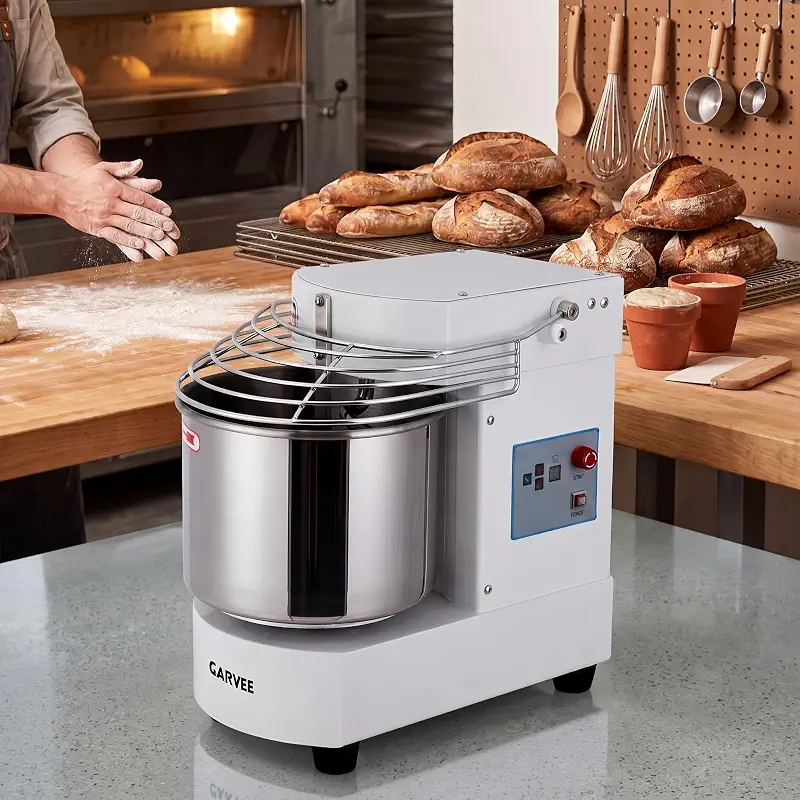
The Garvee 10.5Qt with touch-screen control stands apart by trading mechanical knobs for a digital interface, appealing to operators who want to save and recall mixing profiles or prefer single-tap control over manual adjustment. The 650W motor and dual-rotation system (21 RPM bowl, 159 RPM mixing rod) deliver the same gluten-development mechanism as the brand's other 10.5-quart models, but the digital panel and self-locking emergency stop add a layer of modern safety and convenience. The 10.5-quart capacity and food-grade stainless-steel bowl match competing commercial-grade options, keeping footprint and batch size consistent.
Unfortunately, this model carries no owner reviews yet, making it impossible to assess real-world reliability or user satisfaction. The digital control system is a differentiator, but without field feedback, it's unclear whether the touch screen enhances or complicates daily operation compared to the mechanical Garvee variant. If you're drawn to programmable settings and prefer a streamlined interface, this is promising, but the absence of reviews means you're relying entirely on specifications and the manufacturer's design intent. For buyers who've used commercial touch-screen equipment and trust Garvee's dual-rotation core design, the digital convenience may justify the leap, but waitin for reviews from actual bakery operations would be prudent.
Compared to the ooni, which uses capacitive buttons and an RPM display, this unit targets bakery operations rather than home bakers, and the larger bowl reflects that focus.
Pros
Touch-screen interface enables programmable mixing profiles and recall
Dual-motion mixing system with 650W motor for professional-grade performance
Self-locking emergency stop and safety shield for compliance-heavy environments
Cons
No user reviews available; real-world reliability is unproven
Fixed bowl design requires cleaning in place
Key features
10.5-quart stainless-steel bowl with 11 lb capacity per batch
650W copper motor with dual rotation, 21 RPM bowl and 159 RPM rod
Touch-screen control panel with digital timer and mixing settings
Safety shield interlock with self-locking emergency stop button
Suited for restaurants, bakeries, and food service production
Ideal for: Home bakers, small cafes, and emerging pizzerias seeking reliable dual-rotation mixing without premium pricing.
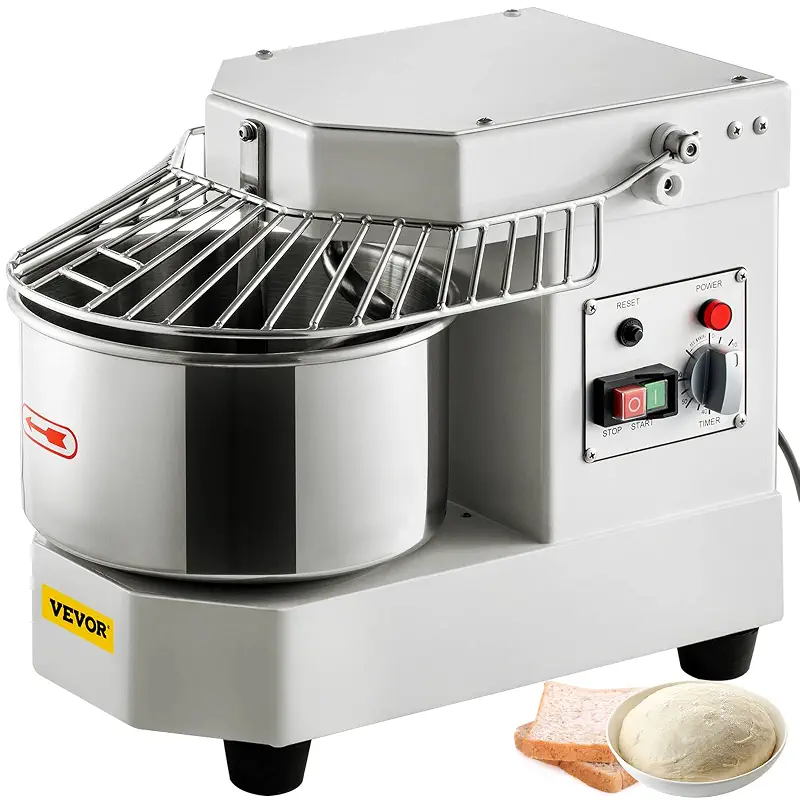
The Vevor Commercial Food Mixer threads the needle between home-scale capacity and commercial-grade performance. At 8.5 quarts (roughly 6.6 pounds of dough), it sits between home stand-mixer territory and full commercial ranges, making it perfect for home bakers who scale up to occasional catering or small cafe operations. The 450W dual-rotation system pairs a slow bowl (21 RPM) with a faster spiral hook (159 RPM), replicating the hand-kneading action that builds elasticity and gluten strength. Owners consistently report that dough comes out smooth and elastic after just 10 minutes, dramatically better than what they achieved with planetary mixers, and the food-grade stainless-steel bowl, security shield, and timer round out professional-feeling features at entry-level commercial pricing.
The practical trade-off is the non-detachable bowl. You'll clean it in place, which one owner addressed by using a spray sanitizer and a small brush rather than submerging. Another limitation is the lack of speed adjustment or reverse rotation; when you want to remove dough, you manually spin the bowl by hand. That's minor for occasional use but adds a small step to cleanup. Compared to the ooni's removable bowl and 58 variable speeds, the Vevor is considerably less flexible, but it delivers comparable gluten development for a significantly lower investment. The timer knob can loosen over time, but owners view that as a minor inconvenience relative to overall value.
This is the practical choice for someone stepping up from a KitchenAid but not yet ready for premium or commercial-scale pricing.
Pros
8.5-quart capacity bridges home and commercial scales at accessible pricing
Dual rotation system produces superior gluten development in 10 minutes
Food-grade stainless steel, security shield, and timer for professional results
No speed adjustment or reverse rotation for process flexibility
Key features
8.5-quart capacity handles 6.6 lbs dough in a single batch
450W motor with dual rotation, 21 RPM bowl and 159 RPM hook
60-minute timer and simple on/off controls with waterproof switch
Food-grade stainless-steel bowl, hook, and rod; rust- and corrosion-proof
Security shield with automatic shutoff and auxiliary rod for rapid forming
How to Choose a Spiral Mixer
Four trade-offs that actually matter when matching a spiral mixer to your kitchen.
Capacity: Match Batch Size to Your Workflow
Spiral mixer capacity ranges from 8.5 to 10.5 quarts, translating to roughly 6.6 to 11 pounds of dough per batch. Home bakers who mix once or twice weekly and freeze extra dough are comfortable at 8.5 quarts; commercial operations and cafes that produce daily typically need 10.5 quarts to minimize batch repetition. Consider spiral mixer capacity & power when evaluating options; a more powerful motor (650W to 750W) paired with the right bowl size ensures consistent gluten development regardless of hydration or flour type. Underfilling a large bowl can cause the mixer to slosh dough rather than knead it effectively, so choose a size that matches your typical batch weight.
Detachable Bowl vs. Fixed Design
Premium models like the ooni offer a removable, dishwasher-safe bowl; commercial-grade options typically have fixed bowls that require hand-washing in place. If counter space and cleanup speed matter to you, a detachable bowl saves time and simplifies sanitizing between batches. Fixed designs reduce moving parts and potential wear points, which appeals to bakeries comfortable with a slightly longer cleanup routine. The trade-off is clear: flexibility and speed versus durability and simplicity. For home use, detachable wins; for high-volume commercial work, fixed designs often feel more robust.
Speed Control and Flexibility
Home mixers like the ooni offer 58 variable speeds (60 to 1,000+ RPM), letting you match mixing intensity to dough type. Commercial models typically feature a single speed designed for standard production dough. If you experiment with high-hydration sourdough, enriched dough, or specialty recipes, variable speed is invaluable; if your workflow is consistent (pizza dough daily, for instance), fixed speed simplifies operation and reduces decision fatigue. Professional cooks also appreciate RPM display because many recipes specify exact rotation speeds. This is less critical for home bakers but worth noting if you follow published professional formulas.
Motor Power and Gluten Development
Spiral mixers range from 450W to 750W. Stronger motors (650W and up) handle dense doughs, high hydration, and longer mix times without strain or thermal stress. The 450W Vevor is sufficient for casual home baking and light cafe use but works best with batches at or above the 6.6 lb minimum; smaller loads risk uneven mixing. If you plan to work with whole-grain, rye, or high-hydration doughs regularly, a 650W or 750W motor provides a comfort margin. The breaker bar found in some models (notably the ooni) further accelerates gluten development, reducing total mix time even on lower power settings.
Build and Cleanup Considerations
Stainless-steel construction is standard across all options reviewed, ensuring durability and food safety. Check whether the bowl detaches and whether the spiral mixer cleaning and maintenance routine fits your kitchen setup; fixed bowls require more careful in-place scrubbing, while removable bowls simplify sanitizing between batches. Security shields and automatic shutoffs add safety but don't materially affect performance. Non-slip feet and sturdy chain-drive systems prevent walking or vibration during heavy mixing. If you move the mixer frequently or share limited counter space, weight and footprint matter; commercial models (10.5 quart) are heavier and larger than home-scale options.
Frequently asked
Quick answers to the questions readers ask most.
How is a spiral mixer different from a stand mixer?
A stand mixer (like a KitchenAid) uses a single attachment that moves in a planetary pattern, while a spiral mixer pairs a rotating bowl with a rotating spiral hook, simulating hand-kneading. This dual-rotation action develops gluten faster and more evenly, making spiral mixers the standard in professional bakeries and pizzerias. Stand mixers are fine for home baking but require longer mixing times and often need additional hand-kneading to match the gluten structure a spiral delivers in minutes.
Can I use a spiral mixer for tasks other than dough?
Yes, most spiral mixers can whip cream, beat eggs, mix batter, and combine fillings or cake frosting using the included flexible beater and whisk attachments. However, they perform best on dough work; specialized planetary mixers excel at whisking tasks. If your primary need is dough and you occasionally need other mixing, a spiral mixer is efficient. If you whip egg whites or make meringue regularly, a dedicated planetary mixer or hand whisk may be more practical.
What's the minimum dough batch size for a spiral mixer?
Most commercial-scale models work best with at least 1,500 grams (about 3.3 pounds) of dough; lighter batches risk tossing rather than kneading. The 8.5-quart Vevor similarly performs best at or above its 6.6 lb capacity minimum. Home models like the ooni handle smaller volumes more gracefully due to refined hook design, but even they benefit from reasonable batch weight. Mixing below the recommended minimum wastes energy and may warm the dough excessively; batching upward or combining doughs improves results.
How do I prevent dough from getting too warm during mixing?
Warm dough over-ferments and loses structure before you finish shaping. Use ice water instead of room-temperature water, and monitor finished dough temperature with a thermometer (target under 85 degrees Fahrenheit for pizza and bread). Commercial mixers run faster and generate heat; the dual-rotation action is efficient but intense. Taking batches out slightly under-mixed and finishing by hand for a minute cools the dough and gives you control. Many professional bakers factor in motor heat and adjust water temperature downward accordingly.
Is a removable bowl worth the extra cost?
A detachable bowl saves cleanup time and fits in the dishwasher, which home bakers and small cafes appreciate. Fixed bowls require in-place scrubbing with a brush and sanitizer, adding 5-10 minutes per cleanup cycle. If you mix daily or several times weekly, the convenience adds up; if you bake once monthly, the cost difference may outweigh convenience. Consider your cleanup tolerance and frequency: daily operators usually prefer the detachable premium option, while occasional users often accept fixed-bowl simplicity.