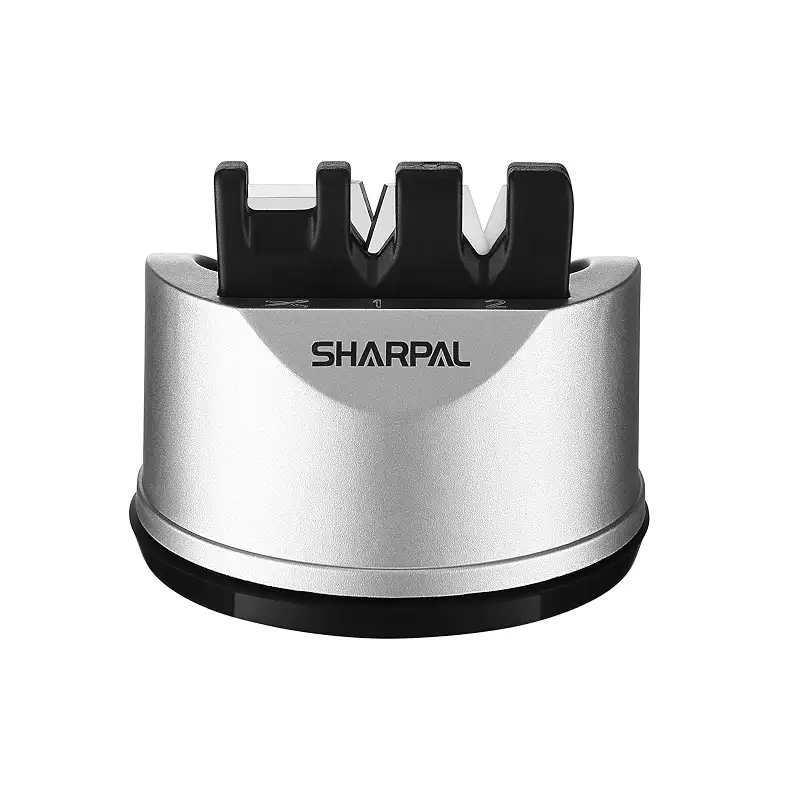
Ideal for: Home cooks and households needing versatile knife and scissor sharpening with minimal learning curve.
The Sharpal stands out as a complete sharpening solution for households that want one tool for multiple blade types. Its three-stage design (coarse tungsten carbide, ceramic honing, and a dedicated scissors slot) means you're not compromising between knife and scissor sharpening; you get both done well. The standout feature is the suction base that anchors the tool to any smooth countertop with twice the holding force of comparable models, which eliminates the fumbling and safety concerns that come with hand-held sharpening. That stability matters when you're learning: buyer feedback consistently highlights how newcomers to sharpening achieve razor-sharp results after just a minute or two, even without prior experience.
The compact footprint keeps it from dominating a drawer or counter, and the 3-year warranty signals confidence in durability. That said, this is a stationary tool: it lives in your kitchen, not your pocket or tackle box. If you travel frequently or maintain field knives and scissors, a portable sharpener might serve you better. But for a household that wants restaurant-quality cuts without technique anxiety, this delivers.
Pros
Powerful suction base keeps sharpener stable during use
Three-stage system handles coarse repair through precision honing
Dedicated scissors slot eliminates guesswork
Cons
Requires smooth, flat surface for suction cup to work
Stationary design means limited portability for field use
Key features
Three-stage sharpening with tungsten carbide and ceramic blades
Enhanced suction base twice as strong as standard designs
Dedicated tungsten carbide slot for scissor sharpening
Compact, space-saving footprint for easy storage
3-year manufacturer warranty and California-based support
#2 Pick
Best for Everyday Carry
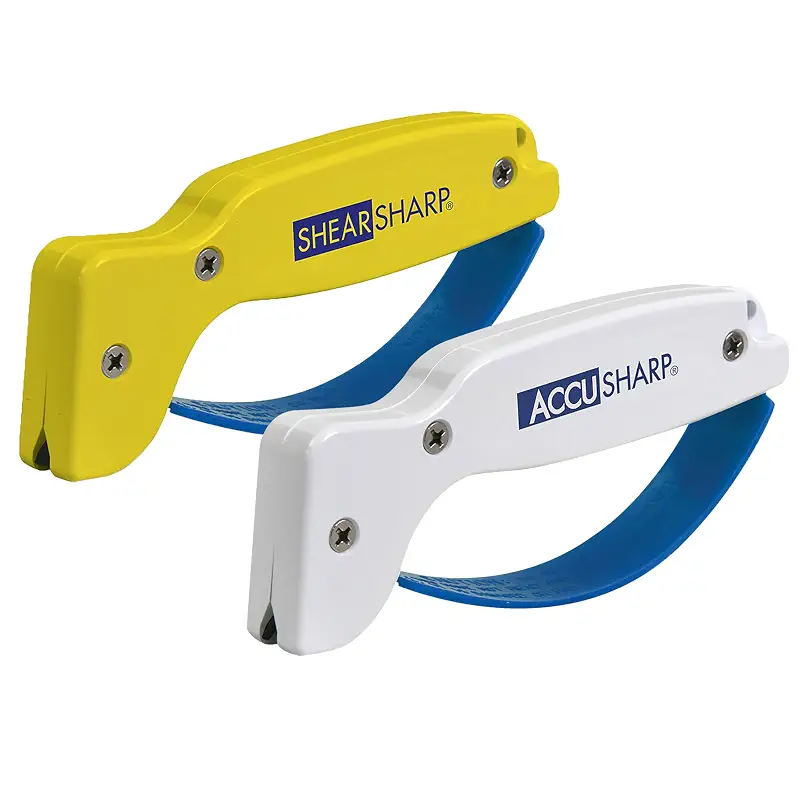
Accusharp
AccuSharp Hand-Held Carbide Blade Sharpener & ShearSharp Scissor Sharpener, Restores and Hones Straight & Serrated Knives, Revives the Edge of General Purpose Scissors
4.7(5,895)
Hand-held carbide sharpener that restores kitchen and pocket knives to sharp in seconds, but its scissor attachment struggles with consistency.
Ideal for: Daily knife users who want portable, quick-touch sharpening and can live with limited scissor functionality.
AccuSharp's hand-held design prioritizes portability and simplicity in a way the Sharpal deliberately doesn't. The knife portion works exactly as advertised: pull it across your blade a few times and you've restored the edge. Owners love the ergonomic handle, the full-length finger guard that keeps hands safe, and the reversible carbide blades that double the tool's lifespan. Many report using it as a maintenance sharpener they keep near the knife block, running blades through it weekly to maintain that factory-fresh sharpness rather than waiting until knives become truly dull.
Where AccuSharp diverges from the Sharpal is on scissors. The ShearSharp scissors attachment, while well-intentioned, generates mixed results. Some owners report decent success with general-purpose scissors, but others found the technique unclear and ended up damaging their blades. Unlike the Sharpal's dedicated scissor slot, this requires angling and light touch that varies by scissor design, leaving room for user error. If your primary need is knife maintenance and you only occasionally sharpen scissors, AccuSharp is a smart, affordable choice. But if scissor sharpening is equally important, the dedicated design of other options in this lineup may save frustration.
Pros
Lightweight, portable design fits easily in any drawer
Reversible carbide blades double tool lifespan
Full-length finger guard protects hands during use
Requires proper angling technique to avoid blade damage
Key features
Diamond-honed tungsten carbide sharpening blades
Reversible design extends carbide lifespan
Ergonomic handle fits both left and right-handed users
Full-length finger guard for safe operation
Works on serrated and straight-edge knives
#3 Pick
Best for Serious Home Cooks
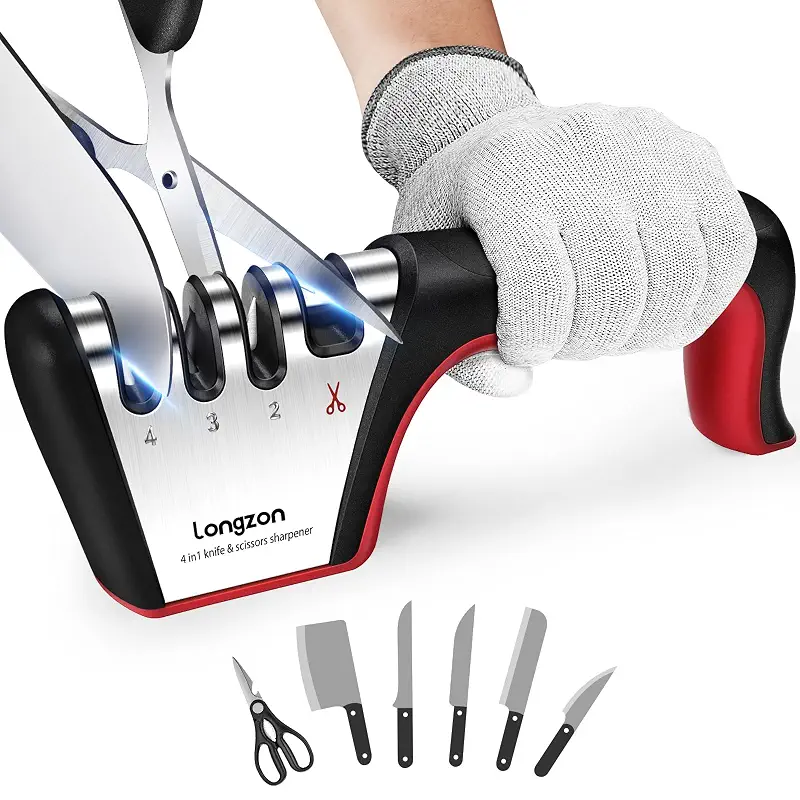
longzon
Longzon 5-in-1 Knife Sharpener 4 Stage with Cut-Resistant Glove, Black+Red | Fits Scissors and Most Knives, Quickly Sharpens & Restores Dull Blades, Easy & Safe for Home Kitchen Use
4.4(38,355)
Four-stage electric-style system restores expensive knife sets to factory sharpness, though scissors technique requires care to avoid over-sharpening.
Ideal for: Home cooks with quality knife collections who are willing to learn proper sharpening technique.
The Longzon sharpener appeals to cooks who've invested heavily in quality knives and actually want to protect that investment. Its four-stage design (scissors slot, coarse grinding, fine grinding, and precision polishing) gives you the same control as more expensive electric models at a fraction of the price. Owners specifically praise it for bringing dull, expensive blades back to that elusive razor-sharp state they'd lost after the initial edge wore off. The included cut-resistant glove and non-slip base add real safety value, not just marketing flourish.
Where this sharpener demands respect is technique. The coarse grinding stage can remove metal aggressively if you're careless, and multiple owner experiences confirm that over-sharpening scissors (sharpening both blades instead of just the cutting side) can render them worthless. This isn't a flaw unique to Longzon (it's true of many multi-stage systems) but it does mean you need to read instructions and practice on cheaper tools first. Compared to the Sharpal's dedicated slots, Longzon requires more user judgment. If you enjoy hands-on kitchen work and don't mind learning the process, the results justify the effort. If you want set-it-and-forget-it simplicity, step back to the Sharpal.
Pros
Four stages let you repair severe dullness then finish precision-sharp
Non-slip base keeps sharpener stable during use
Includes protective cut-resistant glove
Premium materials designed for durability
Cons
Requires understanding which blade surfaces to sharpen on scissors
Aggressive early stages can remove excess metal if misused
Key features
Four-stage sharpening system from coarse repair to precision polish
Non-slip ABS base with solid abrasive components
Dedicated scissors slot in first stage
Included cut-resistant safety glove
Compact design fits kitchen drawers or modern countertops
Ideal for: Occasional sharpeners, field use, and first-time buyers who want fast, foolproof results.
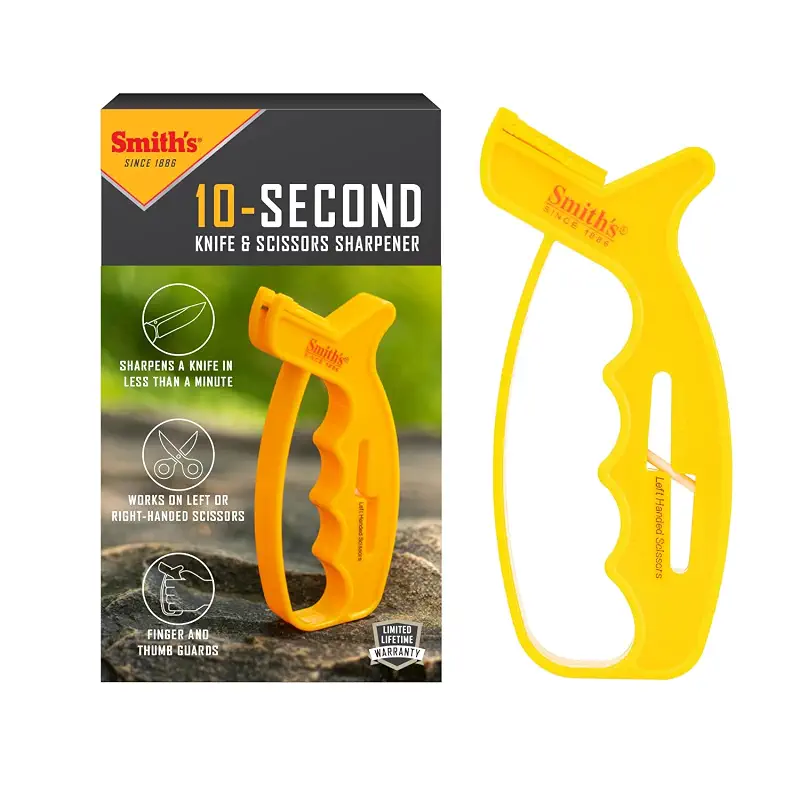
Smith's JIFF-S represents a different philosophy: sharpening doesn't need complexity, just consistency. The V-slot with crossed carbide blades is preset at a fixed angle, so there's no guesswork about whether you're holding it right. Pull the blade through three or four times and you're done. The built-in scissors sharpener uses a floating ceramic rod that adjusts to your scissor's angle automatically: a clever design detail that eliminates the manual angle-finding that derails users with other portable sharpeners.
Owners who bought this as a replacement after five years of daily use are the real testimonial here; they didn't hesitate to repurchase. The reversible, replaceable carbide blades keep costs low when they eventually wear. Where this tool differs from the Sharpal is in refinement: this is a middle-of-the-road solution optimized for speed and portability rather than producing a mirror-polished factory edge. You get functional sharpness without the multi-stage progression. It's perfect for a tackle box, a camping kit, or someone who sharpens casually and doesn't want to fuss. If you sharpen knives and scissors daily and demand that pristine edge, the Sharpal or Longzon will deliver more precision. But for reliable, no-nonsense maintenance, Smith's is hard to beat at this price.
Pros
Fixed angle preset removes guesswork about proper sharpening angle
Floating ceramic rod adjusts automatically to scissor angle
Ideal for: Users with multiple scissor types who know their cutting angles and want lightweight, adjustable sharpening.
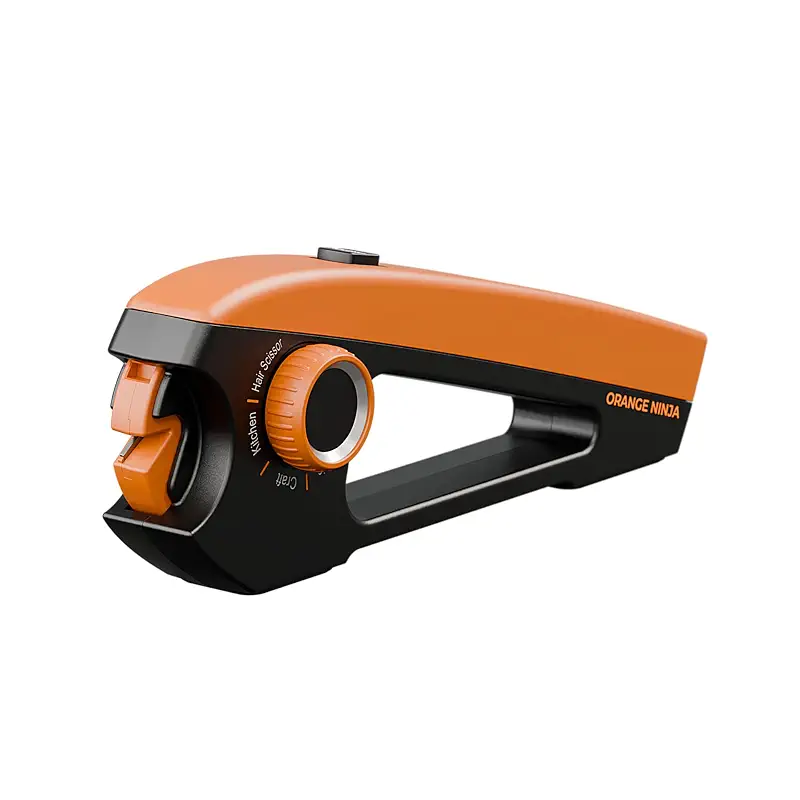
The Orange Ninja takes a specialized approach: it acknowledges that different scissors have different cutting angles and offers four precision settings to match them. This matters if you own a mix of fabric shears, kitchen scissors, and craft tools: each type sharpens differently. Owners who successfully matched their scissors to the correct angle reported excellent results, with shears cutting cleanly afterward.
The critical caveat is angle identification. This sharpener requires you to know (or figure out) which angle setting applies to your scissors, and that knowledge isn't obvious. Owners who guessed wrong reported completely destroyed blades, particularly with expensive dog-grooming or fabric scissors. Unlike the Sharpal's dedicated slots or Smith's automatic ceramic rod, this puts the burden on the user. The compact design and lightweight grip are genuinely nice, and for scissors you understand well (kitchen shears you've owned for years), this works cleanly. But it's riskier with unfamiliar tools. If you're confident identifying scissor angles or you have clear documentation from the manufacturer, this versatility is real value. If you're uncertain, the dedicated designs of the Sharpal or Smith's offer safer results.
Pros
Four angle settings accommodate different scissor designs
Lightweight and portable for compact storage
Easy to grip and intuitive dragging motion
Works on both kitchen and craft scissors
Cons
Requires accurate angle identification or risk damage
Inconsistent results on unfamiliar or specialty scissors
Key features
Four precision sharpening angles for versatile scissor types
Lightweight, portable compact design
Easy-to-grip handle for comfortable one-handed operation
Fits in small spaces alongside other sharpening tools
Suitable for kitchen and craft scissors
How to Choose the Right Scissor Sharpener
Four trade-offs that actually matter when matching a scissor sharpener to your kitchen.
Stationary vs. Portable
Decide where your sharpener lives. Suction-base models like the Sharpal anchor to your counter, offering stability and precision at the cost of portability. If you primarily sharpen at home and want minimal technique learning, stationary works well. Hand-held options suit people who sharpen on the go, need compact storage, or maintain field tools. Portable doesn't mean less effective: it just means you control the angle and pressure yourself rather than relying on a preset slot.
Single-Stage vs. Multi-Stage Systems
Single-stage sharpeners like the Smith's JIFF-S restore a functional edge quickly but can't repair severely damaged or chipped blades. Multi-stage systems (three or four stages) progress from aggressive grinding to fine honing, letting you restore badly dulled scissors to near-factory sharpness. If you sharpen often and your scissors are only lightly dulled, single-stage is efficient. If you neglect sharpening until blades are rough, multi-stage is worth the extra steps.
Carbide and ceramic are the two main blade materials in modern sharpeners. Carbide is harder and works faster but removes more metal, while ceramic hones finer edges with less material loss. Many quality sharpeners use both in different stages. Some sharpeners feature automatic angle adjustment (like the floating rod in Smith's), while others require manual angle awareness. Understanding which technology your scissors need (and which your sharpener offers) prevents mismatches that dull rather than sharpen.
Technique and Learning Curve
Simple sharpeners like the Sharpal with dedicated slots eliminate guesswork; you can't do it wrong. Multi-angle tools like the Orange Ninja require knowing your scissor's cutting angle, creating room for error. Hand-held models like AccuSharp demand smooth, consistent strokes. If you're new to sharpening or prefer foolproof results, preset and dedicated designs reduce frustration. If you enjoy fine-tuning and own varied scissors, a learning curve is an investment in versatility.
Frequently asked
Quick answers to the questions readers ask most.
Can I sharpen both my kitchen scissors and craft scissors with the same sharpener?
Yes, most sharpeners work on both, but with caveats. Kitchen shears often have a 20-25 degree cutting angle, while fabric or craft scissors may vary. A multi-angle sharpener like the Orange Ninja offers flexibility, but you must identify the correct angle. Dedicated-slot designs like the Sharpal work on general-purpose scissors but may not optimize specialty blades. When in doubt, test on inexpensive scissors first.
How often should I sharpen my scissors?
It depends on use frequency and cutting material. Kitchen scissors used daily on vegetables or meat may need sharpening every few months, while craft scissors used occasionally on paper might last a year. A quick pull through a sharpener every time you notice a dull edge (rather than waiting until they're completely unusable) keeps them in top condition and requires less aggressive sharpening work.
What's the difference between sharpening and honing?
Sharpening removes metal to create a new edge, while honing realigns the existing edge without removing much material. Multi-stage sharpeners combine both: coarse stages sharpen, fine stages hone. If you sharpen regularly, you'll mostly hone. If you neglect sharpening, you'll need the aggressive stages to restore a damaged edge.
Can a dull scissors sharpener damage expensive scissors?
Yes. Using the wrong angle or over-sharpening (sharpening both blade surfaces instead of just the cutting edge) can permanently destroy expensive fabric or specialty scissors. Hand-held and multi-angle sharpeners carry more risk than preset models. Always read instructions carefully and test on inexpensive scissors before using a new sharpener on prized tools.
Are electric sharpeners better than manual ones?
Not necessarily. Electric models offer speed and angle control but can over-sharpen if you're not careful. Manual sharpeners like those in this guide give you tactile feedback and control, reducing the risk of damage. The best choice depends on your skill level and patience: beginners often do better with preset manual designs that eliminate guesswork.