Verdict, analysis, and key features for each pick.
#1 Pick
Best Overall
Cuisinart
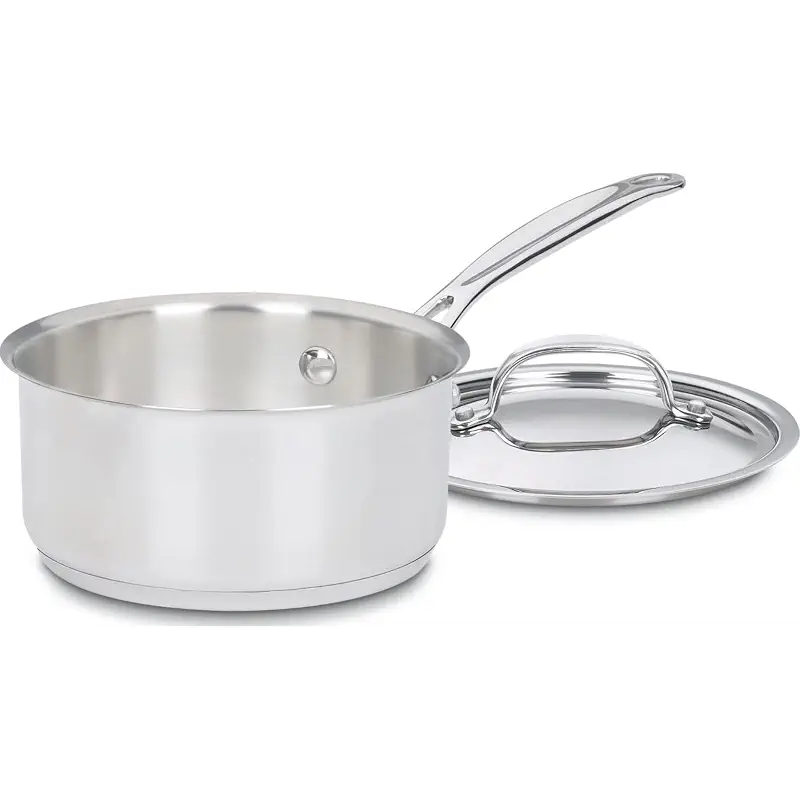
Cuisinart 1.5 Quart Sauce Pan with Cover, Stainless Steel Pot with Lid, Small Kitchen Pots, Dishwasher Safe, Compatible with Induction, Electric, Gas Cooktops, Oven Safe Saucepan, Cool Grip Handles | Stainless steel saucepan with aluminum encapsulated base for quick heating, dishwasher safe & oven safe to 550°F, 719-16
4.6(11,062)
Cuisinart's 1.5-quart saucepan combines trusted stainless steel construction with reliable heat distribution and a lifetime warranty at a price that won't strain the budget.
Ideal for: Home cooks seeking everyday reliability and long-term value with minimal fuss.
This Cuisinart saucepan has earned its reputation the hard way: owners report using the same model for 26 years and counting. The stainless steel interior resists discoloration and won't react with acidic sauces, while the encapsulated aluminum base spreads heat evenly from bottom to rim. On a gas stove, that even distribution matters: no scorched edges, no hot spots where oatmeal burns while the rest stays cool. The cool-grip handle stays genuinely comfortable even when boiling water, though the lid handle will warm up during extended cooking. At 1.5 quarts, it's sized for everyday tasks (eggs, small pasta batches, sauces) without taking up excessive counter or cabinet space.
Compared to the Carote nonstick set, this Cuisinart trades nonstick convenience for stainless steel's durability and the peace of mind that comes with a lifetime warranty. Owners are most vocal about long-term reliability; if you cook regularly and want a pan that will outlast trends, this is the pick. The one caveat: stainless steel requires a touch more elbow grease to clean than nonstick, and food can stick if you're not mindful of heat and a little fat in the pan. For gas-stove users specifically, the flat bottom and solid construction handle flame exposure without warping.
Pros
Encapsulated base ensures even heat distribution across bottom and sides
Cool-grip handle stays safe to touch throughout cooking
Lifetime warranty and proven durability over decades of use
Cons
Stainless steel requires more attention to prevent food sticking
Lid handle becomes warm during extended cooking sessions
Key features
1.5-quart capacity with measurement markings on interior wall
Stainless steel with aluminum-encapsulated base for rapid, even heating
Cool-touch riveted handle and tight-fitting stainless steel lid
Dishwasher safe and oven safe to 550°F
Lifetime manufacturer warranty on all components
#2 Pick
Best Budget Nonstick Set
Carote
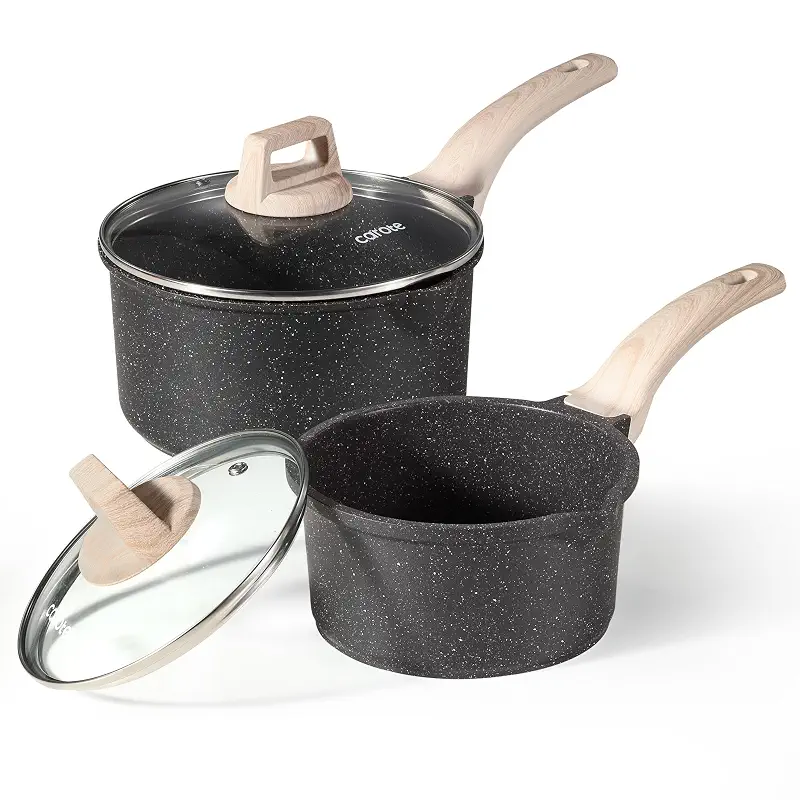
CAROTE Nonstick 1.5Qt & 3.0Qt Sauce Pan Sets with Lid, Black | Kitchen Non Toxic Cookware with Stay-cool Handle, All Stovetops Compatible, Easy to Clean, PFOA Free
4.6(3,805)
Carote's two-pan nonstick set delivers budget-friendly entry into ceramic cookware with zero sticking issues and effortless cleanup on a gas stove.
Ideal for: Budget-conscious cooks who prioritize easy cleanup and don't need high-heat searing.
If you want the convenience of nonstick without the cost of premium brands, this Carote set lands squarely in practical territory. The ceramic coating is PFOA-free, and owners report rice cooking without a burnt bottom: a genuine win for gas cooking where flame can creep up the sides. The wooden-grip handles look elegant and feel good in hand, and the larger 3-quart pan handles soups or pasta for a small family while the 1.5-quart tackles eggs and sauces. The pouring spout is thoughtfully angled, though a few left-handed cooks note the lip lands on the wrong side for their grip.
Where this Carote set differs from the Cuisinart stainless option is in commitment to temperature control: owners emphasize using medium heat, not high, especially on gas. Crank the flame too high and the handle or pan bottom may discolor, or (in one notable case) the nonstick surface can blister. That's not a defect: it's a realistic constraint of nonstick ceramic at this price point. Compared to stainless steel versus nonstick saucepans, nonstick wins on cleanup and ease but loses on durability and the ability to sear or brown meat at high heat. For gas-stove users willing to respect medium heat and use wooden or silicone utensils, this set is a steal.
Pros
Two-pan set offers flexibility for different portion sizes
Ceramic nonstick coating requires minimal oil and washes instantly clean
Attractive design with comfortable wooden-look grip handles
Cons
Requires medium heat on gas stoves to avoid discoloration and surface damage
Lower durability compared to premium stainless steel cookware
Key features
Two-pan set: 1.5-quart and 3-quart saucepans with matching glass lids
100% PFOA-free ceramic nonstick coating with rivetless interior design
Enlarged stainless steel base for rapid, even heat distribution
Wooden-grip handles and ergonomic pouring spout design
Dishwasher safe; hand-wash recommended to extend nonstick life
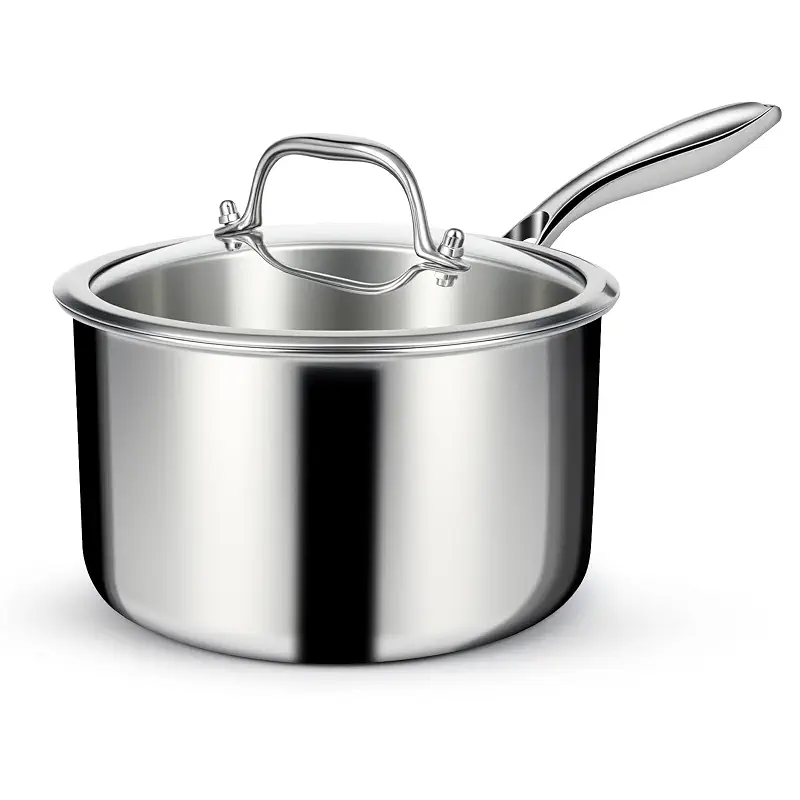
Ewfen's 3-quart tri-ply saucepan delivers heavy-duty stainless steel construction and superior heat distribution at a price that undercuts premium brands without sacrificing performance.
Ideal for: Serious home cooks seeking heavy-duty stainless steel and versatile 3-quart capacity at entry-premium pricing.
Owners consistently call out the weight of this Ewfen pan as a marker of quality, and they're right: the tri-ply construction (304 stainless interior, aluminum core, 430 stainless exterior) creates a solid tool that heats fast and evenly. At 3 quarts, it's bigger than the Cuisinart 1.5-quart, making it better suited for cooking for a family or keeping stock warm. The glass lid is a clear advantage for monitoring simmering sauces without lifting. On gas stoves, the aluminum core distributes flame heat so evenly that owners report surprisingly little sticking compared to other stainless pans: a genuine asset when you're working with direct flame.
Compared to the Cooker King ceramic hybrid, Ewfen trades the marketing of "metal-utensil safe" nonstick for pure stainless durability. You'll need to use a touch of fat or oil to cook proteins without sticking, but that's also how skilled cooks control browning and flavor development. The one caveat from reviews: some users report food sticking slightly more than expected from stainless, though this improves once the pan is properly preheated. For gas cooks who want professional-grade construction and don't mind the care requirements of stainless, this is exceptional value.
Pros
Heavy tri-ply construction with aluminum core heats evenly without hot spots
3-quart capacity suits family cooking and small-batch stock making
Clear glass lid allows monitoring without lifting, sealing in steam
Cons
Stainless steel surface requires proper preheating and oil to minimize sticking
Heavier than nonstick alternatives, demanding more effort to lift and handle
Key features
3-quart capacity with interior measurement markings for precise cooking
Heavy-gauge double-riveted stainless steel handles stay cool to touch
Transparent glass lid creates airtight seal for moisture and flavor retention
Works on all stovetops; dishwasher safe and oven safe to 500°F
#4 Pick
Best Premium Large-Capacity
Cuisinart
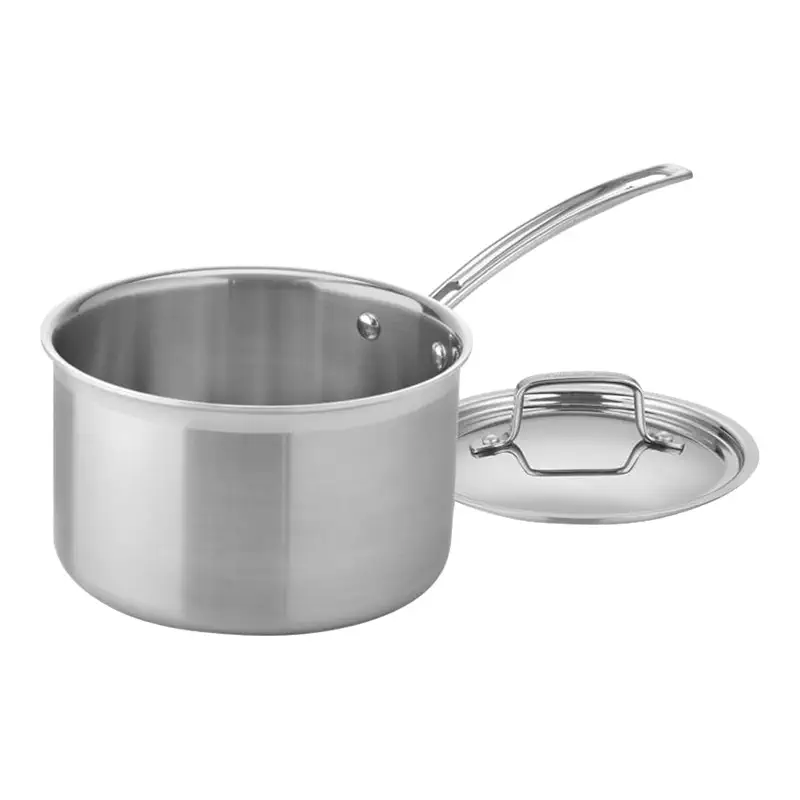
Saucepan with Lid Size: 4 qt.
4.8(7,617)
Cuisinart's 4-quart MultiClad Pro saucepan is the premium workhorse: triple-ply construction with professional-grade heat control, perfect for larger batches and serious cooks.
Ideal for: Experienced home cooks and small households needing large-capacity cookware for stock, soups, and frequent cooking.
The 4-quart capacity is where this Cuisinart shines. Where the smaller 1.5-quart is a utility player, this larger pan becomes your go-to for stock, soups serving four to six people, or pasta nights. The triple-ply construction (stainless interior, pure aluminum core, brushed stainless exterior) creates what Cuisinart calls Heat Surround Technology: heat travels not just up from the bottom but also up the sidewalls, eliminating hot spots entirely. Owners who've used this for decades report that the even heating makes a visible difference in how evenly rice cooks or how predictably sauces thicken.
On a gas stove, the sidewall heating is a double-edged sword. The benefit is perfect heat control throughout the pan. The trade-off: the handle will get warm (or hot) if you crank the burner high and let flame climb the sides. Experienced gas-stove cooks know to keep the flame to the bottom; this pan rewards that discipline with superior, even results. Compared to the Cooker King ceramic hybrid, the Cuisinart is heavier, requires more cleaning effort, but also lasts decades without coating wear and accepts any cooking technique, searing, simmering, even long simmering of acidic tomato sauces without worry. If you cook frequently and value precision over convenience, this is the investment piece.
Pros
4-quart capacity with triple-ply Heat Surround Technology for even cooking throughout
Encapsulation extends from bottom through sidewalls, eliminating temperature differentials
Stainless construction never reacts with food; safe for acidic and long-simmering dishes
Cons
Handle and sidewalls become hot when flame is high on gas stoves
Heavier and more demanding to clean than nonstick alternatives
Key features
4-quart capacity with interior measurement markings and tapered rim for drip-free pouring
Triple-ply construction with pure aluminum core bonded to stainless steel layers
Cool-grip riveted handle with thumb rests for balance and control
Tight-fitting stainless steel lid with secure fit and flavor-lock seal
Works on all cooktops; dishwasher safe and oven safe up to 500°F
#5 Pick
Best Metal-Utensil Nonstick
Cooker King
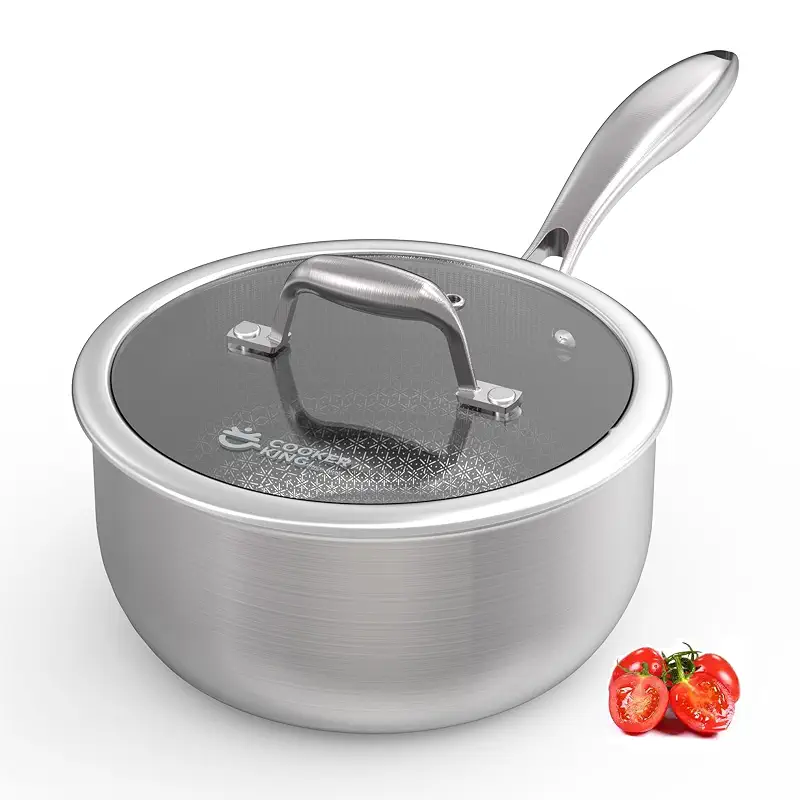
COOKER KING 3 Quart Stainless Steel Saucepan with Lid, Tri-Ply Ceramic Nonstick Pot, Metal Utensil Safe, Dishwasher & Oven Safe up to 900F, Induction Cookware for All Stovetops
4.6(775)
Cooker King's ceramic-hybrid 3-quart saucepan combines scratch-resistant nonstick convenience with the durability to handle metal utensils and extreme oven temperatures.
Ideal for: Pragmatic cooks who want nonstick convenience, durability with metal tools, and high-oven versatility.
Cooker King's tri-ply stainless construction with laser-etched ceramic nonstick is a newer approach to solving a real problem: traditional nonstick coatings wear fast when used with real cooking tools. The etched surface creates micro-texture that grips metal without tearing, and owners confirm that nothing sticks even with rough treatment. At 3 quarts, it's a mid-sized workhorse for soups, pasta, and sauce making. The oven rating to 900°F (lid to 400°F) is generous and opens options for stovetop-to-oven braises or finishing dishes under the broiler.
The caveat is the etching itself: while it enables metal-utensil compatibility, the roughness can be abrasive on wooden spoons and requires thoughtful cleaning. One owner noted the etched surface will slowly grind down a wooden utensil tip, so you're trading some durability of your tools for durability of the pan's nonstick coating. On a gas stove, the tri-ply construction handles flame exposure well, though like all ceramic nonstick, it performs best on medium heat. Compared to the Ewfen stainless option, Cooker King offers easier cleanup and the metal-utensil safety net, but at the cost of eventual nonstick-surface wear (albeit slower than traditional Teflon). For cooks who want nonstick ease without the guilt of a fragile coating, this is the current best compromise.
Pros
Laser-etched ceramic surface resists scratches and tolerates metal utensils
Tri-ply stainless construction heats evenly and works on all stovetops
Oven safe to 900°F for stovetop-to-oven cooking and finishing techniques
Cons
Roughened nonstick surface requires careful hand-washing to maintain integrity
Lid handle becomes quite hot during extended cooking on gas stoves
Key features
3-quart capacity with tri-ply stainless steel for professional heat distribution
Laser-etched ceramic nonstick coating, PFAS/PFOA/PTFE-free for safe cooking
Metal-utensil compatible and scratch-resistant nonstick surface
Stay-cool stainless steel handles and tempered glass lid with steam vent
Dishwasher safe and oven safe to 900°F (lid to 400°F); induction ready
How to Choose a Saucepan for Gas Cooking
Four trade-offs that actually matter when matching a saucepans for gas stove to your kitchen.
Material: Stainless vs. Nonstick
Stainless steel and nonstick ceramic each have distinct strengths on gas. Stainless steel versus nonstick saucepans comes down to durability versus convenience. Stainless steel is virtually indestructible (it won't chip, peel, or degrade) and handles high heat, searing, and acidic foods without worry. Nonstick ceramic (PFOA-free) simplifies cleanup and cooking with minimal oil, but requires medium heat and careful utensil use. For gas stoves specifically, stainless tolerates direct flame creeping up the sides better than nonstick, which can blister or discolor if overheated. If you cook frequently and value long-term durability, stainless is the investment. If ease of cleanup and everyday convenience matter most, ceramic nonstick is the practical choice.
Heat Distribution and Construction
Gas flames create uneven heating if the pan bottom is thin or poorly constructed. Look for encapsulated or multi-ply bases where aluminum (an excellent heat conductor) is bonded to stainless steel layers. This design pushes heat not just upward from the bottom but also along the sidewalls, eliminating hot spots where food burns while the rest stays cool. Heavy-gauge construction (you can feel it in hand) is another sign of quality; lighter pans warp more easily on high gas heat. Heat distribution in saucepans is the single biggest factor in how evenly your sauce thickens, how uniformly rice cooks, and whether eggs scramble smoothly or brown in patches.
Size and Capacity
Choose capacity based on what you cook most. A 1.5-quart pan is ideal for single servings, small pasta batches, and boiling eggs; it fits neatly in smaller kitchens. A 3-quart pan handles family meals, soups, and small batches of stock without oversizing. A 4-quart pan suits frequent cooking for four or more people. On gas stoves, a larger bottom diameter spreads the flame more evenly across the cooking surface: a 3-quart or 4-quart pan actually heats more uniformly than a cramped 1.5-quart on a powerful burner. If you have limited cabinet space, a set with two sizes (like the Carote option) gives flexibility without clutter.
Handle and Lid Design
On a gas stove, handles matter more than on electric. Stainless steel riveted handles stay cooler than welded ones because rivets create a small air gap. Look for handles that are solid and riveted (not hollow), as they resist heat better and last longer. Lids should fit snugly to trap steam and retain heat, and a clear glass or stainless lid lets you monitor cooking without lifting. Avoid lids with plastic handles if you plan to use the saucepan in the oven; metal or heat-resistant silicone is safer. A vented lid or small steam hole prevents pressure buildup, especially useful for boiling pasta or soups where foam can escape.
Gas Stove Best Practices
Protect your saucepan and yourself by keeping the gas flame adjusted so it doesn't climb the sides of the pan. A flame that creeps up the exterior will heat the handle and can scorch or discolor the pan exterior. Medium to medium-high heat is usually sufficient for simmering, sauce-making, and boiling; full-blast flame is rarely necessary and risks damaging nonstick coatings or overheating handles. Flat-bottomed pans sit more securely on gas grates than curved ones, reducing tipping risk. When gas flames do expose the handle, use a dry cloth or silicone holder to grip it safely.
Frequently asked
Quick answers to the questions readers ask most.
Will a nonstick saucepan work on a gas stove?
Yes, but with caveats. Ceramic nonstick (PFOA-free) can be used on gas stoves as long as you keep the flame to medium heat and don't let it creep up the sides of the pan. High heat or side-flame exposure can cause discoloration, warping, or surface damage. Stainless steel is more forgiving on gas because it tolerates higher heat and direct flame without degrading. If you prefer nonstick convenience, just adjust your flame downward and use wooden or silicone utensils to preserve the coating.
How do I prevent food from sticking in a stainless steel saucepan?
Preheat the pan for 1–2 minutes before adding food or liquid. Add a small amount of oil or butter and let it heat until it shimmers; this creates a non-stick layer. Stainless steel is naturally reactive when cold but becomes less sticky as it heats. Avoid moving food too early; let proteins or vegetables develop a light crust before stirring. For sauces and liquids, the pan naturally becomes less sticky as the mixture comes to temperature. Hand-washing and avoiding harsh scrubbing also helps maintain the surface.
Is tri-ply or multi-ply construction worth the extra cost?
For gas cooking, yes. Tri-ply (aluminum bonded between two stainless steel layers) distributes heat far more evenly than single-ply or cheap encapsulated bottoms, which can have seams that allow water to seep in over decades. The even heating visible difference in cooking results: no hot spots, faster and more consistent temperature response. On a gas stove where flame can be intense and uneven, multi-ply construction is the difference between a good pan and one that will outlast you.
Can I put a saucepan directly over a gas flame without a grate?
Not recommended. Always use the gas stove's grate. A grate holds the pan steady, keeps the bottom at a safe distance from the flame, and prevents tipping. Placing a pan directly on a burner without a grate risks accidental tip-overs, uneven heating, and potential damage to both the pan and the stove. Grates are designed to distribute flame evenly and hold cookware securely.
How long will a quality stainless steel saucepan last?
A well-made stainless steel saucepan (with tri-ply construction and riveted handles) can last 20 to 40+ years with normal care. Owners report using the same Cuisinart pans daily for 26 years and still washing them easily. Nonstick ceramic coatings typically degrade after 3 to 10 years depending on use and care. If you cook frequently and want cookware that becomes a lifelong kitchen companion, stainless steel is the investment-grade choice.