Verdict, analysis, and key features for each pick.
#1 Pick
Best Overall
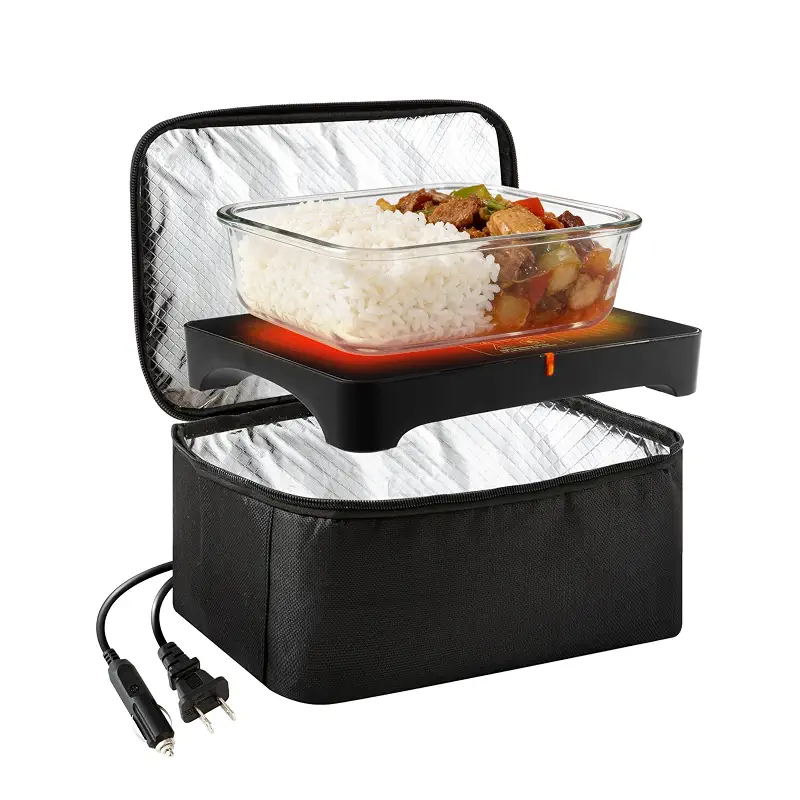
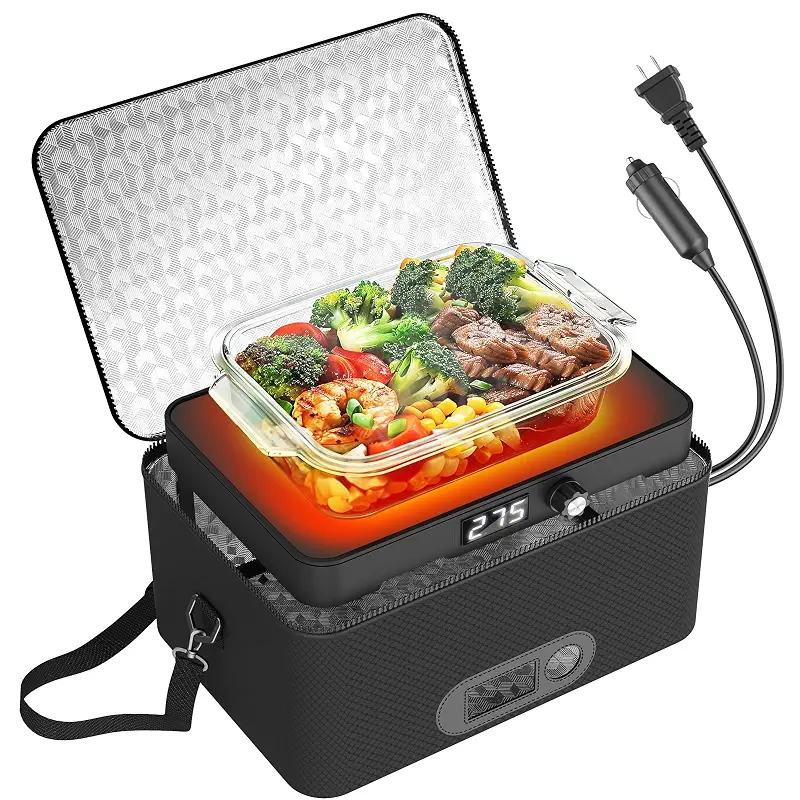
Rottogoon
Portable Oven, 12V 24V 110V-240V Car Food Warmer Portable Personal Mini Oven Electric Heated Lunch Box for Meals Reheating & Raw Food Cooking for Road Trip/Camping/Picnic/Family Gathering(Black)
4.3(3,563)
Proven reliability across thousands of users with digital temperature control and multi-voltage flexibility.
The Rottogoon model has earned trust through sheer review volume: over 3,500 owners have tested it in real kitchens, cars, and office spaces. What stands out is the digital display that lets you see and adjust the temperature, something you don't get on every model in this category. Owners report that food stays moist and doesn't dry out, which is the biggest complaint many have with portable ovens. The conduction heating works steadily, whether you're warming a frozen meal (1 to 1.5 hours) or just reheating leftovers (40 to 60 minutes). The aluminum foil trick several owners mentioned (laying it on the heating plate to keep it clean) tells you this is a product real people have figured out how to live with.
One owner who compared this directly to a competitor found the outer casing genuinely superior. The waterproof material wipes clean if you spill, and there's a small zippered pocket up front for utensils or sauce packets. The switching works seamlessly, which matters if you're moving between a car one day and an office the next. Battery drain is real if you're cooking while parked without the engine running, but plugging into an inverter (around $10) fixes that for road-trip cooking.
The trade-off is cook time. Long meals take patience: chicken or steak from raw can push toward two hours. If you're the type who gets hangry waiting, this isn't your solution. But for meal prep folks and truck drivers who can set it and forget it, the consistency and moisture retention make it the safest choice.
Pros
Digital display for real-time temperature monitoring
Waterproof exterior resists spills and cleans easily
Maintains food moisture better than microwave reheating
Cons
Cooking from raw takes 1.5 to 2 hours; requires patience
Can drain car battery if engine is off during cooking
Key features
Adjustable temperature dial with digital display readout
Multi-voltage: 12V, 24V, and 110V with included connectors
Conduction heat technology for even warming without hot spots
Fits containers up to 10.11" L × 7.08" W × 4.96" H
#2 Pick
Best for Work & Office
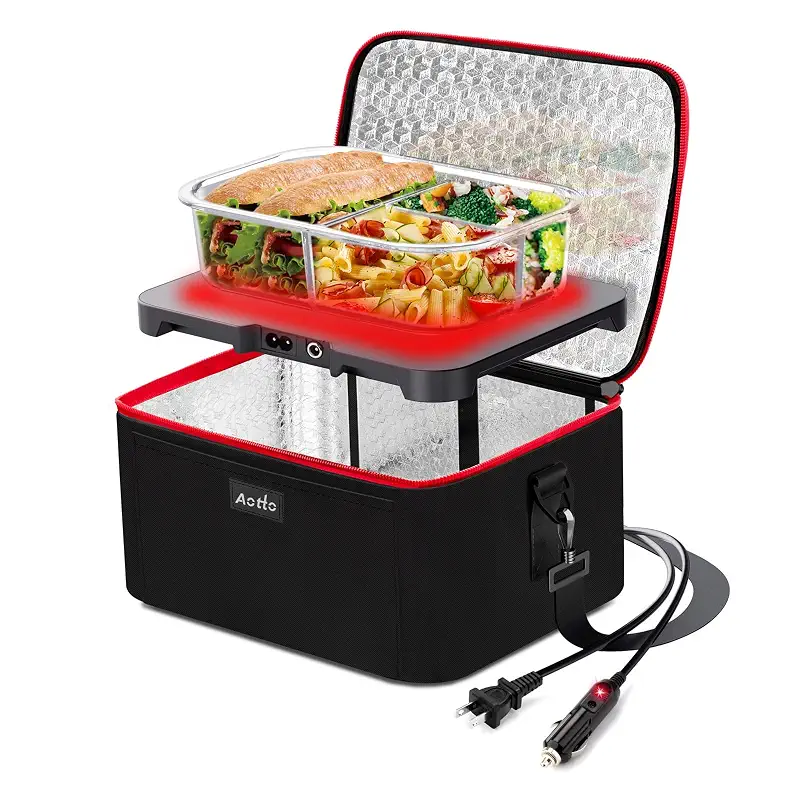
Aotto
Aotto Portable Oven, Electric Lunch Box Food Heater - 12V/24V/110V 3-in-1 Car Food Warmer - Heated Lunch Box for Adults - Cook, Reheat & Keep Meals Warm for Car, Truck, Travel, Work, Home - Black Red
4.6(4,895)
No-button simplicity and automatic temperature control make it office-ready without management.
Ideal for: Office workers and professionals who need reliable daily reheating without complicated settings.
The Aotto stands out for doing exactly what it promises without asking you to think about it. There are no timers to set, no buttons to push, and no digital menu to navigate. You put food in, plug it in, and the internal thermostat handles the rest. For someone who works a desk job and wants to heat lunch while answering emails, this is the path of least resistance. The automatic temperature control stops heating at 249°F and resumes at 115°F, which means your food won't burn no matter how long you leave it plugged in after heating finishes.
Owners consistently report using this daily at work, and one detailed review mentioned cooking scrambled eggs from raw in a glass container, something that speaks to the heating consistency. The build quality feels solid; the zipper holds up, the insulation stays put, and owners aren't reporting premature failures. Compared to the Rottogoon, the Aotto trades the digital display for dead-simple operation, which appeals to people who don't want to fiddle with settings during a busy workday. The collapsible design and adjustable shoulder strap mean you can actually carry it like a bag if you move between locations.
One notable issue: the first buyer received two AC cords instead of a DC cord, which prevented car use entirely. Customer service response was slow initially. If you're ordering primarily for office heating and wall-outlet use, this shouldn't scare you off, but if you need car reliability day one, make sure the correct cords arrive.
Pros
Fully automatic temperature control requires no monitoring
Rugged zipper and well-made exterior fabric withstands daily use
Ideal for: Construction workers, field crews, and hungry professionals needing faster meal-heating cycles.
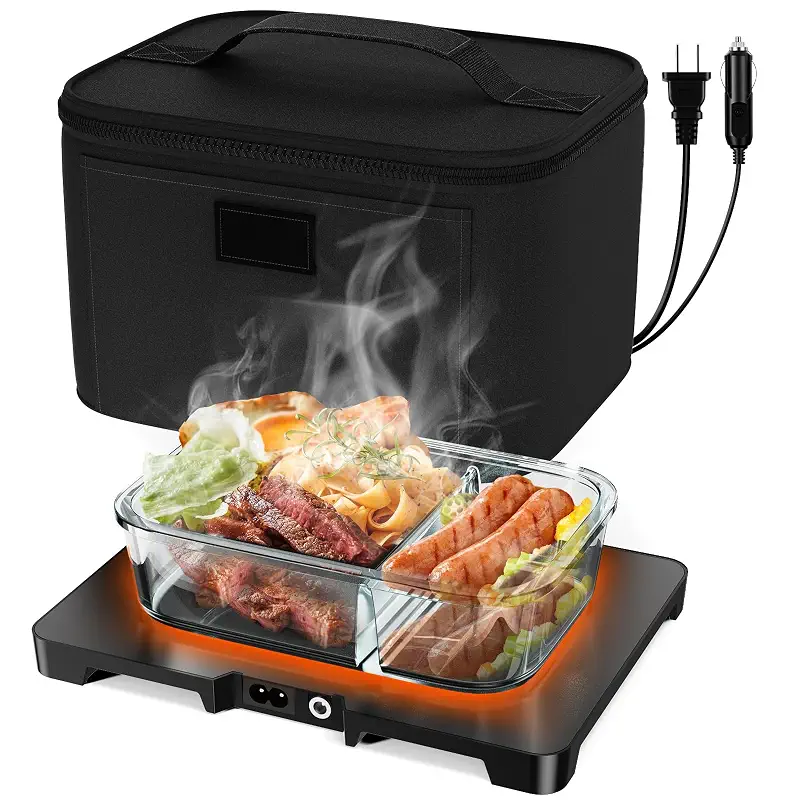
The Andmenow brings notably higher wattage to the portable oven category (100W versus the 60 to 80W you'll see elsewhere) and that translates to noticeably faster heating. Owners report getting meals to eating temperature in 20 to 40 minutes on 110V, which matters if you're on a construction site or field job where your break window is tight. The heating plate is physically larger than some competitors, which gives you more surface area in contact with the bottom of your container, improving heat transfer efficiency. For people bringing divided lunch containers or stacking multiple smaller dishes, this extra space is genuinely useful.
The dual-thermostat design mirrors the Aotto's automatic control, stopping at 249°F to prevent overcooking. Owners in Spanish-language reviews consistently praise how quickly food gets hot, and one English-language user mentioned using it daily without issues. The portable oven setup works well as a standalone hot plate too, which opens use cases beyond just lunch heating, keeping dips warm at a potluck, for example. Where the Andmenow falls short is review volume; with only 20 reviews, you're working from a smaller sample size than the top-ranked Rottogoon or Aotto.
Compared to the Rottogoon's digital display, the Andmenow sacrifices visibility into exact temperature but gains wattage and heating speed. If you value faster turnaround over granular control, and you're willing to trust the automatic thermostat, this model rewards that trade. The carrying handle is sturdy, and owners appreciate the included fork and spoon.
Pros
100W heating power delivers faster warm-up than standard models
Larger heating plate accommodates bigger containers and multiple dishes
Dual thermostat prevents overcooking with no monitoring needed
Cons
Smaller review count (20) means less real-world usage data
No digital display or temperature indication feature
Key features
100W dual-thermostat heating with 249°F automatic shutoff
Enlarged insulated bag and heating plate for larger capacity
power: 12V, 24V, and 110V connectors included
Includes carrying handle, spoon, and fork accessories
#4 Pick
Best for Large Containers & Flexibility
Ddhtsal
Portable Oven Electric Lunch Box Food Heater - 12V/24V/110V 3-in-1 Mini Food Warmer for Car & Truck, 1.8QT Large Capacity Heated Lunch Box for Work Office Travel - Microwave Alternative
4.4(217)
1.8-quart capacity and dual-cord setup handle real meal prep without compromise.
Ideal for: Meal-prep enthusiasts and anyone carrying multiple containers or larger portion sizes.
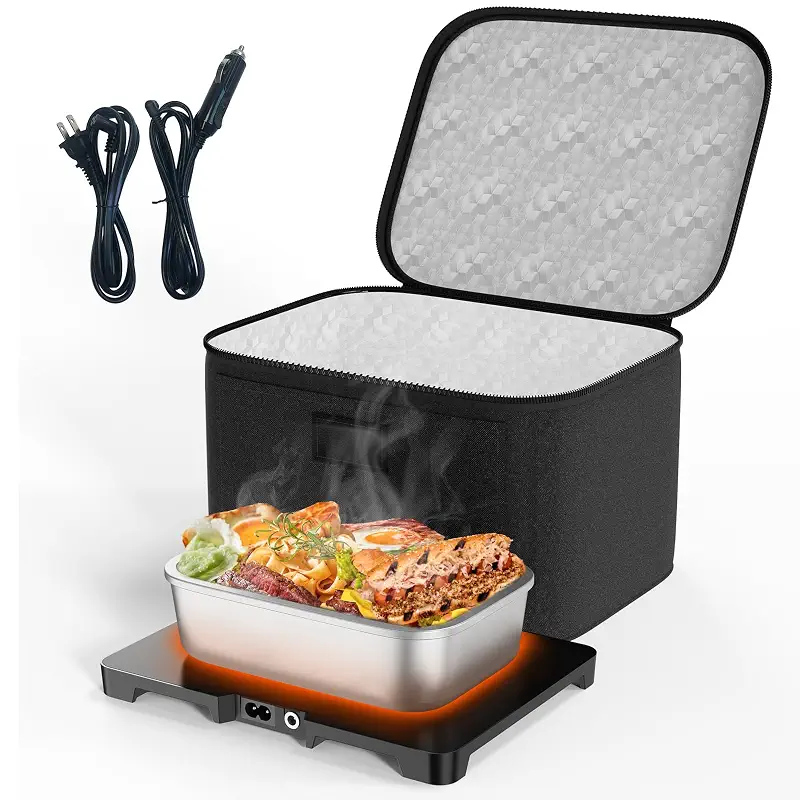
The Ddhtsal brings genuine size to the category. At 1.8 quarts, it holds about 20% more than standard 1.5-quart models, which matters when you're not eating appetizer portions. Owners report fitting full divided lunch containers, soups in separate bowls, and even stacking smaller dishes: all things you can't do in cramped alternatives. The low-slow conduction technology is the same philosophy as other models here, but the extra internal volume gives you more flexibility in how you arrange containers. Both 12V/24V and 110V cords arrive in the box, so you're not buying adapters separately.
Where this model shines is versatility. One Italian-language review detailed using it with different container materials (glass, stainless steel, foil) noting that the uniform heating comes from the wide, flat heating plate making consistent contact with whatever you put on it. A fishing enthusiast mentioned slow-cooking fresh-caught fish on a boat using the 12V connection, which tells you the model handles longer, gentler heating without issue. For people who meal-prep and rotate through different container sizes, this flexibility is real value.
The heating timeline is longer than the Andmenow: 20 to 40 minutes for standard meals is common in reviews, and cold or frozen items need even more time. The thin zipper seals are noted as slightly concerning for long-term durability if you're opening and closing frequently with heavy containers. One user also flagged that the power cords are quite short, which can be annoying if your car outlet or wall socket is far from where you're eating.
Pros
1.8-quart capacity fits substantially larger meals and multiple containers
Both 12V/24V and 110V cords included; no adapter purchases needed
Uniform heating on flat plate works with glass, steel, foil, and ceramic
Cons
Zipper seals feel potentially fragile under frequent heavy use
Power cords are noticeably short for many car and office setups
Key features
1.8-quart large capacity: 20% more than standard models
Dual-cord included setup: 12V/24V and 110V ready to go
Low-slow conduction heating preserves moisture and nutrients
Fits containers up to 9.76" L × 7.01" W × 3.94" H
#5 Pick
Best Budget Pick
Aicpan
Portable Electric Lunch Box Food Heater,12V/24V/110V 3-in-1 Food Warmer Box, Mini Portable Oven Car Food Warmer, Heated Lunch Bag for Adults Office Travel Work Truck Meal Reheating
4.4(243)
Reliable 80W heating at entry-level pricing without sacrificing core features or durability.
Ideal for: Budget-conscious buyers, secondary-location users, and delivery or field workers.
The Aicpan offers the essentials at a price point that won't guilt you if you forget it on a jobsite or want a backup warmer for a second location. At 80W, heating speed sits in the middle of the pack (30 to 50 minutes for standard meals) which is fine for most work and travel scenarios. The blue Oxford cloth exterior is described as "sleek and durable," and owners report using this model multiple times daily (one delivery driver mentioned 3 to 7 uses per day for food transport) without failures. The built-in heating plate increases the warming area, which helps with consistency.
Where the Aicpan separates itself from pure bargain-basement offerings is real user longevity. One Italian-language review went into technical detail about PTC dual-element heating and the gradual temperature rise, noting that the external material stays manageable rather than too-hot-to-touch, and the isolation bag holds heat for a while after unplugging. Another owner mentioned having bought this brand three times over a couple of years because the quality justifies replacement even after heavy use. That's not a complaint; it's confidence in value. The multi-container compatibility is solid: glass, ceramic, stainless steel, foil all work as long as the bottom is flat and the container fits the space.
Compared to the Aotto, the Aicpan trades automatic thermostat sophistication for lower cost. Compared to the Ddhtsal, you get a smaller capacity (1.7 quarts vs. 1.8 quarts), which is negligible. One user flagged a plug receptacle failing after a couple of weeks, though that's an outlier in an otherwise positive review set. For budget-conscious buyers, this is the model to start with; for daily professional use where you'll depend on it every single day, the Aotto or Rottogoon offer more peace of mind.
Pros
Entry-level pricing without sacrificing core heating or container versatility
80W power delivers 30- to 50-minute heating for daily meal schedules
Durable Oxford cloth exterior withstands repeated professional use
Cons
No automatic thermostat; heating continues indefinitely if plugged in
Occasional reports of plug receptacle durability issues
Key features
80W PTC dual-element heating system with gradual temperature rise
power: 12V, 24V, and 110V with both cords included
Built-in heating plate increases warming surface area
Fits containers up to 9.76" L × 7.01" W × 3.94" H
How to Choose a Portable Oven for Your Needs
Four trade-offs that actually matter when matching a portable oven for car to your kitchen.
Power Source: Vehicle, Office, or Both?
The first real choice is whether you need 12V car power, 110V wall power, or both. A true model (12V, 24V, and 110V) costs slightly more but removes the guesswork: you're covered at home, in any car or truck, and in an RV or field site with auxiliary power. If you only heat lunch at an office desk, a 110V-only model is fine, but you lose road flexibility. Understanding the car oven power source comparison helps you match the right voltage to your actual routine rather than paying for capability you'll never use.
Heating Speed vs. Long-Soak Cooking
Wattage determines how fast food gets hot. 100W models heat standard meals in 20 to 40 minutes; 80W models need 30 to 50 minutes. If you're reheating leftovers, this is fine. If you want to cook raw chicken or steak from the car, expect 1.5 to 2 hours regardless of wattage: the conduction method is inherently slow. Decide upfront whether you're reheating meal-prepped food or occasionally cooking from raw. That answer shapes which model makes sense.
Container Flexibility vs. Built-in Convenience
Some models ask you to bring your own glass or stainless container; others come with a fixed lunch container. Bring-your-own is more flexible: you can swap containers, use whatever fits your meal prep, and avoid washing a proprietary lid every day. If you want an all-in-one package with no thinking, the built-in container route saves that decision step. Most portable oven setup for travel guides recommend starting with your own containers because flexibility matters when you're moving between home, office, and a car.
Automatic Controls vs. Manual Attention
Budget models heat indefinitely once plugged in; you unplug them when food is warm. Premium models have dual thermostats that stop heating at 249°F and resume at 115°F, so you can't overcook even if you forget. For office use or predictable routines, automatic control is worth the step up. For occasional road-trip heating or field-job reheating, manual attention is fine. Consider your own habits: are you the type to set and forget, or do you actively monitor your lunch?
Capacity and Container Size
Standard models hold 1.5 to 1.7 quarts; larger models stretch to 1.8 quarts. If you're a light eater or reheating a single container, standard is enough. If you meal-prep in divided containers, bring soup plus a side, or feed two people, the extra 0.1 to 0.3 quarts actually matters. Check the interior dimensions against your favorite containers before ordering: a half-inch difference between models can mean the difference between fitting and forced frustration.
Frequently asked
Quick answers to the questions readers ask most.
Will a portable oven actually cook raw food, or is it just for reheating?
It can do both, but raw cooking is slow. Owners report 1.5 to 2 hours for fresh chicken, steak, or vegetables from cold. It's more practical for meal-prepped food you cooked at home the night before. The conduction heating method is gentler than direct electric coils, so food stays moist rather than drying out, which is the key advantage. If you want restaurant-speed cooking, this isn't the tool. If you want hot, moist home-cooked food whenever you want it, even if you wait a bit, it works.
Can I use any container, or do I need something special?
Any heat-safe flat-bottomed container works: glass, stainless steel, ceramic, foil, even microwave-safe plastic if it won't melt at 249°F. The flat bottom is crucial because it needs full contact with the heating plate. Avoid curved containers or anything with a rounded base. Pyrex glass with a lid is popular among owners because it's durable, won't warp, and you can see inside without opening the lid.
How much power does a portable oven draw from a car cigarette lighter?
12V models draw roughly 5 to 10 amps depending on wattage, which is within a standard lighter circuit. However, running the heater while parked with the engine off will drain your battery over time. Owners recommend either running the engine, using an inverter plugged into a powered outlet, or setting a time limit. For long road trips, plug into a 12V power supply that stays active only when the engine runs.
Does food dry out in a portable oven the way it does in a microwave?
No, which is the major selling point. The conduction heating method is gentler and more uniform, so food retains moisture. Owners consistently report that meats stay juicy and vegetables don't turn rubbery. The insulated bag also traps steam, which helps. The trade-off is speed (it takes longer) but the texture and taste quality is noticeably better than microwave reheating.
What's the difference between 12V and 24V models, and do I need both?
12V is standard in cars; 24V is standard in trucks and RVs. A model with both 12V and 24V plugs covers both vehicle types. If you only drive a car, 12V is sufficient. If you switch between a car and a truck, or travel in an RV, the dual-voltage option removes the need to buy a separate charger or adapter. Most modern models include both plugs or a switchable connector, so you're covered without extra cost.