Best Non-Toxic Slow Cooker for Healthy Family Meals
Find the best non-toxic slow cooker with PFAS-free ceramic or glass pots. Compare top picks for family-sized meals, budget-friendly options, and health-conscious cooking.
Ideal for: Health-conscious home cooks who want a large family slow cooker with stovetop browning capability.
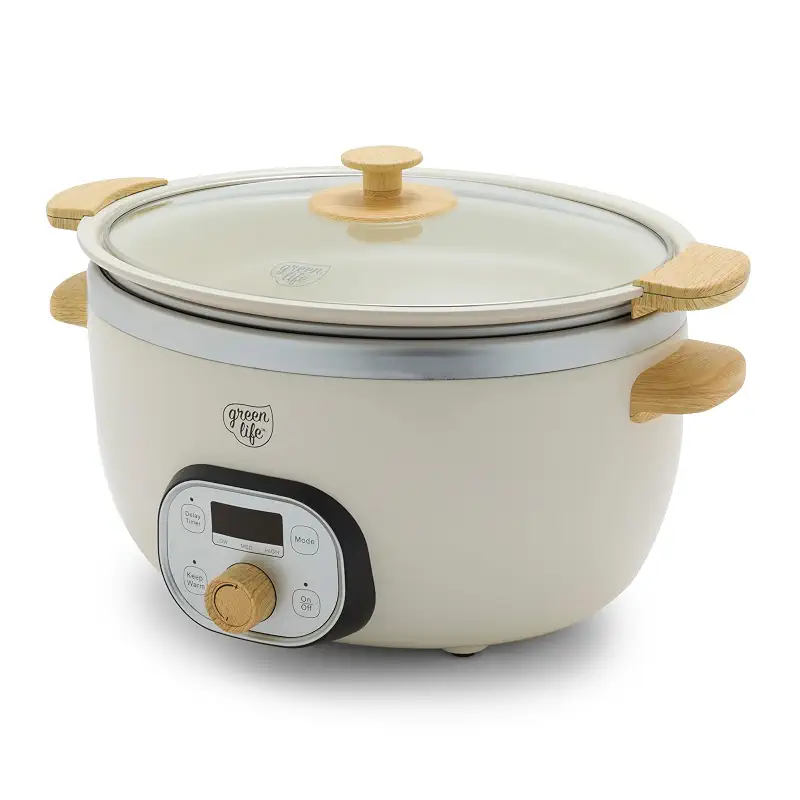
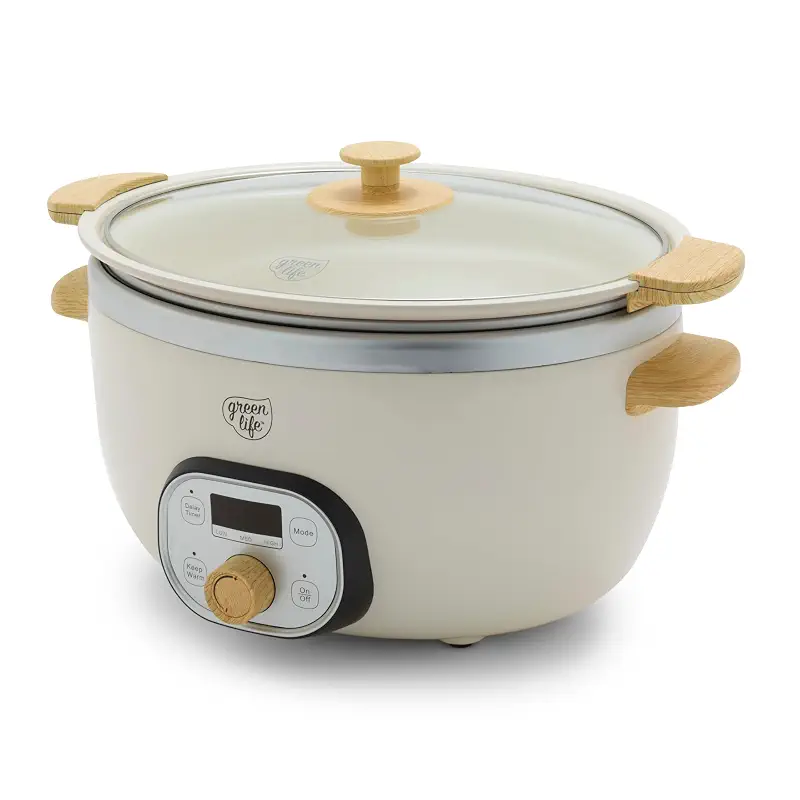
The GreenLife 6QT strikes the balance most home cooks are looking for. The ceramic nonstick interior is derived from sand and comes free of PFAS, PFOA, lead, and cadmium: a straightforward formula that owners consistently trust. What sets it apart is the removable pot design: you can brown meat or sauté aromatics directly on the stovetop, then place the pot back into the base to slow-cook, which builds flavor without dirtying extra pans. The pot is lightweight compared to traditional stoneware, which matters when you're lifting it in and out of the dishwasher or moving it to the sink.
Owners report that the nonstick coating cleans beautifully even after red sauce or barbecue, and many mention it's the best slow cooker they've owned after years of using other brands. The 6-quart capacity handles a roast for 8 people comfortably, and the programmable timer with low, medium, and high settings gives you cooking flexibility from 30 minutes up to 20 hours. One drawback is that a few buyers noted the actual capacity feels closer to 5 quarts when packed: if you regularly cook for 10+, the 8-quart model may be worth the step up.
Compared to the Crock-Pot 7-quart, this one trades manual-only simplicity for more control and a healthier cooking surface. If you want a slow cooker that handles everyday cooking reliably and prioritizes toxin-free materials, this is the one to start with.
Pros
Removable ceramic pot works on stovetop and in oven
Lightweight, easy to clean nonstick interior
PFAS-free coating trusted by thousands of owners
Programmable timer and three heat settings
Cons
Actual capacity slightly less than advertised 6 quarts
Requires 10-minute break-in run before first use to clear odor
Key features
6-quart PFAS-free ceramic nonstick pot, removable for stovetop browning
Programmable timer up to 10 hours with low, medium, and high heat
Keep warm function holds food for up to 4 hours after cooking
Ideal for: Meal preppers and large families who cook for 8+ people or need bulk cooking capacity.
The GreenLife 8QT is the right choice if your regular cooking involves feeding crowds, or if you want to batch-prep several meals at once for the freezer. The 8-quart ceramic nonstick pot is roomy enough for an 8-pound chicken or 6-pound roast with vegetables, and it maintains the same PFAS-free formula and removable stovetop-safe design as its 6-quart sibling. The lightweight pot is the real advantage here; owners specifically mention how much easier it is to handle compared to traditional ceramic stoneware crocks, which can weigh substantially more and strain your wrists when carrying to the sink.
Where the GreenLife 8QT diverges from the 6QT is in real-world user feedback: the smaller pool of reviews (450 versus 6,000+) means slightly less data, but what owners do report is consistent: fast, even heating and faithful cooking times. One buyer flagged a minor chip on the handle finish after light use, suggesting you'll want to hand-wash rather than risk the dishwasher. The three-position dial (Low, High, Warm) is simple and intuitive, though it lacks the programmable timer that the 6QT offers; you'll need to manually monitor your cook time or set a phone reminder.
If batch cooking is your goal and counter space allows, this outperforms the standard Magnifique glass cooker for sheer capacity and the stovetop browning advantage. However, if you want to keep things compact, the 6QT does nearly everything this one does in a smaller footprint.
Pros
8-quart capacity serves 10+ or handles large single batch
Lightweight ceramic nonstick pot easier to clean than stoneware
Removable pot for stovetop browning before slow cooking
PFAS-free, toxin-free coating across all food-contact surfaces
Cons
No programmable timer; manual time monitoring required
Handle finish can chip with dishwasher use; hand-wash recommended
Key features
8-quart PFAS-free ceramic nonstick pot, removable for stovetop use
Ideal for: Small-to-medium households seeking a transparent, coating-free slow cooker with multi-mode cooking flexibility.
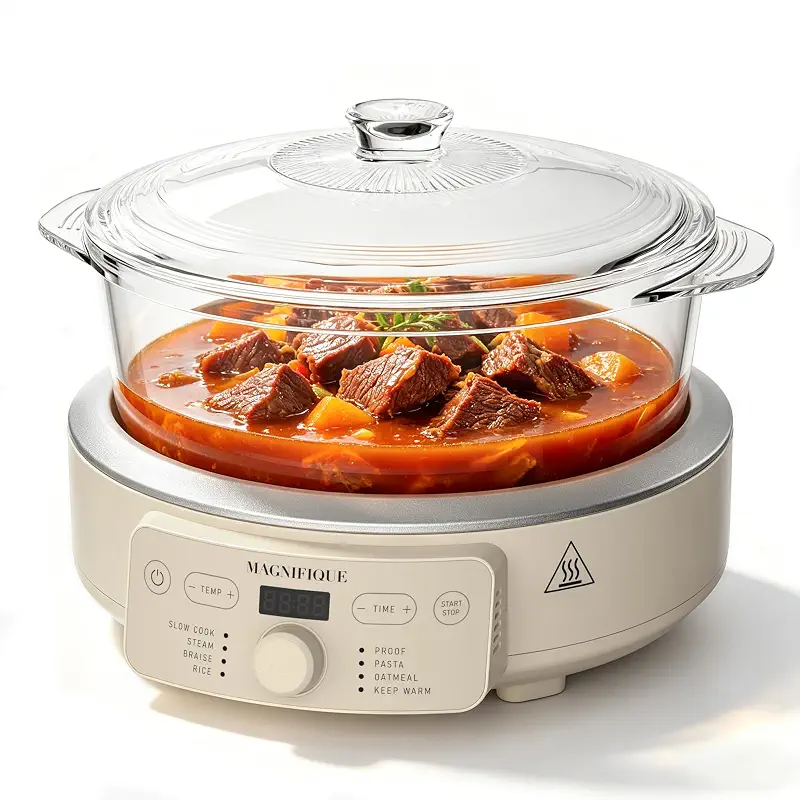
The Magnifique slow cooker takes a completely different approach to non-toxic cooking: instead of a ceramic nonstick coating, it uses borosilicate glass with stainless steel heating elements and contact surfaces. No Teflon, no PFAS, no ceramic coating at all: what you get is transparent, chemically inert glass that lets you see your food at all times and eliminates any question about coating safety or degradation over years of use.
The functionality sets it apart from dedicated slow cookers. Beyond the slow-cook modes, you get rice, pasta, steam, oatmeal, and proof settings, which expands its usefulness for households that want one appliance handling multiple jobs. Owners who have it running regularly praise the glass for being easy to clean and the overall versatility. However, there are some operational quirks to be aware of. A small number of buyers report that the unit locks into a setting once chosen and won't respond to button presses unless you unplug and replug it: a genuine defect in some units, though not universal.
Compared to the GreenLife models, the Magnifique trades stovetop browning capability (the glass pot cannot go on the stove) and larger capacity for a coating-free design and cooking versatility. The 4.5-quart size is noticeably smaller, better suited to cooking for 2–4 people rather than families of 8+. If your priority is absolute transparency about materials and you don't need stovetop browning, this is a credible choice.
Pros
Borosilicate glass pot is completely transparent and coating-free
8 cooking modes: slow cook, steam, rice, pasta, oatmeal, and more
Glass pot usable for serving and refrigerator storage
Easy to inspect food without lifting lid during cooking
Cons
Smaller 4.5-quart capacity not ideal for large families or batch cooking
Some units report control-lock issues requiring unplug/replug cycles
Key features
4.5-quart borosilicate glass pot with stainless steel heating surfaces
8 cooking modes including slow cook, steam, rice, pasta, and oatmeal
Removable glass pot for easy serving and cold storage
Dishwasher-safe glass pot, lid, and steam rack
No nonstick coatings: entirely glass and stainless steel design
#4 Pick
Best Premium Multi-Cooker
GreenPan
GreenPan Elite 14-in-1 Nonstick 6QT Electric Slow Cooker, PFAS-Free Ceramic Multi-Cooker, In-Pot Browning, Dishwasher Safe Lid & Removable Crock, Stainless Steel Steamer, Silicone Handles, White
4.6(491)
14-preset electric slow cooker with in-pot browning, diamond-infused ceramic coating, and stainless steel steamer included.
Ideal for: Home cooks who want preset convenience, in-pot searing, and advanced ceramic nonstick in one appliance.
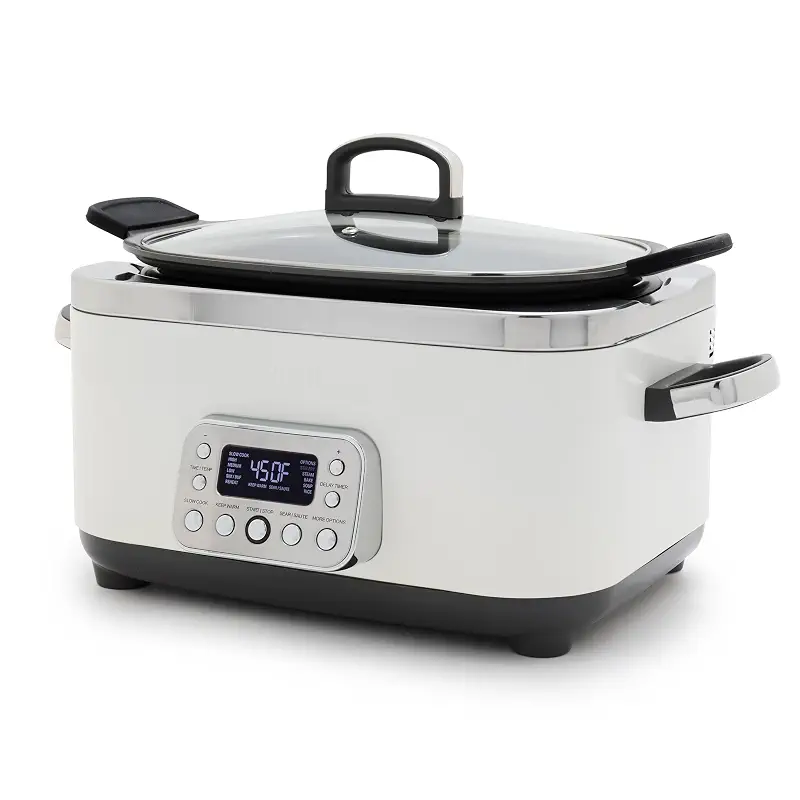
The GreenPan Elite represents the premium end of the non-toxic slow cooker spectrum. Where other models offer basic low/high/warm, this one delivers 14 one-touch presets covering slow cook, soup, stir-fry, rice, bake, steam, reheat, and more. The Thermolon Volt ceramic coating is GreenPan's most advanced formula: infused with diamond particles for durability and claimed to be metal-utensil safe, a rarity in ceramic nonstick cookware. It's still PFAS-free and food-safe, but engineered for heavy use.
The in-pot browning function lets you sear meat or vegetables directly in the ceramic crock without switching to a separate skillet, and the included stainless steel steamer expands your cooking repertoire. Owners report the exterior stays cool to the touch, the crock cleans effortlessly, and the 6-quart capacity handles everything from half a roasted chicken to pork shoulder. One owner specifically noted avoiding the sear function to preserve the ceramic coating long-term: a reasonable precaution that suggests even diamond-infused ceramic benefits from gentler treatment.
Against the GreenLife 6QT, the Elite costs more but gains preset convenience, in-pot browning, a steamer tool, and hardened ceramic. If you want the most feature-rich non-toxic slow cooker with restaurant-quality browning capability built in, this justifies the upgrade. For basic slow cooking, the GreenLife models deliver 90% of the performance at a lower price point.
Pros
14 presets including sear, stir-fry, bake, and steam functions
In-pot browning eliminates need for separate skillet
Diamond-infused ceramic coating more durable than standard ceramics
Includes stainless steel steamer for vegetables and dumplings
Cons
Higher price point than basic GreenLife 6QT models
Diamond ceramic still benefits from careful handling to extend lifespan
Ideal for: Budget-conscious families who value simplicity, reliability, and traditional stoneware materials.
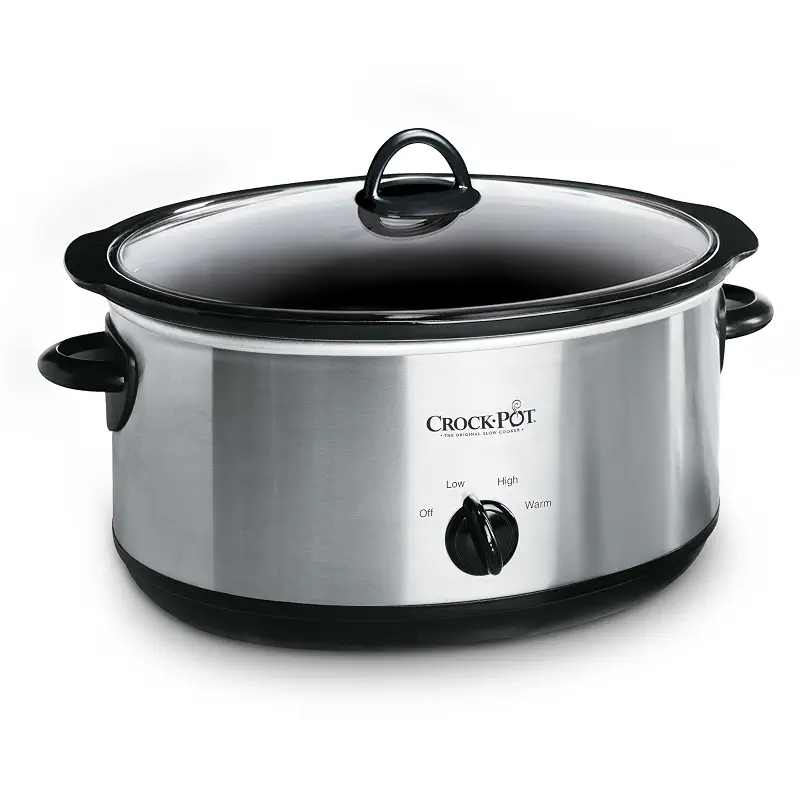
The Crock-Pot 7QT is the standard-bearer for traditional slow cooking. It uses a removable stoneware insert (earthenware, not ceramic coating), which is inherently non-toxic: there's no nonstick coating to worry about, just fired clay. If your concern is avoiding PFAS and synthetic coatings, stoneware answers that directly. The 7-quart capacity is spacious, fitting a 7-pound roast with room to spare, and the stainless steel exterior looks professional on a buffet table.
Owners consistently praise its reliability, and many mention keeping one for over a decade. The manual controls (just low, high, and warm) mean no buttons to fail and no programmable timer to fuss with. Set it and forget it is genuinely how this works. The removable stoneware can go in a microwave or conventional oven up to 400°F, adding utility beyond slow cooking. The trade-off is weight and capacity: stoneware is substantially heavier than ceramic nonstick, and the lack of a programmable timer means you need to be home or use an external timer. One detailed buyer review flagged that this cooker maintains more consistent low heat than a cheaper competing model that ran too hot: temperature stability matters for slow cooking results.
Compared to the GreenLife or GreenPan options, this one forgoes modern conveniences (stovetop browning, multiple presets, lightweight handling) in exchange for proven durability, simplicity, and the absolute certainty that stoneware is food-safe. If you want the least complicated, most affordable entry into non-toxic slow cooking, this delivers.
Pros
Proven durability; owners report 20+ year lifespan
Natural stoneware insert is inherently non-toxic
Simple manual controls with no electronics to fail
7-quart capacity feeds 9+ people or fits large roasts
Cons
Heavy stoneware pot difficult to lift and clean compared to ceramic nonstick
No programmable timer; manual monitoring or external timer required
Manual low, high, and warm settings for simple operation
Stoneware pot safe for oven up to 400°F and microwave use
Stainless steel exterior with black accents and practical handles
Dishwasher-safe lid and stoneware for convenient cleanup
How to Choose a Non-Toxic Slow Cooker
Four trade-offs that actually matter when matching a non toxic slow cooker to your kitchen.
Materials Matter More Than You Think
Non-toxic cooking starts with pot material. Traditional stoneware (like the Crock-Pot) is naturally safe: it's fired clay with no coatings to degrade. Ceramic nonstick coatings (GreenLife, GreenPan) are PFAS-free and derived from sand, making them a safer alternative to older Teflon. Glass pots (Magnifique) eliminate any coating concern entirely. The key is checking the label for PFAS-free certification and avoiding vague terms like "healthy" without specifics. When shopping, prioritize products that explicitly state what their coating is made from and what it excludes.
Capacity and Serving Size
Slow cookers range from 4 to 8 quarts. A 6-quart model serves 6-8 people comfortably; an 8-quart handles 10+ or enables serious batch cooking. A 4.5-quart works well for couples or small households. Actual usable capacity is often slightly less than advertised, so if you regularly cook for large groups, size up. Don't buy based on specs alone: read reviews from buyers with similar household sizes to see real-world capacity feedback.
Removable Pot and Stovetop Capability
The difference between ceramic versus stoneware cookware becomes clearest when you want to brown ingredients before slow cooking. GreenLife and GreenPan models have removable ceramic pots safe for stovetop use, letting you sear meat without dirtying extra dishes. Stoneware and glass pots cannot go on the stove. If browning and one-pot flavor-building appeal to you, a removable stovetop-safe pot justifies the cost. If you're content browning in a separate skillet, it's less essential.
Controls and Convenience Features
Manual controls (low, high, warm) are simple and fail-proof; programmable timers add flexibility but introduce electronics that might need repair. Preset functions (sear, steam, rice) expand versatility but add complexity. Consider your cooking style: weekend meal preppers benefit from timers and multiple modes; weeknight slow-cooker users often do fine with basic low/high. Heavier features mean higher cost, so choose based on how you actually cook.
Cleaning and Long-Term Care
Ceramic nonstick pots are lighter and easier to clean than stoneware; glass is transparent and dishwasher safe but cannot go on the stove. Hand-washing ceramic coatings extends their lifespan: dishwashers are gentler on glass. All removable pots should be washed promptly after cooking to prevent staining and buildup. If durability matters, stoneware and diamond-infused ceramics tend to outlast basic ceramic coatings, though they're heavier.
Frequently asked
Quick answers to the questions readers ask most.
What does PFAS-free actually mean in slow cooker nonstick coatings?
PFAS (per- and polyfluoroalkyl substances) are synthetic chemicals used in traditional nonstick coatings like Teflon. They've raised health and environmental concerns. PFAS-free coatings (like the ceramic and diamond-infused ceramics in GreenLife and GreenPan models) achieve nonstick performance without these chemicals. They're derived from minerals like sand instead. PFAS-free doesn't mean perfectly indestructible, but it removes a chemical class most health-conscious cooks want to avoid.
Can I use a ceramic nonstick slow cooker pot on the stove to brown meat?
Only if the product explicitly states the pot is stovetop and oven safe. GreenLife and GreenPan ceramic pots are designed for this. Stoneware (Crock-Pot) and glass (Magnifique) are not stovetop safe. Even stovetop-safe ceramic pots should be used on medium heat rather than high; low-to-medium browning is gentler on the coating and extends its life.
How much should I spend on a non-toxic slow cooker?
Budget-friendly models like the Crock-Pot 7QT deliver reliable slow cooking with natural stoneware at an entry-level price. Mid-range ceramic nonstick options (GreenLife 6QT) cost moderately more but offer lighter handling and stovetop browning. Premium multi-cookers (GreenPan Elite) cost the most but add presets, in-pot browning, and hardened ceramic. Start with your actual needs: if you slow-cook three times a week, investing in a premium model pays off; if it's occasional, a budget model suffices.
Is stoneware safer than ceramic nonstick for slow cooking?
Both are non-toxic when used properly. Stoneware is naturally inert (fired clay with no coatings) so there's no risk of coating degradation. Ceramic nonstick, when PFAS-free and from reputable brands, is also safe but requires gentler handling and care to preserve the coating long-term. If you're concerned about any coating risk, stoneware eliminates that concern entirely, though it's heavier and less convenient to handle.
Can I put a slow cooker pot in the dishwasher?
Most ceramic and glass removable pots are dishwasher safe. Stoneware is also usually dishwasher safe but can chip if knocked against other dishes. Hand-washing ceramic coatings extends their lifespan: the gentle approach protects the nonstick surface from abrasion. Glass is durable in the dishwasher but should be loaded carefully to prevent breakage. Always check the product manual; some manufacturers recommend hand-washing to maximize durability.