Kitchen & Dining · Cookware
Best Nakiri
Flat-edged vegetable knives compared on steel, edge angle, handle feel and weight, so you can match a blade to the produce you prep.
Affiliate disclosure: As an Amazon Associate I earn from qualifying purchases.
At a glance
2
Lightest TouchChristopher Kimball's Milk Street
3
Everyday WorkhorseMercer Culinary
4
Japanese-Style PickKawahiro
7
Best Hammered Finishimarku
Detailed reviews
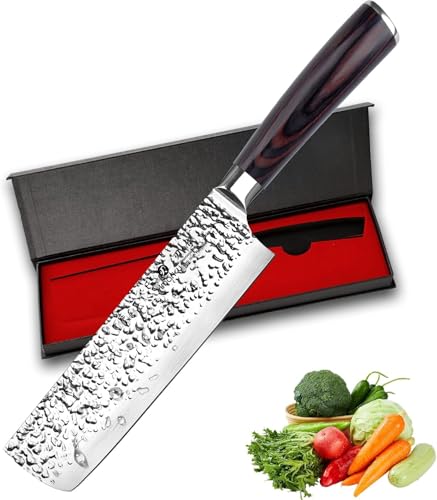
We'd steer first-time nakiri buyers toward the PAUDIN 7" Nakiri Knife. It pairs a 7 inch blade in 5Cr15Mov stainless steel with a pakkawood handle and a wave-pattern finish; the pattern is decorative, not true Damascus, and it is sold as exactly that. The flat edge push-cuts straight down through produce, and owners report that it gets through tough items like squash and sweet potato as readily as tomatoes and fruit.
The feedback converges on an edge that is sharp from the first use, a comfortable grip and a light, easy feel in the hand. Owners also reach for it on boneless roasts, so it stretches a little past vegetables. Critical feedback questions whether the steel lives up to the blade's looks, and its length makes it awkward for working fruit out of a rind, so we'd treat it as a produce knife first.
Pros
- Sharp edge from the first use
- Comfortable pakkawood handle grip
- Handles dense squash and soft tomatoes
Cons
- Wave pattern is not true Damascus
- Steel quality questioned in critical feedback
Key features (4)
- 7 inch blade in 5Cr15Mov stainless steel
- Wave pattern said to reduce food friction
- Pakkawood handle integrated with the blade
- Hardness rated 56 or higher
Slightly shorter than the PAUDIN 7" Nakiri Knife, the Christopher Kimball's Milk Street Nakiri Knife 6.75 Inch uses a 6 3/4 inch blade in 1.4116 German steel, embossed with a file pattern so slices release instead of clinging. The blade stands 2 inches tall, which gives knuckles some clearance during chopping, and the handle has a hard core with a softer, textured outer layer that stays put when wet or greasy.
Owners report a thin blade that glides through produce, a light and balanced feel, and a sharp edge that holds up. They use it for scallions and carrots, and it is also put to work on bread. Care is strict: hand wash it and dry it right away to avoid staining, and sharpen it at a 17 degree angle.
Pros
- Thin blade glides through produce
- Light, balanced feel in the hand
- Textured handle stays grippy when wet
Cons
- Must be hand washed and dried immediately
Key features (4)
- 6 3/4 inch blade in 1.4116 German steel
- Embossed file pattern helps food release
- Two-inch blade height for knuckle clearance
- Dual polymer handle with textured finish
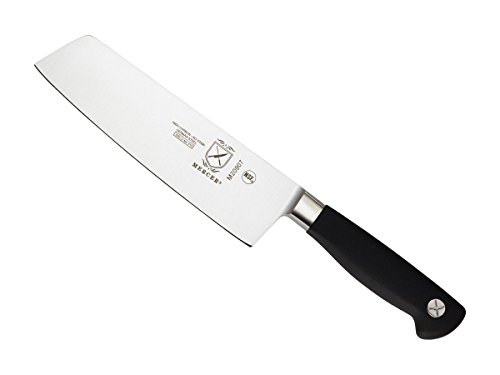
Cooks who find the Christopher Kimball's Milk Street Nakiri Knife 6.75 Inch too airy will find more heft in the Mercer Culinary Genesis 7-Inch Nakiri Vegetable Knife, a forged blade in high-carbon German steel with a taper-ground edge. The feedback leans on its heft: it is heavy enough to push through sweet potatoes and winter squash, yet owners also slice tomatoes and apples very thin with it. The wide, square profile slides along the knuckles, which makes quick chopping and mincing feel easy.
The non-slip handle gets praise for its grip even with wet hands, and owners report that the edge holds up well. The weight is a double-edged trait: owners new to a heavy knife report nicking their fingers, so we'd call it better for cooks who are comfortable with a heavier blade. Wash it by hand; the maker advises against the dishwasher.
Pros
- Forged high-carbon German steel blade
- Non-slip handle even with wet hands
- Heft helps with sweet potatoes and squash
Cons
- Heft takes getting used to
- Hand wash only, no dishwasher
Key features (4)
- Precision-forged high-carbon German steel
- Taper-ground edge for efficient cutting
- Ergonomic non-slip handle
- Lifetime warranty
The Shun Classic Blonde Nakiri Knife 6.5 Inch carries Damascus cladding, while the Kawahiro Japanese Nakiri Knife 7 Inch leans on a hand-hammered black forged finish over a Japanese high-carbon VG-10 core, listed at 62 HRC. Among nakiri knives that borrow Japanese styling, this one adds a handle of ruby wood, turquoise and ebony, and it arrives in a wooden gift box, which makes it an easy present.
Owners report high quality and a keen edge that works well on vegetables and boneless meat. The feedback is thin, so we'd weigh the steel and finish more than long-term durability here. The full-length straight edge is meant to cut through produce rather than crush it, which suits julienne work and thin slicing.
Pros
- VG-10 core with high stated hardness
- Sharp on vegetables and boneless meat
- Distinctive ruby wood and ebony handle
Key features (4)
- Japanese high-carbon VG-10 core
- Hardness stated at 62 HRC
- Hand-hammered black forged texture
- Wooden gift box included
Held next to the Mercer Culinary Genesis 7-Inch Nakiri Vegetable Knife, the Shun Classic Blonde Nakiri Knife 6.5 Inch is shorter at 6.5 inches and far more decorative, with VG-MAX steel inside 68 layers of Damascus cladding and a 16 degree edge. The D-shaped blonde pakkawood handle suits both left- and right-handed cooks, and the knife is handcrafted in Japan with free sharpening and honing and a limited lifetime warranty behind it.
Owners report that it stays sharp for a long time, cuts through hard vegetables like softened butter and is comfortable to hold, with balance that pairs well with its fine edge. Admirers single out the Damascus finish. It is the heaviest of the page's picks that list a weight, a plus for cooks who like a planted feel and a drawback for those who prefer a light blade.
Pros
- Long-lasting edge with little resharpening
- Damascus cladding with eye-catching finish
- Handle comfortable for left- and right-handers
Key features (4)
- VG-MAX steel with 68 Damascus layers
- 16 degree edge angle
- D-shaped blonde pakkawood handle
- Handcrafted in Japan
Shorter than anything else here, the Hoshanho 5.5 Inch Nakiri Knife has a 5.5 inch blade, which is easier to control on a small board. It is made from 10Cr15CoMoV high-carbon stainless steel at 60 HRC with a 15 degree hand-polished edge, a degree finer than the 16 degree edge on the Shun Classic Blonde Nakiri Knife 6.5 Inch. Scallop-shaped hollows on the blade side are meant to reduce sticking.
Owners report that it is sharp out of the box, balanced, and strong enough for carrots and other hard vegetables, with a pakkawood handle that fits the hand well. Durability is where opinions part: owners report that it is built for the long haul, while a common complaint is blade chipping soon after purchase and a cracked handle. We'd treat it as a careful-handling knife for light prep.
Pros
- Short blade eases control on small boards
- Sharp 15 degree edge from the start
- Balanced weight with a comfortable handle
Cons
- Blade chipping reported soon after purchase
- Handle cracking reported by owners
- Shortest blade of the page's picks
Key features (4)
- 5.5 inch blade in 10Cr15CoMoV steel
- Hardness stated at 60 HRC
- Scallop-shaped hollows on the blade
- Pakkawood handle with natural grain
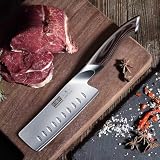
Both this and the Hoshanho 5.5 Inch Nakiri Knife quote a 15 degree edge, but the imarku Nakiri Knife 7 Inch runs to a full 7 inch blade. It has a hammered finish with a hollow edge and mirror-polished spine, all aimed at cutting down on food sticking, and a full-tang pakkawood handle with a non-slip shape. The Japanese high-carbon stainless blade resists rust and stains, though the care instructions call for hand washing only.
Owners report a sharp, well-balanced knife that stays comfortable in smaller hands and slices through everything from vegetables to sourdough. It feels light, with the weight spread evenly between blade and handle. A reported flaw is a handle pin that works loose, so check the fit when it arrives.
Pros
- Hammered finish reduces food sticking
- Light feel with balanced blade and handle
- Slices vegetables and bread cleanly
Cons
- Handle pin can work loose
- Hand wash only care
Key features (4)
- Hammered finish with hollow-edge design
- 15 degree edge angle
- Full-tang FSC-Certified pakkawood handle
- Japanese high-carbon stainless steel blade
Side by side
| Pick | Size | Item weight | Item dimensions |
|---|
#1 Best Overall
Paudin | 7" | 0.5 pounds | 12.28 × 1.97 × 0.08 inches |
#2 Lightest Touch
Christopher Kimball's Milk Street | 6.8" | — | — |
#3 Everyday Workhorse
Mercer Culinary | 7" | 0.25 pounds | 2 × 1 × 12 inches |
#4 Japanese-Style Pick
Kawahiro | 7" | 0.5 pounds | 12.8 × 2 × 0.6 inches |
#5 Premium Pick
Shun | 6.5" | 0.56 pounds | 13 × 2.38 × 0.9 inches |
#6 Compact Pick
Hoshanho | 5.5" | — | — |
#7 Best Hammered Finish
imarku | 7" | — | 12 × 2 × 0.09 inches |
How to Choose a Nakiri
Does the steel matter for a vegetable knife?
Steel and hardness set how long the edge lasts and how forgiving it is. A harder, finer edge cuts cleanly but can chip if it meets a bone, a frozen item or a hard board, so match the blade to how roughly you cook. Among this page's picks, the Kawahiro Japanese Nakiri Knife 7 Inch states a 62 HRC core, the Hoshanho 5.5 Inch Nakiri Knife states 60 HRC, and the Shun Classic Blonde Nakiri Knife 6.5 Inch pairs VG-MAX with Damascus cladding; that cladding is mostly looks, while the core steel does the cutting.
German-style stainless steel, like the 1.4116 in the Christopher Kimball's Milk Street Nakiri Knife 6.75 Inch, tends toward toughness and easy upkeep, which is why we'd point newer cooks there first. A sharper edge angle slices more easily but asks for more care, so a 15 degree edge suits gentle prep best.
What blade length and shape suit your kitchen?
Most of these blades run 6.5 to 7 inches, a length that suits standard boards and gives long, clean slices through a cabbage or a squash. Shorter blades are easier to steer on a small board and in a crowded kitchen, which is where the Hoshanho 5.5 Inch Nakiri Knife makes sense; longer ones cover more ground per cut.
Handle shape matters as much as blade length. A grippy, non-slip handle helps with wet hands, which is the strength of the Mercer Culinary Genesis 7-Inch Nakiri Vegetable Knife, while a lighter handle-and-blade balance tires the wrist less over a long prep session.
Nakiri, usuba or santoku: which flat blade fits?
These three knives overlap, so the choice comes down to the bevel and how much else you want the knife to cut. If you cook mostly vegetables, a nakiri is the simplest specialist. If you want one knife for everything, the japanese knife under 100 picks cover that all-rounder ground better.
- Nakiri: double-bevel, easy to keep sharp and good for either hand
- Usuba: single-bevel professional vegetable knife that asks for more skill
- Santoku: all-purpose blade that also handles meat and fish
How do you cut with a nakiri?
A nakiri has a flat edge with almost no curve, so it works as a push-cutter rather than a rocker. The steps below keep the whole edge in contact with the board and stop slices staying joined together.
- Rest the front half of the blade on the ingredient.
- Push forward and down in one smooth motion.
- Lift the blade and set it back down for the next slice.
- Guide the food with a curled fingertip grip behind the blade.
- Avoid rocking the blade; the flat edge is not made for it.
Our picks at a glance
2
Lightest TouchChristopher Kimball's Milk Street
3
Everyday WorkhorseMercer Culinary
4
Japanese-Style PickKawahiro
7
Best Hammered Finishimarku