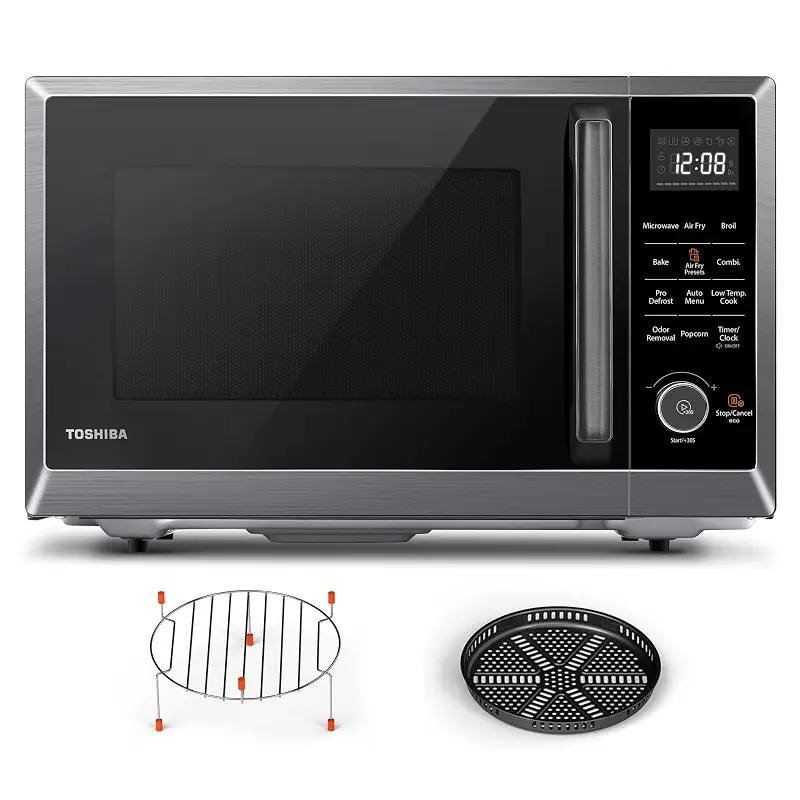
Ideal for: Home cooks seeking maximum cooking modes in a compact footprint; families preparing roasted meals and air-fried foods.
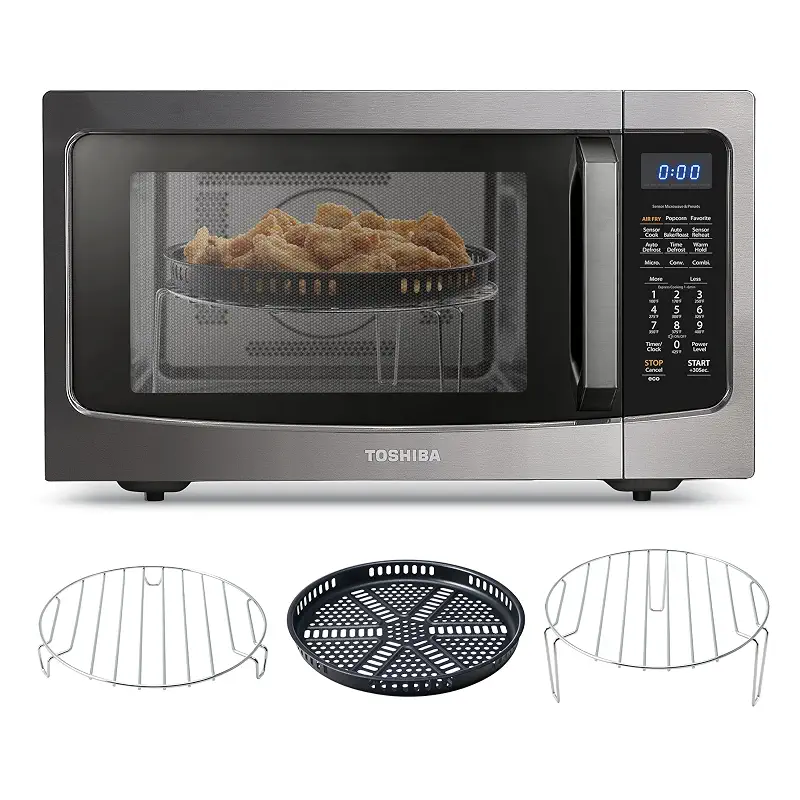
The Toshiba 8-in-1 offers genuine versatility: microwave, air fry, convection, broil, combination cooking, low-temp, odor removal, and defrost modes in a 1.0 cu.ft. unit. The 1000-watt output is sufficient for most everyday tasks, and owners consistently praise the air fryer results and the quiet operation. The 12.4-inch turntable fits a whole roasted chicken or 12-inch pizza, which is genuinely useful for families or meal prep.
However, I have to flag a serious safety issue that emerged in Consumer Reports: certain Toshiba combo models (including variants of this line) were linked to overheating, sparking, and even fire incidents between 2023 and 2026. While this specific model variant appears in those reports, the incidents were tied to units that started on their own or added time without user input. Owners who did experience issues praise Toshiba's customer service for replacements, but the fact remains that you'll want to monitor operation and read recent owner feedback carefully.
Compared to the Black+Decker, the Toshiba gives you more cooking modes and better air fryer performance, but comes with documented reliability questions. If you're comfortable managing that risk and the unit ships without defects, it's a solid performer for small to medium households.
Pros
Quiet operation and strong 1000W microwave output
Air fryer results rival standalone units for crispness
Large turntable accommodates whole chicken or 12-inch pizza
Eight distinct cooking functions cover most meal-prep needs
Cons
Consumer safety reports of overheating and sparking in some units
Requires close attention to manual to use all features correctly
Key features
1.0 cu.ft. capacity with 12.4-inch position memory turntable
1000-watt microwave power with 8 cooking modes (microwave, air fry, convection, broil, combi, low-temp, odor removal, defrost)
Stainless steel interior resists staining and simplifies cleanup
Child safety lock and digital controls with intuitive layout
#2 Pick
Best Budget Pick
Black+Decker
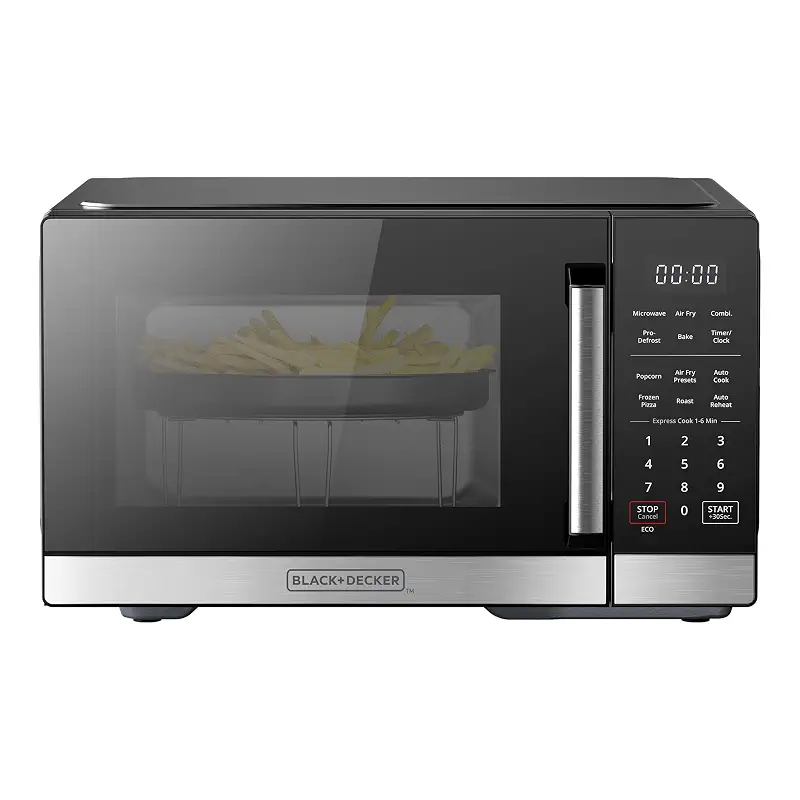
BLACK+DECKER 5-in-1 Microwave Oven Air Fryer Combo, 0.9 Cu.Ft, 900W | Countertop Microwave, Convection Bake & Roast, Child Lock, 10 Power Levels, for Small Kitchens & RVs
4.2(22,736)
Compact five-in-one unit at an accessible price point; solid microwave and air fryer, modest on capacity and controls.
Ideal for: Budget-conscious buyers, dorm dwellers, RV kitchens, and households with minimal counter space and modest cooking needs.
The Black+Decker occupies a unique position in the lineup: it delivers core functions (microwave, air fryer, convection, bake, roast) at a fraction of the cost of premium models. The 900-watt output is lower than some competitors, but owners report it still heats reasonably fast for everyday use. The 11 air fryer presets (French fries, wings, nuggets, fish sticks, etc.) take the guesswork out of temperature and timing, which is genuinely helpful for newer cooks.
That said, the trade-offs are real. The 0.9 cu.ft. capacity is genuinely small: pizza, casseroles, and larger plates will be tight. Several reviews flag that the control panel is difficult to read without backlighting, the unit slides on smooth countertops (a genuine safety concern), and the venting fan has failed in some units within a year. The air fryer function also underperforms compared to dedicated air fryers or the Toshiba OptiChef PRO MAX in this lineup. Where the Toshiba 8-in-1 focuses on breadth of modes, the Black+Decker emphasizes compact simplicity, and for dorms, RVs, or truly space-constrained kitchens, that trade-off makes sense.
If your cooking demands are modest and counter space is your primary constraint, the Black+Decker delivers. Just understand you're getting a beginner-friendly unit, not a workhorse.
Pros
Lowest entry price among combo units in this group
11 preset air fry menus simplify frozen food cooking
Compact footprint with 900W output adequate for small kitchens
Seven auto menus for beverage, vegetables, popcorn, and pizza
Cons
0.9 cu.ft. capacity too small for large plates or family-sized portions
Control panel lacks backlighting, difficult to read in normal kitchen light
Key features
0.9 cu.ft. capacity with 900-watt microwave power output
functionality: microwave, air fryer, convection bake, roast, and combination cooking
11 preset air fry menus and 7 auto cook settings for quick operation
Child lock and quiet operation suitable for shared living spaces
#3 Pick
Best for Family Cooking
Toshiba
TOSHIBA 4-in-1 Countertop Microwave Oven with Air Fryer, 1.5 Cu.Ft, 1000W | Smart Sensor, Convection, Mute Function, Position Memory Turntable, for Home Kitchen, Black Stainless Steel
4.0(3,514)
Larger 1.5 cu.ft. capacity with four solid cooking modes; convection baking stands out, air fryer lags behind standalone units.
Ideal for: Families baking cookies, roasting chicken, and preparing smaller convection dishes; kitchens prioritizing even cooking over speed.
The Toshiba splits the difference between the ultra-compact Black+Decker and the feature-packed 8-in-1: it gives you a genuinely useful 1.5 cu.ft. cavity (the largest in this group) with 1000 watts of microwave power, convection, broil, air fry, and combo modes. The 13.6-inch turntable fits a full roasted chicken or 12-inch pizza, and owners rave about the convection baking: cookies, biscuits, and roasted meats come out evenly cooked without needing a full-size oven.
But here's the caveat: the air fryer function underperforms. Multiple owners report that air-fried food takes significantly longer and comes out less crispy than standalone air fryers. One reviewer noted that their food stayed soggy despite following instructions, leading them to abandon the feature. The convection mode more than compensates for household cooks who prioritize baking and roasting, but if air frying is your primary reason for buying a combo, this isn't your best pick: the OptiChef PRO MAX handles air frying much faster.
The learning curve is moderate; controls are logical if you read the manual, though some preset functions (like the combo mode for reheating pizza) aren't obvious from the buttons alone. It's a reliable workhorse for families who bake, roast, and occasionally air fry, especially if you value the quiet operation and stainless steel interior.
Pros
Largest 1.5 cu.ft. capacity among comparables for full-sized meals
Convection baking delivers evenly cooked results for pastries and roasts
1000W microwave with mute function for quiet operation
Removable turntable and stainless interior simplify cleanup
Cons
Air fryer function significantly slower and less crispy than standalone units
Instruction manual unclear on when and how to use preset features
Key features
1.5 cu.ft. capacity with 13.6-inch position memory turntable
1000-watt microwave with convection, broil, air fry, and combo modes
13 sensor menus and multistage cooking for automated meal prep
Mute button, LED cavity light, and stainless steel interior
#4 Pick
Best Premium Pick
Toshiba
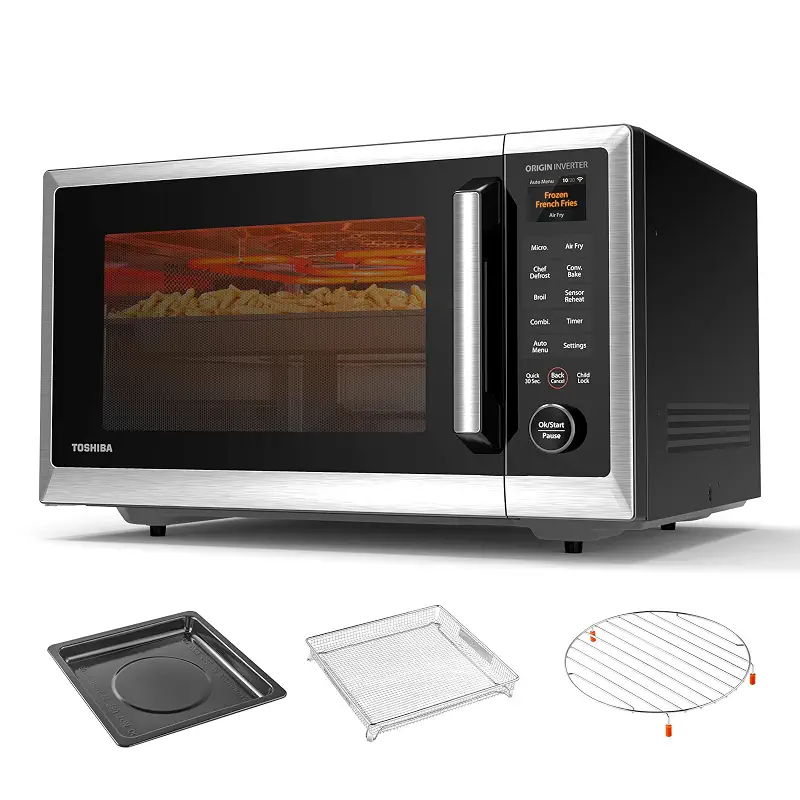
TOSHIBA OptiChef PRO MAX Air Fryer Combo Microwave Oven, 1.3 Cu.Ft, 1100W | 2.4-Inch Color Screen, Origin Inverter Technology, Smart Microwave Sensor, Compatible with Alexa, Countertop, Silver
4.3(275)
Advanced tech with color display and inverter heating; excellent air fryer performance, but steep price and connectivity headaches.
Ideal for: Tech-forward cooks prioritizing air frying speed and even microwave heating; buyers willing to pay for inverter technology and smart controls.
The Toshiba OptiChef PRO MAX aims for the high end of the market with a 2.4-inch color touchscreen, Origin Inverter Technology (which adjusts power 100 times per second for even cooking), and smart sensor humidity control. The 1100-watt output and 1.3 cu.ft. capacity represent solid middle ground, and the air fryer function genuinely delivers crispy results comparable to dedicated units: the big difference from the variant. The color display is responsive and intuitive, making mode switching and preset selection straightforward.
However, this is where premium pricing meets frustration. The network connectivity required for Alexa integration is finicky; multiple owners spent hours troubleshooting 2.4GHz WiFi setup, app switching (between M SmartHome and T-Life), and re-pairing just to get phone control working. The 1100-watt microwave performance feels underwhelming compared to the spec: one owner reported it heats slower than their old 900-watt unit. The interior is slightly obstructed by the broiler element, making tall items (rice pouches, pasta packages) difficult to microwave. And critically, one long-term owner reported catastrophic failure after 4.5 months due to steam sensitivity: the unit stopped powering on entirely after humid cooking sessions.
Compared to the Toshiba 8-in-1, you pay significantly more for the color screen and inverter tech but lose the convection versatility and odor-removal mode. If you want excellent air frying and don't need the smart-home features, the OptiChef is a strong performer: just skip the Alexa integration unless you have specific technical confidence.
Pros
Air fryer performance rivals standalone units for crispness and speed
Origin Inverter Technology ensures even microwave heating without overcooking edges
2.4-inch color touchscreen with intuitive menu navigation
1100W output and humidity sensor for moist, evenly reheated leftovers
Ideal for: Apartment dwellers and office workers needing quiet operation; light to moderate cooks who bake more than air fry.
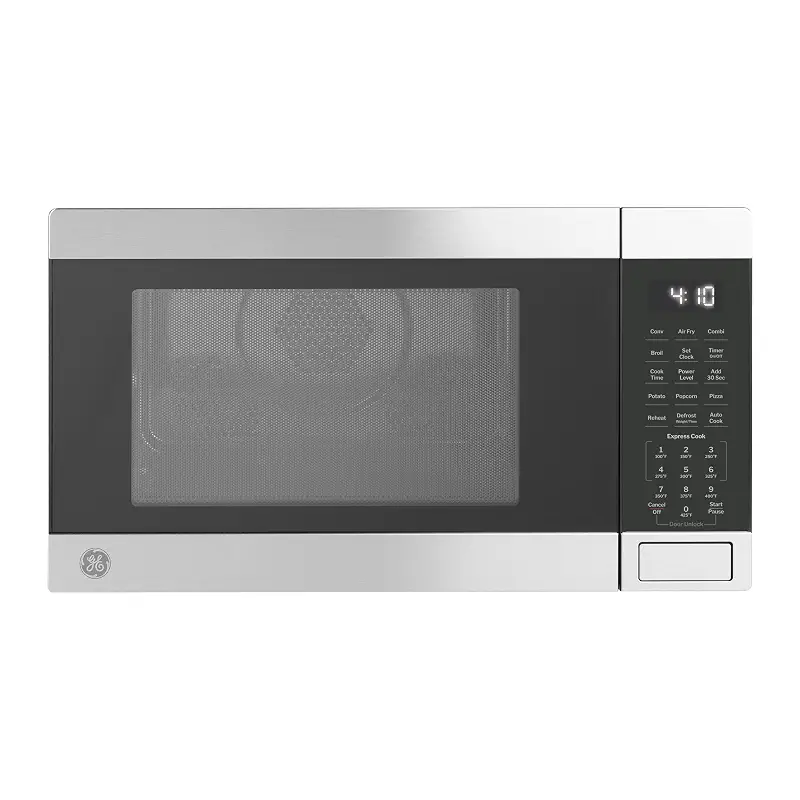
The GE countertop unit is a straightforward four-in-one (microwave, air fryer, convection, broil) with 1050 watts and a sensible 1.0 cu.ft. cavity. It's the quietest unit in this lineup by far: a genuine advantage for dorm rooms, offices, and apartments. The convection function earns consistent praise for even browning and thorough baking; the included wire racks and crisper pan are thoughtfully designed. GE's brand reputation for reliability is partly borne out here: several owners with 8+ months of daily use report flawless performance.
But several red flags deserve attention. The control panel is not backlit; the white text on black background is nearly unreadable without a flashlight or bright ambient light. Multiple owners resorted to applying white nail polish to buttons just to find the controls. More concerning: two owners reported the door latch (a plastic mechanism) breaking after one year, with GE parts costing $96–$212 to replace: nearly as much as a new unit. Interior rust buildup from condensation has also been documented, suggesting potential long-term moisture management issues.
Compared to the best ceramic air fryer options available as standalone units, this GE combo trades specialized air fryer performance for general versatility and whisper-quiet operation. It's a safe bet for noise-sensitive environments and light cooking loads, but the dark control panel and documented latch fragility mean you should budget for potential repairs.
Pros
Whisper-quiet operation ideal for dorm rooms and small apartments
Convection baking delivers consistent browning for pastries and baked goods
1050W output with adjustable power levels for precise microwave cooking
Compact 1.0 cu.ft. capacity fits standard cabinet cutouts
Cons
Control panel not backlit; text virtually unreadable without external light
Plastic door latch prone to breaking; replacement parts costly relative to unit price
Key features
1.0 cu.ft. capacity with 1050-watt microwave power and adjustable settings
functionality: microwave, air fryer, convection, and broil modes
Includes stainless crisper pan, two wire racks, and child lock safety feature
Quiet operation with convenience cook presets for pizza and popcorn
How to Choose a Microwave Air Fryer Combo
Four trade-offs that actually matter when matching a microwave airfryer combo to your kitchen.
Capacity and Turntable Size Matter More Than You Think
The advertised cubic footage only tells part of the story. A 1.0 cu.ft. unit feels genuinely cramped if you cook for a family or regularly roast whole chickens: you'll find yourself working in batches. The turntable diameter determines what actually fits: 12.4 to 13.6 inches is the real-world range here. If pizza, large casserole dishes, or full-sized dinner plates are your regular use, anything under 1.2 cu.ft. will frustrate you. Conversely, if you live in an RV or dorm, the compact footprint of a 0.9 cu.ft. unit is a genuine advantage: just accept that meal prep will be smaller and more intentional.
Microwave Wattage vs. Actual Heating Speed
Specs claim 900W to 1100W, but real-world performance varies. Several owners report that higher-wattage units (1100W) sometimes heat slower than lower-wattage competitors, suggesting that inverter technology or internal magnetron efficiency matters more than the headline number. If you frequently reheat leftovers or defrost frozen foods, read recent owner feedback for actual heating times rather than relying on wattage alone. The microwave versus air fryer differences in performance are particularly stark: one combo unit's microwave might be excellent while its air fryer is sluggish, so match your priorities to the unit's strength.
Air Fryer vs. Convection: Choose Your Specialty
No combo unit excels equally at air frying and convection baking. Some (like the OptiChef PRO MAX) deliver standalone air fryer speed and crispness but cost more. Others (like the Toshiba ) prioritize convection baking for cookies and roasted meats, while air frying takes longer. The Black+Decker and GE occupy middle ground: adequate for both, best at neither. Be honest about which function you'll actually use most. If you bake weekly, convection matters. If you reheat frozen snacks daily, air fryer speed matters. Few households genuinely need both at peak performance.
Control Panel Usability and Learning Curve
Digital displays and touchscreens look modern, but backlighting and button visibility vary wildly. The GE's non-backlit control panel is nearly unreadable in normal kitchen light: multiple owners confirmed this frustration. The Toshiba models require reading the manual to unlock preset functions like combo cooking and low-temperature defrosting, which is fine if you're patient but maddening if you prefer intuitive operation. The Black+Decker prioritizes simplicity with fewer modes, making it faster to master. Look at owner photos and read complaints about control visibility: a fancy interface is worthless if you can't see it.
Reliability and Warranty Coverage
Build quality varies significantly, and warranty terms aren't always obvious from product pages. The Toshiba 8-in-1 carries documented safety reports worth investigating before purchase. The GE's plastic door latch has proven fragile. Black+Decker units have experienced venting fan failures within a year in some cases. When choosing, prioritize brands with responsive customer service and clear warranty periods: some manufacturers (like Toshiba, in documented cases) have stepped in with replacements even after the return window closed. Check if the seller, not just the manufacturer, offers hassle-free returns within 30 days; that window is critical for catching defects.
Frequently asked
Quick answers to the questions readers ask most.
Can I use metal racks and pans in a microwave air fryer combo?
It depends on the mode. Never use metal in pure microwave mode: it causes arcing and sparking. However, most combo units come with metal racks and crisper pans specifically designed for convection, broil, and air fryer modes where metal is safe. The key is switching modes intentionally: if you move a metal pan from convection to microwave, double-check the mode before starting. Several owners have accidentally left metal in the microwave cavity when switching functions, so some mark their racks with tape or use a checklist.
How much counter space do these units actually need?
Manufacturers recommend 3 inches of clearance on each side and above, plus 1 inch at the rear for proper venting. In practice, jamming a unit into a tight corner without airflow causes overheating and moisture buildup: which some owners blame for interior rust and failure. If your counter space is truly constrained, measure the actual footprint (roughly 20–22 inches wide, 13–17 inches deep) and ensure you can leave at least 3 inches on the sides. Countertop placement also matters: smooth formica causes sliding, so use a non-slip mat.
Why do some combo units have moisture buildup and condensation?
When microwaving or air frying steamy foods (soups, rice, pasta), moisture collects inside the cavity. Most units vent this moisture out the side, but design flaws (like inadequate internal drains) cause it to drip down the interior walls instead. Stainless steel interiors resist rust better than painted surfaces, so prioritize models with steel cavities if you cook a lot of wet foods. Wiping the interior after each use helps, but inherent design matters: the GE has been flagged for rust buildup despite cleaning, suggesting a ventilation flaw.
Are the preset 'auto cook' menus actually reliable?
They're convenient shortcuts, not kitchen miracles. Presets for pizza, popcorn, and frozen vegetables work reasonably well if your food matches the assumed size and type. But if your frozen fries are from a different brand or your pizza is slightly larger, results vary. Most experienced cooks ignore presets and manually set temperature, power level, and time using recipes or past experience. The presets are genuinely helpful for beginners and quick reheats, but they're a convenience, not a guarantee of perfect results.
How long do microwave air fryer combos typically last?
Most owners report 2–4 years of reliable daily use before needing repairs or replacement. However, failure timelines vary wildly: some units fail within a year (especially if sensitive to steam or subjected to power surges), while others exceed five years. The brands represented here (Toshiba, Black+Decker, GE) all have documented early failures in some units, so warranty coverage and return policies matter more than brand alone. If longevity is your priority, prioritize models with responsive manufacturer support and easy part availability; avoid units where a single $200 plastic latch can render the appliance unusable.