Ideal for: Home cooks who slice deli meat, cheese, and bread regularly but have limited counter or storage space.
The Borlebbi brings professional-grade construction at a home-kitchen price point. Its 200-watt motor and pair of interchangeable blades handle frozen and thawed meats, cheese, and bread with steady power. Owners praise the blade-swapping ease and the fact that removable components make cleanup straightforward, though wet meats do require patience to clear the underside crevices. The unit is smaller and lighter than commercial-grade competitors, which means it won't dominate counter space: a real advantage if you live in tight quarters or plan to stash it between uses. Some reviewers note the machine walks backward under slicing pressure if you're not anchoring it with your free hand, a minor quirk that disappears with practice.
Compared to the Beswood, which is heavier and commands more space, the Borlebbi trades footprint for portability while keeping blade quality competitive. Its child safety lock is straightforward, and the suction feet grip well to most counters. The motor does generate audible noise, but users who've owned both commercial and home models generally accept that as par for the course in this category. If you slice frequently enough to justify a dedicated kitchen tool but not often enough to warrant a $300+ investment, this is a sensible landing spot.
Pros
Dual stainless-steel blades for meat and bread
Compact footprint fits most cabinets
Removable components simplify cleaning
Responsive customer service on technical issues
Cons
Tends to migrate backward during heavy slicing
Difficult to reach juice buildup in rear crevices
Key features
200W motor with 0–15mm adjustable thickness control
Two removable 7.5" stainless-steel blades for different foods
Compact aluminum body with non-slip suction feet
Child safety lock and removable food carriage for easy sanitation
#2 Pick
Best Premium Performance
Beswood
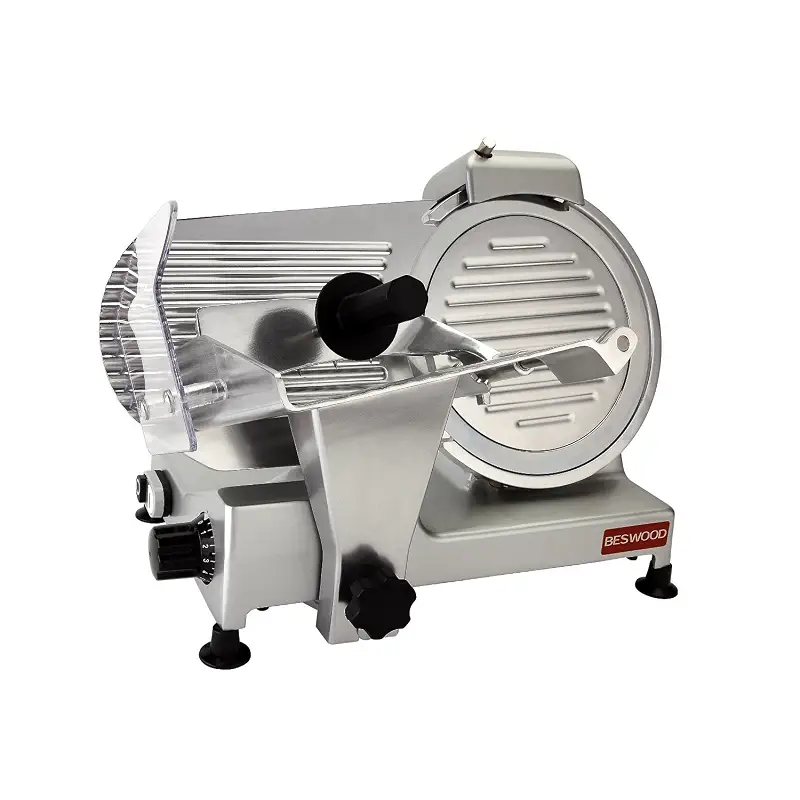
BESWOOD 10" Electric Deli Meat Slicer, Cheese Food Slicer with Premium Chromium-plated Steel Blade, for Commercial and for Home Use 240W, BESWOOD250
4.6(3,358)
Heavy-duty 10-inch slicer with buttery-smooth motion and exceptional blade sharpness.
Ideal for: Regular meat processors and charcuterie enthusiasts with dedicated counter space and monthly slicing demands.
The Beswood represents a step up in motor power, blade diameter, and overall heft. Its 240-watt engine and 10-inch chromium-plated blade cut through thick roasts and semi-frozen meats with noticeably less strain than smaller models. Owners consistently report that the slicing motion feels effortless and the blade holds its edge longer, reducing the need for frequent maintenance. The dial-in thickness system is infinitely adjustable (not click-locked), which lets you dial paper-thin cuts or thicker slices without hunting for a preset notch.
The trade-off is footprint. This slicer is substantially larger and heavier than entry-level options, making it a counter hog if you don't have permanent real estate set aside. Buyers report needing to reduce four-pound roasts into smaller portions because the food tray depth has limits. Where the Borlebbi is storable, the Beswood is a semi-permanent installation. That said, if you make your own lunch meats regularly or process bulk meat for jerky, the smoother operation and larger blade justify the commitment. Cleanup is manageable but not trivial: expect to spend five minutes on a thorough wipe-down. The illuminated on/off switch is a nice detail for safety and visibility.
Continuous thickness dial from 0–12mm for precision cuts
Illuminated safety switch and ETL-listed electrical design
#3 Pick
Best for Adventurous Cooks
Vevor
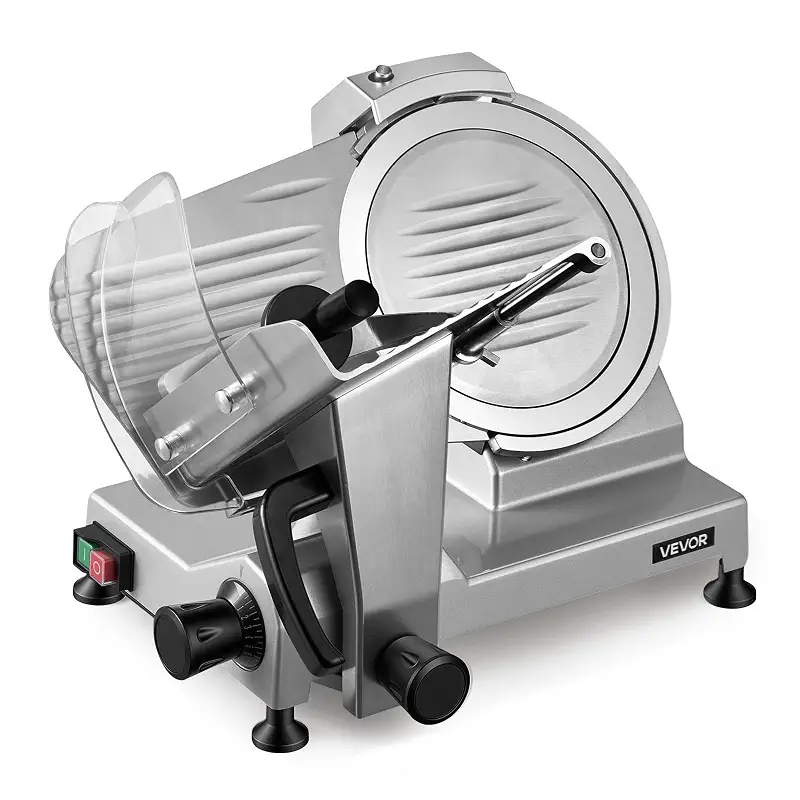
VEVOR Commercial Meat Slicer, 10 inch Electric Food Slicer, 240W Frozen Meat Deli Slicer, Premium Chromium-plated Steel Blade Semi-Auto Meat Slicer For Commercial and Home use | Commercial and Home Use, Premium Chromium-plated Steel Blade Semi-Auto Machine, 300–450 RPM, Adjustable Cutting Thickness
4.4(1,156)
Versatile 10-inch semi-auto slicer that shines with fruits, veggies, and frozen meat alike.
Ideal for: Adventurous home cooks and small-scale food processors who slice beyond deli meats and cheeses.
The Vevor occupies a sweet spot for cooks who want to slice beyond deli meats. Its 240-watt motor and 10-inch carbon-steel blade with built-in sharpening stone handle frozen persimmons, semi-frozen steak, root vegetables, and bread with equal competence. One reviewer, a homesteader with 200 fruit trees, reported slicing Fuyu persimmons at thickness 2.5 and coming away with perfectly dehydrator-ready slices, a use case most meat slicers simply ignore. The metal food pusher with raised spikes grips firmly, and the overall build feels industrial without actual commercial weight.
Against the Cusimax, the Vevor's heavier construction translates to more stability on the counter and less likelihood of wobbling under pressure. However, some owners report a persistent burning smell from the motor during early use, which Vevor's customer service struggles to clarify or address: a concern that hasn't resolved but also hasn't stopped the machines from working. Cleanup is thorough but time-intensive; expect to spend 20 minutes removing and washing the blade. The absence of a child safety lock (a feature some buyers find frustrating on other models) is here viewed as a welcome simplification. If your slicing repertoire includes bread, stone fruit, and soft vegetables alongside meat, this is the most capable generalist in the lineup.
Pros
Handles frozen fruit, vegetables, and semi-frozen meat equally well
Metal food pusher with effective spike grip prevents slipping
Built-in sharpening stone keeps blade ready between uses
Smooth sliding motion and stable counter presence
Cons
Motor develops burning smell that Vevor won't clarify
Blade removal requires Allen wrenches and 20-minute cleanup
Key features
240W motor with 10-inch 45# carbon-steel blade and built-in sharpener
Metal feed pusher with raised spikes for secure grip on varying foods
0–12mm adjustable thickness for ultra-thin to hearty slices
Heavy-duty stainless-steel tray and food-grade materials throughout
#4 Pick
Best for Precision Jerky and Thin Cuts
Cusimax
Meat Slicer,CUSIMAX Electric Deli Meat Slicer with 2 Removable 8.7''Stainless Steel Blades,Removable Food Carriage,1-20mm Adjustable Thickness Food Slicer for Home,Easy for Cut Meat,Cheese,Bread
4.3(5,017)
Twin-blade specialist engineered for ultra-thin, consistent slices and easy adjustment.
Ideal for: Jerky makers and precision slicers with limited counter space who value fine thickness control.
The Cusimax occupies the sweet spot between compactness and capability. Its 200-watt motor drives dual blades (serrated and smooth), and reviewers consistently praise how adjustable thickness from 1–20mm gives fine-grained control over slice profile. Home jerky makers love it because the 1mm minimum setting reveals the semi-frozen meat structure without dragging or compression. The dial turns a bit stiffly (some owners need both hands to adjust it) but once set, it locks firmly in place. Strong suction cups anchor the unit reliably to quartz and laminate counters, a real plus over competitors that tend to creep during heavy work.
Where the Cusimax differs from the Beswood is in scale and intent. The Cusimax is designed for home-frequency use (slicing once or twice weekly), not bulk processing. The food carriage is narrower, so cutting large roasts requires pre-portioning. Owners note that the plastic gripper can slip on larger meats if you push too aggressively: a trade-off for the machine's compact footprint. The serrated blade excels on bread and semi-frozen items; the smooth blade handles deli meats and cheese without tearing. Cleanup is genuinely quick, typically under 10 minutes, thanks to the simple removal mechanism. If precision jerky thickness and ease of storage matter more than bulk capacity, this delivers.
Pros
Dual blades for serrated (frozen/bread) and smooth (meat/cheese) cuts
1–20mm range offers exceptional fine-tuning for jerky
Extra-strong suction cups prevent counter-creep during slicing
Quick 10-minute cleanup with easily removable parts
Plastic food gripper slips on larger, heavier meats
Key features
200W motor with two 8.7-inch interchangeable stainless-steel blades
1–20mm fine-grained thickness adjustment for jerky precision
Industrial-strength suction cups hold firm on various countertops
Removable food carriage, pusher, and blades for thorough cleaning
#5 Pick
Best for Safety-First Home Use
Ostba
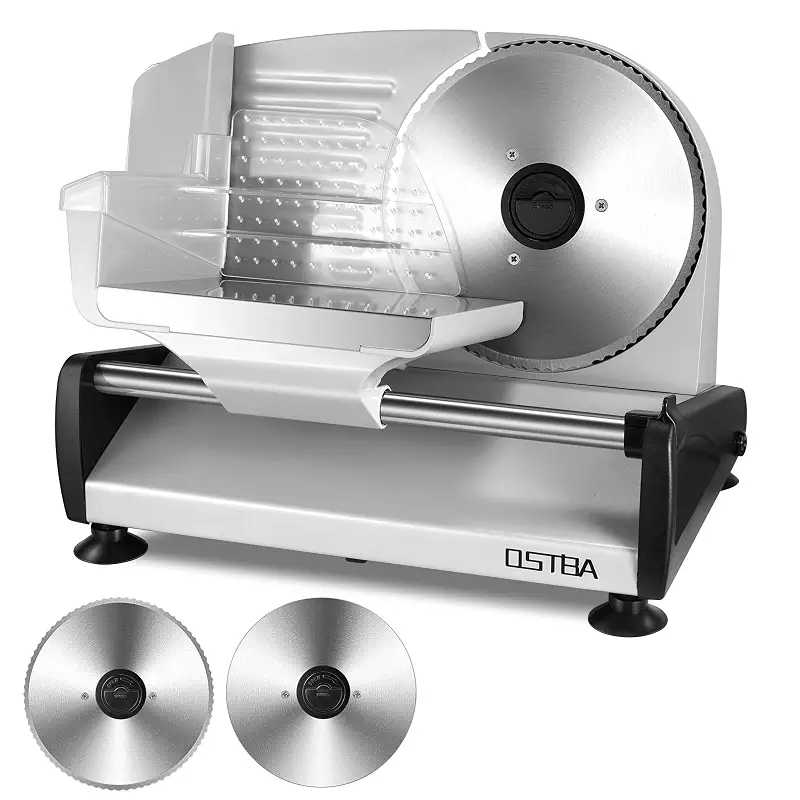
OSTBA Electric Meat Slicer with Two 7.5” Stainless Steel Blades, 200W | Deli Food Slicer with 0-15mm Adjustable Thickness for Home Use, Child Lock Protection, Cuts Meat, Bread and Cheese
4.3(1,612)
Compact dual-blade slicer with straightforward safety locks and reliable quiet operation.
Ideal for: Cautious home cooks and parents wanting a slicer with intuitive safety controls and minimal drama.
The Ostba brings a measured, safety-conscious design to the home-slicer category. Its dual-safety mechanism (requiring you to press both the safety lock and power button simultaneously) appeals to households where distraction or haste are real concerns. The 200-watt motor is adequate for regular home slicing, and the included serrated and smooth blades handle frozen meat, bread, and soft cheeses without fuss. Reviewers report that letting meat chill for a few hours before slicing yields the cleanest results, a simple habit that unlocks the machine's full potential.
Compared to the Cusimax, the Ostba's thickness range (0–15mm) is slightly narrower, which matters if you're pursuing ultra-thin jerky cuts below 1mm. However, the removable ring-guard cover prevents debris buildup better than open-blade designs, a detail that shows up in the longer-term reviews. A few owners report that the food guide is less rigid than preferred, causing slight width variation in thicker slices: a cosmetic issue that doesn't affect safety or taste. At its price point, it's a honest, unfussy machine that prioritizes controlled operation over flashy features. For tasks like butchering raw poultry or preparing ingredients at home, a knife to cut raw chicken remains the traditional choice, but for consistent slices of cooked meats and cheeses, the Ostba excels. If you slice once or twice monthly and want a machine that won't surprise you, this is a steady choice.
Serrated and smooth blades cover frozen and soft foods
Removable ring-guard reduces debris and cross-contamination buildup
Compact size ideal for infrequent, careful home use
Cons
Thickness range limited to 0–15mm, not ideal for ultra-thin cuts
Food guide flexibility causes slight width variation on thicker slices
Key features
200W motor with 7.5-inch serrated and non-serrated stainless-steel blades
Dual safety-lock system requires simultaneous button press activation
0–15mm adjustable thickness for home-use range
Removable ring-guard, food carriage, and pusher for thorough sanitation
How to Choose the Right Meat Slicer
Four trade-offs that actually matter when matching a meat slicer to your kitchen.
Motor Power and Blade Size Matter
Entry-level slicers use 200-watt motors and 7.5-inch blades; premium models jump to 240 watts and 10-inch blades. The jump translates to smoother cutting motion and the ability to handle thicker, denser roasts without bogging down. For home use (slicing once or twice weekly), 200 watts is sufficient. If you plan to process four or more pounds of meat in a single session, the 240-watt jump is worth the investment. Blade diameter affects both tray depth and how much meat you can anchor at once. A 7.5-inch blade fits smaller roasts or requires pre-cutting; a 10-inch blade handles whole roasts but demands more counter space. Understanding meat slicer blade size and motor power helps you avoid undersized machines that frustrate after the first month.
Thickness Control and Slice Precision
Look for machines that dial from 0 to at least 12–15mm, with smooth, progressive adjustment (not click-locked notches). Ultra-thin cuts for jerky or charcuterie demand settings below 1mm; most budget models hit that mark but feel the effort at extremes. Semi-frozen meat slices cleaner and thinner than warm meat, so if fine precision matters, plan to chill your roast before work. Reviewers who make jerky consistently report that 2–3mm thickness produces the most forgiving results for drying and chewing texture.
Cleanability and Removable Parts
All models in this category feature removable blades, food carriages, and pushers. The difference is how many hidden crevices trap juice and meat fiber. Compact designs (7.5-inch blade) are faster to clean (roughly 10 minutes); larger machines (10-inch blade) take 15–20 minutes because meat and moisture get into gaps between the blade assembly and housing. A few owners skip the hassle by slicing in larger batches less frequently. If you slice once weekly, expect cleanup as a 20-minute ritual. The meat slicer cleaning and maintenance routine extends machine life significantly, so choose a model whose disassembly doesn't frustrate you.
Counter Space and Storage Reality
Compact models (7.5-inch blade, 200W) weigh 8–12 pounds and fit most cabinets. Larger models (10-inch blade, 240W) weigh 20–30 pounds and rarely stash away; plan for permanent counter placement or a deep pull-out cabinet. If your kitchen is tight, the smallest reliable option pays for itself in sanity. Many buyers discover too late that the slicer is too large to store, then it lives semi-permanently on the counter gathering dust around the base. Measure your intended spot before ordering.
Safety Features and Operator Experience
Modern home slicers include non-slip feet, blade guards, and food pushers designed to keep your fingers away from the blade. Some add dual-lock systems (safety button plus power button) or child-safety mechanisms. These add friction to startup: a deliberate trade-off. If you live alone or have no young children, the friction may feel unnecessary. If safety is paramount, embrace it. All slicers require a second hand to anchor the machine during use; never assume suction feet alone will hold during a heavy cutting session.
Frequently asked
Quick answers to the questions readers ask most.
Can I slice frozen meat in a home slicer?
Yes, but with limits. Semi-frozen meat (30 minutes in the freezer) slices better and thinner than fully thawed. Fully frozen meat strains 200W motors and can stall the blade. Vevor and Cusimax users report success with semi-frozen jerky preparations. Never force frozen meat through; let it sit 15–30 minutes at room temperature until it yields slightly to thumb pressure.
How often do I need to sharpen the blade?
Home-use blades rarely need external sharpening if you're slicing cooked or thawed meat. Frozen meat, gritty vegetables, and bread dull blades faster. The Vevor includes a built-in sharpening stone; others rely on periodic honing or replacement blades (typically under $30). Most owners go 12–18 months before noticing degradation if they slice 1–2 times weekly.
Why does my slicer produce uneven slices?
Uneven thickness usually stems from inconsistent pressure on the food guide or a guide that flexes under load. Lighter pressure lets the blade do the work; hard pressing deflects the guide and creates a fat side and thin side on the same slice. Allow warm meat to chill first, use steady moderate pressure, and consider practicing on inexpensive deli turkey before investing effort in expensive roasts.
Is cleanup really a nightmare like some reviews claim?
Cleanup depends on what you're slicing. Dry roast beef or cured ham leaves minimal residue and wipes clean in 5–10 minutes. Wet, fatty, or juice-rich meats (fresh roast beef, pork) leave streaks and require more attention, especially in crevices under the blade. Most reviewers report 10–20 minutes with care. A small brush and food-safe disinfectant cloths speed the process; avoid submerging electrical components.
What's the real difference between a $100 and $300 slicer?
Motor power, blade diameter, and materials. A $100 home slicer uses a 200W motor and 7.5-inch blade; a $300 commercial or heavy-duty model uses 240W+ and 10–12 inches. The premium model cuts faster, handles denser meats, and feels more stable. For home use (slicing 1–4 times monthly), the $100 model suffices. For serious home food processing or business prep, the upgrade pays off in speed and durability.