Kitchen & Dining · Small
Best Meat Grinder for Raw Dog Food: Top Picks
Find the best meat grinder for raw dog food. Compare electric grinders with bone-grinding capability, easy cleanup, and powerful motors for homemade pet diets.
Affiliate disclosure: As an Amazon Associate I earn from qualifying purchases.
At a glance
1
Best Budget-Friendly OptionGaniza
2
Best Touchscreen ConvenienceAaobosi
3
Best for Large-Scale Raw FeedingStx International
4
Best Heavy-Duty MotorCheffano
5
Most Versatile Small-Space OptionBumet
Detailed reviews
The Ganiza Food Processors hit a sweet spot for price-conscious owners who want to test raw dog food prep without a major investment. The dual-bowl setup (glass and stainless steel) means you can grind meat in one and keep vegetables separate, eliminating cross-contamination worries. A 450-watt motor and two-speed control handle both meat and produce, and owners consistently report that ground meat emerges in just seconds, with one reviewer noting pork processed in under a couple of minutes.
Where it falls short is sustained use. The overheating protection system kicks in after roughly 30-second bursts, and owners familiar with larger models find themselves taking breaks between batches if they're processing more than five pounds. The plastic lid also rates as flimsy compared to heavier-duty machines. For households grinding once or twice weekly (say, 3–5 pounds at a time) this tool does the job admirably. But if you're planning weekly batches of 15+ pounds for a large dog or multi-dog household, stepping up to a dedicated meat grinder makes more sense.
Compared to the Aaobosi or STX International models, the Ganiza prioritizes simplicity and lower noise over industrial output. Think of it as the right tool for occasional prep, not heavy-duty operation.
Pros
- Fast grinding of soft meat in 6–10 seconds
- Dual bowls prevent meat-to-vegetable cross-contamination
- Affordable entry point for raw feeding experimentation
- Sharp blades and reliable motor for occasional use
Cons
- Overheating protection limits continuous run-time
- Not suitable for large batches or frequent heavy use
Key features (4)
- 450W motor with two-speed control for meat and vegetables
- Glass and stainless-steel bowls included; no plastic contact with food
- Spring-loaded blades with automatic stop for safety
- Compact footprint ideal for tight kitchen counter space
The Aaobosi Electric Meat Grinder brings modern convenience with a smart color touchscreen and preset programs that reduce guesswork. Three-speed settings (Meat, Sausage, Reverse) let you dial in texture without tinkering, and the auto-reverse function prevents jams: a real-world bonus if you're grinding bone-in chicken pieces or denser cuts. Built-in storage for attachments, plus three grinding plates and sausage tubes, means everything stays organized and ready.
The 350-watt rated motor pushes up to 3,000 watts peak and claims 4 pounds per minute output, making it faster than the Ganiza for batch work. Owners praise its versatility for everything from sausage to kibbe to corn grinding, and the stainless-steel construction feels solid. However, the trade-offs are real: it runs loud (one reviewer called it loud enough to "wake the dead" in thin-walled apartments) and it requires hand-washing all parts after use (no dishwasher), with immediate drying to prevent rust or odor absorption.
Compare this to the STX International, which includes a foot pedal and comes with more specialized accessories (kubbe maker, meat claws, burger press) right out of the box. If digital controls and touchscreen appeal to you, the Aaobosi delivers; if you want a larger footprint and more robust cooling, the STX edges ahead for raw feeding at scale.
Pros
- Smart touchscreen with nine preset programs simplifies operation
- Auto-reverse function clears jams without disassembly
- Three grinding plates and versatile sausage attachments included
- Compact design fits standard counter space
Cons
- Significant noise level unsuitable for noise-sensitive spaces
- Requires immediate hand-washing and drying after each use
Key features (4)
- 3,000W max power with 350W rated motor, 4 lbs/min grinding rate
- Three-speed settings: Meat, Sausage, Reverse for jam prevention
- Three grinding plates and sausage tubes with built-in storage compartment
- Stainless-steel body with dishwasher-safe blades; hand-wash other parts
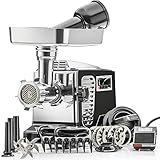
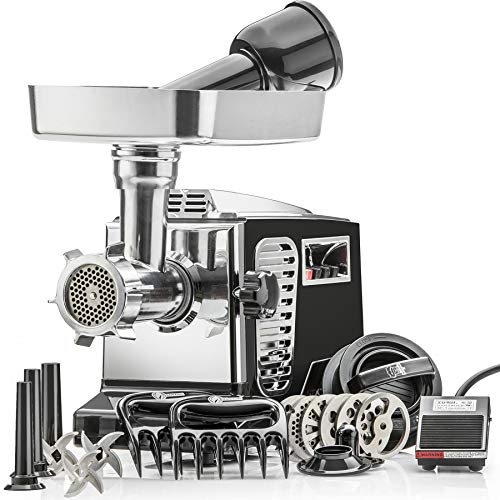
The STX International Turboforce II 4000 is purpose-built for owners committed to large-volume raw dog food prep. As a size-12 machine (not the smaller size-8 found in budget models), it handles 220–260 pounds per hour depending on grinding plate and meat type. The cooling system (a patented quad air induction design) keeps the motor steady during extended runs, crucial when you're processing 20 or 30 pounds in one session. The included foot pedal frees both hands for stuffing sausage or managing meat, an especially smart feature when you're feeding multiple dogs or doing weekly batch prep.
The accessory package is comprehensive: six grinding plates (4mm to 12mm), three stainless-steel cutting blades, three sausage tubes, a kubbe maker, meat claws, burger press, and palm pusher. Most importantly, the manual explicitly states it can grind soft bones (chicken, rabbit, quail, duck) but explicitly warns against turkey, lamb, or larger bones: a safety clarity that protects both you and the machine.
Owners consistently report grinding whole chickens cut into pieces and 40-pound monthly batches for multiple dogs without motor fatigue. Setup and learning curve are steeper than compact models, and noise is notable (though it quiets after 5–10 hours of use, per the manual). The STX costs more than the Ganiza but delivers the capacity and durability that large-scale raw feeders actually need.
Pros
- Size-12 capacity with 220–260 lbs/hour throughput for large batches
- Quad air cooling system prevents overheating during extended use
- Foot pedal control frees hands for safer operation and stuffing
- Soft-bone grinding capability for chicken, rabbit, quail, and duck
Cons
- Significant noise during initial use; quiets after break-in period
- Higher price point and larger footprint than compact models
Key features (4)
- 2,000-watt motor with six grinding plates (4–12mm holes)
- Foot pedal control for hands-free grinding and sausage stuffing
- Soft-bone grinding for poultry (chicken, duck, rabbit, quail)
- Complete accessory kit: sausage tubes, kubbe maker, meat claws, burger press
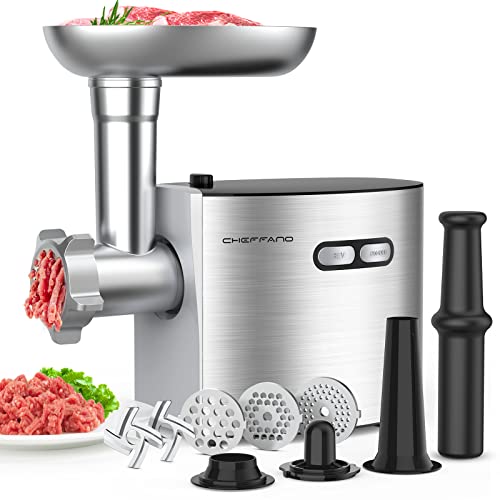
The Cheffano Meat Grinder brings serious motor power (up to 2,800 watts peak with a 350-watt rated copper motor) and advertises approximately 3 pounds of meat per minute. For raw feeders grinding boneless beef, pork, or chicken, the pure speed is appealing, and owners report it churns through 28 pounds of meat in a single session (though the motor ran very hot). The three grinding plates (2mm, 5mm, 7mm), two blades, and kubbe attachment cover most grinding needs, and the 3-layer auger design aims to reduce gray streaks in finished ground meat by keeping temperatures lower during processing.
Where the Cheffano stumbles is heat management and sausage-stuffing design. Multiple owners note the motor becomes very hot after extended use (no patented cooling system like the STX), and the ETL safety certification means it has built-in overheating cutoffs: you'll need breaks. More critically, reviewers report the sausage-stuffing chute is too small, air gets trapped in casings, the platform pops off during sausage feeding, and there's only one stuffing tube size (too narrow for 15mm casings). If your focus is purely grinding meat for raw diets (not making sausage) these drawbacks matter less. But compared to the STX International, the Cheffano lacks the cooling robustness and stuffing refinement needed for serious sausage work.
For households that grind 10–15 pounds at a time and are comfortable taking motor-cool breaks, it's capable. For larger or more frequent sessions, the thermal limitations become frustrating.
Pros
- 2,800W peak power with 350W rated motor delivers fast grinding
- 3-layer auger aims to preserve meat nutrition and texture
- Three grinding plates and kubbe attachment for versatility
- Reasonably priced for motor power and feature set
Cons
- Motor overheats after extended use, requiring cool-down breaks
- Sausage-stuffing design flawed: small chute traps air, platform pops off
Key features (4)
- 2,800W peak, 350W rated copper motor; approximately 3 lbs/min output
- Three grinding plates (2mm, 5mm, 7mm) and two stainless-steel blades
- 3-layer auger system reduces meat-fiber damage during grinding
- ETL safety certified with overheating protection for home use
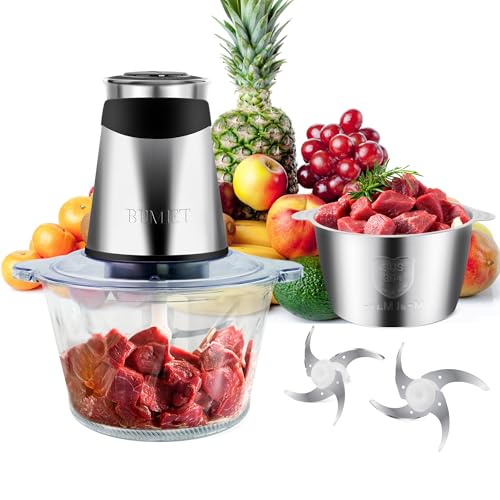
The Bumet Meat Grinder 2×8-Cup Bowls is the lightest-touch option here, designed for individuals and couples doing daily kitchen work or occasional pet-food prep. The 500-watt motor processes soft ingredients in 6–10 seconds and handles meat grinding competently, with two-speed settings (soft/small and hard/meat ingredients). The dual 8-cup bowls (one thick glass, one 304 stainless steel) plus two blade sets provide the same cross-contamination prevention as the Ganiza but in a even more compact package. One reviewer praised it for chopping onions to the desired texture in just 3 seconds.
The trade-off is capacity and thermal tolerance. This is a light-duty processor, not a dedicated meat grinder. One owner stress-tested it making emulsion-type sausage (requiring ultra-fine texture) and reported the motor overheated after 370 grams of meat processing. The unit restarted after a couple of minutes, but the practical lesson is clear: batch-by-batch grinding works here, not large-volume sessions. For raw feeding, it's best suited to grinding one or two chicken breasts at a time for immediate use or short-term storage, not weekly 10-pound batches.
Compared to the STX International or Aaobosi, the Bumet sacrifices power and volume for simplicity and noise-level. If you're grinding small amounts multiple times per week rather than processing bulk meat once weekly, this makes sense.
Pros
- Fast 500W motor processes soft meat and produce in seconds
- Dual bowls and blade sets prevent meat-to-vegetable cross-contact
- Compact design and minimal noise ideal for apartments or tight kitchens
- Affordable and easy to disassemble for thorough cleaning
Cons
- Limited capacity; overheats with batches over 300–370 grams
- Not suitable for large-batch or frequent grinding sessions
Key features (4)
- 500W motor with two-speed settings for soft and hard ingredients
- Glass and 304 stainless-steel bowls with two blade sets included
- Pure copper motor rated for 3x longer service life than standard motors
- Patented auto-stop and overheating protection for family safety
How to Choose a Meat Grinder for Raw Dog Food
Motor Power and Cooling Matter More Than You Think
Peak wattage (2,800W or 3,000W) grabs attention in spec sheets, but rated continuous power is what keeps the motor running. A 350-watt rated motor that overheats after 30 seconds is less useful than a robust 2,000-watt grinder with patented cooling. If you're grinding weekly batches of 10+ pounds, look for a model with a cooling system (like the STX's quad air induction) or realistic run-time limits stated in reviews. Freezing the bowls beforehand (as one reviewer discovered) can stretch performance on smaller models, but it's a workaround, not a solution.
Soft-Bone Grinding Capability Makes Raw Feeding Easier
The ability to grind soft bones (chicken, rabbit, duck, quail) is a genuine convenience and nutritional plus, but not all grinders handle it safely. Only the STX International explicitly documents bone-grinding capability with a disclaimer about which bones are safe. Other models don't mention bones at all, leaving you guessing whether to grind meat and bone separately. If you plan to include whole poultry in your dog's diet, verify the grinder's bone-grinding capability differences before committing, since this affects both speed and equipment longevity.
Size and Footprint Map to Feeding Scale
Compact models (Ganiza, Bumet, Aaobosi) suit apartments and tight kitchens but max out around 5–15 pounds per session. Size-12 grinders like the STX are bulkier but chew through 20+ pounds without strain or cool-down breaks. Calculate your weekly grinding volume: a single dog on raw often needs 3–5 pounds per week, while a multi-dog household might prep 20–40 pounds. Choose your footprint (and price) to match that reality, not the counter space you hope to free up later.
Easy Cleanup Matters for Health and Motivation
Raw meat requires prompt, thorough cleaning to prevent bacterial cross-contamination. Grinders with dishwasher-safe parts simplify the routine; those requiring hand-wash-only in cold water and immediate drying add friction. The Ganiza and Bumet allow glass and steel bowls into the dishwasher, speeding cleanup. The Aaobosi requires hand-wash and immediate drying, a small but real burden if you're grinding twice weekly. Consider how to safely grind raw meat for homemade dog food, and factor cleanup friction into your choice: a grinder you'll actually use beats a powerful one gathering dust.
Noise Level Affects Household Harmony
Compact models tend toward lower noise; dedicated meat grinders can be loud. The Aaobosi was described as "wake the dead" loud in apartments, while the STX quiets down after 5–10 hours of use. If you live in shared housing or prefer a quieter kitchen, prioritize reviews mentioning noise levels. Some owners mitigate by grinding early morning or running cycles during less noise-sensitive times, but recognizing the trade-off upfront prevents buyer regret.
Our picks at a glance
1
Best Budget-Friendly OptionGaniza
2
Best Touchscreen ConvenienceAaobosi
3
Best for Large-Scale Raw FeedingStx International
4
Best Heavy-Duty MotorCheffano
5
Most Versatile Small-Space OptionBumet
Frequently asked
Can I grind frozen meat, or do I need to thaw it first?
Semi-frozen meat (just removed from the freezer, still firm but not rock-solid) is ideal for grinding: it holds together better and the cold slows motor heat buildup. Fully thawed meat can turn to mush if overprocessed. One raw-feeding reviewer froze the processor bowls an hour beforehand to extend motor tolerance. Fully frozen meat may jam small-chute grinders or strain smaller motors; thaw it in the refrigerator overnight first.
How often should I expect to replace blades and plates?
Stainless-steel blades and plates last longer than aluminum or plastic but will dull with heavy use. Owners grinding 10+ pounds weekly report blades remaining sharp for 6–12 months with proper hand-washing and immediate drying. Many manufacturers sell replacement blade sets affordably. The Ganiza includes two blade sets in the box; the STX includes three blades and five plates, giving you spares from day one.
What's the best way to prevent cross-contamination between raw meat and vegetables?
Use separate bowls for meat and produce. The Ganiza, Aaobosi, and Bumet all include dual bowls specifically for this reason (one for raw meat, one for vegetables) along with separate blade sets. Process meat first (if you do it at all), then switch bowls and blades for vegetables. Never share a bowl between raw meat and produce, and hand-wash thoroughly between uses to eliminate odor and bacterial transfer.
Are these grinders safe for grinding chicken bones for raw dog food?
Only the STX International explicitly documents safe bone grinding for chicken, duck, rabbit, and quail: soft bones that fit the machine's 2-inch diameter chute. Larger bones (turkey, lamb, goat) void the warranty. Other models don't mention bone capability in their documentation, so you'd be grinding without clarity on safety limits. If bone grinding is essential to your raw-feeding plan, the STX is the clearest choice; otherwise, consider grinding boneless meat and sourcing ground bone separately.
How long can I run these grinders continuously, or do I need breaks?
Compact models (Ganiza, Bumet, Aaobosi) overheat after 30–60 seconds of continuous use and require cool-down breaks between batches. The STX is designed for extended use (one owner ran it for 3 hours straight) thanks to its cooling system and larger motor. The Cheffano sits in the middle: fast but prone to overheating. Plan your grinding accordingly: compact models suit 3–5 pound batches with breaks; the STX handles 20+ pound sessions in one push.