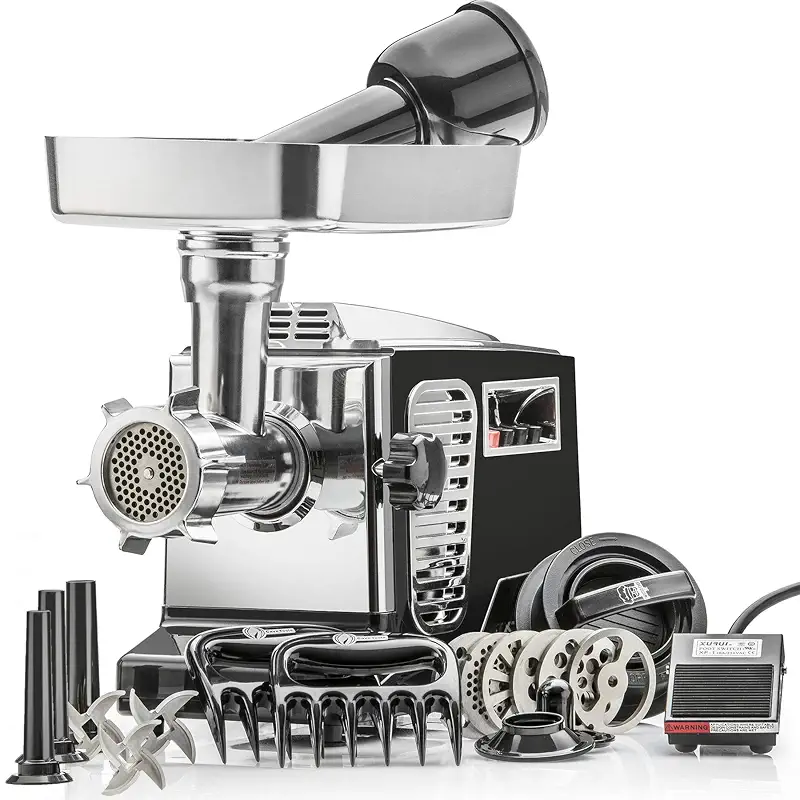
Ideal for: Home cooks and pet food makers processing 30+ pounds of chicken monthly.
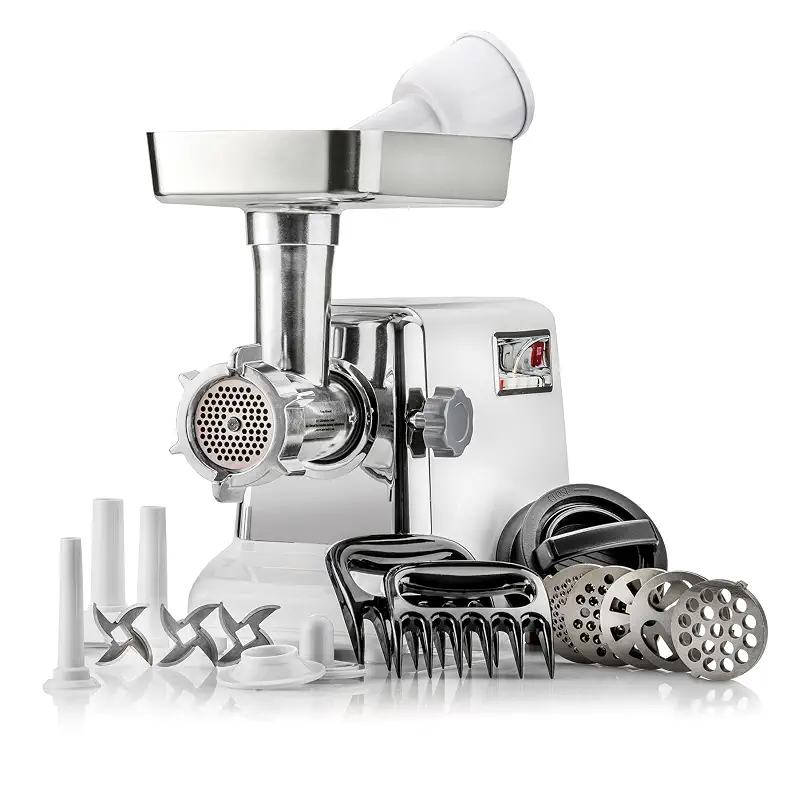
The Stx International Turboforce II 4000 brings serious credentials to the table: 2000 watts of locked motor power, a size #12 grinding head, and explicit manufacturer approval for chicken, duck, and rabbit bones. Owners grinding 40 pounds of chicken backs monthly report consistent performance over years of use, which matters more than any spec sheet.
What makes this model stand out is the thoughtful accessory package. You get six grinding plates (rather than the standard three), three stainless-steel blades, a foot pedal for hands-free operation, and a kubbe maker. That last detail sounds minor until you're stuffing sausage with both hands free and wishing every grinder worked that way. The high-capacity meat tray holds over three pounds, cutting prep time when you're processing larger batches.
The tradeoff is noise and learning curve. Early users report the machine runs loud at first, though it does settle down after 5 to 10 hours of use. Assembly matters; if you install the cutting blade backward, you'll get mush instead of proper grinds. Owners universally recommend reading the manual before first use and keeping meat semi-frozen to avoid pushing overly warm or wet meat through the grinding head. Compared to the Stx International Magnum, this model trades slightly higher wattage for the added accessories and foot-pedal control.
Pros
2000W motor handles chicken bones consistently
Foot pedal enables hands-free grinding and stuffing
Six grinding plates and three spare blades included
Proven durability over multiple years of regular use
Cons
Initial noise level; quiets after 10+ hours of operation
Ideal for: Small-business operators and high-volume home processors who need industrial-grade reliability.
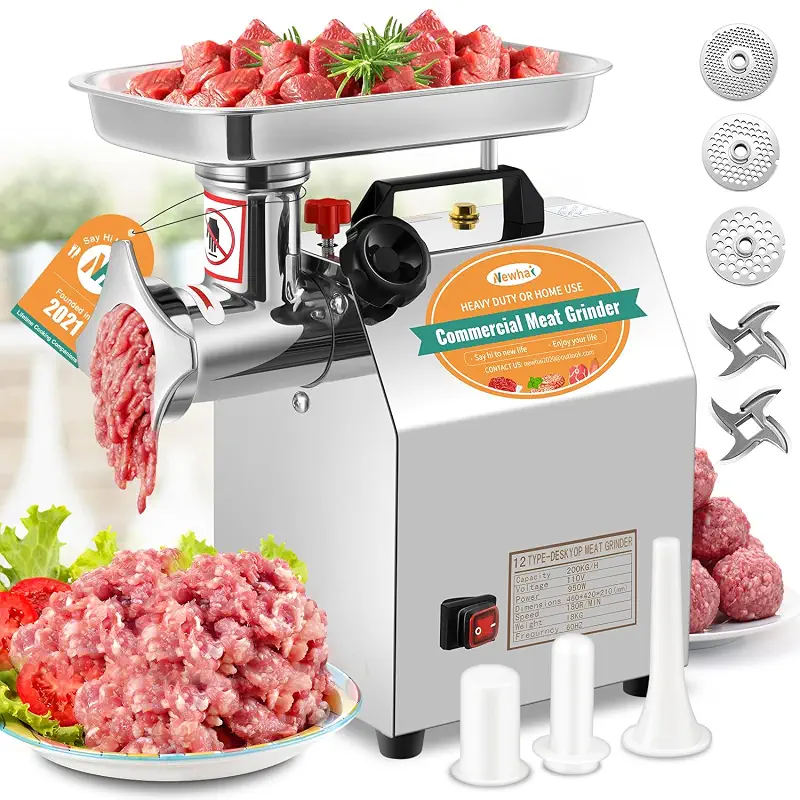
The Newhai 1.3HP Commercial Meat Grinder Machine brings the engineering of restaurant equipment to a kitchen footprint. It's built entirely from food-grade stainless steel, not plastic housing, which signals a different class of durability. At 46 pounds, it's heavier than consumer models, but that weight translates to stability and heat dissipation.
Owners report grinding 60+ pounds of chicken necks and mixed proteins in single sessions without the motor breaking stride. The 950W copper motor with special thread design delivers up to 370 pounds per hour throughput, and the low-speed auger rotation preserves meat texture while avoiding the heat buildup that can turn ground meat gray or discolored. The grinder ships with 6mm, 8mm, and 3mm plates, giving you finer control than many competitors offer. When you're done grinding and ready to serve, best meat claws work beautifully for handling and presenting larger pieces of meat that didn't go through the grinder.
The downside surfaces when you push it hard. One user found turkey necks challenging: larger whole bones will jam without advance cutting. And it runs loud, though that's typical for machines with this output level. Where this grinder differs from the Stx Turboforce II is in the design philosophy: the Newhai prioritizes commercial-duty reliability and compact stainless construction, while the STX adds more accessories and hands-free features. If durability and the ability to process high volumes matters more than convenience features, the Newhai is the choice.
Pros
Full stainless-steel construction resists rust and corrosion
950W motor with excellent heat dissipation and airflow design
Low-speed auger preserves meat texture and nutrients
Three grinding plate sizes (3mm, 6mm, 8mm) for texture control
Cons
Larger whole bones require pre-cutting to avoid jamming
No reverse feature; disassembly needed to clear stubborn blockages
Key features
950W copper motor with special thread design for 30% efficiency boost
Full stainless-steel housing and components for commercial durability
Large feed throat accepts bigger pieces; 11 lbs per minute capacity
Three grinding plates (3mm, 6mm, 8mm) plus sausage stuffer tube included
Low-speed auger rotation prevents heat damage and texture degradation
#3 Pick
Best Mid-Range Electric Grinder
Stx International
STX International Magnum 1800W Electric Meat Grinder | Grinds Soft Bones | High-Capacity Meat Tray | 6 Grinding Plates | 3 Stainless Steel Blades | Sausage Stuffer | Kubbe Maker & More Included
4.3(1,208)
Solid 1800W performance in a compact form, handles soft bones well, backed by excellent customer service.
Ideal for: Home pet-food makers and home cooks grinding soft bones 2-3 times weekly.
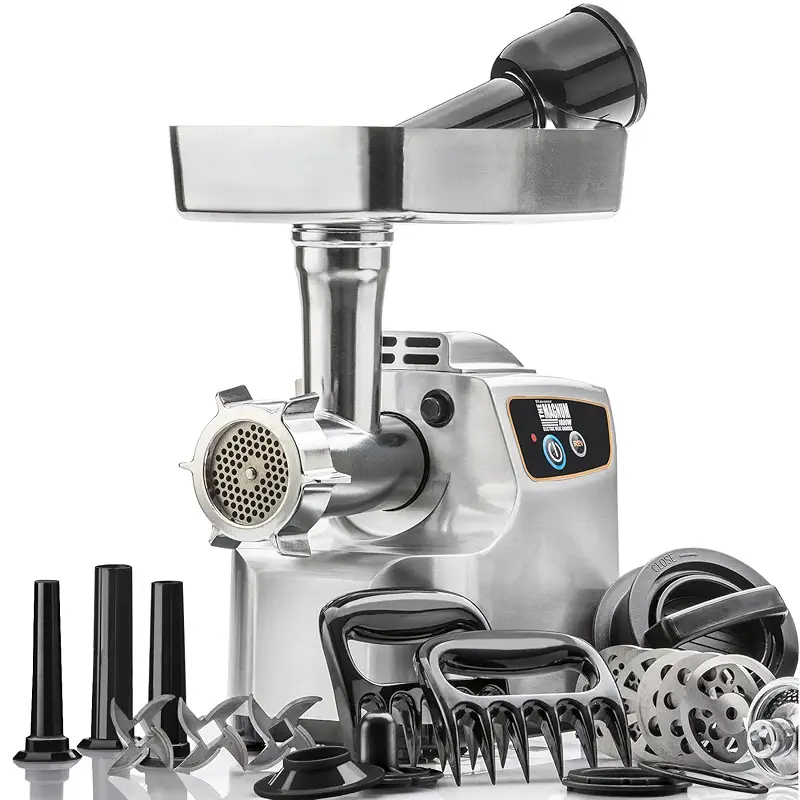
The Stx International Magnum sits between the entry-level and high-end tiers, offering 1800 watts of locked power and the same size #12 grinding head as its more expensive sibling. For most home cooks grinding chicken bones two to three times weekly, this power level is sufficient and predictable.
Owners who prepare raw pet food report reliable results with semi-frozen chicken bones, though the early versions had a design quirk: moisture collecting in the back chamber could cause a gray-black discoloration in the finished grind. STX addressed this by refining the washer stack, now using two metal and one vinyl washer to redirect meat juice flow. Customer service on this machine is notably responsive: owners who contacted the company about the washer issue received replacements promptly.
Where this grinder shows weakness is in sustained high-volume use. Extended runs, like three hours of continuous grinding, can cause external heat buildup, though the machine doesn't actually stall. It's also not the choice if bones are your primary focus; the manufacturer explicitly states it handles soft bones like chicken only, not turkey or larger game bones. Compared to the Newhai commercial model, the Magnum trades industrial durability for lighter weight and more home-oriented accessories, making it better suited to home kitchens with space constraints.
Pros
1800W motor with proven long-term reliability in home kitchens
Compact and lightweight relative to commercial-grade competitors
Excellent responsive customer service and parts availability
Size #12 head with high-capacity meat tray holds 3+ pounds
Cons
External heat buildup during sustained high-volume grinding sessions
Early design flaw with moisture drainage now corrected but worth knowing
Key features
1800W locked motor with patented cowl air-cooling system
Size #12 aluminum grinding head with 2.5-inch output diameter
Five grinding plates, three stainless blades, and kubbe maker included
High-capacity 3-pound meat tray with advanced variable intake technology
Three sausage tubes (1/2 inch, 5/8 inch, 3/4 inch) for casing stuffing
#4 Pick
Best for High-Volume Meat Processing
Stx International
STX International Turboforce 3000 Series 5-in-1 Electric Meat Grinder | 3000W Max | 3-Speed | Size #12 | 5 Grinding Plates | 3 Stainless Steel Blades | Sausage Stuffer | Kubbe Maker & More Included
4.5(4,729)
Powerful 3000W motor with dual speeds, premium grinding plates, and abundant accessories for serious home production.
Ideal for: Home cooks and small producers grinding large batches of boneless meat regularly.
The Stx International Turboforce 3000 Series claims headline wattage of 3000W, though real-world draw under load runs 800 to 1200W, still plenty to move meat efficiently through the grinding head. Where this model excels is throughput: 180 to 240 pounds per hour with properly prepped meat, which matters if you're preparing a month's worth of ground meat in one session.
The dual-speed control gives you precision that single-speed grinders lack. Low speed is gentler on texture and reduces heat; high speed powers through larger batches. The included meat hopper is oversized at 9.75 by 7.25 inches and holds three pounds, minimizing refill stops during production runs. You also get five grinding plates, three stainless blades, and a full sausage-stuffing kit, so there's minimal need to buy extras. For shredding whole poultry before grinding, a best chicken shredder can speed up prep work significantly.
The critical limitation: this grinder explicitly does not grind bones, tendons, vegetables, nuts, or fruits. It's a meat-only machine by design. If bone grinding is your primary goal, this won't work for you. However, if you're processing large quantities of boneless meat (like grinding your own hamburger, poultry, or pork for sausage) the Turboforce 3000's speed and consistency outpace most home alternatives. Compared to the Turboforce II, this model trades bone-grinding capability for raw volume and dual-speed control.
Pros
High throughput (180-240 lbs per hour) for large-batch production
Dual-speed control optimizes for texture or volume depending on use
Five grinding plates and three spare blades reduce accessory costs
Oversized meat hopper minimizes refilling during long sessions
Cons
Explicitly not designed for bone grinding; cannot handle soft bones
Motor wattage claims (3000W) are maximum, not actual continuous draw
Key features
3000W maximum motor (800-1200W actual load) with dual-speed control
Size #12 grinding head with advanced variable intake technology
Five grinding plates and sausage stuffing plate for texture variety
Extra-large meat hopper (9.75 x 7.25 x 2 inches) holds 3+ pounds
Includes three bonus stainless-steel blades for extended use between sharpening
#5 Pick
Best Heavy-Duty Stainless-Steel Value
Horus
#12 Electric Meat Grinder Heavy Duty 1.3 HP Full Stainless Steel Commercial | Grind Chicken Bones and Frozen Meat, for Gamekeeper & Pet Food, With Sausage Stuffer Tube, Large, Industrial, 950W, Home Use
3.7(5)
Commercial-spec stainless build with 950W motor, excellent for bone grinding at an entry-level investment.
Ideal for: Budget-conscious buyers seeking stainless-steel construction and bone-grinding capacity.
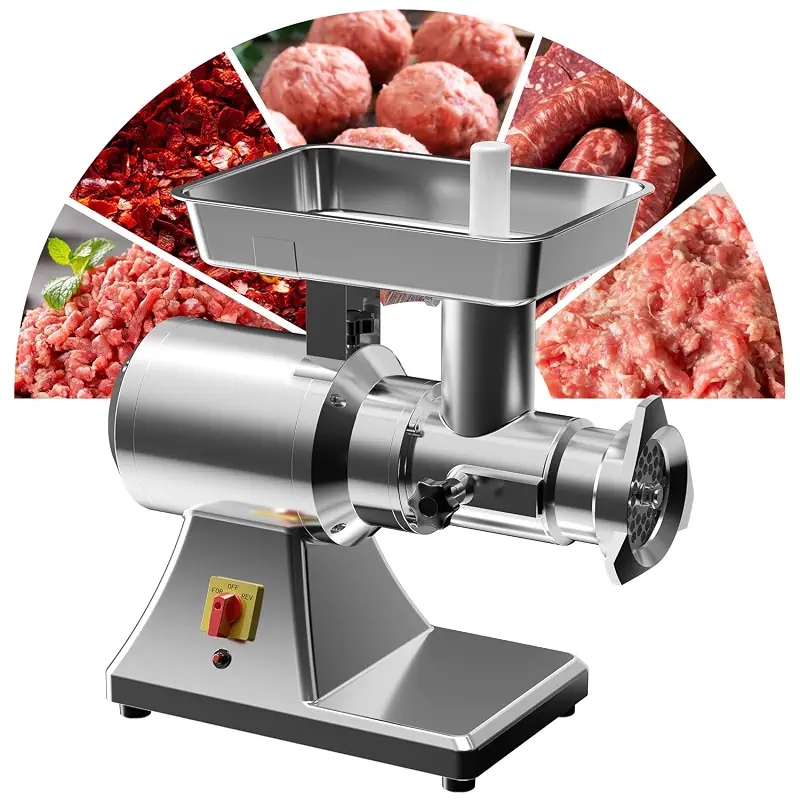
The Horus #12 Electric Meat Grinder is newer to market, reflected in its small review count, but early adopters report impressive results. It's built entirely from stainless steel: tray, housing, blades, and components, which immediately separates it from plastic-bodied competitors. The 950W motor and low-speed auger design target the same outcome as premium models, grinding bones and tough cuts without heat damage or texture loss.
Owners processing chicken bones for raw diets confirm smooth operation with minimal resistance, and the machine handles fresh, frozen, and bone-in proteins without flinching. The large tray at 13 by 9.8 inches and 2.3-inch feed input accommodate bigger meat pieces than compact grinders, and the 11 pounds per minute throughput is respectable for a machine at this investment level.
The main constraint is evidence depth. With only five reviews on file, there's limited long-term durability data compared to models with thousands of owner reports. You're betting on the engineering and materials rather than years of proven track record. The Horus also ships with fewer accessories than the Stx models (two grinding plates, one cross blade, and a plastic stuffing tube) so you may need to buy specialty plates later if you want fine-grinding options. But if you want commercial-grade stainless steel and bone-grinding capability without paying premium-brand markup, this is worth serious consideration.
Pros
Entirely stainless-steel construction for durability and rust resistance
950W motor with low-speed auger preserves meat texture effectively
Large feed tray and 2.3-inch input handle bigger meat pieces
11 lbs per minute throughput suitable for home batch processing
Cons
Limited long-term durability data; newer to market with fewer owner reviews
950W pure motor with low-speed screw extrusion for texture preservation
Complete stainless-steel housing and detachable components for durability
Large stainless-steel tray (13 x 9.8 x 2.7 inches) minimizes refilling
Two grinding plates (6mm, 8mm) plus cross blade and food pusher included
Larger heat dissipation holes prevent overheating during extended use
How to Choose a Meat Grinder for Chicken Bones
Four trade-offs that actually matter when matching a meat grinder for chicken bones to your kitchen.
Motor Power Matters More Than the Spec Sheet
The motor power for bone grinding should sit between 950W and 2000W for reliable home use. Many grinders claim wattage that exceeds actual draw under load, so focus on real-world owner reports rather than maximum ratings. The locked or continuous wattage is what you'll actually use; that's the number to compare across brands. Higher wattage gives you faster throughput and easier handling of frozen or dense meat, but even a 950W motor can grind chicken bones consistently if the blade and auger design work together efficiently. The machine's ability to stay cool (through air-induction systems or ventilation design) matters as much as raw power.
Bone Type Determines Which Grinder Works
Soft bones like chicken, duck, and rabbit are manageable in mid-range grinders. Turkey, lamb, and goat bones require commercial-grade machines or explicit manufacturer approval. Always keep meat semi-frozen before grinding; soft, warm bone becomes paste and can clog or jam the auger. Many owners preparing pet food and raw diets prep meat in batches, freezing it, then thawing just before grinding to find the sweet spot between workable texture and manageable resistance. The blade maintenance after bone grinding is a real responsibility: bone dust can embed in the cutting edge, so hand-washing and proper drying with light oiling become part of your routine.
Stainless Steel vs. Aluminum Construction
Stainless-steel machines (grinding head, tray, and blades) resist corrosion and meat-acid staining, while aluminum parts are lighter and often cheaper. If you're grinding frequently and want low-maintenance cleanup, full stainless construction is worth the investment. Aluminum can discolor or etch over time, especially when bone dust or acidic meats interact with it: purely cosmetic but worth knowing. Stainless also handles temperature swings better; if you grind hot meat into a cold tray, aluminum can warp slightly. For casual use, aluminum works fine; for weekly or more-frequent processing, the stainless option pays dividends in longevity and appearance.
Accessories and Throughput Trade-offs
Grinders marketed for home use include more accessories (extra blades, multiple grinding plates, kubbe makers, sausage tubes) while commercial models strip down to essentials. If you plan to grind bones weekly and also stuff sausage, the bundled accessories save money. If you only grind meat quarterly, fewer accessories are fine; you can buy specialty plates later. Throughput (pounds per hour) matters most if you're processing 30+ pounds in one session; if you grind smaller batches, speed is less critical. A foot pedal is a luxury feature that genuinely helps when stuffing sausage but isn't necessary for bone grinding alone.
Frequently asked
Quick answers to the questions readers ask most.
Can I grind chicken bones in any meat grinder?
No. Only grinders with explicit manufacturer approval for soft bones and sufficient motor power (950W minimum) should handle chicken bones. Grinders designed only for boneless meat can jam, overheat, or break. Check the product description for bone-grinding capability; if it doesn't mention bones, don't attempt it. The Turboforce 3000, for example, is explicitly marketed as bone-free only, while the Turboforce II and Newhai machines are approved for soft bones.
What's the ideal meat temperature before grinding chicken bones?
Semi-frozen is best. Prep meat the day before, cut into chunks, and freeze for 4 to 12 hours until it's stiff but not rock-hard. Thaw it for 30 minutes at room temperature before grinding. This texture gives the auger and blades optimal grip without letting the meat warm up enough to slip past the cutting edges or turn mushy. Warm or fully thawed meat produces poor texture; fully frozen meat can stall the motor. Most owners report the sweet spot is between 32 and 40 degrees Fahrenheit.
How do I clean a grinder after grinding bones?
Never use the dishwasher; hand-wash all parts immediately in hot soapy water. Use a soft brush to clean the blades, plates, and auger, paying special attention to crevices where bone dust lodges. Dry everything thoroughly with a clean towel, including thread areas and tight spaces. Lightly coat metal parts (except the cutting edges) with food-safe oil like coconut oil before storing. This prevents rust and keeps seals from drying out. Discolor on aluminum plates is normal and doesn't affect performance, though stainless stays visually cleaner.
Why does my ground meat come out discolored or grayish after grinding?
Gray or black discoloration usually means meat juice or moisture is reaching the back chamber and reacting with exposed metal. This is common in early production runs and in machines where washers aren't positioned correctly. Solutions: elevate the back of the grinder slightly so juices drain forward, use drier meat with less visible liquid, and ensure the washer stack is seated properly. Contact the manufacturer if the issue persists; replacement washers often solve it. This is purely aesthetic and doesn't mean the meat is unsafe.
Do I need a commercial grinder for home bone grinding, or will a home model work?
A quality home model, like the Stx Turboforce II or Newhai, handles regular bone grinding just fine if you follow best practices: semi-frozen meat, approved bone types only, and proper maintenance. Commercial machines offer more durability for high-volume use (daily or near-daily) and less fussing with design quirks. For once-a-week or once-monthly grinding, a home model saves space and cost. The real difference surfaces in sustained use; commercial machines stay cooler and handle larger batches without fatigue.