Compare top manual meat slicers for frozen beef, pork, and jerky. Find the right slicer for hot pot, BBQ, and sandwich prep with expert recommendations.
Ideal for: Home cooks buying meat in bulk for hot pot, jerky, and Korean dishes; intermediate to experienced home slicers.
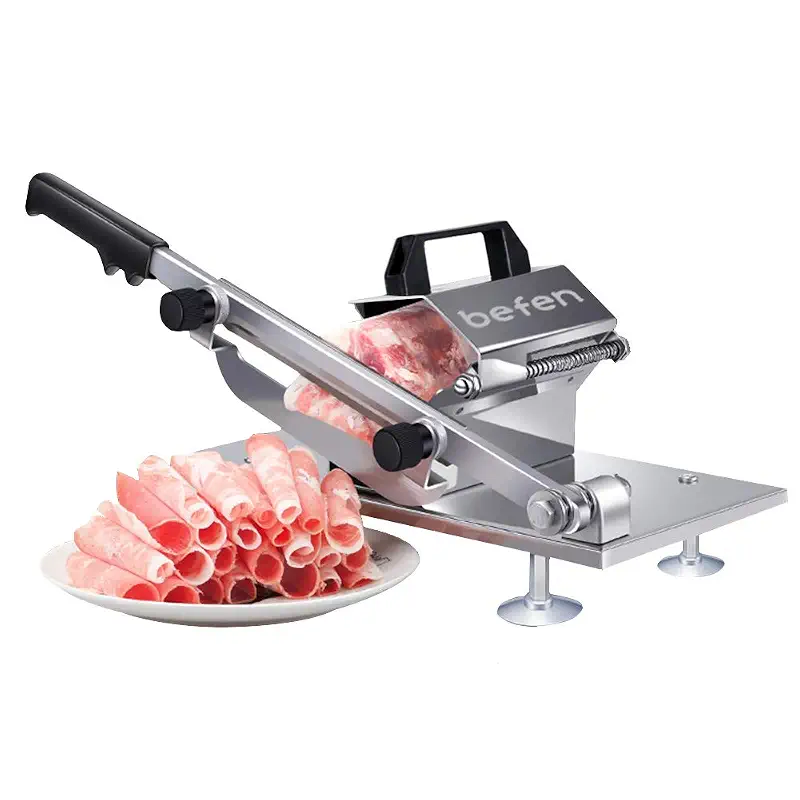
The befen slicer has earned its reputation through sheer consistency. The 1.5mm stainless steel body feels industrial without the industrial price tag, and the blade holds its edge longer than budget competitors. What sets it apart is tolerance for learning: even if your freezing method isn't perfect or you adjust the thickness mid-session, the slicer responds predictably. Most owners report paper-thin slices for Korean beef hot pot and medium cuts for jerky with equal ease. The included meat holder and spare blade add real value without inflating the cost.
Cleanup is straightforward if you're disciplined about reaching between the blade and handle before meat dries. Several owners flagged that the suction cups demand a truly flat surface: tile grout or textured countertops can undermine stability, which is a genuine safety concern if you're exerting real pressure. The feeder tray does require a break-in period and some users find the push-pull motion less fluid than they'd like, though this typically improves with practice and light oiling.
Compared to the Arinoo model, the befen excels when you're slicing irregular chunks or thicker cuts; the Arinoo's more compact design trades some versatility for easier storage. If you're committed to hot pot meals or jerky prep and willing to commit ten minutes to setup and cleanup, this is the slicer that repays that effort.
Pros
Thick stainless steel body resists warping and bending
Feeder tray motion can feel sticky until broken in
Key features
1.5mm thick stainless steel body, twice as durable as standard models
Adjustable thickness from 0.2mm to 20mm for any slicing need
Includes spare blade, meat holder, and ten mesh storage bags
Sharp ergonomic feeder tray with safety guard prevents accidental contact
#2 Pick
Best for Compact Kitchens
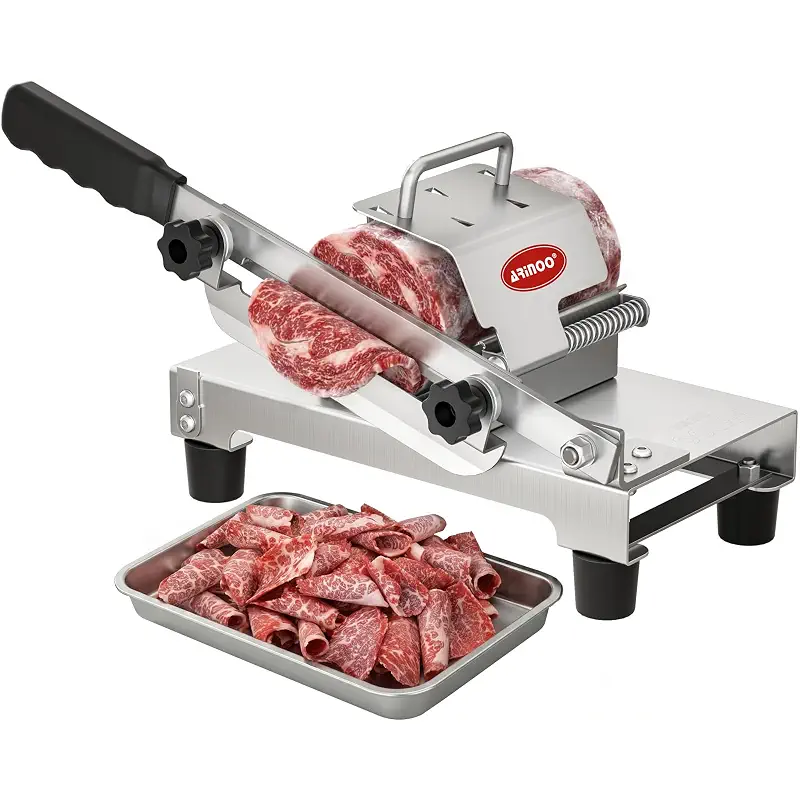
Arinoo
Manual Frozen Meat Slicer, Stainless Steel Meat Cutter for Home Use | Manual Slicing Machine with Adjustable Thickness for Beef, Pork, Lamb, Bacon BBQ,Salad,and Sandwich Slicing Easy to Use
4.4(22)
Smaller footprint with reinforced construction; superior stability on varied countertops without sacrificing cutting power.
Ideal for: Small kitchens, apartments, and home cooks who slice consistently shaped meats for hot pot or deli purposes.
The Arinoo slicer compresses everything that works into a tighter package. The M-shaped support frame with high-elasticity springs makes this model noticeably more stable on uneven surfaces than most competitors, which matters if your countertops are textured or your counter height varies. Reviewers consistently praise the rubber feet for grip without relying entirely on suction cups: a practical advantage that the befen slicer doesn't emphasize. For apartment dwellers or anyone with limited counter space, this design wins.
The 420-grade blade is sharp and the thickness range (0.5mm to 25mm) handles everything from sandwich paper-thin to jerky thick. Owners report that frozen chuck roast and summer sausage slice evenly, and the adjustable knob responds smoothly to your thickness preference. The detachable blade and machine-washable parts mean cleanup is genuinely faster than it is for comparable models. The inclusion of a sharpening stone suggests Arinoo expects this tool to see years of use, which aligns with the feedback.
The trade-off: this slicer performs best on roll-shaped or cylindrical meats (sausage, bacon, rolled pork belly) and is less forgiving if you're slicing irregular chunks. Where the befen accommodates improvisation, the Arinoo rewards precision in meat prep. If you're slicing the same cut repeatedly, that's fine; if you're juggling different shapes, the befen's larger bed gives you more room to work.
Pros
Compact footprint with M-shaped frame for enhanced stability
Detachable blade and machine-washable parts simplify cleanup
Includes spare blade and sharpening stone
Cons
Less accommodating for irregular or large meat chunks
Smaller work surface requires more precise meat placement
Key features
Compact stainless steel frame with reinforced M-shaped support base
Adjustable thickness from 0.5mm to 25mm for diverse cutting tasks
Detachable blade design and machine-washable components for quick cleanup
Sturdy rubber feet and support legs provide superior counter grip
#3 Pick
Best for Fresh Meat & Vegetables
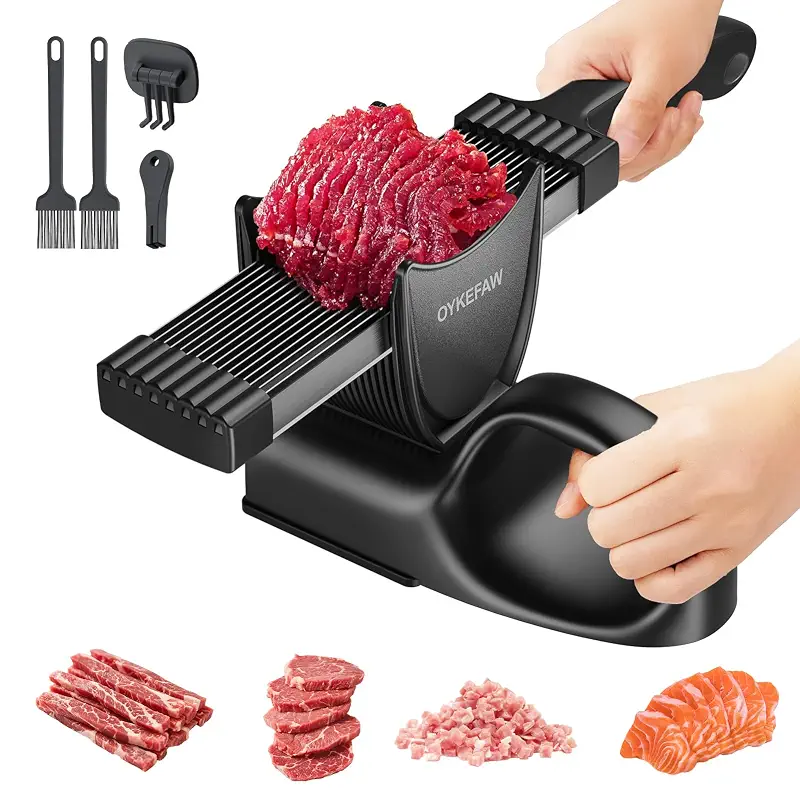
Oykefaw
Fresh Meat Slicer, Adjustable 2 or 4 mm, 17-in-1 Meat Cleavers | Manual Meat Slicer, Fresh Meat Slicer, Stainless Steel Meat Cleavers Knife, Sliced, Striped, Diced for Beef Pork
4.8(10)
Unique 17-blade design slices fresh meat and produce into 18 uniform cuts per pass; specialized for fresh rather than frozen.
Ideal for: Home cooks preparing fresh (not frozen) meat, vegetables, and produce for stir-fry, salads, and batch cooking.
The Oykefaw slicer operates on entirely different logic from the befen and Arinoo models. Instead of a single blade that you push and pull, it uses a multi-blade cage that cuts fresh meat (and vegetables, herbs, cheese) into parallel slices in one stroke. This is brilliant if you're slicing a whole block of pork loin for stir-fry or preparing cabbage for coleslaw, but it's not designed for frozen meat the way the frozen meat slicers vs. fresh category demands.
Owners love how quickly it handles uniform batches: 18 slices at once with 2mm or 4mm spacing means less repetition. The 420 stainless steel blades stay sharp and the food-grade container is removable for cleaning. The included professional brush helps navigate the blade cage. However, the plastic container body raises a legitimate concern from one reviewer: plastic particles can shed into food, particularly if the cage flexes or warps. This is a design flaw Oykefaw should address with metal components.
If your cooking revolves around fresh meat prep and batch vegetable slicing, this is efficient. But it's not a frozen meat specialist and lacks the thickness range of the befen or Arinoo. Choose this only if your primary use is fresh meat and you're okay with the plastic-container risk.
Pros
17-blade cage cuts 18 uniform slices in single pass
Fast for batch preparation of fresh produce
Removable parts and included brush simplify cleanup
Cons
Plastic cage body may shed particles with extended use
Not designed for frozen meat, limiting versatility
Key features
17-blade stainless steel cage produces 18 uniform slices per pass
Two blade sets for flexible 2mm or 4mm thickness adjustment
Food-grade removable container and base for easier storage and cleaning
Professional hard brush included for thorough blade-cage maintenance
#4 Pick
Best for Biltong & Jerky
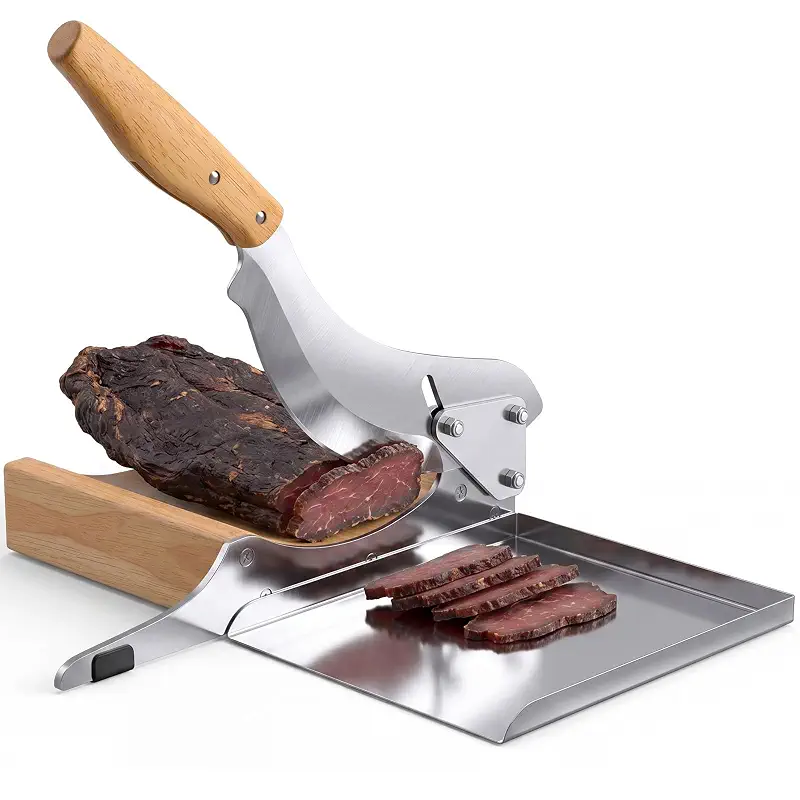
Mifoci
Mifoci Manual Meat Slicer, Radiused Blade for Butter Jerky, Magnetic Tray | Wooden Handle, for Biltong Salami Ginseng Antler, Chinese Herb Gastrodiae Maca, Detachable Magnetic Base for Easy to Clean
3.8(3)
Radiused dual-blade system and magnetic tray designed specifically for cured meats; elegant tool for specialty slicing.
Ideal for: Home jerky and biltong makers who prioritize consistency and clean cuts over speed and volume.
The Mifoci slicer is purpose-built for jerky, biltong, and cured salami: dense, chewy proteins that demand a different cutting approach than fresh or semi-frozen meat. The radiused blade and dual-blade system (moving and fixed knife) prevent tearing and deliver clean edges without shredding, which matters enormously when you're finishing homemade biltong. The magnetic tray is a small design elegance that catches every slice and keeps your workspace tidy; detach it to empty or rinse. Wood handle and stainless steel frame feel substantial and comfortable in extended use.
Owners of this tool tend to be jerky and biltong enthusiasts who've tried other methods and recognize when something works. The radiused blade glides through dried meat cleanly, and the compact size stores easily in a drawer. However, the lift height between blade and base limits meat chunk size: one owner noted they couldn't raise the blade enough for larger cuts, which is a real constraint if you're slicing thick whole pieces. This slicer excels at thin, consistent cuts but struggles with thicker stock.
Where the befen or Arinoo target hot pot and general home slicing, the Mifoci is a specialist tool. If your primary mission is jerky-making or cured-meat slicing and you value precision and workspace aesthetics, this justifies a dedicated spot. If you're buying one slicer to handle multiple tasks, the befen offers more flexibility.
Pros
Radiused blade cuts cured meats cleanly without tearing
Detachable magnetic tray contains slices and simplifies cleanup
Wooden handle and compact design feel refined and store easily
Cons
Limited lift height restricts thickness of meat chunks
Specialized design makes it less versatile for general home slicing
Key features
Precision radiused dual-blade system prevents tearing in dense, cured meats
Detachable magnetic tray captures all sliced content for tidy workspace
Stainless steel frame with wooden handle for comfortable, controlled use
Compact design fits drawer storage and handles herbs, fruits, and nuts
#5 Pick
Best Budget Option
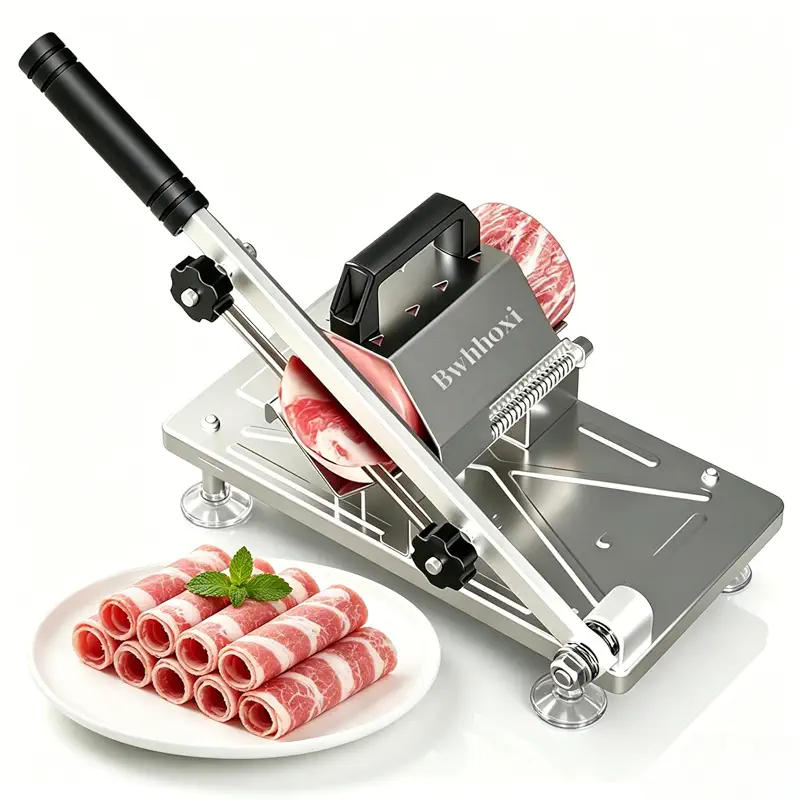
Bwhhoxi
Manual Frozen Meat Slicer Bwhhoxi Upgraded Stainless Steel Compact for Home | Frozen Meat Slicer Cuts Beef, Mutton & Bacon With Adjustable 0.3-8mm Thickness for Home Hot Pot & BBQ. Easy to Clean.
3.9(99)
Lightweight and affordable entry point for casual hot pot slicing; trade-offs in stability and learning curve are real.
Ideal for: Occasional home cooks new to manual slicing who prioritize low entry cost over durability and stability.
The Bwhhoxi slicer is built for home cooks on a tight budget who want to slice frozen meat for hot pot without spending much. At 1.2kg and with adjustable thickness from 0.3mm to 8mm, it checks the basics: dual-layer thickened stainless steel, four non-slip suction cups, ergonomic handle. The foldable design compacts for storage and the sharp alloy blade works when conditions are right.
Owners who prepared their meat properly (fully frozen, not semi-thawed) report even slices for hot pot and BBQ. But the reviews expose real limitations. The suction cups don't hold reliably on most countertops: several owners found the slicer sliding during use, a genuine safety risk when you're applying downward pressure. The body is prone to twisting and bending where heat or stress is applied, undermining durability. The blade and base aren't perfectly square, so one end of your slices may be thicker than the other no matter how much you adjust. And there's no blade guard, which is a concerning omission for storage and transport.
Compared to the befen, you save money but sacrifice stability, longevity, and peace of mind. This makes sense only if you're testing the category or slicing infrequently on a perfectly flat surface with full commitment to setup and safety. For regular hot pot prep, the befen's sturdier build and predictable performance justify the step up in cost.
Pros
Adjustable thickness from 0.3mm to 8mm covers hot pot and jerky
Lightweight and foldable for compact storage
Sharp blade performs well on properly frozen meat
Cons
Suction cups fail to grip most countertops; slicer slides during use
Body twists and bends with extended use; blade and base misalignment affects slice thickness
Key features
Dual-layer thickened stainless steel with adjustable 0.3mm to 8mm thickness
Foldable design and lightweight 1.2kg construction for easy storage
Four non-slip suction cups and meat press cover for counter stability
Food-grade stainless steel components that are fully detachable for cleaning
How to Choose a Manual Meat Slicer
Four trade-offs that actually matter when matching a manual meat slicer to your kitchen.
Frozen vs. Fresh: Which Type You Need
The split between frozen meat slicers vs. fresh meat slicers matters more than the brand. Frozen-focused models (befen, Arinoo, Bwhhoxi) feature a single sharp blade designed to glide through rock-hard meat without crushing or shredding it. Fresh-meat slicers like the Oykefaw use multi-blade cages better suited to softer proteins and produce. If you're buying meat in bulk and planning to freeze it overnight before slicing (the efficiency advantage), go frozen. If you slice fresh meat most of the time, fresh-focused design pays off. Mixing use cases means compromising on both fronts.
Counter Stability and Suction
Suction cups are the weak link in every manual slicer. Textured tile, grout, and uneven counters defeat them; smooth laminate or stainless steel work better. Test your cups on your actual counter before committing. Some models (Arinoo) pair suction with sturdy feet and frame geometry that provides backup stability; others rely entirely on suction. If your countertop is rough or you rent and can't modify it, prioritize models with reinforced frames and rubber feet rather than suction-dependent designs.
Thickness Range and Material Shape
Most models adjust from 0.2mm to 20mm, covering sandwich-thin through jerky-thick. Verify the range matches your cooking style. Also consider meat shape: irregular chunks demand a larger bed and flexible feeder (befen strength), while rolled or cylindrical meats work fine on compact models (Arinoo advantage). If you're always slicing the same cut (summer sausage, for example) a specialized model like the Mifoci for cured meats saves frustration. Versatility costs slightly more but pays off when your cooking habits shift.
Cleanup and Long-Term Care
Meat particles lodge in small spaces between blade and handle; pulling them out requires patience and care, especially if the blade is sharp. Models with detachable blades (Arinoo, Mifoci) clean faster than those requiring disassembly with an Allen wrench. Hand-washing is mandatory: dishwasher use voids warranties and risks rust. Before your first use, check that all fasteners are accessible with the tools provided, or you may find yourself stripped bolts and frustration. Budget fifteen minutes for thorough cleanup after each session.
Blade Quality and Replacement
Blades matter enormously and dull ones turn slicing into a workout. Models including spare blades (befen, Arinoo) reduce downtime when your edge degrades. Some brands offer affordable replacement blades; others charge significantly. Check the product listing for replacement-blade availability and cost before buying. A slicer with a durable blade you can actually replace is far better than one where a dull edge means retirement.
Frequently asked
Quick answers to the questions readers ask most.
Do I really need to freeze meat overnight, or will partially frozen work?
Fully frozen works dramatically better. Meat that's semi-thawed or soft won't slice cleanly; you'll get shreds and uneven thickness. Most manufacturers recommend 24 to 48 hours of hard freezing before slicing. The colder and more solid the meat, the smoother and faster the cut. This is non-negotiable if you want results that justify buying the tool.
How sharp is the blade, and is it safe for home use?
These blades are genuinely sharp: they'll cut through meat effortlessly but also your sponge or finger without warning. Every model includes a safety guard or feeder tray that keeps your hands away from the blade during slicing, but assembly and cleanup demand respect. Never reach toward the blade while adjusting thickness. Treat it like any sharp kitchen knife: present and dangerous if you're careless, manageable with attention.
Can I use a manual meat slicer on fresh (not frozen) meat?
Yes, but the results depend on your blade type. Single-blade models like befen work on fresh meat if it's chilled and firm, though frozen gives better cuts. Multi-blade fresh-meat slicers (Oykefaw) excel at soft meat and produce but aren't engineered for frozen. If you're splitting your use between fresh and frozen, a frozen-focused model gives you more flexibility, though neither is perfect for both.
What's the difference between a 0.2mm and 20mm slice, and when would I use each?
0.2mm to 1mm is paper-thin: perfect for Korean beef hot pot or sandwich meats where tenderness matters. 2mm to 5mm is medium, good for stir-fry and most casual eating. 8mm to 20mm is chunky, used for jerky or when you want hearty slices that won't fall apart during cooking. Start at your target thickness, make a test cut, and adjust. Most owners adjust by feel after one or two passes.
Why does one end of my slices come out thicker than the other?
This usually means the blade and base aren't perfectly square to each other: a manufacturing tolerance issue. It can also happen if the meat holder or feeder tray shifts mid-stroke. Check that all fasteners are tight and the meat holder sits flush before slicing. If the problem persists, the slicer may have internal misalignment, which is a reason to consider a replacement from a brand with tighter quality control.