Kitchen & Dining · Small
Best Low Wattage Microwave
Find the best low wattage microwave for apartments, dorms, and RVs. Compare 700W compact models with powerful heating, child locks, and retro designs.
Affiliate disclosure: As an Amazon Associate I earn from qualifying purchases.
At a glance
2
Best Retro AestheticCostway
4
Best for Intuitive OperationNostalgia
5
Best for Flexibility and MemoryFarberware
Detailed reviews
The Chefman 0.7 cubic-foot model strikes the balance that makes it the most dependable choice for most buyers stepping into the low wattage space. It delivers the promised 700 watts without the power-creep issues some competing models experience. The child safety lock integrates into the handle pull itself, meaning you're not wrestling with a separate latch every time you open the door: a practical detail that surfaces in repeated owner praise. Ten power levels give genuine flexibility for melting, defrosting, and full-power cooking, and the six preset buttons (popcorn, pizza, beverages, veggies, potatoes, leftovers) handle the 80% of tasks most households actually perform.
The control buttons do require firm pressure, which some users interpret as a durability feature and others find tiring. This is a real trade-off. The microwave also works best positioned against a wall or cabinet, since aggressive button pressing can inch it forward across the counter. In kitchens where that's not practical, you'll want to anchor it or accept that you're working around the design rather than with it. Compared to the Nostalgias retro dial approach, the Chefman leans digital and straightforward: better if you want instant presets, less charming if you prize a mechanical aesthetic.
Owners consistently report reliable, even heating from day one, and the stainless-steel exterior wipes clean without showing fingerprints. The mute button is a genuine convenience for early mornings or light sleepers. At this power level and price point, it's the most consistent recommendation across different household types, earning its place as the top countertop microwave under $100 for buyers who prioritize dependable daily heating over flashy automation.
Pros
- Child lock integrated into handle for single-step door opening
- Ten power levels plus six preset buttons for everyday tasks
- Mute function silences beeps for quiet mornings or light sleep
- Even heating across compact chamber with reliable performance
Cons
- Buttons require firm pressure and can move microwave if not braced
- Compact size means larger dishes won't fit flat on turntable
Key features (5)
- 700-watt output with 10 adjustable power levels for precision cooking
- 0.7 cubic-foot capacity fits standard dinner plates with modest turntable
- Six one-touch presets for popcorn, pizza, beverages, veggies, potatoes, leftovers
- Child safety lock and mute button for family homes and quiet environments
- Dishwasher-safe glass turntable and wipe-clean black exterior
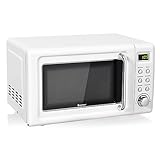
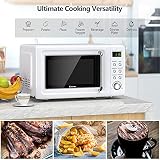
The Costway small microwave leans hard into retro styling, and that's either your reason to buy it or reason to skip it. The exterior design, chrome handle, and color palette genuinely capture mid-century appliance aesthetics in a way that feels intentional rather than nostalgic-for-profit. Interior dimensions are generous for the footprint, and a 9.5-inch turntable accommodates most standard dishes. The mechanical dial and button layout simplify the interface to essentials: power level, cooking time, auto-cooking menu, and go.
The tradeoff is that five power levels (versus the ten offered by the Chefman or Farberware) give less fine-tuning range. For most reheating and defrosting, five levels are adequate; if you're regularly melting small amounts of butter or running prolonged low-power defrost cycles, you'll feel the constraint. The eight auto-cooking presets (popcorn, pizza, potato, vegetable, meat, fish, beverage, reheat) offer decent breadth. The microwave will beep every three minutes after cooking ends if you don't remove the turntable, not dangerous, but worth knowing if you're the type to walk away.
Compared to the more straightforward digital interfaces of other models in this lineup, the Costway's mechanical approach appeals to buyers who find touchpads frustrating or who simply prefer the tactile satisfaction of turning a dial. The heating performance itself is solid and reliable; the retro design is the main feature differentiation here.
Pros
- Authentic retro styling with chrome accents and period-correct proportions
- Mechanical dial controls feel intuitive and durable
- Eight auto-cooking presets with defrost by weight or time
- Spacious interior fits larger plates despite compact exterior footprint
Cons
- Only five power levels limits precision for specialized low-power tasks
- Continues beeping every three minutes after cooking unless turntable is removed
Key features (5)
- 700-watt output with five adjustable power levels and mechanical dial interface
- 0.7 cubic-foot capacity with 9.5-inch turntable and spacious internal dimensions
- Eight auto-cooking settings plus defrost by weight or time function
- Retro chrome handle and period-accurate styling in teal or white finish
- LED display, child lock, and compact 18x14x10-inch footprint for tight spaces
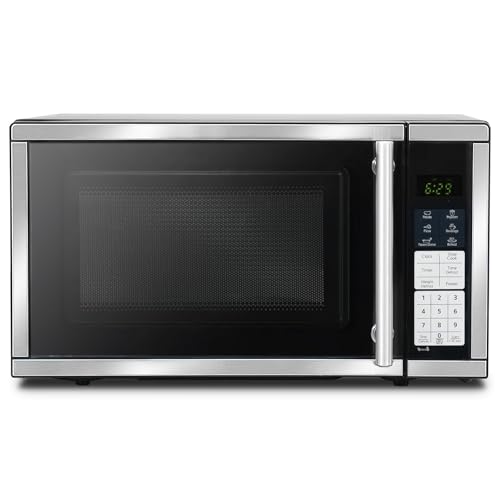
The Smad 0.7 cubic-foot model occupies a sweet spot between feature-heavy and bare-bones. It delivers ten power levels, six one-touch presets (popcorn, potato, pizza, and others), a rotating glass turntable, LED display with clock, interior lighting, and child safety lock: the full roster of practical functions without extra complexity or premium pricing. Buyers consistently report that it heats evenly and performs well across everyday tasks like reheating leftovers, defrosting, and warming beverages.
The microwave is quiet during operation, and the compact 0.7 cubic-foot chamber is large enough for standard plates and frozen meals. Where it positions itself in this lineup is as the pure-function alternative to the Chefman's button-pressure quirks or the Costway's retro design statement. If you need a microwave that simply works without fanfare or frustration, this is it. Compared to the Farberware, which shares similar specs and wattage, the Smad edges ahead in owner satisfaction ratings, though the difference is modest and both are solid choices for apartment and dorm use. The main trade-off is that at this price point and feature set, you're relying on a less-established brand name, which may matter if you value long-term service support or want reviews from a larger installed base.
Owners report durability and consistent performance; the lack of elaborate programming means fewer things to break or confuse.
Pros
- Ten power levels with six one-touch preset buttons for common foods
- Quiet operation and even heating across compact chamber
- LED display, interior lighting, and child safety lock standard
- Straightforward design minimizes complexity and potential failure points
Cons
- Less-established brand than Chefman or Farberware may affect service options
- Compact size means some larger baking dishes won't fit on turntable
Key features (5)
- 700-watt power with 10 adjustable levels and multi-stage cooking capability
- 0.7 cubic-foot interior with 9.6-inch glass turntable and LED display
- Six one-touch preset buttons for popcorn, potato, pizza, and more
- Interior lighting, child safety lock, and easy-to-clean stainless-steel exterior
- Compact footprint designed for apartments, dorms, and office break rooms
The Nostalgia retro compact stands out for how it handles the core interaction: starting the microwave and adjusting time. Press the large central dial button once and it runs for one minute; rotate the dial to scale up or down in one-minute increments. This is immediate and tactile in a way digital keypads can't match. For the 80% of uses where you're simply reheating for 15 to 60 seconds, the rotary interface is faster than navigating a button sequence on a traditional model. Owners praise this design repeatedly, noting it's easier to use than microwaves they've owned for decades.
The 12 pre-programmed settings add capacity for specialty tasks like defrost and popcorn, but the dial-first approach means they're supplementary rather than central to the user experience. The rotating glass carousel is robust and the LED display is bright and easy to read. Where this trades off against the Chefman is in button-press reliability: the Nostalgia's physical dial doesn't have the pressure-sensitivity issues some report with the Chefman's keypad. Interior lighting only comes on during cooking, not when the door opens, which is a minor inconvenience but not a functionality problem.
Compared to the Farberware, the Nostalgia's dial approach is less conventional but more satisfying to owners who dislike touchpad navigation. The microwave is available in multiple retro colors (white, black, red), so aesthetic preference can also drive the choice here. At this wattage and size, this model appeals most to buyers who spend more time thinking about usability than specs.
Pros
- Large central dial for one-minute start and intuitive time adjustment
- 12 pre-programmed cooking settings including express cooking and defrost
- Rotating carousel ensures even heating with durable glass construction
- Retro styling with chrome accents available in multiple color options
Cons
- Interior light activates only during cooking, not when door opens
- Lower price point sometimes correlates with shorter appliance lifespan per some reviews
Key features (5)
- 700-watt output with five power levels and express one-minute start button
- 0.7 cubic-foot capacity with rotating carousel and bright LED digital display
- 12 pre-programmed cooking settings for popcorn, pizza, potato, veggies, and more
- Retro chrome handle and aesthetic design in white, black, or red finishes
- Child safety lock, delay timer, and compact footprint for small kitchens
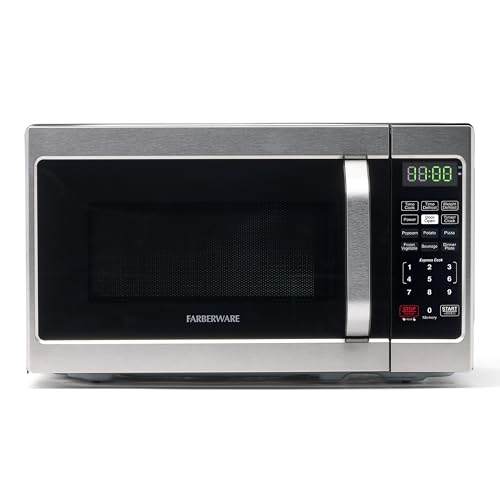
The Farberware 0.7 cubic-foot model offers the broadest feature set among low wattage compacts. It includes ten power levels, six one-touch presets, defrost by weight or time, a memory function for saving custom cooking sequences, and a clear LED display with kitchen timer and clock. The stainless-steel exterior appeals to buyers whose kitchen aesthetic leans contemporary rather than retro. Interior lighting lets you monitor cooking without opening the door, and the child safety lock is standard.
The memory function is genuinely useful if you regularly cook specific items at custom settings: save your favorite defrost routine or low-power butter-melt sequence and recall it with a button press. This moves beyond the preset buttons offered by competitors; it's personalization at the user level. The heating performance is reliable and even across the 0.7 cubic-foot chamber, making it a solid practical choice for apartments and shared kitchens. Compared to the Smad, which shares similar wattage and feature count, the Farberware adds the memory function and stainless finish, though owner satisfaction is nearly equivalent and the Smad is often priced lower.
One caveat: some owners report that the child safety lock is difficult to disable if you find it annoying, and you may need to consult the manual or contact support. The door latch itself also requires you to press Cancel before opening, which adds a step compared to models with push-to-open handles. For buyers who value programmability and a more premium appearance, this is the strongest choice, though the marginal benefit over the Chefman or Smad is modest for casual everyday use.
Pros
- Memory function saves custom cooking sequences for repeated use
- Ten power levels with defrost by weight or time for precision cooking
- Stainless-steel exterior complements modern kitchen aesthetics
- Six one-touch presets plus timer and clock on large LED display
Cons
- Child safety lock difficult to disable and requires Cancel press before opening
- Manual power-level adjustment sequence more complex than some competitors
Key features (5)
- 700-watt power with 10 adjustable levels and multi-stage cooking options
- 0.7 cubic-foot capacity with rotating turntable and interior lighting
- Memory function stores custom cooking sequences for repeated use
- Six one-touch presets plus defrost by weight or time settings
- Stainless-steel finish, LED clock and timer, child safety lock standard
How to Choose a Low Wattage Microwave
Understanding Why Wattage Matters Less Than You Think
A 700-watt microwave isn't weak: it's simply designed for electrical systems with lower capacity. The relationship between microwave wattage and cooking performance hinges on microwave wattage and cooking performance more than raw numbers suggest. A 700W unit heats food just as effectively as a 1000W unit; it simply takes slightly longer. For everyday tasks (reheating coffee, defrosting chicken, warming leftovers), the time difference is 30 seconds to two minutes. Where wattage truly matters is if you're running the microwave frequently or simultaneously with other high-draw appliances. In RVs, older rental apartments, or homes with shared electrical service, lower wattage prevents breaker trips or flickering lights. If your current home has stable power, wattage is more about matching your actual usage pattern than solving a real constraint.
Size and Footprint Trade-Offs
All five models reviewed here measure 0.7 cubic feet: the standard compact size. That translates to roughly 13 inches wide, 10 inches deep, and 10 to 11 inches tall, depending on the model. A standard dinner plate (9 to 10 inches) fits flat on the turntable with modest clearance; larger baking dishes or pizza plates may not. Counter space is the practical constraint: these models work well on top of mini-fridges, on shelving units, or tucked into corner nooks where full-size microwaves won't fit. If you're outfitting a dorm or studio, measure your target spot and compare to the exterior dimensions (which include the handle). Some models sit farther from the wall due to power cord placement: a detail that matters in tight kitchens.
Control Interface: Buttons, Dials, and Touchpads
The three main control styles present different usability profiles. Digital keypads (Chefman, Farberware, Smad) offer the most preset buttons and granular power-level control but require multiple button presses for simple tasks. Mechanical dials (Costway) reduce the interface to essentials and appeal to users who find touchpads confusing or frustrating. The Nostalgia's hybrid approach (large central button for one-minute start, dial for time adjustment) is the most intuitive for most buyers. Older users and those with hand-strength limitations often prefer dials or large buttons over small, sensitive touchpads. Think about your own microwave habits: if you're reheating for 20 seconds multiple times a day, a dial wins. If you're defrosting by weight or running specialty presets weekly, a button interface with more options makes sense.
Compactness and Portability for RVs and Rentals
Low wattage microwaves are the standard choice for RVs and rental apartments because they don't demand dedicated circuits or heavy amperage. The compact size here (roughly 18 inches wide) means they stack easily or fit in tight galley spaces. For RV owners specifically, the Chefman and Farberware have a reputation for surviving road vibration without parts loosening or the turntable derailing. Renters benefit from the fact that these models are lightweight enough to move without help and don't require permanent installation or venting modifications. If you're furnishing a temporary space, the return-on-investment is higher because you can take the microwave with you when you leave. Weight ranges from 30 to 35 pounds depending on the model, manageable for one person to carry but substantial enough to feel solid and durable.
Child Safety and Practical Locking Mechanisms
All models include child safety locks, but the implementation differs. The Chefman integrates the lock into the handle pull itself, so opening the door is a single motion. The Costway and Smad use separate button-press sequences to enable the lock. The Nostalgia and Farberware require pressing a Cancel button before the door will open when locked. If you have young children, the Chefman's approach is most practical for everyday use: the lock is on by default but doesn't slow down adults who need the microwave multiple times daily. For rental units or shared kitchens where you want the lock active all the time, the Farberware's Cancel-to-open design is more secure. Consider your household rhythm: a family that microwaves constantly will tire of extra steps; a parent of a toddler may appreciate the friction as a safety reminder.
Our picks at a glance
2
Best Retro AestheticCostway
4
Best for Intuitive OperationNostalgia
5
Best for Flexibility and MemoryFarberware
Frequently asked
Can I use a 700-watt microwave in an RV or rental apartment with limited electrical service?
Yes, this is one of the main reasons to choose low wattage. A 700W microwave draws roughly 6 to 7 amps, compared to 10 to 15 amps for a full-size 1000W+ model. If you're running it on a 15-amp circuit shared with other appliances (like a mini-fridge or coffee maker), the lower wattage significantly reduces the risk of breaker trips. In RVs, it's often the minimum viable choice for avoiding generator strain or battery drain. Check your RV or rental breaker specs, but in most cases, 700 watts is specifically the safer choice for electrical-constraint situations.
Will a 700-watt microwave take significantly longer to cook food than a 1000-watt model?
The difference is modest and rarely noticeable for everyday tasks. Reheating a cup of coffee takes maybe 10 to 15 seconds longer; defrosting a small chicken breast might add 30 seconds. Cooking from frozen (like frozen dinners) may add one to two minutes over a full session. For the vast majority of household microwave use (which is warming, not cooking) the time penalty is negligible. The real benefit of lower wattage is consistent, even heating without hot spots, which many users actually prefer for melting butter or gently warming delicate foods.
Do low wattage microwaves have reliability issues compared to higher-wattage models?
No. A 700W microwave uses the same core components as a 1000W unit; the difference is in the magnetron power rating and internal transformer size. Lower wattage can actually mean fewer stress failures because the electrical components work less hard over their lifetime. The main reliability wildcard is brand reputation and build quality, not wattage level. All five models reviewed here have solid owner-satisfaction ratings and multi-year track records. The most common failures are mechanical (turntable bearing, door hinge) rather than electrical, and those happen regardless of wattage.
What's the difference between preset buttons and the memory function?
Preset buttons (six or twelve, depending on the model) are manufacturer-programmed for common foods like popcorn, pizza, and potatoes. You select the preset and press start. Memory function (available on the Farberware) lets you record your own custom cooking sequence: for example, defrosting at 30% power for 5 minutes, then cooking at high power for 2 minutes, and save it to a button. If you regularly cook the same items at the same settings, memory saves you from re-entering the sequence each time. For casual users, preset buttons are sufficient; for households with specific routines, memory is a convenience upgrade.
Which model is best for beginners or people who find microwave controls confusing?
The Nostalgia retro compact is the easiest to learn and use. Press the central dial button once and it runs for one minute; rotate the dial to add or reduce time. No sequence to memorize, no menu-diving. The Costway's mechanical dial is also straightforward but requires selecting from a menu of auto-cooking options if you want specialty functions. The Chefman is friendly once you accept that buttons need firm pressure, and the mute button is a nice convenience. Avoid the Farberware if you're not comfortable with a multi-step power-level adjustment sequence. For absolute simplicity, the Nostalgia wins.