Kitchen & Dining · Gadgets
Best Knife to Cut Onions
Compare santoku, nakiri, serrated and cleaver options for dicing and slicing onions, plus a finger-saving holder, and see which suits your prep.
Affiliate disclosure: As an Amazon Associate I earn from qualifying purchases.
At a glance
1
Best Serrated SlicerOmesata
2
Best Finger ProtectorQPEY
4
Best Compact SantokuZwilling
5
Best Seamless Handleimarku
6
Heavy-Duty Specialty PickMueller
7
Best for Vegetable PrepPaudin
Detailed reviews
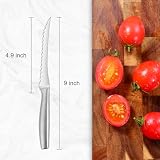
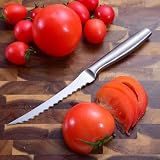
We'd steer cooks who mostly want clean, thin slices toward this serrated knife, which is built for produce with a tough skin and a soft middle. Onions fit that description once the papery layer is off, and owners report that it also slices shallots and scallions finely, along with garlic.
The stainless blade is light (0.09 pounds on the spec sheet) and the textured handle is made to be non-slip and balanced. Owners report that the edge stays sharp through regular use and that it comes through repeated dishwasher cycles without rusting; a common complaint is that the blade feels a little flimsy. The pointed tip is a bonus on tomatoes, where it lifts out seeds.
Pros
- Slices shallots and scallions finely
- Pointed tip lifts out tomato seeds
- Owners report no rust after dishwasher runs
Cons
- Blade can feel slightly flimsy
Key features (4)
- Serrated stainless steel blade for tough skins and soft middles
- Contemporary textured handle with non-slip grip and balanced weighting
- Pointed tip suited to seed removal on tomatoes
- Lightweight stainless body listed at 0.09 pounds
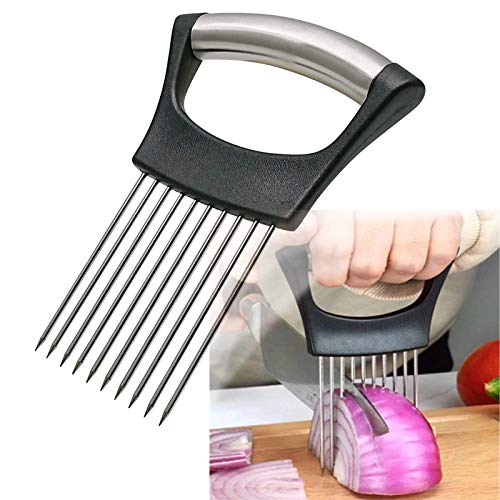
This is not a knife at all, which is why we'd pair it with any blade on this page rather than treat it as a replacement. Stainless tines sink into the onion, and the wide plastic handle gives you something sturdy to hold while the knife works through the slices. Beside a thin slicer like the Omesata Tomato Knife, it keeps the produce steady while the blade does the cutting.
Owners report that it holds onions, other vegetables and meat firmly in place, feels sturdy, and keeps hands clear of the blade, which they find especially useful while knife skills are still developing. The tines can also double for tenderizing meat, and the tool is dishwasher safe.
Pros
- Pins onions firmly while slicing
- Keeps fingertips clear of the blade
- Sturdy build holds items stable
Key features (4)
- Stainless steel fork tines that sink into the onion
- Extra-wide plastic handle with a non-slip grip
- Lightweight 0.13-pound build that is dishwasher safe for easy cleaning
- Long tines that double as a meat tenderizer
If we had to hand one knife to a first-time buyer for onion work, this is where we'd start. Santoku means three virtues, and the maker lists onions among its target jobs; the hollow edge adds small scallops that keep wet slices from clinging to the blade.
Owners report that it takes and holds an edge, and they describe it as light and well balanced, with a handle that is comfortable for chopping vegetables. At 0.4 pounds it sits well below the Zwilling Pro Santoku Knife 5.5 Inch, which weighs 0.7 pounds, so this Classic is the one we'd choose when wrist fatigue is the worry. The fully forged construction and triple-rivet handle add durability, the blade is stain and rust free, and a lifetime warranty against manufacturer's defects comes with it.
Pros
- Holds a sharp edge well
- Light, balanced feel in the hand
- Comfortable for chopping vegetables
- Lifetime warranty against manufacturer defects
Key features (4)
- Seven-inch hollow-edge blade with scallops that release wet food
- Fully forged construction with a seamless blade-to-handle transition
- Traditional triple-rivet handle shaped for comfortable vegetable chopping
- German stainless steel blade, Spanish-made, cleaned by dishwasher or hand
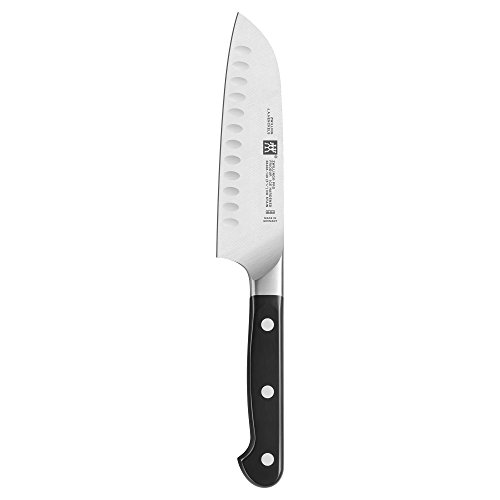
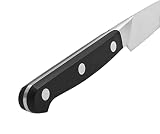
At 5.5 inches this is the shortest santoku of the group, which makes it quick to maneuver on a board of smaller onions or shallots. The blade is forged from a single piece of high-carbon stainless steel with an ice-hardened finish, and the maker positions it for lasting sharpness under heavy daily use.
Owners report that it holds an edge, cuts smoothly, and feels well balanced without being heavy, and they say the curved bolster nudges the hand into a proper grip. Durability is a recurring theme, with owners expecting it to last for years. Cooks who prefer the longer reach of the Zwilling J.A. Henckels Classic Santoku Knife 7-Inch will find this one more compact, while those wanting a sturdier full-tang feel get it here at 0.7 pounds.
Pros
- Holds an edge through regular use
- Curved bolster guides a safe grip
- Well balanced without feeling heavy
- Forged single-piece construction
Key features (4)
- Forged high-carbon stainless steel with an ice-hardened, laser-controlled edge
- Full-tang triple-riveted handle for a secure, durable grip
- Curved bolster shaped to guide finger placement and grip
- Compact 5.5-inch blade that the maker rates dishwasher safe
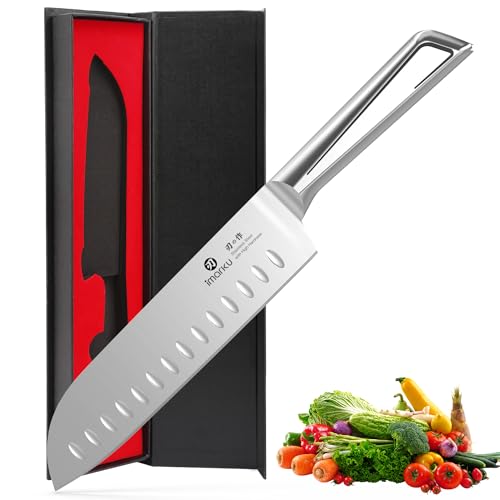
This is the santoku for cooks who dislike wooden or riveted handles: blade and handle are one piece of stainless steel with no gaps where residue can collect. The hollow scallops help wet onion slices release instead of clinging, and the 0.1-inch blade suits clean cuts through skins and layers. That spine weight also helps with dense vegetables, a trait that matters just as much when choosing the best knife to cut potatoes.
Owners report that it is razor sharp out of the box and keeps its edge, slicing through vegetables and bread, and that it feels light and balanced without tiring smaller hands; they also say it has held up in the dishwasher. Cooks comparing it with the Paudin Nakiri Knife 7" will notice the handle difference: pakkawood there, all steel here, which makes this one the easier choice when dishwasher cleanup matters.
Pros
- Hollow scallops release wet onion slices
- Seamless steel handle, nothing to trap residue
- Reported to stay sharp over time
- Comfortable, balanced feel for smaller hands
Key features (4)
- Seven-inch high-carbon stainless steel blade with double-bevel edge
- One-piece stainless steel handle with no rivets or open seams
- Hollow scalloped edge that helps wet food slide off
- Thin 0.1-inch blade rated rust-resistant and dishwasher safe
We see this as the specialty pick of the lineup: a cleaver first, with an 18-degree double-bevel edge in German high-carbon stainless steel and a seamless full-tang steel handle. For onions it brings width and mass, and the broad blade also works as a scoop to carry chopped pieces to the pan. Set beside the Zwilling J.A. Henckels Classic Santoku Knife 7-Inch at 0.4 pounds, its 1.12 pounds is a very different feel in hand.
Owners report that it stays sharp, cuts cleanly through roasts and steaks, and has a grippy handle that doesn't slip; a common complaint is that the rounded handle can feel unsteady and a little handle-heavy until you adjust. Hand washing is recommended to protect the edge. Because of its size and weight, we'd choose it for cooks with larger hands or those who also break down meat.
Pros
- Substantial heft suits dense foods
- Seamless full-tang steel handle
- Edge reported to stay sharp
- Wide blade doubles as a scoop
Cons
- Rounded handle can feel unsteady
- Handle-heavy balance takes getting used to
- Hand washing recommended to protect the edge
Key features (4)
- 18-degree double-bevel edge in German high-carbon stainless steel
- Seamless full-tang stainless steel handle with contoured grip
- Wide seven-inch blade that doubles as a bench scraper
- Substantial 1.12-pound build for chopping dense ingredients
A nakiri is the vegetable specialist in this group: the flat edge meets the board along its whole length, so a push-cut goes straight through an onion without the rocking motion a curved blade needs. That matches how owners describe it, with fast, even dicing of onions, squash and sweet potato. Cooks used to dicing with a santoku such as the Imarku Santoku Knife 7 Inch will find the flat profile the main change, along with the pakkawood handle.
The steel is 5Cr15Mov at 56+ hardness, and the waved pattern is meant to cut food friction. Owners report that it arrives very sharp, feels light and comfortable, and is easy to maintain. A common complaint concerns how the steel copes with very dense produce, and owners advise hand washing and drying right away, so this is not a dishwasher knife. It is also meant for vegetables and soft foods rather than bones or anything frozen.
Pros
- Flat edge push-cuts onions cleanly
- Arrives sharp and stays comfortable
- Pakkawood handle fits the hand well
- Waved blade pattern reduces sticking
Cons
- Hand wash and dry immediately
- Steel toughness questioned on dense produce
- Not meant for bones or frozen food
Key features (4)
- Seven-inch flat nakiri blade in 5Cr15Mov stainless steel
- 56+ hardness stainless steel edge that is easy to re-sharpen
- Pakkawood handle balanced against the thin blade at the pinch point
- Waved blade pattern meant to cut friction and ease cleaning
Side by side
| Pick | Item weight | Size |
|---|
#1 Best Serrated Slicer
Omesata | 0.09 pounds | — |
#2 Best Finger Protector
QPEY | 0.13 pounds | — |
#3 Best Overall
Henckels | 0.4 pounds | 7" |
#4 Best Compact Santoku
Zwilling | 0.7 pounds | 5.5" |
#5 Best Seamless Handle
imarku | — | 7" |
#6 Heavy-Duty Specialty Pick
Mueller | 1.12 pounds | 7" |
#7 Best for Vegetable Prep
Paudin | 0.5 pounds | 7" |
How to Choose a Knife for Cutting Onions
Which blade shape works best on onions?
Cooks usually reach for a santoku or a chef's knife, with a flat-edged nakiri as the vegetable-first alternative. Santoku blades are shorter and thinner, and the scalloped hollows let wet slices fall free, which is why the Zwilling J.A. Henckels Classic Santoku Knife 7-Inch and the Imarku Santoku Knife 7 Inch suit everyday dicing. A nakiri's flat edge makes full contact with the board for push-cuts, and the Paudin Nakiri Knife 7" is the vegetable specialist here. Leafy greens ask for something else entirely, and the best knife to cut lettuce is a different decision from the one you make for onions.
The common choices, in short:
- Santoku: shorter, thinner blade, often with a hollow edge
- Nakiri: flat edge for push-cuts through vegetables
- Chef's knife: longer, curved blade rocked through the cut
- Serrated slicer: grips slippery skins and soft interiors
- Paring knife: small blade for trimming roots and tiny onions
How sharp does the edge need to be?
Sharpness matters more than any other trait for onions. A dull edge crushes the cells and releases more of the irritant that stings your eyes, while a keen one parts the layers cleanly and leaves tidier pieces. High-carbon stainless steel is the usual choice for holding that edge; harder steel stays sharp longer but needs more careful use. The Zwilling Pro Santoku Knife 5.5 Inch is the pick built around edge retention, with an ice-hardened forged blade, while the Paudin Nakiri Knife 7" arrives very sharp but asks for gentler handling on dense produce.
Do handle and balance really matter?
Yes, because onion prep is repetitive. A secure, non-slip grip and an even weight spread cut down on fatigue and slips, and a bolster or full tang adds control. The Imarku Santoku Knife 7 Inch uses a seamless all-steel handle that leaves no gaps for residue and stays steady in wet hands, while heavier blades like the Mueller Meat Cleaver 7 Inch, at 1.12 pounds, suit larger hands that want mass behind the cut.
How should you care for an onion knife?
Wash by hand with mild soap, dry right away, and hone between sharpenings so the edge keeps cutting cleanly; a whetstone or sharpener handles the heavier work when honing stops being enough. Dishwasher tolerance varies, so check each knife before loading it: the Zwilling J.A. Henckels Classic Santoku Knife 7-Inch can be cleaned either way, while the Paudin Nakiri Knife 7" is best washed and dried by hand.
Our picks at a glance
1
Best Serrated SlicerOmesata
2
Best Finger ProtectorQPEY
4
Best Compact SantokuZwilling
5
Best Seamless Handleimarku
6
Heavy-Duty Specialty PickMueller
7
Best for Vegetable PrepPaudin
Frequently asked
Why does a sharper knife make cutting onions less tearful?
A dull edge crushes the cells and releases more of the irritant, so more of it reaches your eyes, while a keen edge slices through the cells cleanly. Chilling the onion beforehand also slows the release. For a blade that owners describe as sharp from the first use, look to the Imarku Santoku Knife 7 Inch.
How do you cut an onion safely?
Trim the stem end, halve the onion through the root, peel it, and lay each half flat. Make parallel cuts without going through the root, then cut across them to dice. Keep the fingers of the guiding hand curled back, or let the QPEY Onion Holder do the holding so your fingertips stay out of the way.
Can a serrated tomato knife handle onions?
It can help on slippery skin and for thin slices, and owners of the Omesata Tomato Knife report fine slicing of shallots and scallions as well as tomatoes. For dicing a pile of onions, a santoku like the Zwilling J.A. Henckels Classic Santoku Knife 7-Inch, which lists onions among its main jobs, is the more natural fit.
Is a nakiri better than a chef's knife for onions?
A nakiri's flat edge lets you push straight through the onion, which suits dicing and slicing, while a chef's knife is more versatile and rocks through the cut. If vegetables make up most of your prep, the Paudin Nakiri Knife 7" is the pick that settles it; for mixed tasks, a santoku or chef's knife covers more ground.