Best Knife for Slicing Brisket: Top Carving Knives Tested
Find the best knife for slicing brisket. Compare 5 top-rated carving knives for meat, from budget to premium options. Expert reviews and buyer guidance inside.
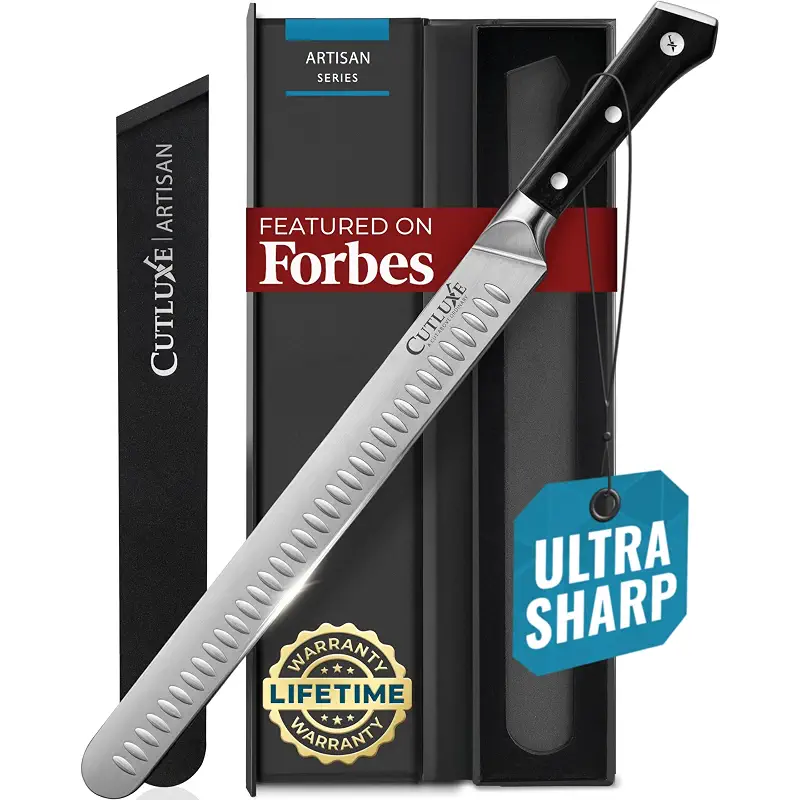
Cutluxe Brisket Knife, 12" Carving & Slicing Knife for Meat & BBQ | Razor Sharp German Steel, Full Tang Ergonomic Handle, Sheath Included – Grilling Gift for Men
4.8(7,433)
Premium German steel with full-tang build and exceptional sharpness; industry-favorite edge retention at a fair price.
Ideal for: Home cooks and BBQ enthusiasts who want professional-grade sharpness and longevity without premium pricing.
The Cutluxe 12-inch brisket knife has earned its high rating by doing one job exceptionally well: slicing large cuts of meat with almost no resistance. The hand-sharpened edge at 14-16 degrees per side cuts cleanly through fat and muscle fiber, and owners consistently report that it maintains that sharpness across many uses. The full-tang construction means the steel runs continuously through the handle, making it solid and well-balanced without feeling heavy or clumsy.
What strikes me most about the feedback is how often buyers describe it as a workhorse that outperformed much pricier alternatives. One owner compared it favorably to a $120 specialty knife from a warehouse club and found this one superior. The hand-honed edge and 56+ Rockwell hardness rating are real specifications that translate to less work on your part when the blade meets the meat.
The main trade-off is that the sheaths some owners received showed wear after repeated use, which has frustrated a few users who expected the warranty to cover that accessory. For the knife itself, the warranty is lifetime and covers defects in materials or craftsmanship. If you prioritize edge-holding and don't mind hand-washing, this is a safe, proven choice.
Pros
Exceptional edge retention after multiple uses and cuts
Full-tang construction ensures solid, balanced feel in hand
Stays sharp through extended carving sessions without forcing
Cons
Sheath material can wear or separate after repeated use
Requires hand-washing to preserve edge and finish
Key features
12-inch razor-sharp German steel blade at 14-16 degrees per side
Full-tang construction with triple-riveted pakkawood handle
56+ Rockwell hardness for long-lasting edge retention
Granton blade indents reduce sticking and friction during slicing
#2 Pick
Best Value Pick
Hoshanho
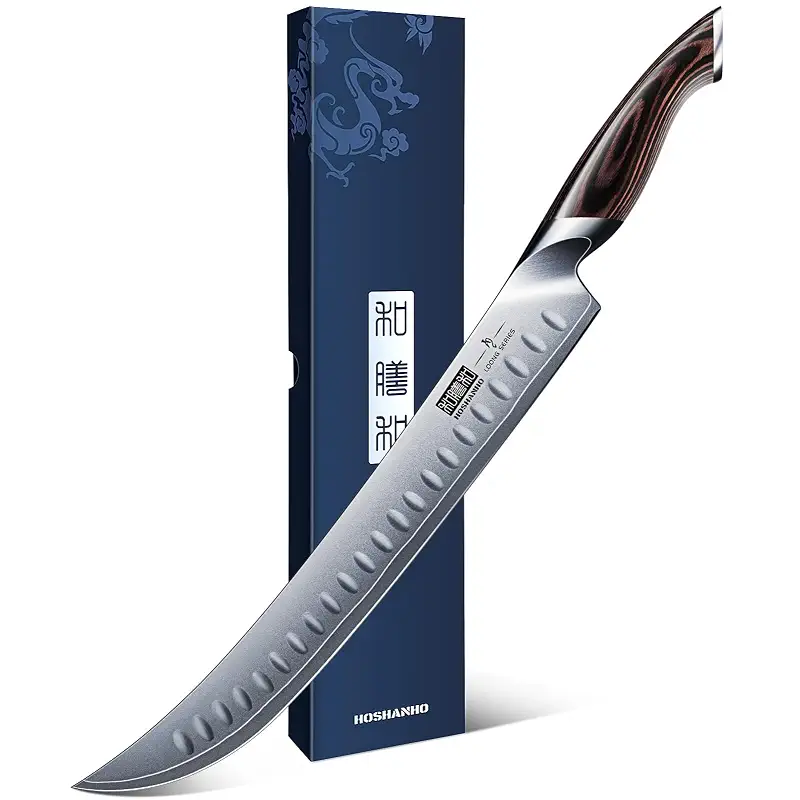
HOSHANHO Carving Slicing Knife, 12 Inch Razor Sharp Japanese Brisket Knife | Japanese High Carbon Steel Curved Butcher Breaking Knives with Ergonomic Handle, Professional Butcher Knife for Meat Cutting
4.7(692)
Japanese high-carbon steel carving knife that cuts like a premium blade at a budget-friendly entry price.
Ideal for: Budget-conscious buyers and home meat cooks who want professional cutting performance without the premium price tag.
The Hoshanho carving slicing knife brings Japanese steel engineering to the mid-range market, and owners who've paid double the price for comparable knives elsewhere describe it as a genuine bargain. The 15-degree hand-sharpened edge glides through large cuts with the kind of buttery smoothness you'd expect from specialty butcher knives, and the hard-steel composition resists chipping even under heavy use on bone or hard cartilage.
One buyer noted it cut through an 11-pound brisket like never before, finishing work that used to take 30 minutes in under 10 minutes with less downward pressure required. That's the real-world payoff: less fatigue, cleaner slices, faster results. The wood handle adds to the appeal: it feels warm and finished, not like economy plastic. Owners report it stays sharp for months when cleaned and dried after each use and stored properly on wood or plastic cutting boards.
The catch is that several reviewers flag it as made in China despite marketing language around "Japanese" steel and design. If that matters to you, the Cutluxe or Hoshanho's sibling model (the B0DCVB4LDP) might be a better fit. The length can also be challenging to store in a standard knife block; it protrudes significantly. Still, for the cutting performance you get at this price, I'd call it a strong entry point.
Pros
Exceptional sharpness and cutting efficiency at mid-range price
Cuts through large meat with minimal effort and resistance
Nice wood handle and balanced weight distribution
Cons
Storage challenge; 12-inch blade sticks out of standard knife blocks
Made in China despite Japanese steel marketing
Key features
12-inch Japanese high-carbon steel blade with 15-degree edge angle
Hand-sharpened for cutting efficiency and precision slicing
Ergonomic hardwood handle with non-slip, wear-resistant material
Works on large roasts, turkey, ham, and other substantial cuts
#3 Pick
Premium Pick
Hoshanho
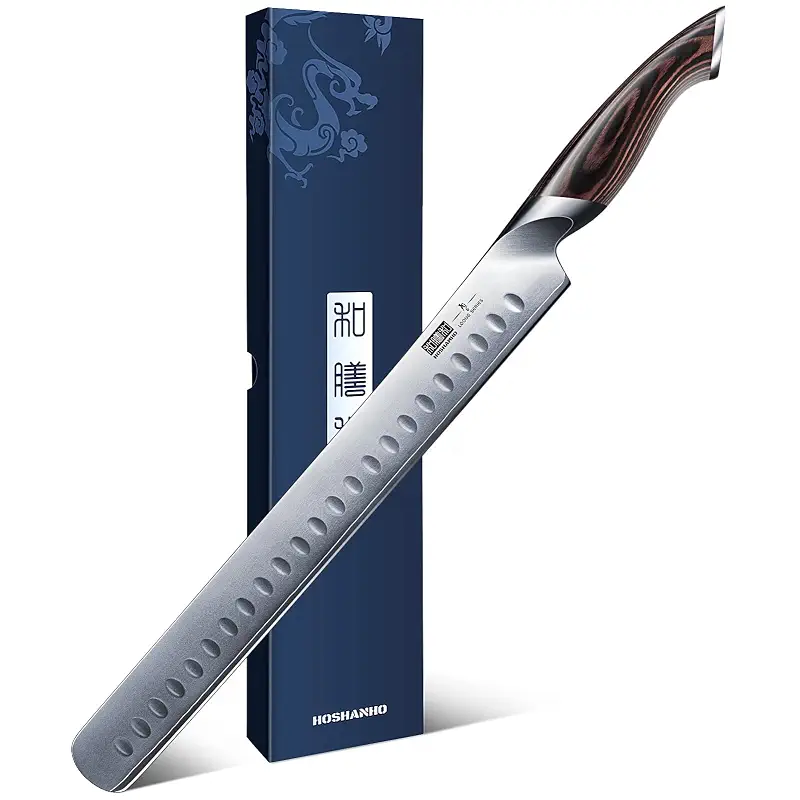
HOSHANHO Carving Knife 12 Inch, Razor Sharp Japanese Brisket Slicing Knife | Japanese High Carbon Steel Brisket Knife with Ergonomic Pakkawood Handle, Breaking Knives for Meat Cutting, BBQ, Turkey
4.8(744)
Single-piece forged Japanese steel with meticulous edge work; a refined tool that delivers quiet, confident performance.
Ideal for: Serious home cooks and small-business pitmasters who value steel integrity and refined execution over warranty coverage.
The Hoshanho 12-inch carving knife (this variant) represents a step up in refinement from the earlier budget model. What sets it apart is the single-piece forge construction, which means blade and handle are forged as one unit rather than assembled. That eliminates any concern about looseness or separation over years of use, and it gives the knife a minimalist, almost minimalist aesthetic that suggests purpose rather than marketing.
Owners describe using it on brisket as nearly meditative: the blade glides cleanly through bark and meat alike with no tearing or resistance. One reviewer noted the longer blade allows you to use long, confident slicing motions rather than short sawing strokes, which reduces hand fatigue and produces better-looking results. The Japanese 10Cr15CoMoV steel treated at sub-zero temperature carries exceptional hardness while resisting brittleness, and the 15-degree edge angle is optimized to minimize cutting resistance. Where the Cutluxe focuses on marketable specs and warranty coverage, this knife prioritizes execution and feel.
Compared to the Cutluxe, this sacrifices some marketing shine for steel quality and forging integrity. The lack of a lifetime warranty may concern some buyers, but owners report the knife holds its edge well and feels like a purpose-built instrument rather than a multi-tool. Storage remains a challenge due to length.
Pros
Single-piece forged construction eliminates separation or looseness
Japanese high-carbon steel maintains sharp edge through extended use
Long blade enables smooth, single-pass cuts without forcing
Cons
12-inch length makes standard knife block storage impractical
No lifetime warranty; reliant on proper care and maintenance
Key features
Single-piece forged Japanese 10Cr15CoMoV high-carbon steel
Proprietary sub-zero temperature treatment for hardness and durability
15-degree ground edge for minimal cutting resistance and precision
Ergonomic handle optimized for long-term comfort and control
#4 Pick
Best for Beginners
Mairico
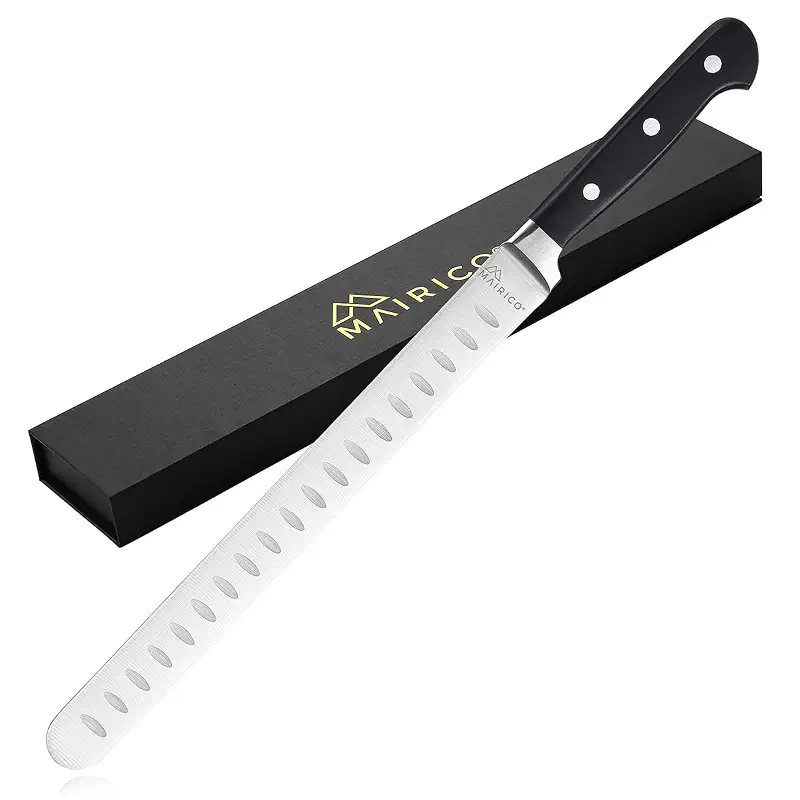
Brisket Slicing Knife - Ultra Sharp Premium 11-inch Stainless Steel Carving Knife for Slicing Roasts, Meats, Fruits and Vegetables
4.7(11,006)
Reliable stainless-steel carving knife with hollow-ground blade; sharp out of box and forgiving for newer users.
Ideal for: First-time carving-knife buyers and home cooks who slice meat occasionally and prioritize ease of use over edge longevity.
The Mairico brisket slicing knife sits slightly shorter than the 12-inch crowd, which actually makes it more approachable for home cooks still building their knife skills. The blade is stainless steel with hollow-ground indents (also called granton edges) that prevent meat from sticking to the blade as you cut, which means less rocking and more gliding. Owners praise the sharpness right out of the box and note that it produces paper-thin slices for roast beef sandwiches or presentation-quality brisket cuts.
One key insight from the reviews: this knife rewards proper technique but doesn't punish you for being inexperienced. Because it's shorter and lighter than the 12-inch German and Japanese options, it's less tiring to control during longer carving sessions, and the stainless-steel construction is more forgiving if you occasionally forget to hand-wash it. The value proposition is strong: owners consistently compare it favorably to knives costing two or three times as much. However, one experienced reviewer noted the blade doesn't hold its edge as long as premium options and requires more frequent honing or sharpening.
Compared to the Cutluxe, which boasts a longer blade and higher Rockwell hardness, this trades longevity between sharpenings for accessibility and a lower entry cost. If you're new to carving large cuts or want something less intimidating to store and handle, this is a pragmatic starting point.
Pros
Arrives sharp and ready to use; no break-in period needed
Hollow-ground indents prevent meat sticking and ease cutting motion
Shorter, lighter blade easier to control for less experienced users
Cons
Edge retention shorter than premium German or Japanese alternative
Requires more frequent sharpening or honing to maintain performance
Key features
premium stainless-steel blade with hollow-ground indents
Well-balanced weight distribution for comfortable grip and control
Engineered for precise cuts with minimal downward pressure needed
Works on brisket, roasts, turkey, ham, salmon, and fruits or vegetables
#5 Pick
Most Versatile
Cutluxe
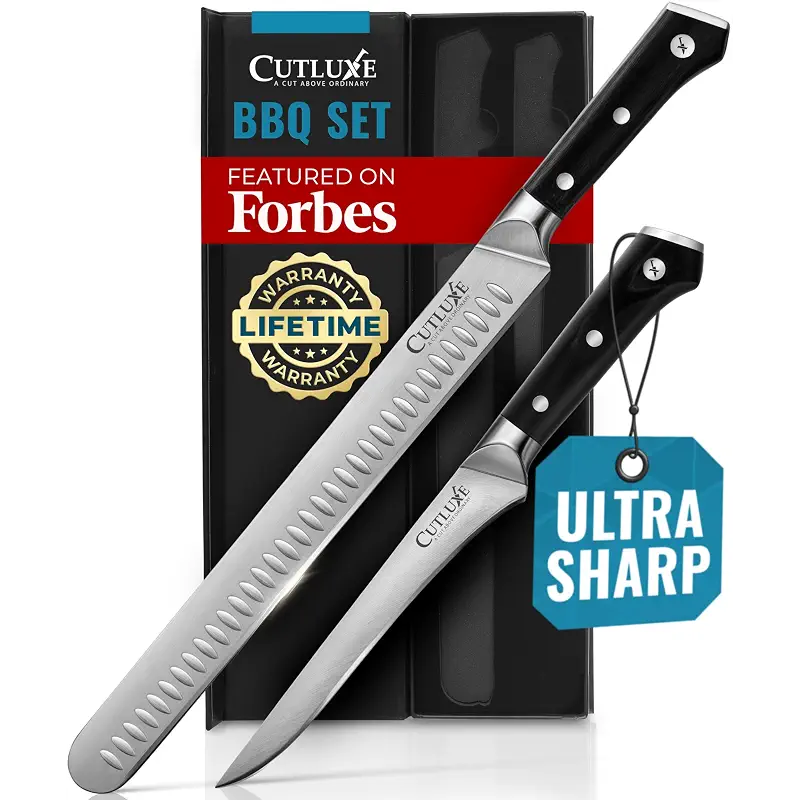
Cutluxe Carving Knife Set, Brisket Slicing & Boning Knife for Meat & BBQ | Razor Sharp German Steel, Full Tang Ergonomic Handle – Grilling Gift for Men, Artisan Series
4.8(1,524)
Two-knife set pairing a 12-inch carving blade with a 6-inch boning knife; covers carving and detail trimming in one purchase.
Ideal for: Serious home cooks, small grillmasters, and gift-givers who want both carving and detail trimming in premium German steel.
The Cutluxe carving knife set answers the question many home cooks face: which single knife covers the whole job? The answer is typically two. The 12-inch slicing knife uses the same German steel (56+ Rockwell) and full-tang construction as the standalone Cutluxe model reviewed earlier, meaning you get the same edge-holding performance and build quality. The addition here is a 6-inch boning knife with granton edges, designed for trimming fat, removing silverskin, and detail work before and after cooking.
Owners describe the larger knife as handling heavy carving duties while the smaller one excels at prep and presentation finishing. The set comes packaged in a velvet-lined box, which signals quality at a glance but also reinforces the storage challenge: you'll need dedicated space for two premium knives, not a standard magnetic strip or block. One buyer noted the blade top edge is cut square, which requires careful handling to avoid finger cuts during use: a minor but real ergonomic note worth knowing.
Where this differs from buying two single knives is convenience and value: the set costs less than purchasing each separately, and the packaging makes it an attractive gift. If you're already committed to hand-washing and careful storage, the dual functionality and Rockwell rating make it a solid investment. Compared to the single-knife options, this suits anyone who butchers whole cuts regularly or wants to handle prep work with the same steel quality as slicing. Much like choosing a top kiritsuke knife when you want versatility and precision in one blade, this set prioritizes multi-purpose performance.
Pros
Dual knives cover carving and detail trimming in one set
Same Rockwell hardness and build quality as standalone Cutluxe
Granton edges on both blades reduce sticking and friction
Cons
Requires dedicated storage space; takes up more room than single knife
Top blade edge is squared, posing small injury risk if mishandled
Key features
12-inch carving knife and 6-inch boning knife with granton edges
Full-tang German steel construction, 56+ Rockwell hardness
Ergonomic handles offer superior control and comfort while slicing
Velvet-lined storage box protects blades and makes an impressive gift
How to Choose the Right Brisket Knife
Blade Length and Geometry
For brisket and large roasts, 11 to 12 inches is the sweet spot. Longer blades let you make one smooth, continuous slice rather than multiple short sawing motions, which preserves the meat's fiber structure and produces cleaner presentation. The edge angle matters too: 14-16 degrees per side is standard for carving knives and offers a balance between sharpness and durability. Anything sharper gets dull faster; anything duller requires more pressure.
German vs. Japanese Steel
When deciding between german versus japanese brisket knives, remember that German steel (high-carbon stainless) forgives occasional dishwasher trips and neglect, while Japanese steel (high-carbon, often harder) holds an edge longer but demands hand-washing and proper storage. German knives typically sit in the 54-56 Rockwell hardness range. Japanese often exceed that. For home use, either works; pick based on your maintenance commitment.
Edge Technology and Maintenance
Granton edges (hollow-ground indents along the blade) reduce sticking and friction, especially useful for brisket and smoked meats. They're not essential but worth having. Hand-sharpened edges from the factory arrive sharper than mass-produced alternatives, but they require proper maintenance. Learning how to sharpen and maintain your meat slicing knife will extend any blade's life by years. Stainless-steel knives are more forgiving; carbon steel requires more discipline.
Storage, Weight, and Handling
A 12-inch knife is long enough to stick out of standard knife blocks, so plan your storage before buying. Full-tang construction (steel running through the entire handle) feels more solid and lasts longer than partial-tang, but it adds weight. Most owners prefer balanced weight over lightweight; less effort means fewer slips and straighter cuts. Budget options tend to feel lighter and less controlled; premium options distribute weight to reduce hand fatigue.
Frequently asked
How sharp should a brisket knife be out of the box?
Premium carving knives arrive hand-sharpened and ready to use, capable of slicing meat cleanly without tearing. Most owners report using them immediately without any honing or sharpening. A truly sharp blade glides through meat with minimal downward pressure. If you receive a knife that requires sawing motions or heavy pressure, contact the seller: it likely wasn't finished properly at the factory.
Can I use a chef's knife instead of a dedicated carving knife?
You can, but a dedicated carving knife performs better. Chef's knives are typically 8 inches and wider, designed for rocking motions and general prep work. Carving knives are longer, narrower, and tapered to a finer tip, allowing smooth slicing strokes that produce clean, even pieces. The extra length also keeps your knuckles clear of the cutting board. A carving knife is a specialist; a chef's knife is generalist.
Should I hand-wash or use the dishwasher?
Hand-wash every time. Dishwasher heat and abrasive detergents dull edges, damage handles, and can cause corrosion over time. Rinse immediately after use, wipe dry, and store safely. This takes two minutes and extends your knife's lifespan by years. It's the single best investment in edge longevity you can make, regardless of the knife's price.
How often do I need to sharpen a carving knife?
A premium carving knife used regularly on a wood or plastic cutting board may hold its edge for 6-12 months of weekly use before requiring true sharpening. Regular honing with a steel between uses extends that window. Stainless-steel knives hold their edge slightly shorter than high-carbon steel. Frequency depends on cutting surface (glass and stone destroy edges fast) and the steel's hardness rating.
What's the difference between a carving knife and a slicing knife?
In professional kitchens, the terms are often used interchangeably, though traditionalists distinguish carving knives (for cooked meats at the table) from slicing knives (for raw proteins in the kitchen). For home cooking, a 12-inch carving knife handles both jobs well. Length, narrowness, and edge sharpness matter far more than the name. Look for a blade that handles the size of meat you're cutting most often.