Best Knife for Raw Chicken: Sharp Boning & Fillet Options
Find the best knife for raw chicken. Compare curved boning knives, fillet knives & butcher sets for clean, precise poultry cuts at home or professionally.
Ideal for: Home cooks and barbecue enthusiasts who process whole chickens or trim large cuts regularly.
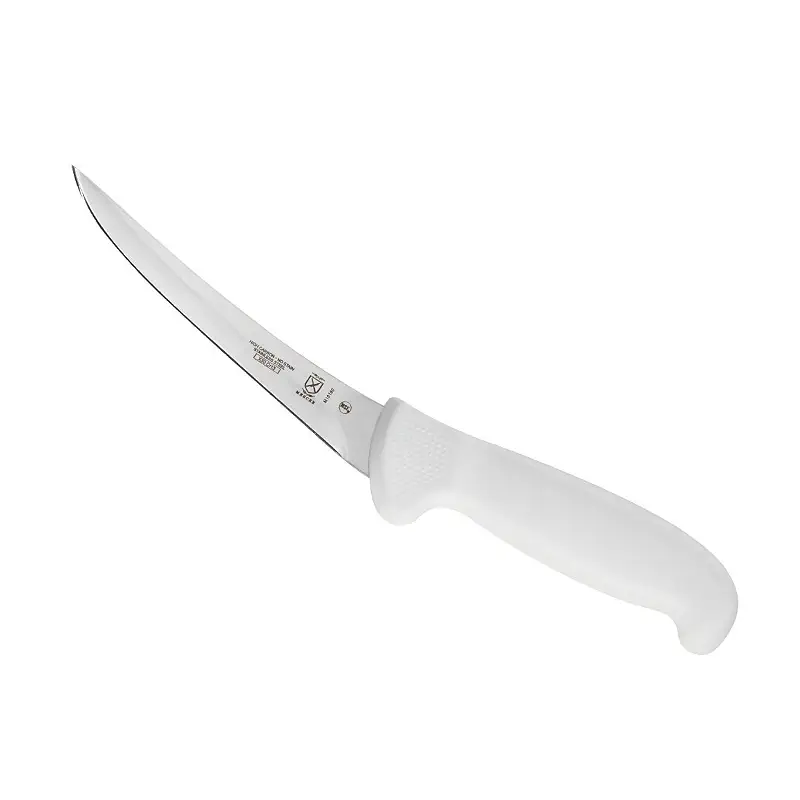
The Mercer Culinary Ultimate White has earned trust from both home cooks and barbecue professionals for its straightforward engineering and consistent performance on poultry. The high-carbon Japanese steel arrives genuinely sharp and responds well to quick maintenance between uses, which matters when you're moving through multiple chickens. The curved blade is the real asset here: it lets you follow the natural contours of bone and joint, reducing the pressure needed to separate thighs from breasts or trim away excess skin and membrane. The white polypropylene handle grips securely even when greasy, though some users report it becomes slick midway through a longer prep session; textured bumps on the grip zones help mitigate this.
Where this knife excels is in versatility. Owners use it for chicken, brisket trimming, and fish filleting without complaint, which speaks to how well the blade geometry solves the core problem: cutting close to bone without wasting meat. The 6-inch length is comfortable for most hand sizes and gives you enough blade to work efficiently without feeling unwieldy.
If you're comparing this to the Victorinox boning knife, I'd choose the Mercer if you want the sharpest edge right out of the box and value the slightly narrower profile for intricate work around joints. The trade-off is that Victorinox's stainless steel is easier to maintain long-term, while the Mercer requires more attentive hand-washing and occasional sharpening.
Pros
Razor-sharp edge straight from the box
Curved blade follows bone contours precisely
Excellent value for Japanese steel quality
Cons
Handle becomes slippery when saturated with grease
Requires hand-washing and attentive maintenance
Key features
6-inch curved blade with high-carbon Japanese steel
Polypropylene handle with textured grip zones
Flexible enough for detail work, stiff enough for control
Designed for separating meat from bone efficiently
#2 Pick
Best for Daily Use
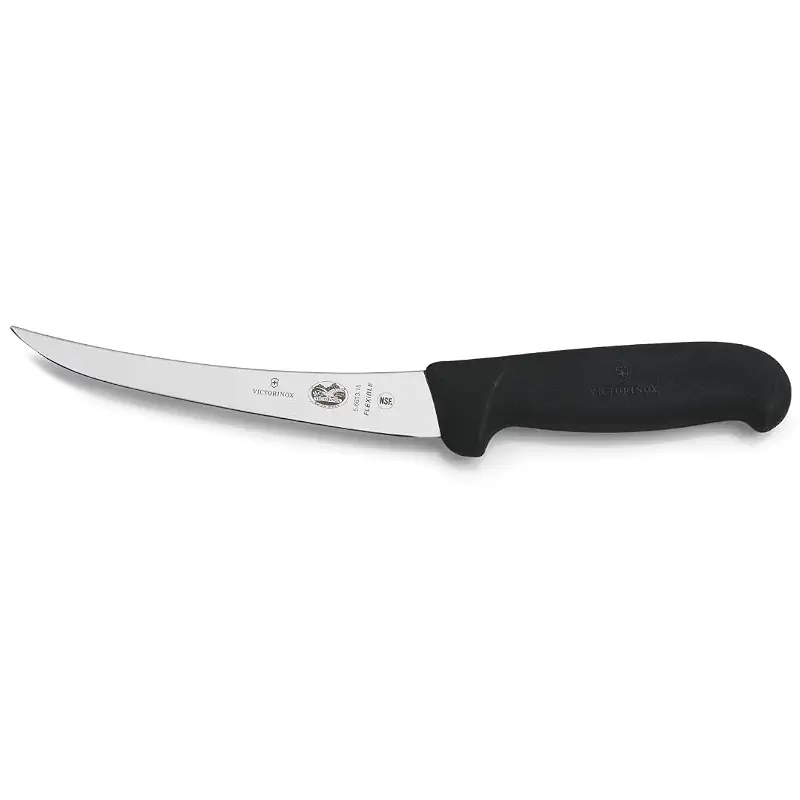
Victorinox
Victorinox Fibrox 6-In Curved Boning & Fillet Knife, Flexible Steel Blade | Ergonomic non-slip handle for meat and poultry, Swiss made precision tool, NSF approved professional grade kitchen cutlery
4.8(4,187)
Flexible curved boning knife with dishwasher-safe design and Swiss-made durability; the everyday workhorse for poultry and fish.
Ideal for: Home cooks seeking a versatile boning knife for chicken, fish, and regular kitchen prep with minimal maintenance.
Victorinox's Fibrox boning knife is the knife America's Test Kitchen calls 'Old Faithful,' and the moniker sticks once you use it. The 6-inch curved blade is flexible enough to bend around delicate chicken joints without fighting you, yet it maintains enough stiffness to cut through cartilage and small bones cleanly. The stainless steel takes a sharp edge and holds it longer than high-carbon models, which means fewer sharpening sessions over the life of the knife.
The Fibrox handle is where this knife earns its reputation for professional use at home. It's ergonomically contoured to sit in your hand without fatigue, stays grip-friendly even when wet or greasy, and is genuinely dishwasher-safe: a practical feature if your kitchen rhythm doesn't allow for hand-washing every single tool. NSF certification speaks to food-safety design, though most home users won't notice the difference. The lightweight feel reduces wrist strain during longer prep work, which matters if you're breaking down multiple birds in one session.
Compared to the Dragon Riot set, this single knife is narrower and more flexible, better for surgical work around individual joints. The Dragon Riot's heavier breaking knife is superior if you're dividing large roasts or handling thick-skinned birds, but this Victorinox is your precision tool.
Pros
Stainless steel holds edge longer between sharpenings
Fibrox handle stays grip-secure when wet or greasy
Dishwasher-safe construction without losing durability
Cons
No protective sheath included in the package
Stainless steel is easier to sharpen but slightly less acute than high-carbon
Key features
6-inch curved flexible stainless steel blade
Swiss-made Fibrox Pro ergonomic handle
NSF-approved food-safety standard
Dishwasher-safe design for low-maintenance care
#3 Pick
Best Value Set
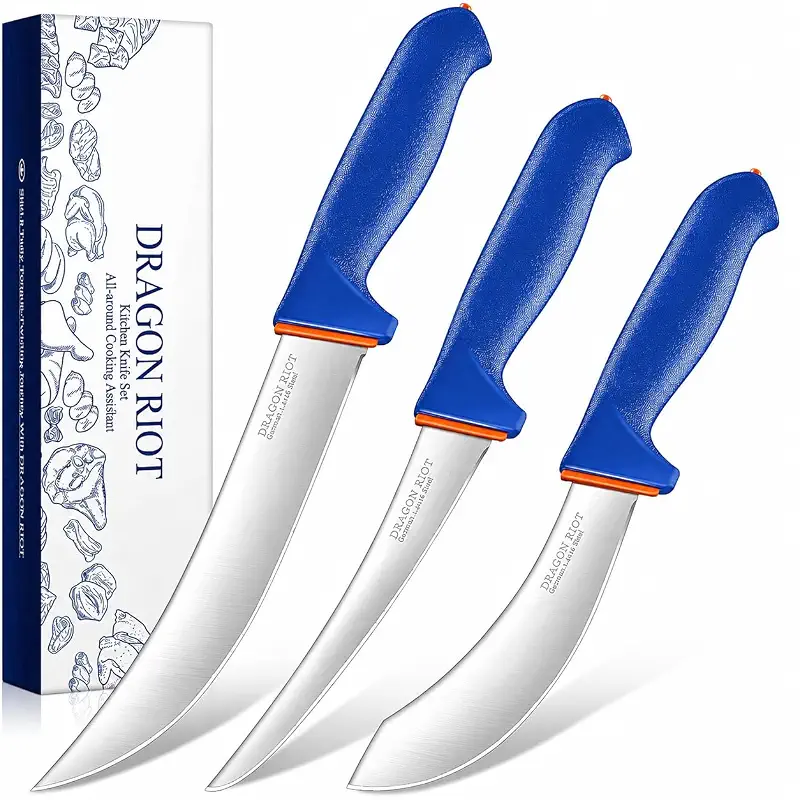
Dragon Riot
DRAGON RIOT 3-Piece Butcher Knife Set, Meat Processing Knives | Stainless Steel, For Meat Processing and Everyday Kitchen Prep
4.6(438)
Three-knife butcher set with boning, skinning, and breaking blades; choose this for variety and breaking down whole birds or large cuts.
Ideal for: Poultry and meat processors who want dedicated tools for boning, skinning, and breaking without buying separately.
The Dragon Riot 3-piece set delivers a complete poultry-processing toolkit at a price that makes you question why anyone buys single knives. You get a 6-inch boning knife for detail work, a 6-inch skinning knife with a shorter, wider blade for peeling skin cleanly, and an 8-inch breaking knife for heavier slicing and separation tasks. German stainless steel with a 58 Rockwell hardness and hand-polished 14-16 degree edge angle means each blade arrives genuinely sharp and durable.
What impresses owners is consistency across all three knives: lightweight handles, secure grips, and edges that stay sharp through multiple uses without immediate maintenance. If you're processing a whole bird, the boning knife handles thighs and breasts, the skinning knife removes skin efficiently, and the breaking knife divides the carcass for stock. For poultry-focused cooks, this justifies itself in one session.
There's a tradeoff against the single-knife precision approach: the breaking knife is longer and heavier than the Victorinox option, which some find tiring for detail work. Where the Mercer or Victorinox let you use one curved blade for everything, this set asks you to switch tools, but gives you the right tool for each job. One noted complaint is that the included steel sharpener is nearly useless; budget separately for a proper honing rod.
Pros
Three different blades for boning, skinning, and breaking work
Hand-polished edges arrive sharp and maintain sharpness well
German stainless steel balances durability with ease of sharpening
Cons
Included steel sharpener is ineffective for proper maintenance
Switching between three knives slows down workflow versus one versatile blade
Key features
6-inch boning knife for joint and tendon work
6-inch skinning knife for clean skin removal
8-inch breaking knife for larger cuts and roasts
High-carbon German 1.4116 stainless steel across all three
#4 Pick
Best for Large Breakdowns
Victorinox
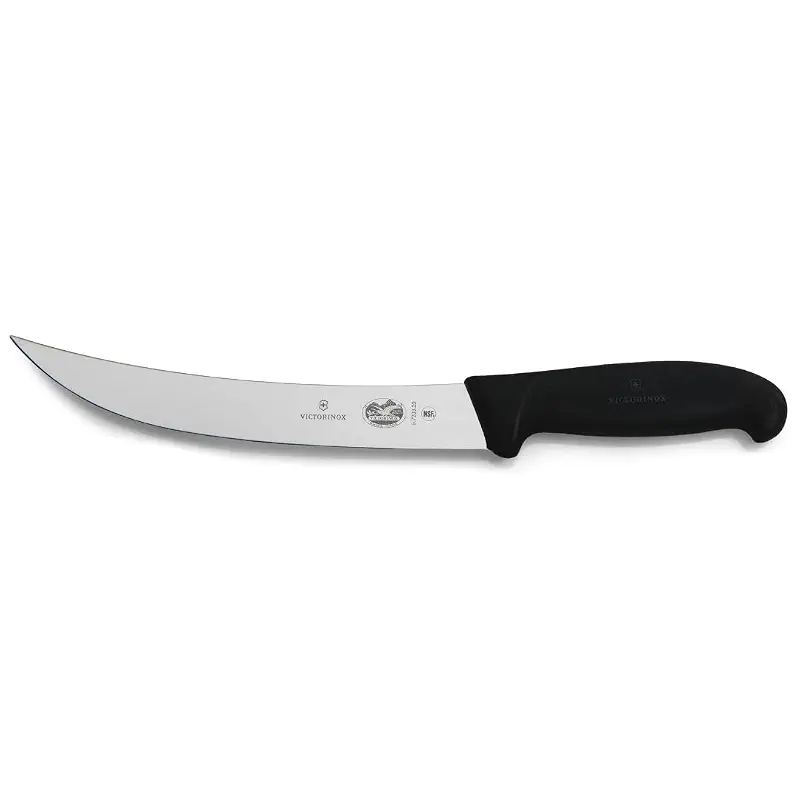
Victorinox Fibrox 8-Inch Curved Breaking Knife - Pro Butcher Slicing Knife | Swiss made stamped stainless steel blade with a non-slip ergonomic handle, NSF approved and dishwasher safe meat knife
4.8(4,044)
Heavy 8-inch curved breaking knife with Swiss precision engineering; dominant choice for trimming large roasts and whole-bird carcass division.
Ideal for: Butchers and home cooks processing whole chickens, large roasts, or whole birds regularly in high volume.
Victorinox's 8-inch breaking knife shifts the focus from precision detail work to efficient volume processing. The wider, heavier blade does the leverage work for you, making it easier to slice through thicker muscle groups and cut uniform portions without the meat sliding apart or tearing. If you're breaking down bone-in chicken thighs by the tray or portioning a whole bird into precise roasting pieces, the extra blade weight is an asset, not a burden.
The turned-up curve at the blade tip is engineered specifically for this task: it prevents the sharp point from digging into your cutting board or catching in meat, which accelerates workflow significantly. Owners who've worked with high-end Japanese steel acknowledge that this Victorinox is easier to sharpen and re-sharpen than harder, more exotic alloys, which matters in practical kitchen terms. You spend less time maintaining it and more time cutting.
Despite its size, it's balanced well enough that wrist fatigue isn't the issue it would be with an unrefined blade. When compared to the Hoshanho fillet knife, this breaking knife is substantially heavier and stiffer: the Hoshanho excels at thin, precise slicing, while the Victorinox is designed for the forcing cut that divides heavy roasts and sectioned birds.
Pros
8-inch blade with strategic weight distribution for leverage
Turned-up tip prevents catching and accelerates cutting rhythm
Swiss-made stainless steel resharpens easily and holds edge reasonably
Cons
Heavier blade is less suited to detailed joint work than smaller boning knives
Longer length requires adequate cutting-board space and control
Key features
8-inch curved blade optimized for meat breaking and portioning
Wider blade profile distributes force and prevents meat from folding
Fibrox ergonomic handle reduces wrist tension during heavy use
Swiss-made stainless steel with easy maintenance sharpening
#5 Pick
Best for Precision Trim Work
Hoshanho
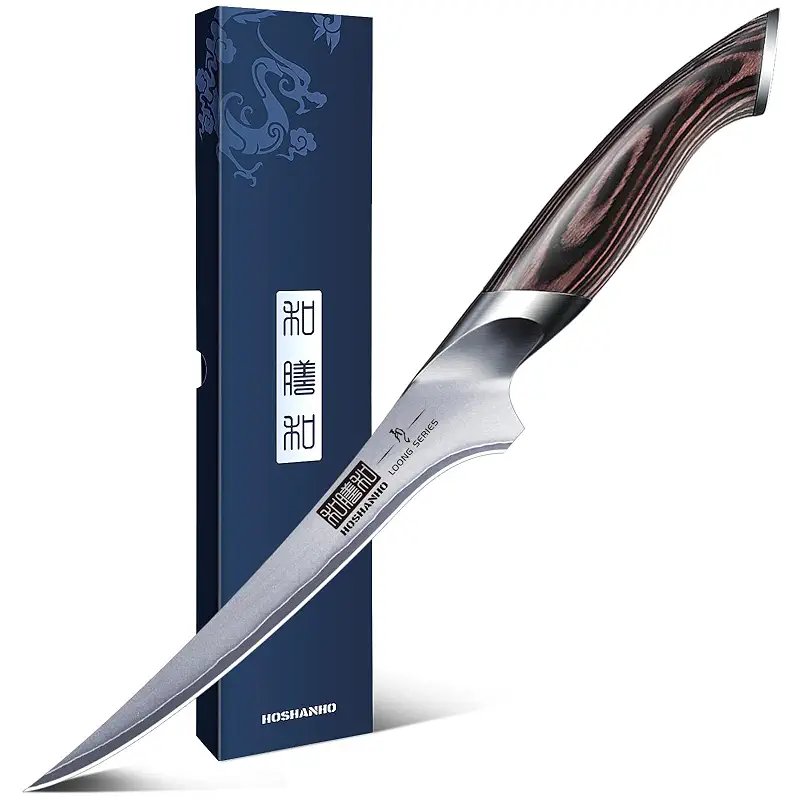
HOSHANHO Fillet Knife 7 Inch, Super Sharp Japanese Fish Boning Knife | Professional High Carbon Stainless Steel Filleting Knives for Meat Poultry Cutting
4.7(4,188)
Japanese 7-inch fillet knife with premium thin blade and PakkaWood handle; unmatched for removing film, sinew, and achieving clean poultry cuts.
Ideal for: Detail-oriented cooks who trim and finish poultry cuts, remove silverskin, or perform delicate fillet and membrane work.
The Hoshanho fillet knife brings Japanese blade geometry to the poultry kitchen in a way the European options don't quite match. The 7-inch blade is thinner and more flexible than boning knives, which means you can work with surgical precision when removing the thin silverskin from a chicken breast or trimming fat membranes that European heavier blades would crush. The 15-degree edge angle on both sides (not the 20-degree European standard) produces a keener point, arriving sharper from the box than most competitors.
High-carbon stainless steel 10Cr15CoMoV is a middle ground between hard Japanese knives that demand skill to sharpen and soft European steel that resharpens easily: it's genuinely durable without becoming a chore to maintain. The PakkaWood handle is more refined than plastic, offering warmth and a premium feel that translates to better control during intricate work. Owners repeatedly mention using this for trimming brisket fat, cutting pockets into breasts for stuffing, and peeling membrane from ribs with minimal waste.
The trade-off is flexibility: this blade is more forgiving than a rigid chef's knife but stiffer than the Victorinox boning knife, which means it's less comfortable for heavy breaking work and more suited to slicing and separating. If you prioritize finishing-level precision over raw processing power, this is your choice over the Dragon Riot set.
Pros
Arrives sharper than most competitors due to 15-degree edge angle
Thin flexible blade excels at membrane and sinew removal
PakkaWood handle provides superior grip and aesthetic refinement
Cons
Less flexible than dedicated boning knives for joint work
Heavier than some Japanese fish knives, lighter than European breaking knives
Key features
7-inch thin flexible blade with 15-degree double-bevel edge
Japanese high-carbon 10Cr15CoMoV stainless steel
PakkaWood handle with ergonomic shape and corrosion resistance
Includes protective plastic sheath for drawer storage
How to Choose a Knife for Raw Chicken
Four trade-offs that actually matter when matching a knife for raw chicken to your kitchen.
Blade Flexibility and Curve Matter Most
A curved boning knife follows the natural contours of bone and joint with less pressure than a straight blade, which is why it's the standard for poultry work. Some curves are subtle; others turn up sharply at the tip. Owners consistently report that the curve reduces hand fatigue and waste because you're working with the bird's anatomy, not against it. A blade that's too rigid forces you to muscle your way through cartilage; one that's too floppy won't cut cleanly. Look for the boning knife versus butcher knife comparison to understand the specific geometry differences, as the two solve different problems.
Edge Angle and Steel Type Affect Maintenance
Japanese steel typically uses a 15-degree edge angle (sharper, requires more frequent maintenance), while European stainless typically runs 20 degrees (slightly less acute, easier to sharpen). High-carbon steel holds a finer edge longer but demands hand-washing and occasional oiling to prevent rust; stainless steel is easier to maintain and often dishwasher-safe. For home cooks processing chicken weekly, stainless is usually the practical choice. If you sharpen regularly and want the sharpest possible cut, high-carbon Japanese options deliver.
Blade Length and Your Hand Size
A 6-inch boning knife is the standard for poultry work and fits most hands comfortably without being unwieldy. Larger hands may prefer a 7-inch fillet knife; smaller hands sometimes find a 6-inch blade easier to control for detail work. The 8-inch breaking knife is for higher-volume processing where leverage and weight assist the cut. Test the knife grip if possible: a handle that aligns with your natural grip angle reduces fatigue significantly over a session of multiple birds. Pairing your knife work with best meat claws gives you options for handling raw birds more securely during prep.
Handle Material and Grip in Wet Conditions
Polypropylene handles are lightweight and dishwasher-safe but can become slippery when saturated with poultry juices and grease. PakkaWood and textured plastic handles offer better grip security when wet. Fibrox (Victorinox's proprietary material) is specifically engineered for food safety and maintains grip even when greasy. If you're processing multiple birds in succession, a secure wet-weather grip isn't a luxury: it's a safety feature that prevents the knife from sliding during the force cut.
Single Knife Versus a Set for Poultry Work
A single curved boning knife handles 80% of chicken prep if you're willing to use it for both detail and breaking work. A three-knife set like the Dragon Riot gives you a dedicated skinning blade and heavier breaking knife, which is faster if you're processing poultry regularly but requires switching tools and storage space. For occasional cooks, one excellent boning knife is simpler; for regular butchery or high-volume prep, a set provides the right blade for each task. The safe raw chicken cutting guide covers technique nuances that apply regardless of your knife choice.
Frequently asked
Quick answers to the questions readers ask most.
What's the difference between a boning knife and a fillet knife?
A boning knife has a short, sharp curve designed to separate meat from bone by following joint contours and cutting close to bone. A fillet knife is thinner and more flexible, designed for slicing parallel to bone with minimal waste. For raw chicken, a boning knife is typically the better choice because it handles joint work and skin removal more efficiently. A fillet knife shines when you're trimming silverskin or removing thin membranes.
Can I use a chef's knife instead of a boning knife for chicken?
A chef's knife works in a pinch, but it's not ideal. The wider blade and straight edge don't follow bone contours as efficiently, meaning you either waste meat or spend more time and pressure getting close to the bone. A curved boning knife is designed specifically for this motion and reduces fatigue. If poultry is a regular task, investing in a proper boning knife saves time and frustration.
How do I keep the blade sharp between sharpenings?
Use a honing rod (ceramic or steel) before or during your cutting session to realign the blade edge: this isn't sharpening but rather maintaining the edge you have. For actual sharpening, high-carbon Japanese steel responds well to whetstones at home, while stainless European knives are easier to sharpen with a steel and honing rod. Handwash immediately after use, dry completely, and store the blade safely (tip down in a block or on a magnetic strip, never loose in a drawer).
Is a dishwasher-safe knife acceptable for poultry work?
Yes, stainless steel Fibrox knives like the Victorinox are dishwasher-safe and designed for professional kitchens where volume processing demands low-maintenance tools. High-carbon Japanese steel is not dishwasher-safe and should be hand-washed to prevent rust. Both approaches work; it's a matter of maintenance preference and how often you use the knife.
What should I look for in a handle for safe, comfortable cutting?
Look for a textured or ergonomically shaped grip that feels secure even when wet or greasy: this prevents the knife from slipping during the force cut, which is where most accidents happen. The handle should sit naturally in your palm without requiring you to grip extra-tight, reducing hand fatigue. Test the balance by holding it mid-blade; the knife should feel like an extension of your hand, not a tool you're controlling.