Kitchen & Dining · Gadgets
Best Knife for Cutting Chicken Bones
Cleavers, a boning knife, a fillet knife and poultry shears sorted by weight, edge and handle, so you can match the tool to your bones.
Affiliate disclosure: As an Amazon Associate I earn from qualifying purchases.
At a glance
5
Best Curved Boning KnifeMercer Culinary
6
Best Shears AlternativeMad Shark
7
Best for Heavy BonesRococo
Detailed reviews
This is the pick we'd hand to a cook who wants one knife for breaking down whole birds and then handling the rest of dinner prep. The blade is described as German high-carbon stainless steel with an 18° double-bevel edge, and the full tang seamless steel handle keeps weight behind the cut. At 1.12 pounds it sits in the middle of this lineup, heavy enough to carry through a poultry joint without the fatigue of the biggest choppers.
Owners report that the edge stays sharp through daily use, that it works through roasts, ribs and tailbones, and that the grip does not slip in the hand. The single-piece construction also earns praise. A caution raised in reviews is that large beef bones are better left to a bone saw, and owners note the handle feels too round, which raises control worries for some cooks. The handle is dishwasher safe, but the maker recommends hand washing to keep the edge longer.
Pros
- Sharp edge that stays that way
- Handles poultry joints and ribs
- Secure, non-slipping grip
- Wide blade doubles as scraper
Cons
- Handle shape feels too round
- Hand washing recommended for the edge
Key features (4)
- Seven-inch German high-carbon stainless steel blade
- 18° double-bevel edge, hand-sharpened on both sides
- Full tang seamless stainless steel handle
- Wide blade usable as a bench scraper
Think of this as the precision tool of the group. The seven-inch blade is Japanese 10Cr15CoMoV steel polished to 15° per side, with a pakkawood handle, and at 0.66 pounds it is far lighter than any cleaver here. Its slim profile suits cutting pockets in chicken breasts, trimming fat and removing bones from thighs, which is how owners describe using it.
Next to the Mueller Home 7-Inch Meat Cleaver Butcher Knife, this is the knife for removing bone rather than breaking it, though Amazon's summary of owner feedback says it also cut through chicken bones. Owners report that it arrives very sharp, holds the edge, and feels balanced and secure in the hand. Reservations are small: the plastic sheath is described as flimsy, reviews call it a touch heavy and long for a boning knife, and it flexes less than fish skinning calls for.
Pros
- Razor sharp straight from the box
- Slim blade suits trimming and boning
- Balanced, comfortable pakkawood handle
- Hand-polished 15-degree edge
Cons
- Plastic sheath described as flimsy
- Blade flexes less than some want
Key features (4)
- Seven-inch Japanese 10Cr15CoMoV steel blade
- Hand-polished 15° edge on each side
- Pakkawood handle with ergonomic shape
- Thin blade for slicing, trimming and butterflying
The Syokami splits its 7.7 inch blade into two sharpening zones: 15° per side at the front for slicing and 30° per side at the rear for chopping small bones. That makes it a sensible choice for a cook who portions chicken, then moves on to squash and herbs without changing knives. Shock-absorbing holes in the blade, a gear-textured FSC-certified wood handle and a built-in herb stripper round out the design.
It weighs 1.06 pounds, close to the Mueller Home 7-Inch Meat Cleaver Butcher Knife, and owners describe that weight as helpful for chopping, including turkey breakdown and partly frozen meat for sausage. Praise centers on sharpness and a comfortable grip. The serious caveat is blade durability: Amazon's summary notes reports of chipping and even a blade breaking on first use, while others find it sturdy. Reviews also raise the worry that the raw wood handle could suffer if left sitting in water.
Pros
- Two edge angles for slicing and chopping
- Weight helps with chopping
- Gear-textured handle resists slipping
- Built-in herb stripper
Cons
- Blade chipping or breaking reported
- Raw wood handle worries about water
Key features (4)
- 7.7 inch blade with 15° front and 30° rear edge
- Shock-absorbing holes to soften chopping rebound
- FSC-certified wood handle with textured grip
- Three-hole herb stripper built into the blade
At 2.56 pounds, this is the heaviest tool on the page, and its design leans into that. The front-heavy blade has a 25-degree V edge and a stated hardness of 60-62 HRC, the back is a blunt side for cracking bone, and the full tang ebony handle is riveted three times. A leather sheath is included, which matters for a blade this size.
The Rococo Meat Bone Cleaver Knife shares this axe-like profile but weighs 2.16 pounds, so the choice between them is partly about how much heft your wrist wants. Amazon's summary of owner feedback is what we have for the Huusk: buyers describe it as sharp, well made and able to chop through turkey bones, cabbage and watermelon. Opinions on weight are the one open question, with some finding it nice and others heavier than expected.
Pros
- Front-heavy weight drives bone cuts
- Blunt back side cracks bones
- Full tang ebony handle
- Leather sheath included
Cons
- Weight divides owners
- Heaviest pick on this page
Key features (4)
- Hand-forged blade with 25-degree V-shaped edge
- Stated hardness of 60-62 HRC
- Double-sided head with blunt bone-cracking back
- Natural ebony handle, 6.3 inches, three rivets
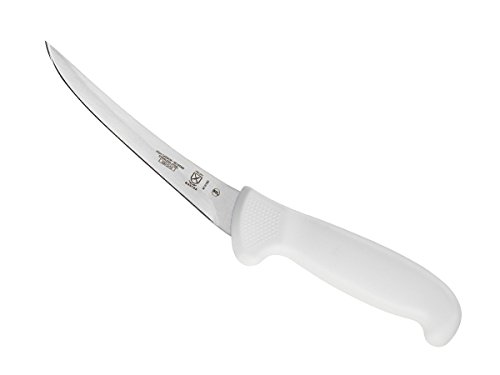
This is a tool for the part of the job that comes after the cleaver: working close to the bone. The six-inch curved blade, made of one-piece high-carbon Japanese steel, gives a better working angle around bones, and at 0.29 pounds it is the lightest knife here. The polypropylene handle has textured finger points for grip.
The Hoshanho Fillet Knife 7 Inch is the closer rival, with a straighter, thinner blade and a wood handle, while the Mercer's curve is built for deboning chicken, trimming fat and sinew, and brisket work. Owners report that it comes very sharp, keeps its edge and trims meat cleanly. Reviews note the handle can get slick with grease and the length feels long for the task, and one who processed deer found it needed frequent steeling; blade flexibility also draws conflicting reports, with some finding it supple and others stiff. The maker asks for hand washing only.
Pros
- Curved blade follows bone closely
- Lightest knife on the page
- Textured handle for grip
- Holds a good edge
Cons
- Handle gets slick with grease
- Blade flexibility reports conflict
- Hand wash only, no dishwasher
Key features (4)
- Six-inch curved blade in high-carbon Japanese steel
- One-piece blade construction with polypropylene handle
- Textured finger points for a non-slip grip
- Designed for deboning chicken, ham and fish
Shears answer the chicken-bone question differently: instead of swinging a blade, you cut with leverage. These have 3.5mm molybdenum-vanadium blades, aluminum handles, a spring-loaded action and a thumb-activated safety lock, and the reviews describe spatchcocking chickens and even a large turkey with little effort. Replacement springs are included.
A cook uneasy about swinging the Huusk Meat Cleaver Knife may find these far more comfortable for backbones and joints. Owners report that the cut is clean and strong, the build feels solid and the shears wipe clean or come apart for washing. The main concern is hand size: the handle spread is wide, which makes them hard to hold for small hands, and the grip is described as both secure and slippery depending on the user. Reviews also note the box lacks spring-change instructions, and spring life is the open question. They are not a slicing knife, so they work alongside a blade rather than replace one.
Pros
- Cuts chicken bones and spines
- Spring action eases one-handed use
- Safety lock for storage
- Spare springs included
Cons
- Wide handle spread tough for small hands
- Grip can feel slippery
Key features (4)
- 3.5mm molybdenum-vanadium steel blades
- Spring-loaded action with thumb-activated safety lock
- Aluminum handles with non-slip finish and thumb rest
- Dishwasher-safe construction with replacement springs
The Rococo is built for harder work than a single chicken. The 6.3-inch blade is 5mm thick with a 25° V-shaped edge, forged with the handle as one full tang piece, and it weighs 2.16 pounds. Owners report that it goes through turkey necks, pork ribs and beef bones, stays sharp across repeated bone cuts, and does not chip or bend on impact.
Pair it with the Mercer Culinary 6 Inch Curved Boning Knife if you want a strong chopper for bones and a light blade for trimming. Reviews advise against it if chicken is all you cut, since pork ribs and beef bones suit it better, and we agree that it is oversized for light poultry work. The maker also warns that it rusts if left damp, so wipe it dry after washing; this is a knife that asks for a little routine care.
Pros
- Cuts through ribs and beef bones
- Does not chip or bend
- Full tang forged without soldering
- Stays sharp after repeated use
Cons
- Oversized if you only cut chicken
- Needs drying after each use
Key features (4)
- Hand-forged high carbon stainless steel blade, 5mm thick
- 25° V-shaped edge to reduce cutting resistance
- Integrated full tang handle with non-slip grip
- Oxford cloth cover for carrying
Side by side
| Pick | Item weight | Listed size |
|---|
#1 Best Overall
Mueller | 1.12 pounds | 7" |
#2 Best Thin Blade
Hoshanho | 0.66 pounds | 7" |
#3 Most Versatile
Syokami | 1.06 pounds | 7.7 Inch |
#4 Heaviest Chopper
Huusk | 2.56 pounds | 6.69 IN |
#5 Best Curved Boning Knife
Mercer Culinary | 0.29 pounds | 6" |
#6 Best Shears Alternative
Mad Shark | — | — |
#7 Best for Heavy Bones
Rococo | 2.16 pounds | 6.3" |
How to Choose a Knife for Cutting Chicken Bones
How much weight and thickness do chicken bones need?
Chicken bones are small, but joints and backbones still need either mass or leverage behind the blade. A heavier, thicker cleaver carries through on its own momentum, while a lighter one demands more wrist action and a second pass on denser joints. A lighter blade is easier on a smaller hand, though, so weight should match both the bones and the cook.
For a middle path, the Mueller Home 7-Inch Meat Cleaver Butcher Knife weighs 1.12 pounds and is comfortable for most poultry work. If you regularly go on to ribs and beef bones, the Rococo Meat Bone Cleaver Knife has the 5mm thickness and heft for that job, though it is more than chicken alone requires.
Do you need a cleaver, or something thinner?
A cleaver chops through bone; a boning or fillet knife works around it. Home cooks often need only the second kind of cut, because the aim is to free meat from the bone rather than to split it. The Mercer Culinary 6 Inch Curved Boning Knife suits that task, with a curve that stays close to the bone, and the Hoshanho Fillet Knife 7 Inch gives you a straighter, thinner blade for trimming and boning.
If the job is mostly boneless thighs and breasts, our guide to the best knife to cut chicken covers lighter blades that make more sense than a heavy chopper. For spines and breastbones without a swing, the MAD SHARK Heavy Duty Poultry Shears use leverage instead.
For chicken alone we'd start with the Mueller Home 7-Inch Meat Cleaver Butcher Knife if you want one blade for chopping and prep, the MAD SHARK Heavy Duty Poultry Shears if you mostly spatchcock, and the Mercer Culinary 6 Inch Curved Boning Knife if you mostly bone.
- Cleaver: splits joints, backbones and larger bones
- Boning knife: frees meat from bone with fine control
- Fillet knife: thin blade for trimming and skinning
- Poultry shears: cut spines and joints by leverage
What handle and care should you expect?
Handle shape decides how safe a heavy blade feels, especially with wet or greasy hands. Look for a full tang, where the steel runs through the handle, and a textured or contoured grip. Wooden handles look good but dislike standing water, and carbon-style steels want to be dried right after use.
The Syokami Meat Cleaver Chef Knife 7.7 Inch pairs a gear-textured wood handle with a two-zone edge, but keep it dry and watch for edge damage reports. The Huusk Meat Cleaver Knife offers an ebony handle on the heaviest build, so check that its weight suits your wrist before committing.
- Wash by hand and dry the blade straight away
- Keep wood handles out of standing water
- Store sharp blades in a sheath or on a rack
- Match blade weight to your wrist strength
Our picks at a glance
5
Best Curved Boning KnifeMercer Culinary
6
Best Shears AlternativeMad Shark
7
Best for Heavy BonesRococo
Frequently asked
Can poultry shears replace a knife for chicken bones?
For cutting spines, ribs and joints, yes: shears use leverage instead of a swing, and the MAD SHARK Heavy Duty Poultry Shears are the pick here for spatchcocking and portioning. They do not slice, so you still want a knife for boneless cuts, and the wide handle may not suit small hands.
Is a heavy cleaver overkill for chicken?
Often, yes. Chicken bones are thin, so a mid-weight cleaver like the Mueller Home 7-Inch Meat Cleaver Butcher Knife is usually enough, while the Rococo Meat Bone Cleaver Knife makes more sense if ribs and beef bones are also on your board.
Can these knives go in the dishwasher?
Check each one before you load it. The Mueller Home 7-Inch Meat Cleaver Butcher Knife has a dishwasher-safe handle but the maker recommends hand washing to preserve the edge, and the Mercer Culinary 6 Inch Curved Boning Knife is listed as hand wash only. Hand washing and drying right away is the safest habit for any of them.
How do you stop a forged cleaver from rusting?
Wash it as soon as you finish, dry it completely and store it dry. The Rococo Meat Bone Cleaver Knife carries a maker warning about rust, so it needs drying after washing, and the same routine suits the Huusk Meat Cleaver Knife.