Kitchen & Dining · Cookware
Best Kitchen Knife Under 50: Top Choices for Home Cooks
Find the best kitchen knife under 50. Compare sharp chef knives, santoku blades, and budget options. Expert picks for home cooks and everyday use.
Affiliate disclosure: As an Amazon Associate I earn from qualifying purchases.
At a glance
3
Best Long-Term Durabilityimarku
5
Best for Beginners & Easy CareVictorinox
Detailed reviews
The Paudin 8-inch chef knife has earned its reputation through consistent, reliable performance. What stands out is the combination of edge retention and comfort: owners who've used it daily for months report it still cuts tomatoes cleanly without crushing them, which is the real test of a budget blade. The 2mm thickness strikes a practical middle ground: thin enough to feel responsive, sturdy enough not to flex annoyingly through tougher vegetables and meat.
The ergonomic wooden handle is genuinely comfortable during longer prep sessions, and the weight distribution between blade and handle feels considered rather than accidental. We'd choose this over the imarku santoku if you want pure versatility, since an 8-inch chef's knife handles everything from mincing herbs to breaking down chicken, whereas a santoku is more specialized for slicing.
One honest limitation: the spine has sharp edges near the handle if you like to press down with the flat of your blade. Some owners note this takes a moment to adjust to, but it's not a flaw that worsens with age. Hand-wash only, like any good knife, and it will hold its edge longer than you might expect at this investment level, the same care applies to the best folding fillet knife, where blade maintenance determines how cleanly it handles lake trout at a remote camp.
Pros
- Razor-sharp edge right out of box, holds sharpness months
- Lightweight with excellent blade-to-handle balance
- Comfortable wooden grip for extended cutting sessions
Cons
- Spine near handle has square edges, may feel sharp when pressing
- Requires hand-washing; stainless steel needs prompt drying
Key features (4)
- 8-inch high-carbon stainless steel blade, 2mm thickness
- Hand-polished by craftsmen; etched wave pattern on blade
- Ergonomic wood handle with full tang construction
- Includes protective blade sleeve and gift box
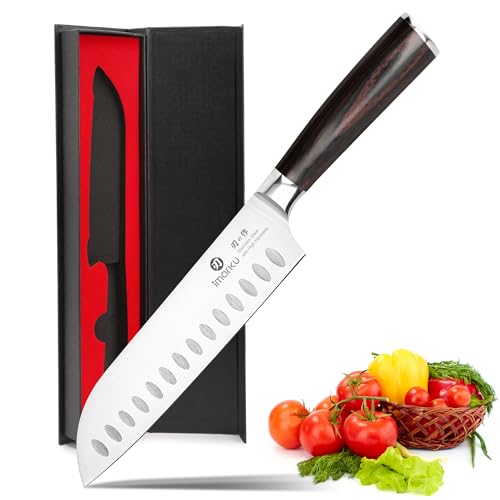
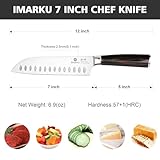
The imarku 7-inch santoku takes a different approach than a traditional chef's knife. Its straight edge and flat profile work beautifully for slicing vegetables, fish, and fruits with paper-thin precision: owners rave about cutting cherry tomatoes so thin they're translucent. The hollow-edge design (those small scallops along the blade) creates tiny air pockets that let food release from the knife without sticking, which matters when you're dicing onions or slicing stacks of mushrooms.
Compared to the Paudin chef's knife, this sacrifices some versatility for pure cutting finesse. Where the chef's knife rocks and chops, the santoku pushes straight down: a different motion that takes maybe one meal to get comfortable with, then becomes second nature. The Pakkawood handle is stable and sanitary, resisting the warping that can plague wooden handles over time, though some early reviewers noted slightly protruding rivets; newer batches seem to have addressed this.
The 15-18 degree edge per side is sharper than most German-style knives and holds up well to daily use. At 2.5mm thickness, it's slightly thicker than the Paudin, which gives it a touch more durability when working through denser items, though it's still very much a slicer's tool rather than a chopper's. For tasks like preparing chicken, the best knife to cut chicken breast is typically a chef's knife rather than a santoku, since you need leverage and rocking motion more than pure slicing precision.
Pros
- Hollow-edge scallops prevent food sticking during slicing
- Sharp 15-18 degree edge, excellent for precise cuts
- Stable Pakkawood handle resists warping and cracking
Cons
- Not ideal for heavy chopping or breaking down whole poultry
- Requires hand-washing and prompt drying like all high-carbon steel
Key features (4)
- 7-inch santoku blade with Japanese high-carbon stainless steel
- Hollow-edge scallop design reduces food adhesion
- 2.5mm blade thickness with 15-18 degree edge per side
- Pakkawood handle with ergonomic advanced manufacturing process
The imarku Japanese 8-inch chef's knife has one credential that matters to budget-conscious buyers: owners who've used it for a decade report it still performs like a serious tool. One owner with ten years of daily use even got a replacement blade under imarku's lifetime warranty in just two days, which tells you something about how the company stands behind the product. The 56-58 HRC hardness (Rockwell scale) means this blade is noticeably harder than lower-tier stainless options, so it resists dulling from regular use.
The high-carbon stainless composition with 16-18% chrome gives you corrosion resistance without the maintenance burden of pure carbon steel. It's heavier than the Paudin, which some cooks prefer for a more substantial cutting feel, though it's not so heavy that it causes fatigue. The Pakkawood handle shares the same stability advantages as the imarku santoku. Where this knife differs from the Paudin is in its proven longevity; if you're planning to reach for the same knife for years, this ranks among the best kitchen knives under 50 despite the slightly higher price in that range.
Sharpening is straightforward with standard honing steel, though the higher hardness means you'll need to maintain it more carefully than softer blades. The trade-off is that it holds an edge longer between sharpenings.
Pros
- Proven 10+ year durability with verified owner testimonies
- Higher hardness (56-58 HRC) resists dulling from daily use
- Genuine lifetime warranty backed by fast replacement service
Cons
- Slightly heavier than some alternatives, not for everyone
- Requires regular hand-washing and careful storage
Key features (4)
- 8-inch gyutou blade with 0.6-0.75% carbon content for hardness
- High-carbon stainless steel, 56-58 HRC hardness rating
- Ergonomic Pakkawood handle from FSC-certified African wood
- Includes protective sheath and lifetime warranty against defects
The Keemake 8-inch chef knife arrives with the most aggressive edge geometry of the lineup: hand-sharpened to 8-12 degrees per side, versus the 15-18 degree edges on Japanese models. This means it's almost frightening in its initial sharpness. Owners describe cutting ripe tomatoes without crushing them, slicing partially frozen meat cleanly, and making julienne cuts with minimal effort. The 1.4116 German high-carbon stainless steel at 58±2 HRC hardness is premium material for the price range, and it holds that scary-sharp edge longer than you'd expect.
Compare this to the Victorinox further down the list, and the Keemake sacrifices some forgiving durability for cutting performance. The steeper edge is sharper but slightly more vulnerable to chipping if you accidentally strike bone or a hard cutting board. That said, most home cooks won't stress the blade that way. The Pakkawood handle mirrors the construction quality of the imarku models, and the included sheath is a practical touch for drawer storage. Manufacturing tolerances are tighter here: one reviewer noted some rough edges on the handle's pommel, worth checking when it arrives, though sanding takes two minutes.
Sharpening this knife demands respect for its bevel angle; use the included instructions or you risk degrading the edge. But if you want maximum sharpness and don't mind a little extra care, this is where peak cutting performance lives under fifty dollars. Specialized blades like the best kiritsuke knives demand similarly precise maintenance, so if you're willing to invest in technique, this knife rewards that commitment.
Pros
- Sharpest edge in the group at 8-12 degree bevel
- Premium 1.4116 German high-carbon stainless steel, 58±2 HRC
- Holds exceptional edge through weeks of heavy daily use
Cons
- Steeper edge more prone to chipping on hard surfaces
- Requires careful sharpening at precise angles to maintain
Key features (4)
- 8-inch blade, 1.4116 high-carbon stainless steel, 58±2 HRC hardness
- Hand-sharpened to 8-12 degree bevel per side
- Ergonomic Pakkawood handle with curved design and sloped bolster
- Includes protective sheath, polishing cloth, and gift box
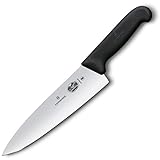
The Victorinox Fibrox Pro stands apart because it's the only knife in this lineup that's genuinely dishwasher-safe and requires no special maintenance. The stainless steel (chromium carbide, not high-carbon) dulls faster than the premium options above, but it also won't rust if you're lazy about drying it, and you won't spend mental energy worrying about proper care. This makes it ideal for a kitchen where multiple people cook, or where a knife might sit wet for a while.
Owners consistently report it arrives sharper than expected and slices vegetables with surprising ease for a budget blade. The 5.7-ounce weight and tapered stainless edge mean less hand fatigue during long prep sessions, particularly notable for people with arthritis or smaller hands. America's Test Kitchen endorses it as their top pick under a hundred dollars, which speaks to how Swiss engineering and fifty-plus years of professional kitchen use translate even at this price point.
The honest limitation: this knife dulls faster than the high-carbon models above. Most users report needing to hone it (use a steel) before each cooking session and sharpen it more frequently than the premium blades. But that's by design: lower hardness means easier maintenance for home cooks who don't own whetstones. If you want a no-fuss knife that just works and doesn't demand expertise, this is the practical choice. Where a knife like the Keemake prioritizes peak sharpness, the Victorinox prioritizes reliability and ease.
Pros
- Genuinely dishwasher-safe; low-maintenance stainless steel
- Exceptionally light at 5.7 ounces, reduces hand fatigue
- Swiss-made, proven in professional kitchens for decades
Cons
- Dulls faster than high-carbon models; requires more frequent honing
- Lower hardness means edge won't hold as long between sharpening
Key features (4)
- 8-inch stainless steel blade, laser-tested for consistency
- Lightweight at 5.7 ounces with excellent balance
- Ergonomic TPE Fibrox non-slip handle, dishwasher safe
- Swiss-made since 1884; lifetime warranty against defects
How to Choose a Kitchen Knife Under 50
Blade Style: Chef Knife vs. Santoku
A traditional 8-inch chef's knife is your workhorse: it rocks, chops, minces, and slices in one tool. A santoku (7 inches) excels at precision slicing and dicing, using a straight-down motion rather than a rocking motion. If you cook a lot of vegetables and fish and enjoy exact cuts, the santoku shines. If you break down whole chickens, make stocks, or want one blade to do everything, go with a chef's knife. Specialty knives like kiritsuke knives offer Japanese-style precision for advanced cooks, but most home kitchens benefit more from mastering a single versatile chef's knife first. The difference in blade style often matters more than the brand when it comes to how much you'll actually enjoy using it.
High-Carbon vs. Stainless Steel
High-carbon stainless steel (the Paudin, imarku, and Keemake models) gets sharper and holds an edge longer, but requires hand-washing and prompt drying. Pure stainless steel (the Victorinox) dulls faster but is forgiving: it won't rust if you forget it in the sink. If you're just starting out or cook with others who might not hand-wash, the Victorinox removes stress. If you cook alone and want maximum edge retention, high-carbon is worth the care commitment. This choice often shapes your entire relationship with the knife, so think honestly about your kitchen habits.
Sharpness and Maintenance via Chef Knife Sharpening and Care
A sharp knife is safer than a dull one because it requires less force and is less likely to slip. Most knives under fifty arrive impressively sharp, but they dull at different rates. German-style blades (wider edge angle, around 20 degrees) hold up to neglect better. Japanese-style blades (narrower angle, 12-15 degrees) feel sharper but need more consistent honing. Use a honing steel before each session to realign the edge, and sharpen with a whetstone or pull-through sharpener a few times a year. The Victorinox is the exception: it's easier to maintain because it's softer steel, but it also demands more frequent attention.
Handle Comfort and Weight
The best knife is the one you'll reach for, and that depends on your hand size and grip preference. Heavier knives (like the imarku 8-inch) feel more substantial and do more work for you; lighter knives (the Victorinox) reduce fatigue over long sessions. A wooden handle feels warm and provides grip, while synthetic materials like Pakkawood are stable and sanitary. If you have arthritis or hand pain, a lightweight knife with a comfortable grip becomes your most important feature. Spend a moment thinking about which knife feels right in your hand before ordering, since returns add friction to a budget purchase.
Understanding Santoku and Chef Knife Differences
The main functional difference comes down to cutting motion and blade geometry. A chef's knife has a curved edge that lets you rock it back and forth while staying on the board. A santoku has a flat edge that works straight down: better for precise slicing, less versatile for rough work. A chef's knife also typically has a wider blade, offering more knuckle clearance and more leverage for heavy tasks. Once you understand santoku and chef knife differences, you can pick based on your actual cooking style rather than following trends. Neither is objectively better; they're built for different jobs.
Our picks at a glance
3
Best Long-Term Durabilityimarku
5
Best for Beginners & Easy CareVictorinox
Frequently asked
Can I really use a budget knife for years without it falling apart?
Yes, if you choose the right one and maintain it. Owners report using the imarku 8-inch model for a decade with daily use. The key is hand-washing, prompt drying, and occasional honing. The cheaper your knife, the more care matters. A fifty-dollar knife treated well will outlast a two-hundred-dollar knife treated poorly. Expect to hone before each use and sharpen a few times a year, and you'll get years of reliable performance.
What's the difference between honing and sharpening?
Honing realigns the edge between sharpenings: it takes thirty seconds with a steel rod and extends your knife's working life between actual sharpening sessions. Sharpening removes material to create a new edge; it's necessary a few times a year but more involved. Using a steel regularly means your knife stays sharp longer and you sharpen less often. For budget knives, consistent honing is the secret to making them perform like more expensive blades.
Is an 8-inch knife too big for a small kitchen or small hands?
An 8-inch chef's knife is standard and manageable for most cooks, even those with smaller hands. The Victorinox at 5.7 ounces and the imarku santoku at 7 inches are both lighter and smaller alternatives if an 8-inch feels unwieldy. Visit a kitchen store to hold different sizes if you can; the right feel matters more than the spec sheet. A slightly smaller blade you'll actually use beats a bigger blade that stays in a drawer.
Do I need a knife block or sharpener if I buy one of these?
No block is required, but storage matters for edge protection. A magnetic strip, a drawer with blade guards, or a simple sheath keeps your edge from dulling prematurely. A honing steel (around twenty dollars) is more important than a sharpener if you maintain regularly: most home cooks never need a dedicated sharpener if they hone consistently. If you want to sharpen at home, a basic pull-through sharpener or a one-thousand-grit whetstone covers most needs.
Which knife is safest for a beginner or someone learning to cook?
The Victorinox is safest in the sense that it's forgiving and won't punish bad technique. It dulls faster, so you'll feel when you're pressing too hard instead of letting the blade do the work. The Paudin or imarku models are sharper right out of the box, which means they're actually safer once you learn proper technique because they cut cleanly with minimal force. Pick based on your comfort level: if you're nervous, start with the Victorinox; if you're ready to learn proper knife skills, the sharper models teach you faster.