Kitchen & Dining · Making
Best Keg CO2 Regulator for Draft Beer and Kegerators
Find the best keg CO2 regulator for your draft beer system. Compare dual-gauge models, dual-output designs, and commercial-grade options for consistent carbonation.
Affiliate disclosure: As an Amazon Associate I earn from qualifying purchases.
At a glance
4
Best for Multiple KegsKegco
5
Best Dual-Output ValueDbgogo
Detailed reviews
The Hilangsan strikes a practical balance between precision and ease of use. Its two-stage design reduces tank pressure in steps, which stabilizes output pressure, something homebrewers and bar operators both appreciate when they want consistency without fussing. The locking knob is a genuine quality-of-life feature; accidentally bumping the adjustment is one of those small frustrations that adds up over time, and this model eliminates it. The gauge clarity matters more than spec sheets suggest; large, readable dials mean you can diagnose pressure problems at a glance instead of leaning in to squint.
Owners report the unit holds pressure well and doesn't bleed down overnight: a reliable baseline for any regulator. The included sealing washers and thoughtful packaging (extra clamps, multiple barb options) show the maker understands what buyers actually need when converting or installing. A few users report the relief valve can leak below maximum rated pressure, though this appears to be an isolated tolerance issue rather than a design flaw.
Compared to premium models that cost two or three times as much, this delivers the core function most home setups need. It's not a commercial-grade piece of gear, but it earns its place through durability and straightforward operation.
Pros
- Locking knob prevents accidental pressure drift
- Dual-stage design stabilizes output pressure reliably
- Clear dual gauges with protective shockproof case
- Includes sealing washers and multiple barb fittings
Cons
- Relief valve occasionally leaks below rated pressure
- Entry-level build compared to commercial-grade units
Key features (5)
- Dual-stage reduction with lock-nut pressure adjustment
- 0-60 PSI output gauge and 0-3000 PSI tank gauge
- Heavy-duty chrome-plated brass construction
- inlet, compatible with standard CO2 tanks
- Includes sealing washers and swivel fittings
#2 PickMost ProvenKegco
The industry standard for home and light-commercial use.
Ideal for: Home and small-commercial brewers who value proven durability and a large community of users for troubleshooting.
The Kegco 542 has earned its reputation through sheer longevity and consistency. With more than a thousand reviews and a solid 4.1 average, it represents the accumulated experience of a real installed base: homebrewers, bar owners, and even SodaStream alternatives all rely on it. The forged brass body and sealed design mean it resists corrosion and holds pressure over years, not months. The dual gauges (0-60 PSI output, 0-2000 PSI tank) cover the range most users need, and the large hand control knob makes adjustments intuitive.
Owners consistently note reliable performance over months and years of regular use. Some mention the adjustment knob can feel stiff under pressure and that fine-tuning requires a wrench rather than bare hands, but users acknowledge this is a trade-off for a more robust design. The 45-PSI safety relief valve is appropriately conservative. A handful of users report bent faceplates or early gauge failure, but these are exceptions in a pool of thousands, and the company's track record of honoring replacements is solid.
Where the Hilangsan prioritizes affordability and the Sparc Gen2 emphasizes premium finish, the Kegco 542 sits in the proven middle: it costs less than high-end models but more than bare-minimum options, and it delivers the kind of reliability that keeps operators from worrying about their gear.
Pros
- Forged brass body resists corrosion over years
- Large installed base with documented long-term reliability
- Straightforward dual-gauge design and large hand knob
- Excellent customer support and replacement history
Cons
- Adjustment knob stiffens under pressure, often needs wrench
- Gauge faceplates occasionally arrive bent from manufacturing
Key features (5)
- Forged brass body with all-brass connections
- Dual gauges: 0-60 PSI output, 0-2000 PSI tank display
- Integral safety relief valve at 45 PSI
- Large hand control knob for pressure adjustment
- Includes tank connection washer and sintered brass inlet filter
The Sparc Gen2 targets the homebrewer or bar operator who wants precision without sacrificing usability. Its standout feature is the oversized 2-3/8-inch rubber-clad gauges: the larger display makes reading pressure at a glance easier than smaller dial faces, and the rubber boots protect them from drops. The factory calibration and higher gauge range (0-3500 PSI on the tank gauge, 0-80 PSI output) give slightly more resolution for fine adjustments. Unlike the Kegco 542, this regulator can resolve smaller pressure changes, which matters if you're dialing in different carbonation levels across multiple kegs.
Owners praise the build quality and ease of adjustment. The included bottle nut wrench and multiple sealing washers reduce installation friction. Some users note slight pressure drift overnight (a drop of a few PSI), which appears tied to knob hysteresis rather than a leak: a minor caveat that doesn't affect most operators. One critical review flagged overpressurization on unused kegs, but this is a system design issue, not a regulator flaw; kegs should always have a pressure relief valve if left pressurized. Where the Hilangsan prioritizes value and the Kegco 542 emphasizes proven reliability, the Sparc Gen2 leans toward refinement and precision for setups where consistency matters most.
Compared to other premium-tier models, the Sparc Gen2 balances cost and capability well: it's a genuine step up in gauge clarity and build feel without premium-sector pricing.
Pros
- Oversized rubber-clad gauges for easy, accurate readings
- Factory-calibrated for higher resolution pressure adjustment
- Sturdy construction with protective gauge boots
- Includes wrench and extra sealing washers for clean setup
Cons
- Slight overnight pressure drift reported by some users
- Heavier unit may tip smaller CO2 tanks under pressure
Key features (5)
- Oversized 2-3/8-inch factory-calibrated dual gauges
- Output pressure range 0-60 PSI, tank gauge 0-3000 PSI
- Integrated safety relief valve with manual release knob
- Includes 1/4-inch, 3/8-inch, and push-to-connect fittings
- Heavy-duty construction with protective gauge boots
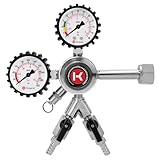
The Kegco Premium Commercial Grade takes a different approach: instead of managing pressure to one output line, it splits pressure between two kegs through separate shut-off valves. This is genuinely useful for bars, tasting rooms, or serious homebrewers running a dual-tap setup without needing a secondary regulator. The multi-stage body design is the real innovation here; it reduces tank pressure first, then fine-tunes output in a second stage. The result is a knob that rotates less than a full turn for the entire pressure range, making micro-adjustments far easier than models where small turns of the knob cause big pressure jumps.
Owners consistently praise how smooth and responsive the adjustment is compared to cheaper single-stage models. One reviewer described switching from a cheaper regulator that required multiple turns to get any response; this unit delivers proportional control. The built-in check valves prevent backflow into the regulator if a keg develops pressure, an important safety feature for commercial environments. The rubber-clad gauges are protected, and the manual pressure release knob provides failsafe venting.
Where the Sparc Gen2 prioritizes single-output precision, this model solves the two-keg problem elegantly. It costs more than single-output regulators, but operators of multi-tap setups find the dual control worth it. This is the choice if your next step is managing two kegs at the same pressure without buying a second regulator.
Pros
- Multi-stage design enables ultra-smooth pressure adjustment
- Dual shut-off valves for independent keg control
- Built-in check valves prevent dangerous backflow
- Commercial-grade construction with protected gauges
Cons
- Higher cost than single-output regulators
- Larger footprint may not fit compact spaces
Key features (5)
- Multi-stage pressure reduction for precise knob control
- Dual shut-off valves with integral check valves
- Two product design for simultaneous two-keg supply
- Manual pressure release knob for emergency venting
- Rubber-clad gauges with protective boots
The Dbgogo takes a simpler, more affordable approach to the two-keg problem. Instead of the multi-stage complexity of the Kegco Premium Commercial Grade, it uses a Y-shaped output design where both outlets operate at the same pressure controlled by a single knob. This means less cost and a smaller footprint, though it sacrifices the independent valve control the Kegco offers. For homebrewers or casual setups where both kegs sit at the same carbonation level, this trades flexibility for simplicity and price.
Despite only three reviews, the feedback is enthusiastic and detailed. Users praise the straightforward installation, clear gauges, and solid brass construction. One reviewer noted the dual-output design lets them run two kegs without a secondary regulator: exactly the use case this product targets. The 0-60 PSI output gauge and 0-3000 PSI tank gauge cover standard ranges. The 45-50 PSI safety relief valve and manual release knob match industry standards. The O.D. 5/16-inch barbed outlet fits common gas line tubing with hose clamps.
Compared to the Kegco 542 or Sparc Gen2, this is a specialty piece: it solves a specific problem (two kegs, same pressure, budget-conscious) rather than being a general-purpose regulator. The tiny review count is a trade-off; you're buying potential rather than decades of proven use. For new brewers or casual two-tap setups, the value proposition is compelling.
Pros
- Dual Y-output design for two kegs from one tank
- Significantly lower cost than commercial dual-stage models
- Heavy-duty forged brass body with clear dual gauges
- Simple installation with included sealing washers
Cons
- Limited review history; unproven long-term durability
- Both outputs must operate at same pressure; no independent control
Key features (5)
- Y-type dual-output design for simultaneous two-keg supply
- Heavy-duty forged brass body construction
- Dual gauges: 0-60 PSI output, 0-3000 PSI tank
- Safety relief valve (45-50 PSI) with manual release knob
- inlet, 5/16-inch O.D. barbed outlet
How to Choose a Keg CO2 Regulator
Single-Stage vs. Dual-Stage Design
Understanding single vs dual stage regulators is essential to choosing the right model for your needs. Single-stage regulators reduce tank pressure directly to output pressure in one step, making them simpler and cheaper but less stable under changing tank pressure. Dual-stage models reduce pressure twice, first to an intermediate level, then to final output, providing steadier pressure control as your tank depletes. For home kegerators and bars, dual-stage stability matters most if you want consistent pours without constant adjustment. Single-stage regulators work fine for occasional use or backup setups where slight pressure variation isn't critical.
Gauge Readability and Tank Compatibility
Look for regulators with gauges large enough to read without leaning in: pressure mistakes happen when you can't see what's actually set. The output gauge (typically 0-60 PSI for beer) should be easy to resolve in small increments. The tank gauge (usually 0-2000 or 0-3000 PSI) lets you know when a refill is coming. All modern regulators use the inlet connection, which fits standard CO2 tanks. Double-check that the outlet barb diameter (usually 1/4-inch or 5/16-inch) matches your gas line tubing; mismatches mean leaks or no flow. Some models include multiple barbs or push-to-connect fittings, giving you flexibility if you upgrade your setup later.
Output Capabilities and Multi-Keg Setups
Standard single-output regulators control pressure to one keg line. If you're running two kegs (one beer, one soda, or multiple beer styles), you have two paths: buy a dual-output regulator that supplies both kegs at the same pressure, or use a secondary single-output regulator on a separate splitter tank. Dual-output regulators cost more upfront but simplify plumbing and eliminate redundancy. Single-output is the default choice for one-keg setups and most home brewers. For bars or tasting rooms, dual-output becomes worthwhile once you're managing consistent pressure across multiple taps.
Keg Regulator Maintenance Guide and Pressure Hold
A regulator should hold pressure steadily overnight, leaking down over hours signals a faulty relief valve or internal wear. Owners consistently flag which models drift and which stay rock-solid over months of use. Check reviews not just for initial performance but for long-term reliability reports; some cheaper units work fine for weeks before pressurizing creep develops. Beyond daily use, a keg regulator maintenance guide should cover occasional seal inspection and washer replacement (most regulators include spares). Quality brass construction and sealed designs resist corrosion and outlast plastic or poorly finished components by years. If you're investing in a regulator, prioritize models with proven multi-year durability over lowest initial cost.
Safety Relief Valve and Emergency Venting
Every regulator includes a built-in safety relief valve that vents excess pressure, typically at 45-50 PSI. This protects your gauges and kegs if something goes wrong (accidental adjustment, temperature change, failed keg valve). Some regulators also include a manual relief knob you can pull to vent pressure on demand: useful when troubleshooting or swapping kegs. A sensitive relief valve is actually preferable to a sluggish one; you'd rather have minor accidental vents than find out the safety valve doesn't work in a crisis. Read reviews for any reports of excessive venting or complete failure to relieve, as these are genuine safety concerns.
Our picks at a glance
4
Best for Multiple KegsKegco
5
Best Dual-Output ValueDbgogo
Frequently asked
What does mean, and does my regulator have it?
is the standard connection thread for CO2 tanks used in draft beer systems. It's the industry-wide fitting, so all modern keg regulators have a inlet. Your CO2 tank will have a valve labeled ; make sure the regulator matches before buying. European and specialty tanks use different connections (CGA-600, etc.), so if you have an unusual tank, verify compatibility first.
How do I know when my CO2 tank is empty?
The tank gauge (usually 0-2000 or 0-3000 PSI) on your regulator shows this. When the needle drops to near-zero, your tank is depleted or nearly empty. Most operators refill at 300-500 PSI remaining to avoid running completely dry. A heavy tank also indicates fullness; an empty tank feels noticeably lighter. Plan your refill schedule based on how fast you carbonaate: a 5-pound tank lasts weeks for a casual home setup but may need weekly refills in a busy bar.
Why does my beer foam when the pressure is set correctly?
Foaming usually isn't a regulator problem: it's typically caused by warm beer line (run line through ice water), wrong pressure for your tubing length, or a worn-out tap valve. Check that your gas line runs through cold water if it's long. Pressure is correct when beer pours smoothly without excess foam or flat taste. If pressure is holding steady on the gauge but foam persists, inspect your tap valve and tubing for wear before blaming the regulator.
Can I use a regulator designed for beer on a soda or kombucha setup?
Yes, most keg regulators work equally well for beer, soda, or kombucha: they're all just CO2-carbonated beverages at similar pressures (typically 10-50 PSI). The regulator itself doesn't care what liquid is in the keg. The main difference is whether you're using ball-lock or pin-lock kegs; the output barb connection is the same, but your fittings may differ. Verify your barb size and keg connector type before buying.
What's the difference between a regulator for a kegerator and one for a commercial bar?
Home kegerator regulators are usually single-stage or simple dual-stage designs managing one or two kegs at modest pressure (10-40 PSI). Commercial-grade regulators often feature multi-stage designs for precise control over many taps, dual shut-off valves, and built-in redundancy. Commercial gear is also built tougher to survive heavy daily use. For home use, a residential model works perfectly; commercial regulators are overkill unless you're actually running a bar.